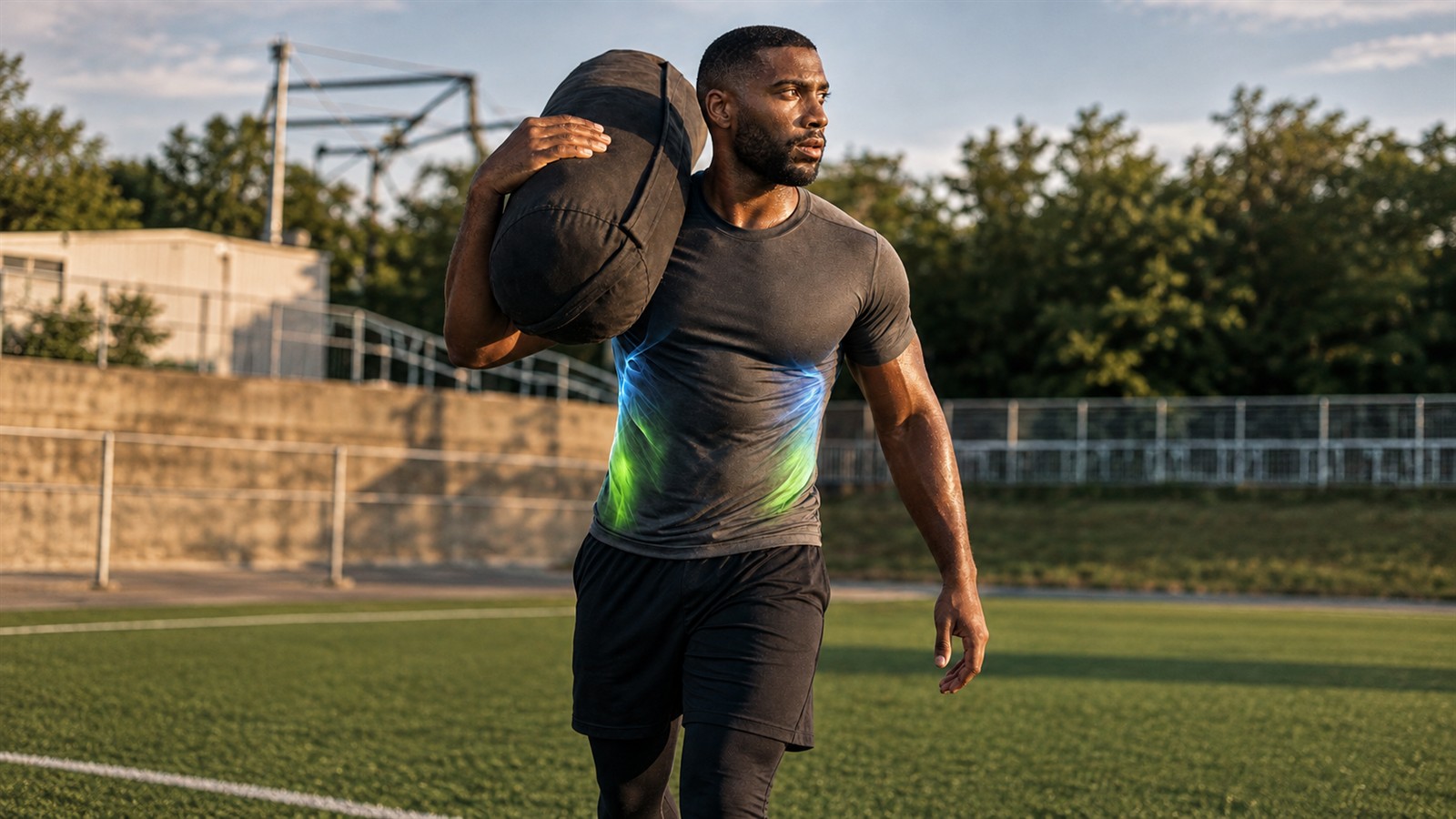

A sandbag can make an ordinary carry feel unfamiliar.
The load shifts against your body, the grip changes, and you have to keep adjusting as you move.
That experience is real.
It does not automatically mean a sandbag builds more strength or recruits more core muscle than a barbell at the same weight.
The useful question is narrower: what does the research show about unstable loads, and when does that make a sandbag worth adding to a strength program?
Several studies offer clues, but the details of the equipment and exercises matter.
One often-cited experiment compared a sandbag, a water bag, and a barbell during a clean and jerk.
Its most striking result belonged to the water bag, not the sandbag.
Why a shifting load feels different
A conventional barbell has a predictable center of mass.
Its plates do not flow from one end of the bar to the other during a rep.
A partially filled bag can change shape, slide against the lifter, and alter the way the load sits against the body.
Those changes may make it harder to hold a position or move smoothly.
That difficulty can be useful if controlling an awkward object is the point of the exercise.
A carry, pick-up, or front-loaded squat asks the trunk, hips, shoulders, hands, and feet to coordinate around the object.
But “harder to control” is a description of the task.
It is not proof that every muscle works harder or that the same person will gain more strength over time.
The distinction matters because muscle activity measured during one session is an immediate response.
Training adaptation requires repeated, progressive work and adequate recovery.
A higher electrical signal in one muscle during one movement cannot by itself establish superior strength, muscle growth, or transfer to everyday activities.
What the clean-and-jerk study actually found
In a 2015 study published in the International Journal of Sports Physical Therapy, 21 fit young men performed clean-and-jerk variations with a barbell, sandbag, and water bag.
The researchers used the same absolute load, 20 kilograms, and measured electrical activity in selected shoulder, trunk, and hip muscles.
The main finding was greater activity in the external oblique, lumbar erector spinae, and gluteus medius during the water-bag version than during the other conditions.
The anterior deltoid did not differ significantly across conditions.
The researchers concluded that a water bag may increase core activity during this particular maneuver compared with the sandbag and standard barbell versions.
That result is easy to misstate.
It does not say the sandbag produced significantly greater core activation than the barbell.
It also does not say any unstable object will have the same effect as a partially filled water bag.
Liquid sloshing inside a container is a specific mechanical challenge.
Sand or another filler may behave differently, depending on how tightly it is packed and how much space it has to move.
The experiment was small and acute.
It involved only young, fit men and one complex lift.
The researchers did not assign participants to months of sandbag or barbell training and compare their eventual strength.
That limits how far the result can be extended to beginners, older adults, rehabilitation, or a routine built around carries and squats.
Where the “15 percent lighter” claim comes from
Another study of 15 resistance-trained men compared a standard bench press at 75 percent of one-repetition maximum with a press using a flexible Earthquake bar at 60 percent.
In that setup, the unstable condition used a load that was 15 percentage points lower.
Some stabilizing muscles, including the biceps and one middle-deltoid measure, showed higher activity.
That is an interesting finding, but it was not a sandbag experiment.
The unstable load hung from a flexible bar during a bench press.
It should not be converted into a blanket claim that sandbag training activates stabilizers more while using 15 percent less weight.
The researchers measured only a few repetitions, not long-term outcomes.
A later bench-press study in experienced powerlifters complicates the picture.
Unstable loads changed bar motion and increased biceps activity, but most measured stabilizer activity was not different, even when the unstable conditions used substantially less weight.
The results are exercise- and setup-specific, rather than a universal advantage for instability.
More activation does not guarantee better results
Instability can raise the coordination demand of a movement.
It can also limit the amount of force a person produces.
A review of instability in resistance training noted that unstable conditions may reduce externally measured force output even when muscle activation stays high.
That trade-off helps explain why unstable objects can feel demanding while a stable bar remains better suited to heavy, precisely measured work.
Research on unstable surfaces should also be kept separate from research on unstable loads.
Standing on a balance device changes the support under your feet.
Carrying a sandbag changes the object in your hands or on your body.
Both create instability, but they are not identical interventions.
A systematic review of stable and unstable exercise surfaces found results that varied by exercise and muscle.
Its findings should not be treated as a direct trial of sandbag carries.
The practical takeaway is to pick an exercise for the outcome you can actually measure.
If your goal is a heavier squat or deadlift, a stable bar and a repeatable progression make progress clear.
If your goal includes controlling a bulky object while walking, turning, or picking it up, a sandbag gives you a direct way to practice that task.
Neither choice needs a claim that one tool is scientifically superior for every purpose.
How sandbags can fit beside barbells
Start with the role of each session.
A barbell can anchor the main strength work because you can change the load in small, known increments.
A sandbag can follow as accessory work for carries, front-loaded squats, or controlled pick-ups.
This is a programming choice, not a tested formula that every lifter needs.
For example, a person who already squats twice a week might keep those lifts unchanged and add one short sandbag carry block after one session.
Another person could use a sandbag front hold during a lighter day to practice maintaining posture under an awkward load.
The initial dose can be modest.
Quality of movement is a better first target than racing through as many repetitions as possible.
Sandbag weight is only one variable.
A larger bag can be harder to secure against the body even at the same mass.
Handle placement, how firmly the bag is packed, carry distance, walking speed, and the way you pick it up all change the task.
If several of those variables change together, it becomes hard to know what caused progress or soreness.
Keep most of them consistent while you learn.
For a broader look at why measured progression matters, see our guide to training volume and frequency.
A sandbag does not suspend the ordinary rules of managing workload and recovery.
A simple way to begin
Choose a bag light enough that you can pick it up without a sharp tug or a desperate twist.
Place it close to your feet.
Brace your trunk, bend at the hips and knees, and bring the bag close to your body before standing.
The exact grip will depend on its shape and handles, but the goal is controlled contact rather than an arm’s-length swing.
For a bear-hug carry, stand tall with the bag held securely in front of you.
Walk a short distance at a pace that lets you breathe and keep your path clear.
Turn slowly.
Put the bag down under control instead of dropping it from fatigue.
You can add distance over time if your posture and breathing stay steady.
A shoulder carry is more asymmetrical.
Use a lighter load than you might expect, avoid a rushed heave, and practice both sides.
If the bag starts pulling you into a strong sideways lean, stop and reset.
There is no prize for dragging a load farther after your movement quality has disappeared.
People with current pain, recent surgery, balance problems, or a condition that changes exercise tolerance should get individual guidance before adding loaded carries.
The goal is a manageable training challenge, not a test of whether discomfort can be ignored.
If you want a different way to train the trunk, our medicine-ball core training review explains another tool and its evidence.
How to progress without guessing
Repeat the same carry style, load, and route for a few sessions before making it harder.
Track a practical measure such as distance, duration, or the number of clean sets completed.
Then change one variable.
Add a little distance, use a slightly heavier bag, or shorten the rest between sets.
You do not need to change all three.
If your grip or posture consistently gives out before the muscles you intend to train, adjust the exercise.
A different bag shape or a shorter carry may let you work more productively.
This is especially relevant when comparing sessions: two bags with identical stated weights can still feel very different because of dimensions and how much the contents move.
Keep a stable lift in the program if maximal strength is the priority.
That gives you a reliable reference point for progress while sandbag work supplies a separate skill and conditioning challenge.
Our article on why resistance training matters beyond muscle size covers the broader value of building a sustainable lifting habit.
What the evidence supports now
The strongest direct clean-and-jerk comparison does not show that sandbags beat barbells for core activation.
It found a greater signal with a water bag in several measured muscles.
Other unstable-load studies, mostly using special bars rather than sandbags, show that some muscles may work harder in specific conditions while others do not.
None of that proves that every sandbag exercise produces superior long-term results.
Sandbags remain useful because they let you practice controlling an awkward object, carry in several positions, and add variety to a program.
Barbells remain useful because stable loading makes heavy strength work and small progressions easier to measure.
Choose the tool that fits the exercise goal, and let repeatable training outcomes—not an appealing claim about a single EMG study—tell you whether it is helping.
References
- Calatayud J, et al. Core muscle activity during the clean and jerk lift with barbell versus sandbags and water bags. International Journal of Sports Physical Therapy. 2015. PubMed.
- Lawrence MA, et al. Effect of an unstable load on primary and stabilizing muscles during the bench press. PubMed.
- Lawrence MA, et al. Effect of unstable loads on stabilizing muscles and bar motion during the bench press. PubMed.
- Behm DG, Anderson KG. The role of instability with resistance training. PubMed.
This article is for general education and does not replace individual medical or training advice.