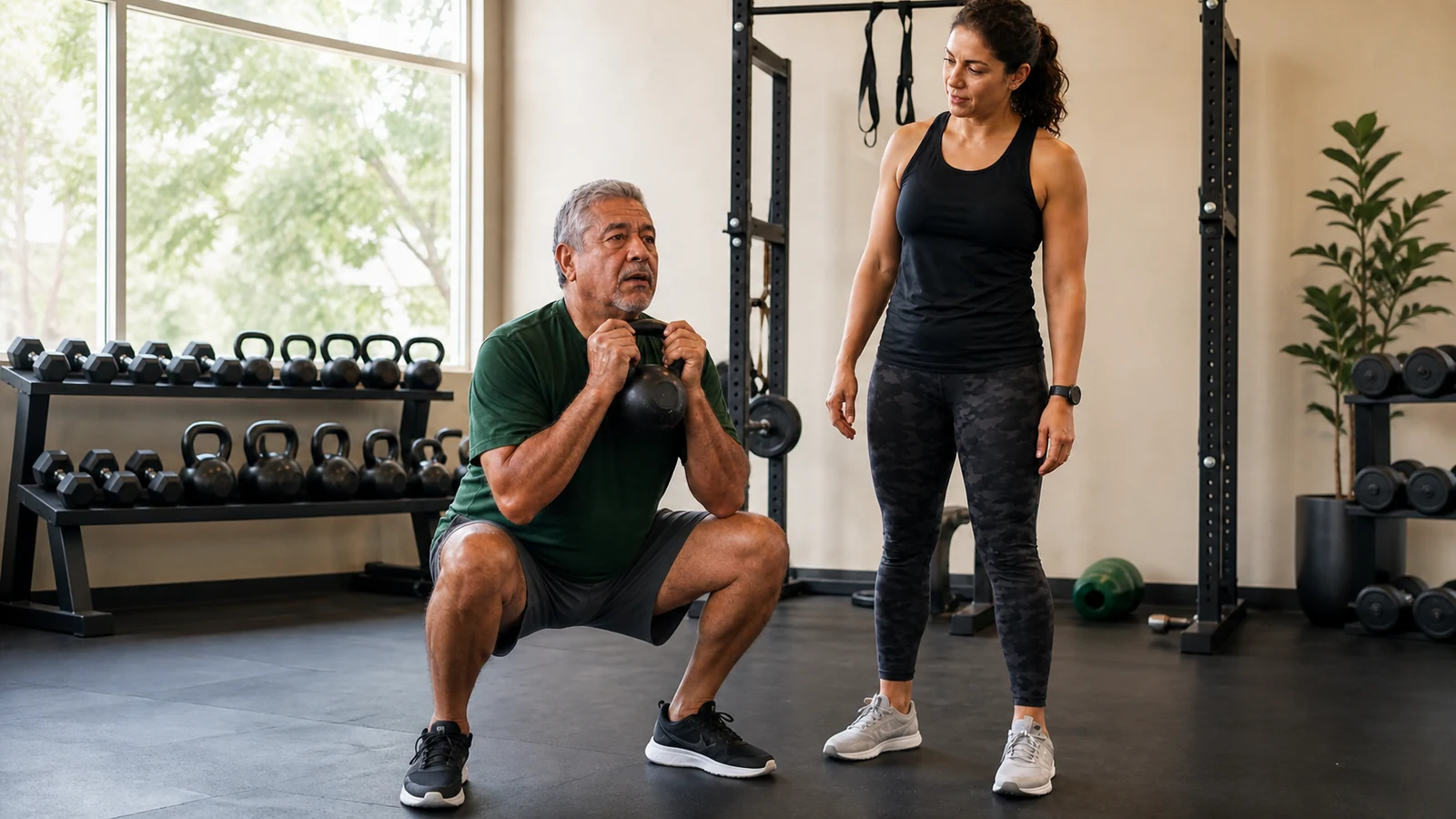

Human cohorts link resistance training or measured strength with lower mortality. They do not establish how many extra years lifting would give an individual.
A practical starting structure is two strength sessions across the week, with walking or another aerobic activity on other days. That reflects public activity guidance, not a longevity experiment that tested the exact schedule.
Strength training and longevity: what was actually measured?
| Evidence | People and measure | Finding | What it cannot prove |
|---|---|---|---|
| Kraschnewski 2016 | 30,162 United States adults aged 65 or older; reported strength-training participation | Meeting a twice-weekly guideline tracked with lower mortality during 15 years of follow-up. | That two sessions caused longer life or that all participants used the same program. |
| Momma 2022 and Shailendra 2022 | Reviews of observational cohorts; reported muscle-strengthening or resistance-training time | Modest weekly activity was associated with lower mortality; dose curves suggested strong associations near 30 to 60 minutes. | A personal minimum, a 60-minute ceiling, or harm from training longer. |
| Zhang 2026 | Three prospective health-professional cohorts with repeated resistance-training reports | Moderate long-term training tracked with lower mortality, with the modeled association plateauing around 120 or more weekly minutes. | That a person should target 120 minutes or that the study randomized a training dose. |
| 2026 older-women cohort | 5,472 ambulatory women aged 63 to 99; measured grip strength and five chair stands | Stronger grip and faster chair stands were associated with lower mortality over an average 8.4-year follow-up after many adjustments. | That a grip score is a personal lifespan forecast or that starting lifting produced the result. |
Reported training and measured strength answer different questions. None of these studies randomized a strength program to measure extra years of life.
Is there a best weekly dose for a longer life?
The 2022 review modeled its largest association near 30 to 60 weekly minutes. The 2026 three-cohort analysis instead reported a plateau around 120 or more minutes.
Population, reporting methods and statistical adjustment can change a dose curve. These observations cannot establish a universal minimum, maximum or best dose.
The two-day strength guideline is easier to use than a mortality-optimized minute target. The CDC adult guide pairs two muscle-strengthening days with 150 weekly moderate aerobic minutes and advises choosing activity that fits your abilities.
What did the 2026 older-women study add?
The 2026 study adjusted for measured activity and sedentary behavior. Adjustment does not turn grip and chair tests into an assigned lifting program.
Strength tests can reflect illness, pain, joint function and past activity. A low score invites a functional assessment, not a lifespan forecast.

Why include walking or other aerobic activity?
The 2022 review linked reported resistance plus aerobic activity with lower mortality than reporting neither.
The 2026 cohorts also compared combinations. At their highest aerobic-activity levels, mortality risk was low regardless of resistance-training time.
Activity groups can differ in many other ways. For the separate walking evidence, see our daily steps and mortality guide.
An illustrative week, not a lifespan prescription
| Day | Editorial example for a generally healthy adult |
|---|---|
| Monday | Strength session using a squat or chair rise, a push, a pull and a carry or balance task at a manageable effort. |
| Tuesday | Comfortable walking or another aerobic activity. |
| Wednesday | Walk or rest according to recovery and schedule. |
| Thursday | Second strength session for the major muscle groups, with suitable variations. |
| Friday to Sunday | Spread aerobic movement through the remaining days and build toward the population guideline as appropriate. |
This week is not the routine used in any mortality study and does not give an individual load, set count or medical clearance. If you are new to training, start with an appropriate version you can repeat; a qualified professional can help when pain, recent surgery, osteoporosis or a cardiovascular condition changes exercise choices.
What the video claim gets right and what remains uncertain
Life Between Lifts discusses resistance training and longevity. A video’s framing cannot establish a causal effect that observational studies did not test.
The National Institute on Aging describes practical strength and function benefits. Those are useful goals for exercise planning.
Watch the original video
Sources
- Kraschnewski et al. (2016), older-adult strength-training participation and mortality.
- Momma et al. (2022), cohort meta-analysis of muscle-strengthening activities.
- Shailendra et al. (2022), resistance-training mortality review.
- Zhang et al. (2026), repeated-measures resistance-training cohorts.
- Muscular strength and mortality in women aged 63 to 99 years (2026).
- CDC, adding physical activity as an adult (2025).
- National Institute on Aging, muscle-strengthening and physical function.
This article offers general fitness information, not a personal exercise or medical plan. Ask a qualified clinician or exercise professional how to adapt resistance training if a diagnosed condition, injury or recent surgery affects your activity.