
A YouTuber recovering from reverse shoulder replacement surgery shared their day 26 morning routine online.
The video comes from a channel called Motorhoming Fun, which is normally about motorhome travel, scenic walks, and outdoor life.
It is not a medical channel, and the creator is documenting their own personal recovery, not offering professional treatment advice.
That makes the video a genuine window into one patient’s experience.
It is not a guide that anyone else should copy exactly.
Reverse shoulder replacement is a real surgery with real risks, and the path someone takes through rehab can shape how well they recover.
So instead of walking through this one video’s specific day 26 routine, this article looks at what published orthopedic research actually says about recovering from this surgery.
That includes when motion should start, how structured a rehab plan needs to be, and why daily home habits matter for the long run.
It also covers who should never build their own rehab schedule from a stranger’s video alone.
What the Video Claims
The video is titled “Reverse Shoulder Replacement Recovery Day 26: My 6AM Rehab Routine and Daily Exercises.”
In it, the creator walks through the exercises and habits they personally do each morning, 26 days after their surgery.
They present this as their own lived experience, not as instructions written or filmed by a surgeon or physical therapist.
Motorhoming Fun’s channel is normally about motorhome travel across the UK, countryside walks, and outdoor footage, not orthopedic medicine.
Nothing in the video description or the channel’s other content suggests the creator is a doctor, physical therapist, or other licensed clinician.
That does not make the video worthless.
Personal recovery diaries can be genuinely helpful for other patients going through the same surgery.
But it does mean the specific day 26 routine shown is one person’s approved plan from their own surgical team.
It is not a universal timeline that fits every reverse shoulder replacement patient.
Recovery speed and allowed movements after this surgery vary a lot between patients, and even between surgeons.
Copying someone else’s day 26 exercises without your surgeon’s approval could put your shoulder at risk.
This article will not repeat or endorse that specific routine step by step.
Instead, it looks at what controlled studies and systematic reviews say about reverse shoulder replacement rehab in general.
What Real Research Shows About Timing of Motion
One of the biggest open questions in reverse shoulder replacement rehab is simple.
How soon should a patient actually start moving the arm?
A 2025 systematic review and meta-analysis compared early mobilization to delayed rehab protocols after this surgery (Thamrongskulsiri et al., 2025).
The review focused on patients who had the surgery for reasons other than a broken bone, since fracture patients often need extra healing time first.
Across the pooled studies, researchers looked at shoulder function, range of motion, and complication rates.
A separate 2026 systematic review took a similar approach, comparing early rehabilitation to more conventional, slower timelines after reverse shoulder replacement (Alkhouri et al., 2026).
That review also looked at functional recovery and complication rates, including joint instability.
Together, these two reviews reflect a real shift in how surgeons think about the first weeks after this surgery.
Older thinking often favored longer immobilization, keeping the arm in a sling before movement began.
Some newer protocols in the reviewed studies started passive motion earlier, while still protecting specific risky positions.
The research in this area is still developing, and results were not identical across every study the reviews included.
What stays consistent is that timing of motion is treated as a real clinical decision.
It is not a one size fits all rule that any video can safely hand out to viewers.
That is why a single creator’s day 26 routine cannot substitute for a surgeon’s individualized protocol.
What Real Research Shows About Structured Rehab Protocols
Beyond timing alone, researchers have also studied how structured, phase based rehab protocols affect outcomes after this surgery.
A 2022 study published in the journal Cureus followed patients through a defined postoperative rehabilitation protocol after reverse shoulder replacement (Pereira et al., 2022).
The researchers tracked clinical and functional results as patients moved through different phases of that protocol.
Studies like this generally describe rehab happening in stages.
Patients typically move from protecting the joint, to passive movement, to active exercises, to strengthening work.
The exact number of weeks in each stage can vary between surgical teams, and even between individual patients.
Healing speed depends on tissue quality, the specific implant used, and how the surgery itself was performed.
What research in this space consistently supports is the value of a structured, staged plan over an unstructured mix of exercises.
A defined protocol gives both the patient and their care team a way to check progress against expected milestones.
It also signals when someone is falling behind, or trying to move too fast, both of which carry real risks.
This is very different from watching one person’s personal daily routine and assuming the same exercises will fit every recovery.
A structured protocol built by your own surgical team accounts for your specific implant, your tissue quality, and your surgical approach.
What Real Research Shows About Home Exercise Routines
The video’s whole premise, a personal daily home routine, is not itself a bad idea.
Research on home exercise after this surgery actually supports that general idea.
A 2026 study in the journal JSES International followed patients doing home exercise after reverse shoulder replacement over a long term follow up period (Wittmann et al., 2026).
Some patients in that study used functional electrical stimulation to support their exercises, layered on top of a standard home program.
The researchers were specifically interested in how these home habits held up over time, not just in the first few weeks after surgery.
This kind of long term follow up matters, because a lot of shoulder function returns gradually, over months rather than weeks.
Findings like this support the idea that consistent home exercise, done as part of an approved plan, plays a real role in outcomes.
That is a genuinely encouraging parallel to what the video shows, a real patient sticking with a daily home routine.
The difference is that the specific exercises in a study like this one were assigned and monitored by a clinical team.
They were not self selected from general fitness knowledge or borrowed from someone else’s video.
A daily rehab habit clearly matters, but the content of that habit still needs to come from a professional who has examined your shoulder.
Consistent daily home exercise appears to genuinely help recovery after reverse shoulder replacement, but the exercises themselves still need to come from your own surgical team, not a stranger’s video.
The Mechanism
Reverse shoulder replacement is not the same surgery as a standard shoulder replacement.
That difference changes how rehab has to work.
In a standard shoulder replacement, the surgeon keeps the ball and socket in their normal position and relies on an intact rotator cuff.
Reverse shoulder replacement flips that setup, placing the ball on the shoulder blade and the socket on the arm bone.
Surgeons typically choose this reversed design when a patient’s rotator cuff is too damaged to support a standard shoulder replacement.
That flipped geometry changes the joint’s mechanics.
The deltoid muscle, not the rotator cuff, becomes the main muscle powering arm movement after this surgery.
This is a big part of why rehab timing and specific movements matter so much after this particular procedure.
Certain arm positions can put a reconstructed joint at higher risk of slipping out of place in the early weeks.
This includes reaching behind the back or moving the arm across the body.
That risk is a large part of why many protocols restrict specific movements early on.
It is not because gentle motion itself is dangerous.
Muscles and tendons around any joint also lose strength quickly when a limb is protected and used less.
That is one reason recent rehab research increasingly favors starting appropriate motion sooner, once it is judged safe by a clinician.
Losing muscle mass is a real risk during any extended recovery period, not just after surgery. This piece on losing weight and muscle mass looks at that pattern in more general terms.
The exact rehab plan that manages this tradeoff safely depends on your specific implant, your tissue condition, and your surgeon’s own operative notes.
That is information only your own surgical team actually has, which is why a video, however well meaning, cannot replace their plan.
Watch the video
What This Evidence Does Not Prove
None of this research proves that any single day by day exercise list, including the one in this video, is the correct plan for every patient.
The systematic reviews summarized here pool data from multiple studies, and even they note real differences in results between the studies included.
They do not prove that early motion is always better.
They show it appears to be safe and sometimes beneficial in the populations studied so far.
They do not prove that a specific number of weeks in a sling is correct for your shoulder, your implant, or your tissue quality.
This research also does not prove anything about the specific presenter’s personal outcome, since one person’s story is not a controlled study.
A video showing someone doing well on day 26 does not prove their specific exercises caused that result.
Other factors, like their overall health or surgical technique, could easily be involved too.
None of the cited research establishes a single universal timeline that applies the same way to every reverse shoulder replacement patient.
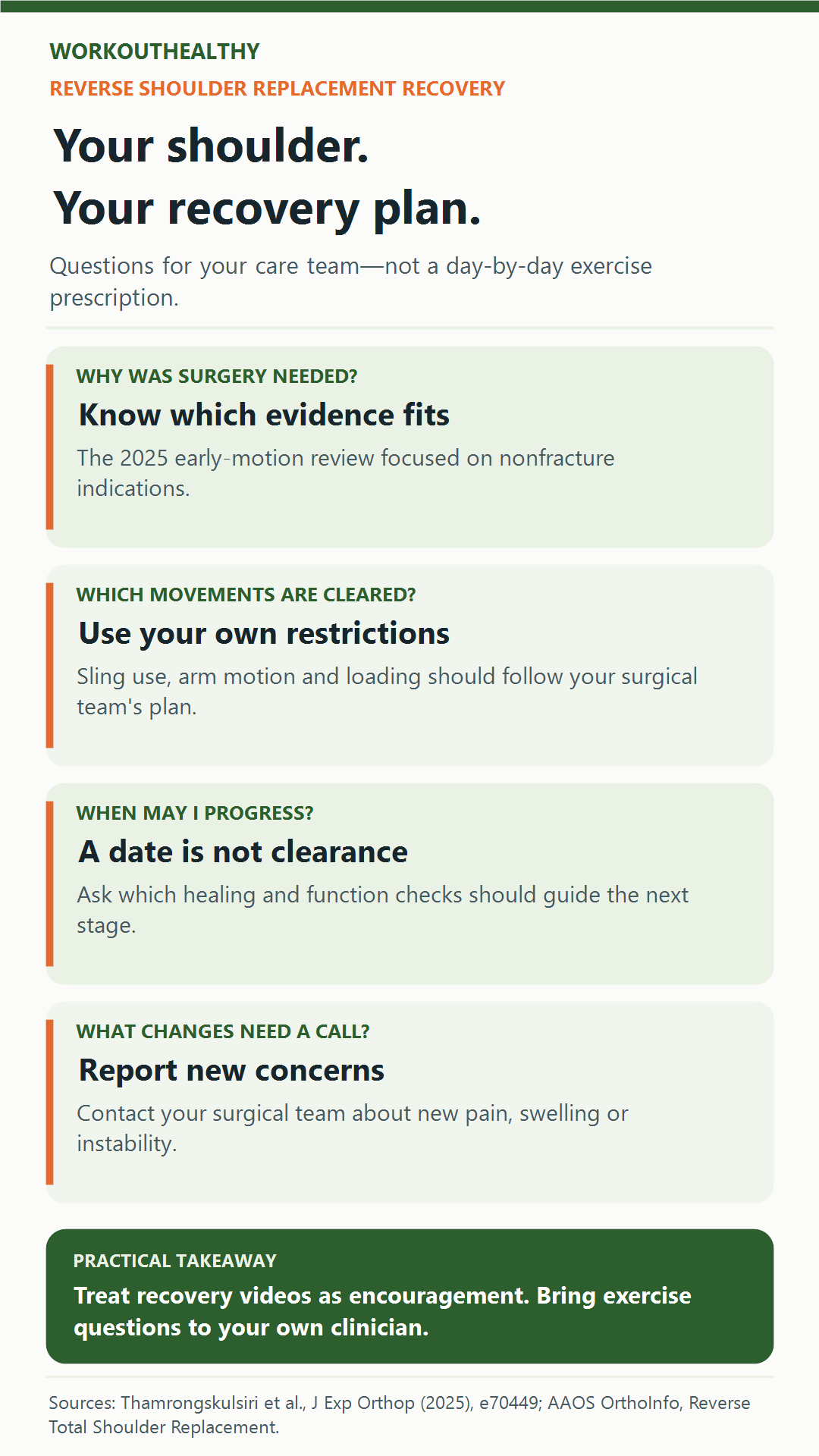
Who Should Work With a Clinical Team
No video, including this one, can safely hand out a universal day by day shoulder rehab timeline.
That is worth saying plainly.
Anyone recovering from reverse shoulder replacement should be following a plan built by their own surgeon and physical therapist.
That plan should not be copied from a stranger’s video, however well intentioned that stranger is.
This matters even more here, because the wrong movement at the wrong stage can genuinely risk dislocating a reversed shoulder joint.
A physical therapist can adjust a plan in real time, based on swelling, pain, and healing progress.
That is something no video can assess for you.
If your own recovery feels slower or faster than what you see online, that is a conversation for your surgical team, not a reason to change your routine alone.
The site’s Misty Copeland hip replacement recovery article tells a similar story about a different joint entirely.
It shows how much a professionally guided recovery plan matters, even for a very fit, experienced athlete.
Hip and shoulder replacement are different surgeries with different risks.
Both benefit from the same core idea, that structured professional guidance beats guesswork every time.
If you are considering reverse shoulder replacement, or are already recovering from it, treat a video like this one as encouragement, not instructions.
Who Should Be Extra Careful
Anyone in the first weeks after reverse shoulder replacement surgery should be especially careful about trying new exercises without direct clearance.
People with additional health conditions, like diabetes or osteoporosis, may heal tissue more slowly and need a more cautious rehab timeline.
Older adults recovering from this surgery should be particularly careful, since bone and tendon healing can take longer with age.
Anyone who notices new pain, new swelling, or a feeling that the shoulder is unstable should stop and contact their surgical team right away.
Do not try to push through those warning signs on your own.
People who have had a previous shoulder surgery, or a more complex procedure, often need a more individualized protocol.
General strength training guidance, like this Insider piece on whether lifting weights keeps your brain young, is written for the general population.
It is not written for someone in early post-surgical recovery, and it should not be applied without a clinician’s sign off.
That kind of broader strength training guidance becomes relevant again later, once a surgeon has cleared wider activity.
A Practical Takeaway
If you or someone you know is facing reverse shoulder replacement, the most useful takeaway here is simple.
Get your actual rehab plan from your own care team, not from a video.
A structured, staged rehab protocol appears to matter more than any single exercise choice, based on the research reviewed here.
Consistency with an approved home routine, similar in spirit to what this video shows, does appear to support better long term outcomes.
Simple daily activity, like short approved walks, is often part of a broader recovery plan once a surgeon allows it.
General population walking guidance, like this piece on how many miles you should walk a day, is a useful starting point for context.
That said, it should always be adjusted for your own surgeon’s specific restrictions after a shoulder surgery.
Watching recovery videos like this one can genuinely be motivating.
Seeing someone else’s daily consistency can be a real source of encouragement during a hard recovery.
Just remember that the specific exercises shown belong to that person’s own approved plan, not a script for anyone else to follow.
Bring any video you find inspiring to your own physical therapist, and ask directly whether anything in it applies to your specific recovery.

Want more like this? Subscribe to WorkoutHealthy Insider for practical explanations behind popular fitness claims.
References
Alkhouri, S., Lau, A., Kuni, T., Digiacomo, D., Ahdout, J., Bobeck, J., & Mousad, A. D. (2026). Early versus conventional postoperative rehabilitation after reverse total shoulder arthroplasty: A systematic review of functional outcomes and complications. Disability and Rehabilitation. https://doi.org/10.1080/09638288.2026.2683002
Pereira, V. C., Barreto, J., Tomé, S., Cunha, J., Amaro, J., Moreira, J., Miranda, A., & Branco, C. A. (2022). Clinical and functional results of reverse total shoulder arthroplasty and postoperative rehabilitation protocol. Cureus. https://doi.org/10.7759/cureus.23322
Thamrongskulsiri, N., Itthipanichpong, T., Kongmalai, T., & Kongmalai, P. (2025). Early mobilisation versus delayed protocols after reverse total shoulder arthroplasty for nonfracture indications: A systematic review and meta-analysis. Journal of Experimental Orthopaedics. https://doi.org/10.1002/jeo2.70449
Wittmann, T., Krawczyk, S., & Raiss, P. (2026). Long-term follow-up of functional electromyostimulation-augmented home exercise after primary reverse total shoulder arthroplasty. JSES International. https://doi.org/10.1016/j.jseint.2026.101744
This article is for general information only and is not medical advice. If you have an injury, ongoing pain, or a medical condition, talk to a doctor or physical therapist before you change how you train or eat.