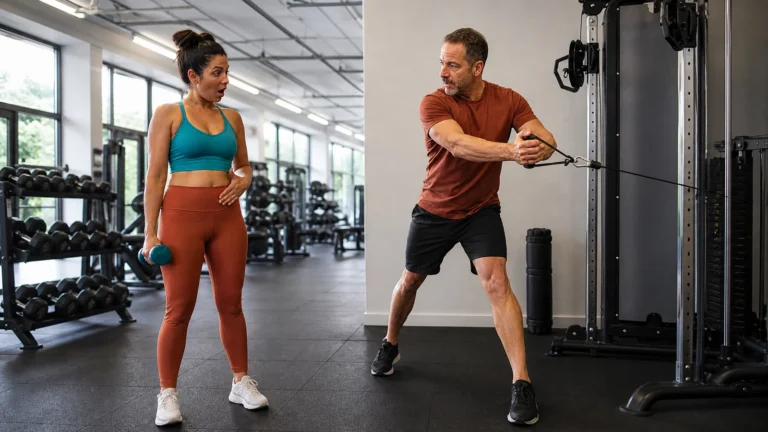

A recent video from a hospital sports medicine program made a broad promise.
It said its sports and lifestyle medicine program helps every body prevent injury, recover faster, and return to peak performance, regardless of activity level.
The video did not explain any specific protocol behind that promise, and this article does not attempt to grade it.
Instead, it looks at one narrow, well studied version of the same idea: a structured warm-up program done before practice or a game.
Specifically, it looks at whether these programs actually lower the rate of injuries in real athletes, using real published research rather than a marketing claim.
The answer, across several large trials, is a clear yes for some injuries and a more complicated picture for others.
What a Structured Warm-Up Program Actually Is
A structured warm-up program is not the same as a few minutes of jogging and stretching before practice starts.
It is a specific sequence of exercises. These exercises target balance, strength, and control around the knee and hip.
Programs like this usually include running drills, controlled jumping and landing practice, single leg balance work, and eccentric strengthening for the hamstrings, done as a warm-up rather than as a separate workout.
The best known example is FIFA’s 11+ program, built for soccer, which takes about 20 minutes and replaces a normal warm-up rather than adding to practice time.
Similar neuromuscular training programs have also been built for other sports, and for younger and adolescent athletes specifically.
The Original Trial That Started This Field
In 2008, a research team led by Thomas Soligard published a cluster randomized controlled trial in the BMJ that tested a comprehensive warm-up program called “The 11” in young female soccer players (Soligard et al., 2008).
The trial followed 1,892 players between the ages of 13 and 17, across 125 Norwegian football clubs, for a full season (Soligard et al., 2008).
A structured warm-up program cut overall injury rates by roughly a third and nearly halved severe injuries, without adding any extra time to practice.
Overall injury rates were about 32 percent lower in the intervention group, with a rate ratio of 0.68 (Soligard et al., 2008).
Overuse injuries dropped even further, down 53 percent, and severe injuries fell by 45 percent (Soligard et al., 2008).
One specific measure, lower extremity injuries counted on their own, did not reach statistical significance, a limitation worth naming rather than glossing over (Soligard et al., 2008).
A Larger Review Confirms the Pattern, With One Twist
A single trial, however large, is still one trial.
In 2017, a team led by Kristian Thorborg pooled data from six separate randomized controlled trials covering both FIFA’s original “11” program and the newer “11+” program (Thorborg et al., 2017).
The two programs did not perform the same. The older “11” program showed no measurable benefit, with a rate ratio of 0.99.
The newer, more detailed 11+ program showed a real effect, reducing injury incidence by about 39 percent, with an incidence rate ratio of 0.61 (Thorborg et al., 2017).
That gap matters, because it means the specific content of a program, not just the general idea of warming up differently, is what drives the results (Thorborg et al., 2017).
A Version Built Specifically for the Knee
Some programs go further, targeting one injury in particular: a torn ACL.
In 2012, a team led by Markus Waldén tested a 15 minute neuromuscular training program in adolescent female soccer players across 230 Swedish clubs (Waldén et al., 2012).
The trial included 4,564 players. It ran for one full season.
Players in the intervention group suffered 7 ACL injuries, compared with 14 in the control group, a reduction of about 64 percent (Waldén et al., 2012).
Twice as many adolescent female soccer players tore an ACL on teams that skipped the 15 minute neuromuscular warm-up, compared with teams that used it consistently.
Other, less severe knee injuries did not show a statistically significant difference between groups, which the researchers attributed partly to how few of those injuries occurred overall (Waldén et al., 2012).
The Same Pattern Shows Up in Adult, Male Athletes
Most of the strongest evidence for these programs comes from adolescent and young adult women, since ACL injury rates are notably higher in that group.
That raises a fair question. Does it hold up for men?
A 2015 randomized trial led by Holly Silvers-Granelli followed 65 NCAA Division I and II men’s college soccer teams, comparing FIFA’s 11+ program against normal training (Silvers-Granelli et al., 2015).
The intervention teams recorded an injury rate of about 8 per 1,000 athlete exposures, compared with roughly 15 per 1,000 in the control teams, a reduction of about 46 percent overall (Silvers-Granelli et al., 2015).
Players in the control group also missed more practice and game time per injury than players in the intervention group (Silvers-Granelli et al., 2015).
The Mechanism: Why This Works Better Than Static Stretching
For decades, a standard warm-up meant a light jog followed by static stretches held for 20 or 30 seconds.
Neuromuscular training programs replace that with movement that actually resembles what the sport demands: cutting, landing, decelerating, and balancing on one leg.
The idea is to rehearse the exact movement patterns most linked to injury, under control and at low speed, before asking the body to do them at full speed and under fatigue.
Explosive, controlled jump and landing work is part of this same family of training, a topic our piece on whether box jumps build muscle looks at from a different angle.
A large share of ACL injuries happen during landing or a sudden change of direction, not from contact with another player.
Training the muscles around the knee and hip to control that exact motion appears to be the mechanism behind the reduction in injuries seen across these trials.
Balance and single leg control, built through consistent practice rather than one session, work the same way core stability does in the strength benefits readers described from yoga, training stabilizer muscles that a normal lift or sprint does not reach directly.
What This Evidence Does Not Prove
None of this research proves that any single athlete who follows a warm-up program is guaranteed to avoid injury.
These are population level results, meaning fewer injuries across a large group of players, not a personal guarantee for any one person (Soligard et al., 2008; Thorborg et al., 2017).
Most of the strongest trials studied soccer specifically, so applying these exact findings to other sports involves some reasonable extrapolation rather than a proven, sport specific rule.
The 2017 review also found that not every version of a warm-up program works, since the original “11” program showed no measurable benefit while the newer 11+ program did (Thorborg et al., 2017).
That means the specific exercises and structure of a program matter as much as the decision to warm up differently at all.
Common Mistakes That Undercut a Warm-Up Program
The most common mistake is treating the program as optional once a season gets busy.
Compliance research on these programs consistently shows that teams doing the full program most weeks see the biggest benefit, while teams that do it occasionally see a much smaller effect.
Rushing through the exercises to save time removes the loaded, controlled repetition the training is actually built around.
Skipping the strength and landing components while keeping only the running and stretching portions leaves out the part of the program doing most of the protective work.
Using the program only during preseason, then dropping it once the season starts, misses the point, since the risk these programs address does not go away once games begin.
Assuming a program designed for soccer transfers directly, exercise for exercise, to a very different sport ignores real differences in movement demands.
Who Should Check With a Doctor or Physical Therapist First
Most healthy athletes can start a structured warm-up program without any special clearance. Some situations call for guidance first.
Anyone recovering from a recent ACL tear, ligament sprain, or other significant knee or hamstring injury should get individual clearance before starting jump and landing drills.
Younger athletes with open growth plates deserve careful supervision when adding new strength and landing work, since their tissue responds differently than an adult’s does.
Anyone with persistent knee pain, swelling, or a joint that gives way during normal activity should get that evaluated before adding a demanding new training program.
Coaches working with large teams should loop in an athletic trainer or physical therapist when possible, rather than designing modifications to the program without guidance.
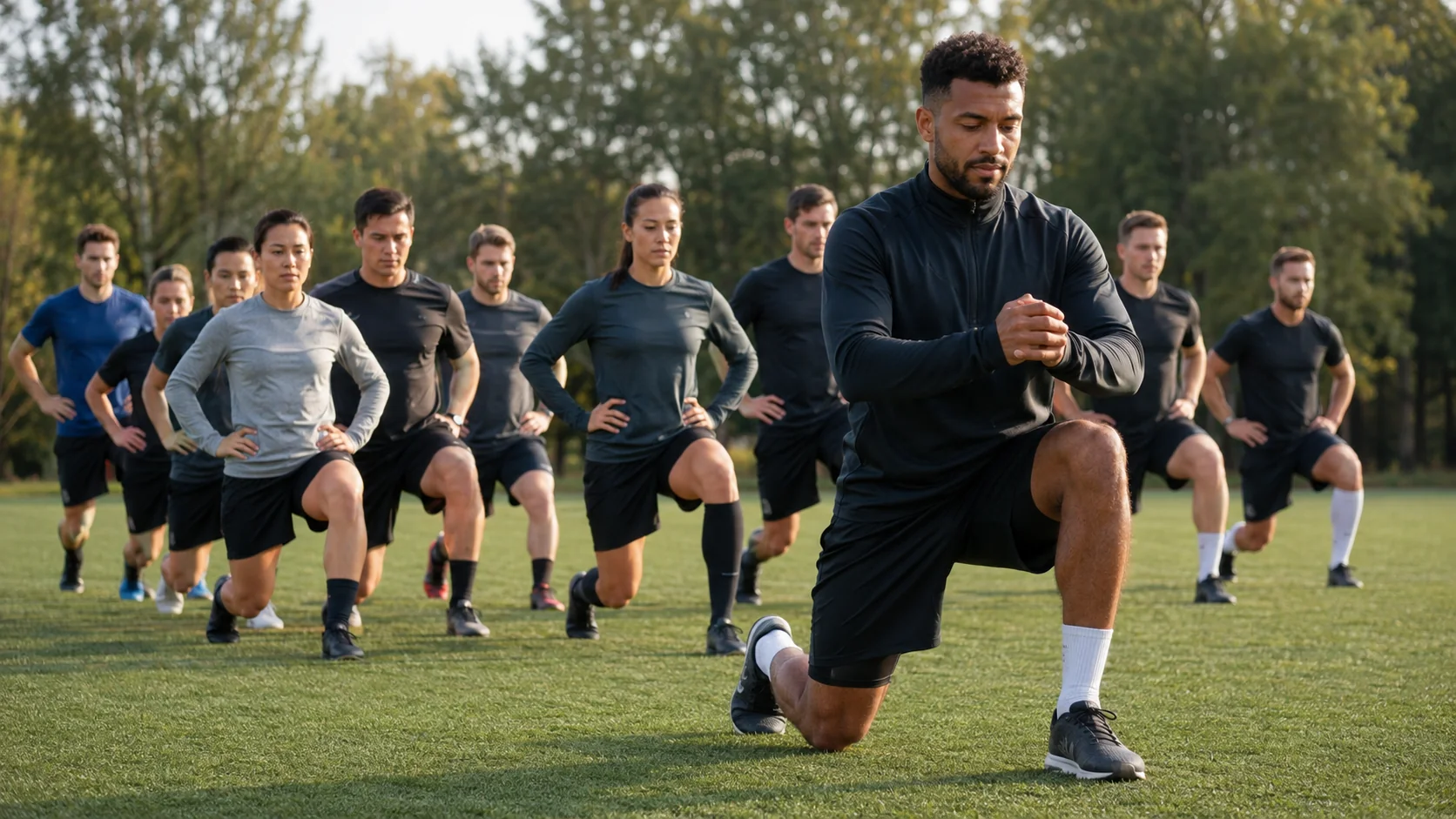
A Practical Step-by-Step Way to Start
Start by treating the warm-up as part of practice, not a separate task squeezed in before it begins.
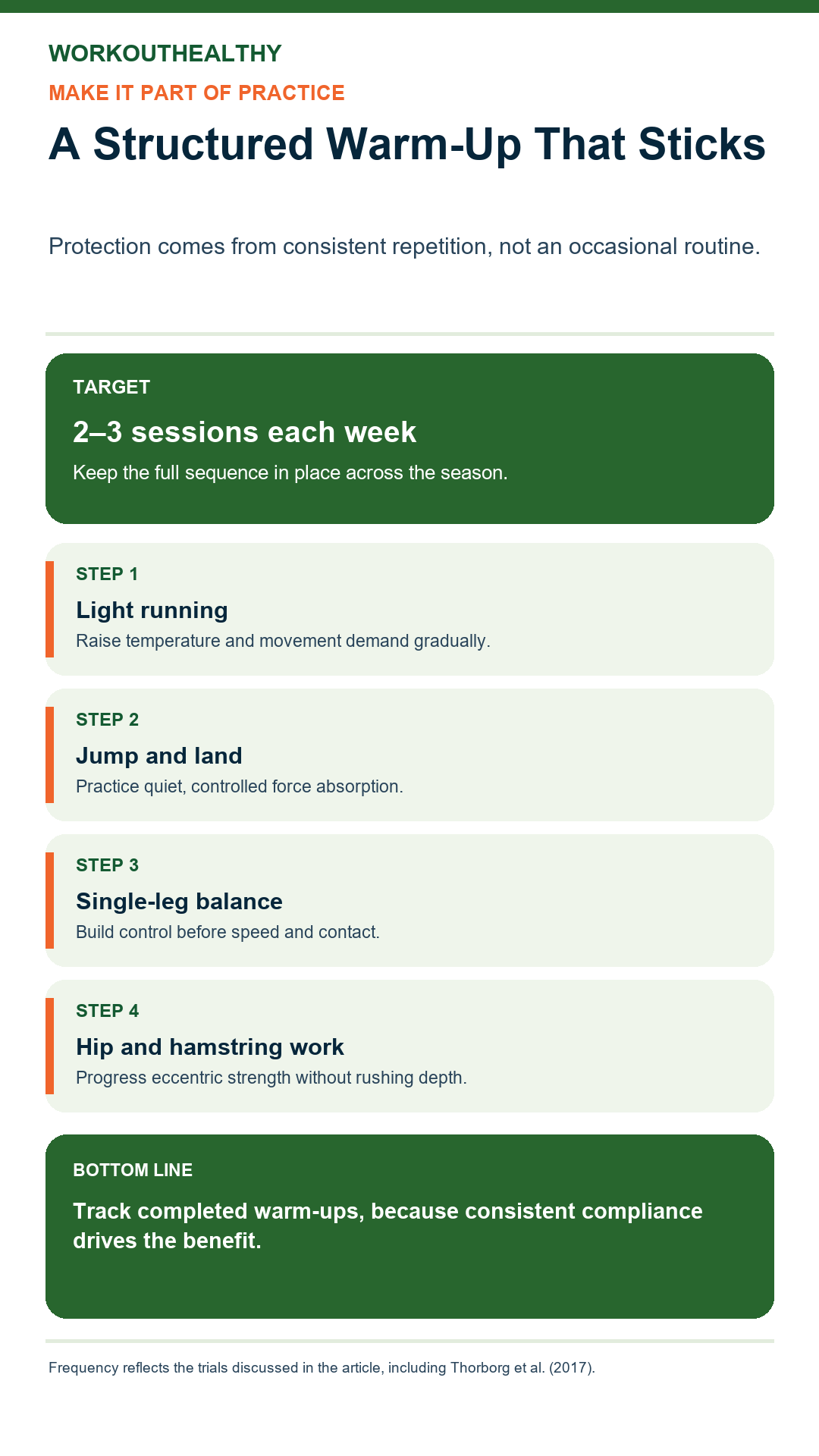
Replace a standard jog and stretch routine with a structured sequence: light running, controlled jumping and landing, single leg balance holds, and hip and hamstring strengthening, in that order.
Aim for two to three sessions a week at minimum, since the trials showing the biggest effect used that same frequency rather than an occasional session (Thorborg et al., 2017).
Give the program a full season, not a few weeks, since the protective effect comes from consistent repetition rather than a short introduction period.
Add a genuine eccentric hamstring exercise, like a slow Nordic curl, if hamstring strain is a concern in your sport, building up the range of motion gradually rather than starting at full depth.
The same gradual, build-it-up approach used for something as simple as increasing daily walking mileage safely applies just as well to adding a new, more demanding warm-up routine.
Track which weeks the full program actually happened, not just whether it was planned, since compliance is what separates the trials that found a benefit from the ones that did not.
Watch the Original Video
Want more research backed breakdowns like this one? Subscribe to WorkoutHealthy Insider for practical explanations behind popular fitness claims.
References
This article is for general information only and is not medical advice. If you have an injury, ongoing pain, or a medical condition, talk to a doctor or physical therapist before you change how you train or eat.