
Sled pushes can serve different training goals, but the same hard push does not prove that you built muscle, improved sprint speed or got a better workout than squatting. Decide what you want to measure before you decide whether a sled belongs in the session.
The strongest direct training study here concerns short sprints in high school athletes. Other commonly cited sled research tests a towed sled behind a runner, which is a different task from driving a gym sled by its handles.
Choose the goal before judging the sled push
| Your goal | What a sled push can add | What to record | Evidence limit |
|---|---|---|---|
| Leg day variety | Repeated steps against horizontal resistance after or alongside other lower body work. | The same sled and lane, distance, plate load, completed work and how it affected the rest of the session. | The cited research does not show greater long term muscle or strength gains than squats. |
| Conditioning | A repeatable task that can feel demanding when work and recovery are arranged as intervals. | Distance, push time, recovery time and whether the last effort resembled the first. | Feeling breathless is not a test of superior cardiovascular adaptation. |
| Short acceleration | Practice producing forceful early steps against resistance, within an athlete’s sprint program. | Short sprint outcomes without the sled, in addition to sled-session details. | A youth-athlete intervention does not establish a universal load or benefit for recreational lifters. |
| HYROX preparation | Familiarity with pushing a sled while preparing for that event’s demands. | The event’s current rules, equipment, surface and your comparable practice conditions. | A general leg-day finisher is not a substitute for race-specific practice. |
This is a decision guide, not four workout prescriptions. A qualified coach can help select work, rest and loading for a particular athlete; the studies below do not supply one best session for everyone.
What a sled push actually asks you to do
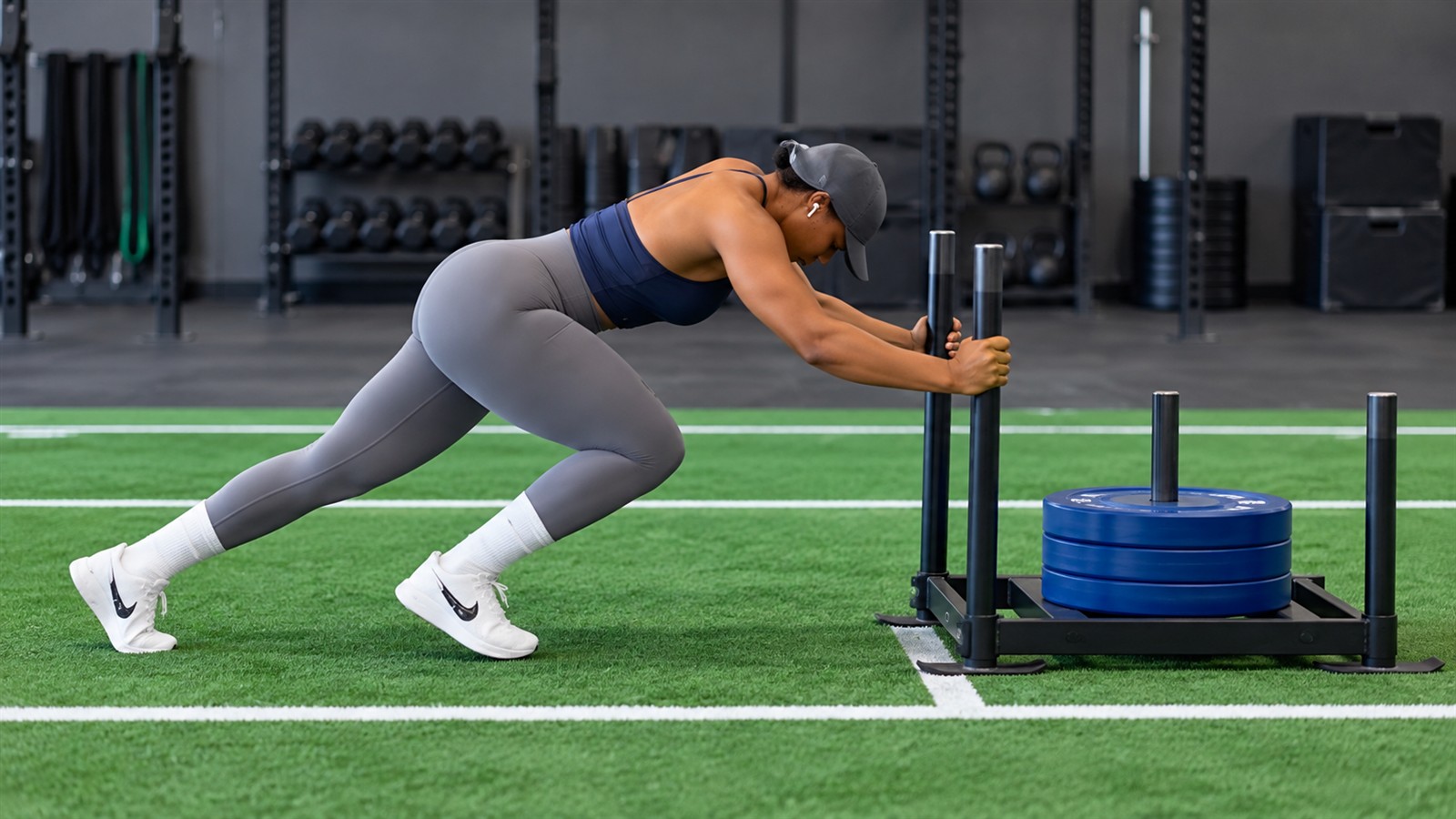
A handle push combines repeated forward steps with horizontal resistance. The legs produce force while the trunk and arms transmit it through the handles, and effort often rises quickly as the sled moves.
Load alone does not determine the challenge. Turf, flooring, sled construction and worn skids change friction, so the same plates can feel very different on two lanes.
That is why a number such as “200 pounds on the sled” is not a portable measure of difficulty. If you compare sessions, identify the sled and surface as carefully as you record the plates.
Which studies actually tested a handle push?
| Study type | What researchers measured | What the result cannot tell you |
|---|---|---|
| Direct push training | Cahill and colleagues assigned 50 male high school athletes to unresisted sprinting or three sled-push load groups for an eight-week training program. The resisted groups improved five to 20 meter split times, with the largest gains in the first five meters. | Which load or session will improve an adult gym member’s speed, or whether pushes build more muscle than other leg work. |
| One-session muscle activity | Maddigan and colleagues compared electrical activity in leg and trunk muscles during a maximum 20-step sled push and a 10-repetition-maximum back squat in ten trained men. | Long term hypertrophy, strength superiority, injury risk or the best way to program either exercise. |
| Broader resisted sprint research | A 2025 review pooled 14 team-sport studies with 344 athletes and reported gains in short sprint tests, while judging the overall risk of bias high. A 2018 review also addressed resisted sled sprint training. | That towing or dragging a sled behind a sprinter produces the same outcome as pushing handles across gym turf. |
The first study is the closest match to a gym sled push, but its participants were young athletes following a structured program. Its result supports a possible role in short acceleration work; it does not turn every hard push into a measured speed gain.
The squat study is often treated as a strength contest between two exercises, although it measured electrical activity during one session. Muscle activity cannot answer which method adds more muscle over months.
Push, tow and drag are related tasks, not one evidence bucket
In a handle push, your hands drive the sled in front of you. In a towed sprint, a belt or harness connects the runner to a sled behind the body; a backward drag changes the direction and movement again.
All three use resistance against the ground, but their body position and movement demands differ. When a study says “resisted sled training,” check which task its athletes actually performed before applying the result to a gym push.
The 2025 team-sport review found favorable pooled effects for five and ten meter sprint tests, while its pooled 20 meter result was not statistically significant. Many included interventions were drags, and the review’s high risk-of-bias judgment limits certainty about the average effect.
A comparison log that does not pretend to measure muscle growth
A useful sled record describes the task you repeated. Write down the sled, surface, plates, distance, push time and rest, then note whether other leg work came before it.
Imagine two fictional sessions on the same lane with the same sled and plate load. If a 20 meter push takes less time in the second session, you completed that specific task faster under the conditions recorded.
That observation is worth keeping, but it does not establish a change in muscle size or explain why the time changed. Different recovery, footwear, timing or effort could also matter.
If the surface changes, start a new comparison rather than treating the old plate number as an equivalent load. This prevents a rougher lane from looking like lost fitness and a slicker lane from looking like a sudden gain.
Our workout tracking template shows how to keep completed work, effort and the next-session decision in separate fields.
Should sled pushes replace squats or sprints?
The cited studies do not support a universal swap. Squats make load and range of motion easier to standardize for lower body strength work, while unresisted sprinting directly practices running without a sled.
A sled push can add a distinct resisted-stepping task when that fits the goal and available space. Choose it as a complement for a stated reason, then compare an outcome that matches that reason.
If muscle size and strength are your main goals, our low reps versus high reps guide explains why those outcomes need separate measures.
For an athlete chasing sprint speed, the unresisted sprint result matters more than how dramatic a gym finisher felt. For a general lifter who enjoys sled work, the question may simply be whether it fits without displacing the primary work they want to progress.
What the research does not establish
“Zero impact” is too strong: the feet still contact the ground and the body still handles force. The absence of a jump or a bar on the shoulders does not make a push free of load on the knees, hips, ankles or back.
The EMG comparison did not measure injuries, and the sprint studies did not test every medical condition or rehabilitation plan. Sled pushing should not be sold as injury-proof or as the best exercise for every person.
If pain, a current injury or a medical condition affects training choices, ask a qualified clinician whether this exercise fits your situation. A qualified strength coach can review the movement and program for a healthy athlete with a specific performance goal.
The takeaway
Sled pushes are a flexible training tool with some direct evidence for short acceleration work in trained youth athletes. The evidence is much thinner for claims about superior muscle growth, universal conditioning benefits or safety compared with other exercises.
Choose one goal, record the setup and compare the matching outcome. That gives the sled a clear job without turning the toughest push into proof of every result you want.
References
- Cahill, M. J., et al. (2020). Influence of resisted sled-push training on the sprint force-velocity profile of male high school athletes. Scandinavian Journal of Medicine & Science in Sports, 30, 442 to 449. PubMed record.
- Maddigan, M. E., et al. (2014). Lower-limb and trunk muscle activation with back squats and weighted sled apparatus. Journal of Strength and Conditioning Research, 28, 3346 to 3353. PubMed record.
- Salazar Orellana, C., et al. (2025). Effects of resisted sled training on sprint performance in team sports: A systematic review and meta-analysis. Journal of Bodywork and Movement Therapies. PubMed record.
- Alcaraz, P. E., et al. (2018). The effectiveness of resisted sled training for sprint performance: A systematic review and meta-analysis. Sports Medicine, 48, 2143 to 2165. PubMed record.
Medical disclaimer: This article explains exercise research for general information; it is not medical advice. If pain, an injury, or a medical condition affects your training choices, ask a doctor or physical therapist whether sled pushing fits your situation.