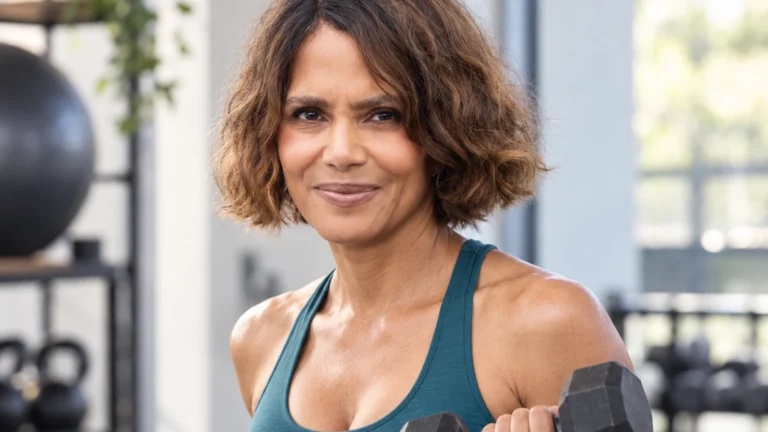

A medicine ball can change a familiar exercise without making the workout complicated.
Holding the load while you march, squat, or lunge gives your body a different task from doing the movement with empty hands.
That is the useful idea behind WORKOUT’s medicine-ball video.
Its description emphasizes an added challenge to balance and the core, while the demonstrations mix controlled movements with throws and floor exercises (WORKOUT, 2026).
Research offers context for this approach, but the exact routine has not been validated by the studies discussed here.
The distinction matters: a tool used in athletic training is not automatically proof that every workout using that tool produces the same results.
Here is what the source video includes, what three research papers establish, and how to approach the movements with a clear purpose.
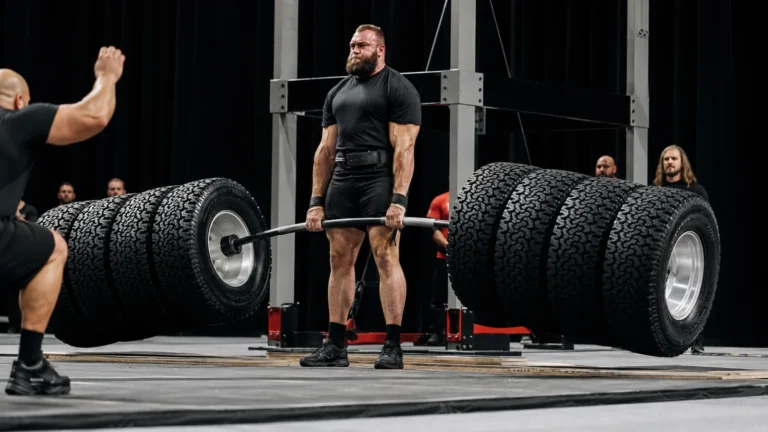
The featured scene is an illustration adapted from the social creative, not a photograph of a study participant.
What the medicine-ball video actually includes
The source is the 9-minute, 28-second video Intense Medicine Ball Exercises (Level Up Your Training), published by WORKOUT on July 29, 2026.
Its published chapters start with marching at 0:00, squat to overhead press at 0:42, ball carry at 1:23, and slam at 2:04.
They continue through overhead squat, lunge biceps curl, rear lunge, ball throwing, overhead throw, ball rotation, and thruster.
Russian twist, sit-up, and hollow hold finish the listed sequence (WORKOUT, 2026).
This is a mixed routine, so calling the whole video a maximal rotational-power session would miss much of what it contains.
Marching with a held load has a different task from releasing a ball, and a floor hold has a different task again.
The chapter list helps you review the movements before deciding which ones belong in your own session.
It does not supply an individualized choice of ball weight, training frequency, or progression.
You can use the video as a menu of demonstrations rather than assume that completing every chapter is necessary.
An overhead movement or throw that does not fit your space or ability can be left out.
The quality of a session depends on the movements you can perform and the goal you have chosen, not the intensity word in its title.
What the baseball study measured
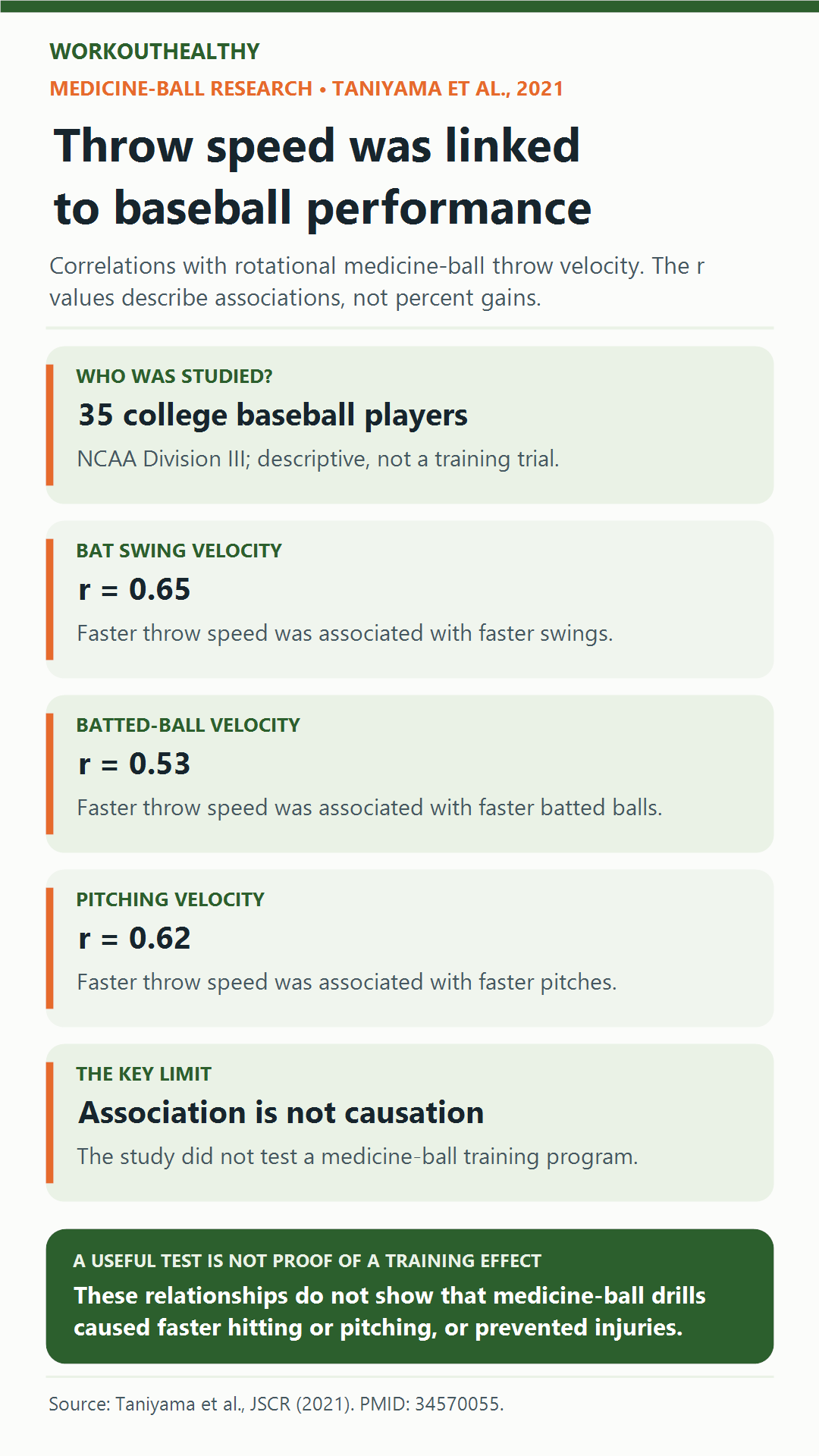
Taniyama et al. (2021) tested 35 NCAA Division III baseball players, including 15 pitchers and 23 hitters, with three players counted in both groups.
Faster rotational medicine-ball throw velocity was associated with faster bat swings, batted balls, and pitches.
The correlations were 0.65, 0.53, and 0.62 respectively.
Those numbers describe relationships between measurements, not percentage improvements from training.
The study was descriptive and did not assign players to a medicine-ball exercise program.
It therefore cannot show that practicing the throw caused faster hitting or pitching.
This still makes the finding useful for understanding what a particular test may reflect.
It asks whether athletes who perform well on one task also tend to perform well on related tasks.
For a coach, that can inform a discussion about assessment.
For a recreational exerciser, the useful question is different: which movement quality do you want to practice?
A test association cannot answer how many repetitions you need, how quickly you will improve, or whether a particular circuit is right for you.
A useful performance test and an effective training program are different questions. Evidence for one does not automatically answer the other.
A training study with a different method
Saeterbakken et al. (2011) studied 24 female high-school handball players, divided into a training group of 14 and a control group of 10.
Both groups continued their regular handball training for six weeks.
The additional program used six progressive, unstable, closed-chain exercises with sling equipment twice weekly.
Throwing velocity increased by 4.9% in the added-training group and did not improve in the control group.
This was a training study, but it did not test the WORKOUT video or a medicine-ball-only circuit.
The result suggests that this specific core-stability program could contribute to throwing performance in this population.
It does not establish an eight-week result, a universal improvement for beginners, or a direct measurement of every participant’s trunk strength.
That narrower interpretation is still meaningful.
A program can work in one setting without becoming a ready-made prescription for everybody.
When someone cites this paper to support a workout, ask whether the participants, exercises, and outcome resemble the recommendation.
A medicine ball in the gym and a sling program for handball athletes share a broad interest in trunk control.
They remain different interventions, and treating them as identical would hide the details that make the research useful.
What the larger review found
Rodríguez-Perea et al. (2023) included 22 studies in their systematic review and 21 in the meta-analysis.
The programs lasted at least four weeks and involved healthy participants older than 12.
The pooled results favored core training for balance and several jumping or throwing-distance outcomes.
The pooled throwing or hitting velocity effect was small and not statistically significant, with p = 0.14.
The authors rated the evidence for that velocity outcome as low certainty.
Balance and vertical-jump evidence received moderate ratings, while some other outcomes had low ratings.
Results from isolated and combined programs varied by outcome.
This does not support a blanket statement that adding core work to lifting always produces the strongest improvement.
It also does not validate a single short video as a substitute for the longer programs examined.
The practical lesson is to identify the outcome before announcing that core training works.
Improved balance, farther throwing, and faster throwing are separate findings.
A headline that combines them into one promise can be more confident than the actual results.
For your own plan, choose something you can observe consistently, such as a controlled carry or a stable marching pattern.
That gives practice a purpose even when the research does not provide a guaranteed performance gain.
What these findings mean for your workout
A held ball, a controlled repetition, and an explosive release can each have a place in training.
They also call for different priorities.
When you hold a ball away from your body, the load changes the demand on your position and balance.
When you release it, you must also account for where it will land or rebound.
These are basic mechanical differences, not proof that one version builds more muscle or burns more fat.
You can organize the session around the quality you want to practice.
For controlled movement, choose a load that lets you keep a consistent path.
For a throw, get instruction on the specific drill and make sure the ball and area are suitable.
For a conditioning session, allow the pace to change without losing control of the exercise.
None of the cited studies measured calorie burn, changes in abdominal fat, or the long-term health effect of this exact routine.
Feeling your trunk work is also different from documenting an increase in strength.
For a broader approach to training, our guide to the basics when progress stalls explains why the overall plan deserves attention.
An exercise earns its place when it serves that plan, rather than simply making a familiar movement feel harder.
Common mistakes worth avoiding
The first mistake is letting the ball choose the movement for you.
A load that you cannot control changes the task into managing an object that is already getting away from you.
Start by checking whether you can comfortably hold it and perform the unloaded movement.
Another mistake is assuming that every weighted ball is designed for slamming, bouncing, or throwing against a wall.
Check the manufacturer’s instructions and the gym’s rules for the exact equipment.
An improvised weighted bag may be suitable for some controlled holds, but do not assume it is safe to throw.
A third mistake is racing the video without reviewing the landing area.
Leave enough space for the movement and for any bounce the drill may produce.
Keep other people outside that area, and avoid chasing a ball through a crowded gym.
It also helps to separate useful effort from discomfort that changes your movement.
Our explanation of why soreness is a poor scoreboard offers better ways to think about progress.
You do not need a painful next day to justify practicing a new skill.
Keep the purpose visible: control for a carry, a suitable setup for a throw, and a repeatable pace for conditioning.
When to adjust the movement or seek guidance
The research discussed here does not establish that this routine is safe for every injury, age, or medical condition.
If you have current shoulder or back pain, or are recovering from surgery, ask a qualified clinician about the movements before adding load.
An overhead squat, a rapid throw, and a floor sit-up can each require a different adjustment.
You do not have to solve all three in the same session.
A coach can also help you choose a version that matches your experience and available equipment.
For a new exerciser, reviewing the movement without a ball is a reasonable starting point.
You can then ask whether adding weight improves the intended task or simply makes it difficult to control.
Stop an exercise if pain, dizziness, or a loss of control develops, and seek appropriate advice.
A shorter range or a different movement may fit your needs better than pushing through the demonstration.
The video shows possibilities and cannot assess your medical history.
Make those decisions with someone who can observe your movement and understands your circumstances.
A practical way to explore the routine
Begin by deciding whether you want to practice a movement, explore a throw, or put together a manageable conditioning session.
That choice determines which parts of the video deserve your attention.
Review the chapter you want to try, check the equipment instructions, and make sure the space is clear.
Practice the movement without load before deciding what ball feels manageable.
For a held movement, notice whether the ball stays on the intended path and whether you can maintain your position.
For an unfamiliar throw, ask a qualified coach to check the setup and technique.
Use enough rest to repeat the movement with control instead of treating the next chapter as a deadline.
There is no research-backed universal dose in this video that requires everybody to do the same repetitions or work periods.
Write down what you tried, the load you used, and the version you could control.
At a later session, compare the same task under similar conditions.
Change one practical variable at a time, such as the load or duration, so you can understand what made the movement harder.
If the change causes you to lose control, return to the earlier version and review the technique.
Choose the task before you choose the intensity. A repeatable movement gives you something useful to practice.
A medicine ball can be a simple addition to a workout when it supports a clear goal.
The strongest takeaway is a more deliberate use of the tool, with expectations that match the evidence.
Watch the Original Video
Want more like this? Subscribe to WorkoutHealthy Insider for practical explanations behind popular fitness claims.
References
Rodríguez-Perea, Á., Reyes-Ferrada, W., Jerez-Mayorga, D., Chirosa Ríos, L., Van den Tillar, R., Chirosa Ríos, I., & Martínez-García, D. (2023). Core training and performance: A systematic review with meta-analysis. Biology of Sport, 40(4), 975-992. https://doi.org/10.5114/biolsport.2023.123319
Saeterbakken, A. H., van den Tillaar, R., & Seiler, S. (2011). Effect of core stability training on throwing velocity in female handball players. Journal of Strength and Conditioning Research, 25(3), 712-718. https://doi.org/10.1519/JSC.0b013e3181cc227e
Taniyama, D., Matsuno, J., Yoshida, K., Pyle, B., & Nyland, J. (2021). Rotational medicine ball throw velocity relates to NCAA Division III college baseball player bat swing, batted baseball, and pitching velocity. Journal of Strength and Conditioning Research, 35(12), 3414-3419. https://doi.org/10.1519/JSC.0000000000004148
WORKOUT. (2026, July 29). Intense medicine ball exercises (level up your training) [Video]. YouTube. https://www.youtube.com/watch?v=XxMQHqBFNhA
General information: This article is not medical advice. If you have an injury, ongoing pain, or a medical condition, talk to a qualified clinician before changing how you train.