
Pulmonary rehab at home can be a structured clinical program, with an assessment, an individual exercise plan and support from a rehabilitation team. Home exercise does not have to mean managing a lung condition alone.
The important choice is the type of program and support you receive. A general exercise video can show movement ideas, but the research on home rehabilitation does not automatically validate that particular routine.
This guide compares the main options, explains two COPD trials and provides a record to complete with your care team. It also identifies the five movements listed in the source video behind this article.
Start with the right kind of help
If breathing difficulty starts suddenly or seriously interferes with breathing or talking, call 911 or seek emergency care, as MedlinePlus advises. New or worsening breathing difficulty needs medical assessment rather than an online exercise routine.
If you already have a lung condition, ask your clinician about pulmonary rehabilitation and whether a home option fits your current needs. Follow your existing care plan while discussing any change.
A recent hospital stay, changing oxygen needs or difficulty with balance gives the team information for that decision. A page or video cannot assess these factors for you.
What a home pulmonary rehabilitation program includes
The National Heart, Lung, and Blood Institute describes pulmonary rehabilitation as a supervised medical program. It can combine exercise, breathing techniques, education and other support for living with lung disease.
Assessment may include breathing tests, a walking test or exercise monitoring. The results help the team choose a plan instead of assigning everyone the same pace, repetitions or oxygen instructions.
| Arrangement | What happens | What to confirm |
|---|---|---|
| Center program | Assessment, exercise sessions and education at a rehabilitation service. | Visit schedule, travel needs and how home activity fits between visits. |
| Supported home program | A personal home plan with scheduled clinical contact, which may use telephone calls. | Where intake happens, who reviews progress and how to reach them. |
| Telerehabilitation | A rehabilitation service delivered remotely using communications technology. | Whether sessions are live, what monitoring is used and what equipment or internet access is needed. |
| Standalone exercise video | Playback of a routine without a personal assessment or a clinician observing the viewer. | Whether your team wants any part of it included in your plan. |
These are useful descriptions, not four guaranteed levels of care. Providers may use the terms differently, so ask what the service actually delivers.
A remote program may still require an in-person assessment. Telephone support, live video classes and an exercise handout are also different arrangements, even when each is described as home rehabilitation.
Who the guideline recommendations apply to
The 2023 American Thoracic Society guideline strongly recommends pulmonary rehabilitation for adults with stable COPD, after hospitalization for a COPD exacerbation, and with interstitial lung disease. Its recommendation to offer center-based rehabilitation or telerehabilitation applies to stable chronic respiratory disease.
The evidence behind that remote-care comparison was overwhelmingly from people with COPD. It does not establish that every remote format works equally well for every lung diagnosis or immediately after a hospitalization.
The guideline also emphasizes retaining the core parts of rehabilitation, including assessment and individually prescribed exercise. Home delivery changes the location and contact method; it does not remove the need for an appropriate plan.
Two home-versus-center trials, two different questions
The trials below are often used to discuss home pulmonary rehabilitation. Both involved people with COPD, but their programs and primary outcomes differed.
| Trial | Home model tested | Primary result and limits |
|---|---|---|
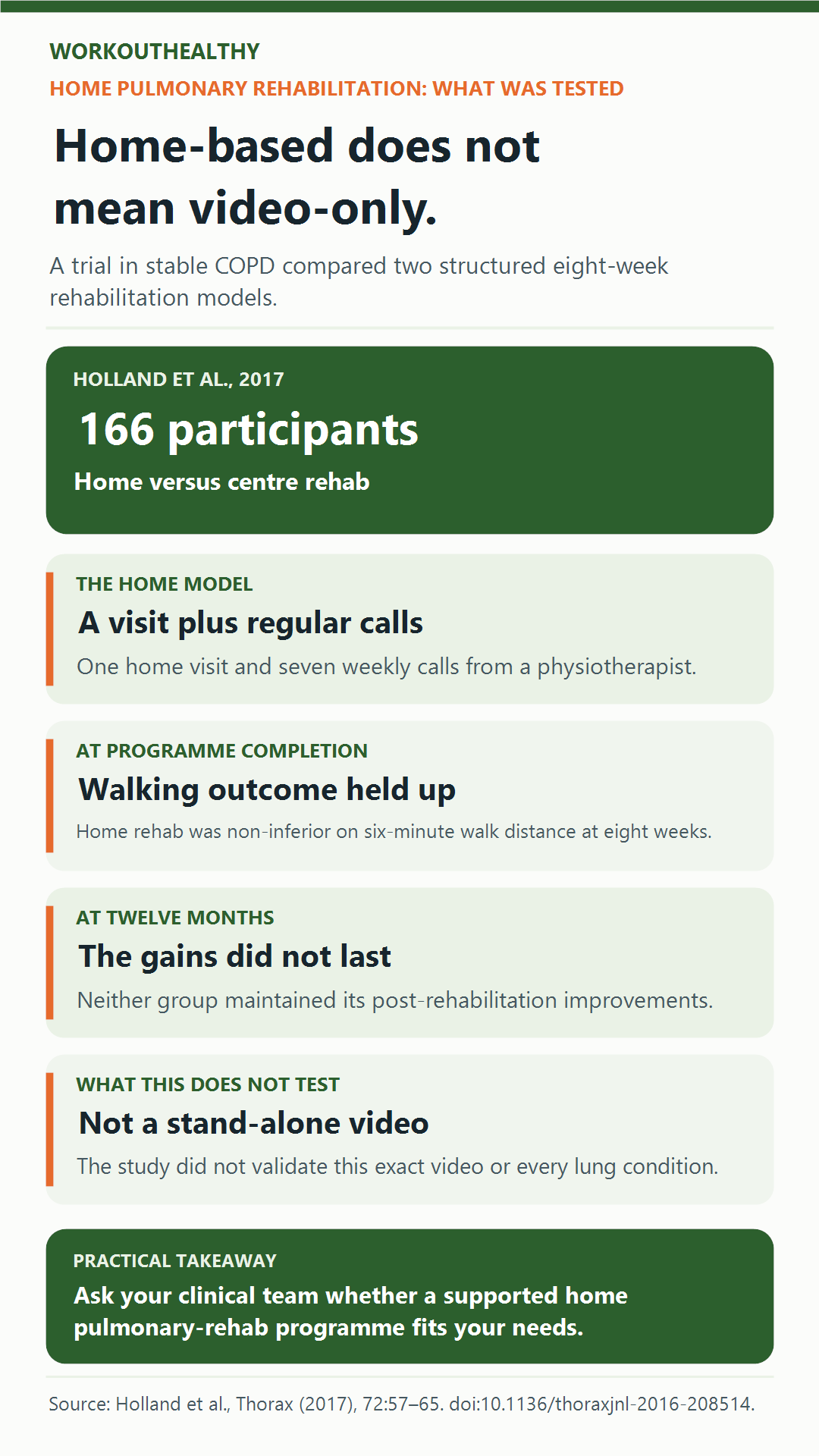
| Holland and colleagues, 2017 166 adults with stable COPD |
Eight weeks, with one physiotherapist home visit and seven weekly calls. | Home rehabilitation met the trial’s noninferiority test for six-minute walking distance at completion. At 12 months, walking noninferiority was not established and walking gains were poorly maintained; quality-of-life outcomes remained equivalent between programs. |
| Horton and colleagues, 2018 287 adults referred for COPD rehabilitation |
Seven weeks, with a hospital introduction, a self-management manual and two calls. | Both groups improved on the primary breathlessness questionnaire, but home-program noninferiority was inconclusive. A total of 109 participants missed the seven-week assessment, adding uncertainty. |
Noninferiority asks whether an option can be ruled out as worse than another by more than a preset margin. A trial finding no statistically significant difference does not, by itself, establish noninferiority or identical results.
Holland’s center-program completion rate was low, which limits transfer to services with higher completion. Neither trial separately randomized the visits or calls, so their individual effects cannot be identified.
Walking capacity, breathing symptoms and lung function are different outcomes. Our guide to posture and breathing measurements explains why chest movement and a lung-test result also need separate interpretation.
What the five-movement video actually contributes
The source video from Pulmonary & Cardiac Exercise lists these five movement labels:
- Chest openers with leg expansions
- Leg circles
- Donkey kicks
- Standing knee tucks to elbows
- Alternating upward punches
This identifies the video’s content so you can discuss it with a rehabilitation team. It is not an instruction to copy its sets, repetitions or duration.
The description names audiences including COPD, pulmonary fibrosis and lung transplant recovery, but those are the publisher’s audience claims. The studies compared clinical programs, not this video.
A seated movement, a supported standing exercise and an unsupported balance task can have different demands. A team’s decision about one activity does not automatically apply to the whole sequence.
The video is linked and embedded in the final section for source context. Its existence does not establish the presenter’s credentials, clinical supervision of a viewer or a tested treatment benefit.
Make the home plan concrete with your team
Ask the service to explain its assessment, contact arrangements and progress checks before you decide. Travel, accessibility, hearing or vision, technology and help at home may affect which option you can use consistently.
The record below is an editorial aid for that conversation, not a new exercise program. Fill in the parts your team has actually set, and ask about any blank field instead of guessing.
| Record | Question to answer with the service |
|---|---|
| Program and contact | Who is responsible for my plan, and how do I contact them during and outside scheduled sessions? |
| Assessment | Which checks are needed before starting, and where will they happen? |
| Activity plan | Which activities, amounts and rest periods have been set for me, and who changes them? |
| Oxygen and medicines | What are my prescribed instructions during activity, including any monitoring the team wants? |
| Symptoms and stopping | What response should I expect, when should I stop, and which changes require a call or emergency help? |
| Progress | What should I record, when will it be reviewed and which outcome will we reassess? |
| After the course | What is the maintenance plan and how do I get help if participation becomes difficult? |
Oxygen flow and exercise intensity are individual instructions to obtain from the clinical team. A generic oxygen-saturation number, video pace or another patient’s plan should not replace them.
If the team asks you to log sessions, use its requested measures and note any symptoms or reasons a session changed. A useful review explains what you could repeat and what got in the way, rather than simply counting completed videos.

Finding a program and checking coverage
Ask your referring clinician or local rehabilitation service whether it offers supported home care, telerehabilitation or a combination of home and center visits. Explain the barrier you are trying to solve, such as transport, scheduling or accessibility.
Ask the program and your insurer about the specific service, referral requirements and out-of-pocket costs. Coverage of pulmonary rehabilitation does not automatically mean every home or virtual provider is covered for your diagnosis and plan.
Before enrolling, confirm the contact schedule and whether you need a smartphone, reliable internet, monitoring equipment or another person present. Ask how the service handles a missed session, changing symptoms or difficulty using its technology.
The useful next step
Home pulmonary rehabilitation is a care option to discuss, not a promise that any home workout will produce a particular result. The most useful choice is a program you can access with an assessment, a clear plan and support suited to your condition.
Bring the program record and any video you are considering to that conversation. The aim is to understand what your own plan includes and how its progress will be checked.
References
Holland, A. E., Mahal, A., Hill, C. J., Lee, A. L., Burge, A. T., Cox, N. S., Moore, R., Nicolson, C., O’Halloran, P., Lahham, A., Gillies, R., & McDonald, C. F. (2017). Home-based rehabilitation for COPD using minimal resources: A randomised, controlled equivalence trial. Thorax, 72(1), 57 to 65. https://doi.org/10.1136/thoraxjnl-2016-208514
Horton, E. J., Mitchell, K. E., Johnson-Warrington, V., Apps, L. D., Sewell, L., Morgan, M., Taylor, R. S., & Singh, S. J. (2018). Comparison of a structured home-based rehabilitation programme with conventional supervised pulmonary rehabilitation: A randomised non-inferiority trial. Thorax, 73(1), 29 to 36. https://doi.org/10.1136/thoraxjnl-2016-208506
MedlinePlus. (2025, April 1). Breathing difficulty. National Library of Medicine. Medical encyclopedia guidance.
National Heart, Lung, and Blood Institute. (2022, March 24). Pulmonary rehabilitation. National Institutes of Health. Program overview.
Rochester, C. L., et al. (2023). Pulmonary rehabilitation for adults with chronic respiratory disease: An official American Thoracic Society clinical practice guideline. American Journal of Respiratory and Critical Care Medicine, 208(4), e7 to e26. https://doi.org/10.1164/rccm.202306-1066ST
Watch the original source video
This source is retained for the article’s comparison with formal rehabilitation, rather than as a personal treatment recommendation. Ask your team whether any of its activities fit your plan.
Watch the original video on YouTube if the embedded player does not load.
Medical disclaimer: This article is general fitness information, not medical advice. If you have an injury, ongoing pain or a medical condition, talk to a doctor or physical therapist before changing how you train.