
A rounded-shoulder desk posture can make a deep breath feel different. Your ribs, spine, shoulder blades, and breathing muscles all move together. But a tight chest muscle is not a diagnosis for shallow breathing, and a doorway stretch cannot be expected to increase lung capacity. The useful question is narrower: can chest mobility and posture work make breathing more comfortable for some people?
The evidence suggests that posture can change chest movement and measured breathing in certain settings. Studies of pectoral stretching show changes in muscle length or shoulder position, while studies that directly measure lung function give a more mixed picture. That distinction is worth keeping in view before trying to “fix” your lungs with one stretch.
Why the chest and shoulders enter the conversation
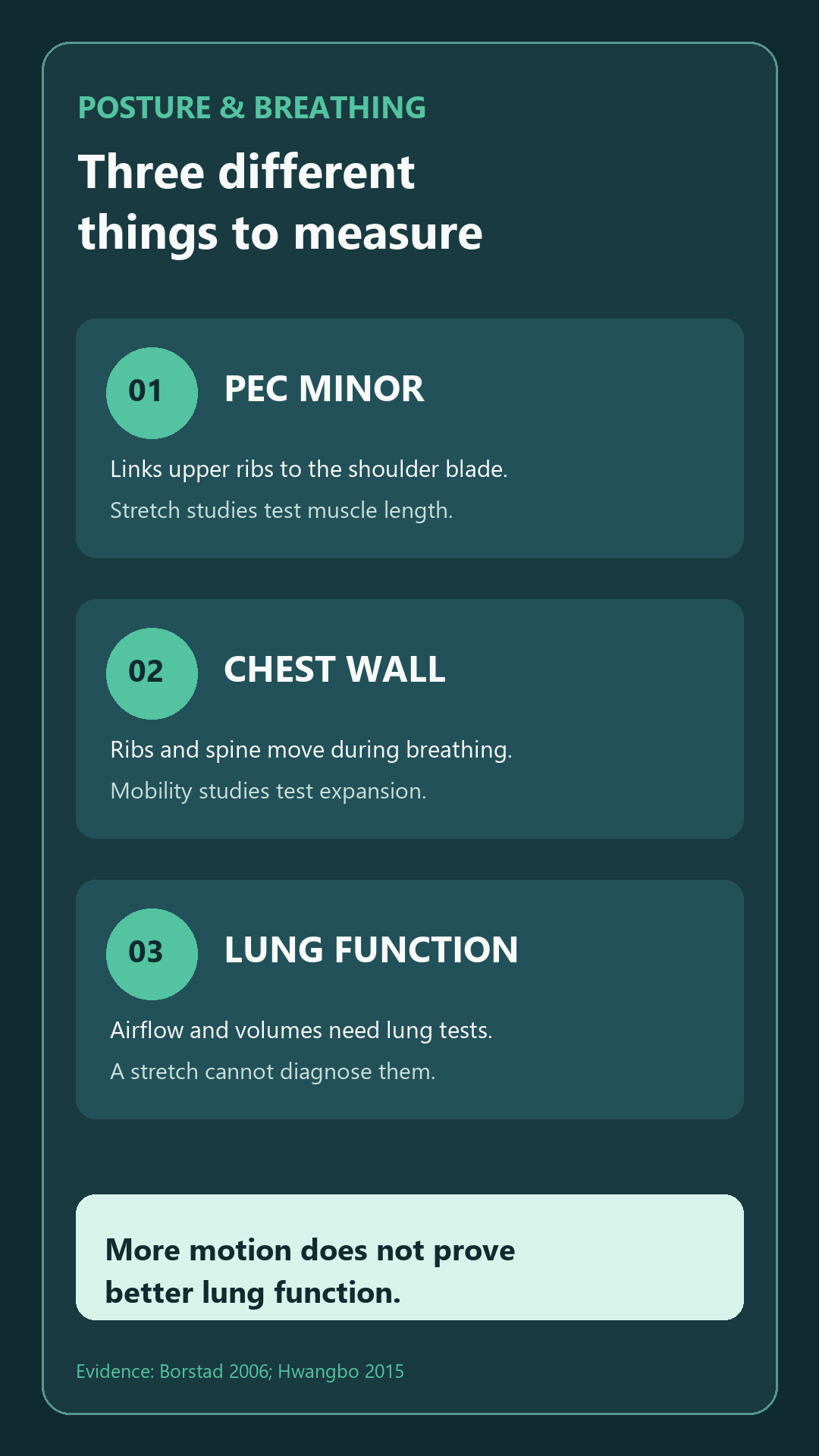
The pectoralis minor is a small muscle under the larger pectoralis major. It runs from several upper ribs to the coracoid process of the shoulder blade. Its position lets it influence how the shoulder blade sits and moves. A relatively short pectoralis minor is associated with altered scapular mechanics. It is one reason clinicians may include chest mobility in a shoulder or posture program.
Breathing, however, is much larger than one muscle. The diaphragm is the main muscle of quiet breathing. Intercostal muscles help move the ribcage; the abdominal muscles, neck, and shoulder girdle contribute under different demands. The lungs do not become physically smaller simply because a person spent an afternoon at a computer. “Chest tightness limits lung expansion” is a plausible feeling or mechanical hypothesis in some people, not a universal medical explanation for shallow breathing.
Forward head position and rounded shoulders can be associated with changes in thoracic shape. In a small study, forward head posture was linked to a more expanded upper thorax, a more contracted lower thorax, and lower measures of respiratory function. The study does not establish that desk posture caused an individual’s breathlessness or that correcting posture would reverse disease. It does show why movement of the neck and ribcage belongs in a careful discussion.
For a practical self-check, notice whether you can let the lower ribs move gently outward as you inhale in a comfortable upright position. Do not force an exaggerated “perfect” posture or hold your shoulders rigidly back. Breathing should feel easy. Posture is a changing position, not a single pose that must be maintained all day.
What the stretching studies measured, and what they did not
A 2006 laboratory study compared three pectoralis-minor stretches in 50 people without shoulder pathology. A unilateral self-stretch produced the largest measured immediate change in muscle length. That is useful evidence for selecting a stretch to lengthen the muscle in the short term. It did not test lung capacity, breathing symptoms, or long-term desk habits.
A later randomized comparative study of 60 young women with rounded shoulders compared pectoralis-minor stretching alone with stretching plus lower-trapezius strengthening. Both groups improved measured posture-related outcomes over the short intervention; the combined program did better on pectoralis-minor resting length. The trial’s population and outcomes matter. It supports the idea that a program can change some shoulder measures, not a promise of easier breathing in every adult.
The closest breathing evidence often comes from combined programs or populations with existing illness. A randomized trial in men with chronic obstructive pulmonary disease and forward shoulder posture included pectoral stretching and scapular strengthening. After eight weeks, the exercise group improved chest expansion and respiratory muscle strength. This was a supervised program for a specific clinical group; its findings cannot be reduced to “a 30-second doorway stretch opens healthy lungs.”
In a small trial of thoracic self-mobilization in healthy adults, chest expansion improved relative to a control group after six weeks, while measured pulmonary function did not significantly differ. That is a particularly helpful distinction: greater movement at the chest wall and better lung-test numbers are separate outcomes. The Facebook image’s claim that a tight chest muscle can “quietly limit how deeply your lungs are actually able to expand” should be read with that uncertainty attached.
Mobility is not the same as lung capacity. A stretch may change comfort or chest movement without changing the lung’s underlying function.
How to try a gentle doorway stretch
Stand beside a sturdy doorframe. Place one forearm against the frame with the elbow at a comfortable height, generally no higher than the shoulder if a high position irritates it. Step forward or gently turn your torso away until you feel a mild stretch across the front of the chest. Keep the shoulder relaxed and breathe normally. Ease out before there is pinching, tingling, dizziness, or pain.
A 20- to 30-second hold is a reasonable, simple starting convention, but the research above does not prove that exact duration is a therapeutic dose for breathing. One or two comfortable repetitions per side can help you assess the sensation. A person with shoulder instability, recent surgery, nerve symptoms, or a condition that limits stretching should ask a clinician or physical therapist about appropriate movements.
The angle changes which tissues feel the stretch. Raising the arm high or arching the lower back to chase more range may put stress where you do not want it. Move a little, breathe, and stop at a mild stretch. If the movement causes pain in the front of the shoulder, back off. The point is to explore comfortable motion, not to force the chest open.
Stretching alone may also miss the shoulder-blade strength side of the picture. In the rounded-shoulder trial, combining pectoralis-minor stretching with lower-trapezius work produced a better change in resting muscle length than stretching alone. That does not mean everyone needs a formal strengthening plan, but it gives a reason to include varied pulling and upper-back movements instead of repeating the same stretch endlessly.
Can breathing practice add something?
Gentle diaphragmatic breathing can help some people slow their breath and reduce stress or a sense of breathlessness. A review of adult stress studies found only three eligible studies, so it called for more research. A larger 2026 review of randomized trials found widely varying protocols and substantial concerns about study quality. These results support modest, individualized expectations, not a universal breathing “reset.”
Try sitting comfortably with the jaw and shoulders relaxed. Place a hand on the lower ribs if that helps you notice movement. Inhale gently through the nose if comfortable, allowing the ribs and abdomen to move without forcing an oversized breath. Exhale slowly and easily. Stop if you feel lightheaded, short of breath, or distressed. The goal is comfortable awareness, not a breath-holding contest or a requirement to use only the diaphragm.
People with asthma, COPD, anxiety-related breathing symptoms, and other conditions may be taught different techniques by a clinician. A systematic review of breathing techniques in serious respiratory illness found some reduction in breathlessness versus usual care, but the average difference did not exceed the review’s minimal important threshold. That is another reason to treat practice as an optional aid rather than a treatment substitute.
Our separate review of slow breathing and heart-rate variability explains why a short-term physiological change should not be overread as a broad health outcome. You can pair a few easy breaths with the doorway movement if it feels good, but no study cited here proves that this combination compounds benefits in the general population.
A realistic desk-day routine
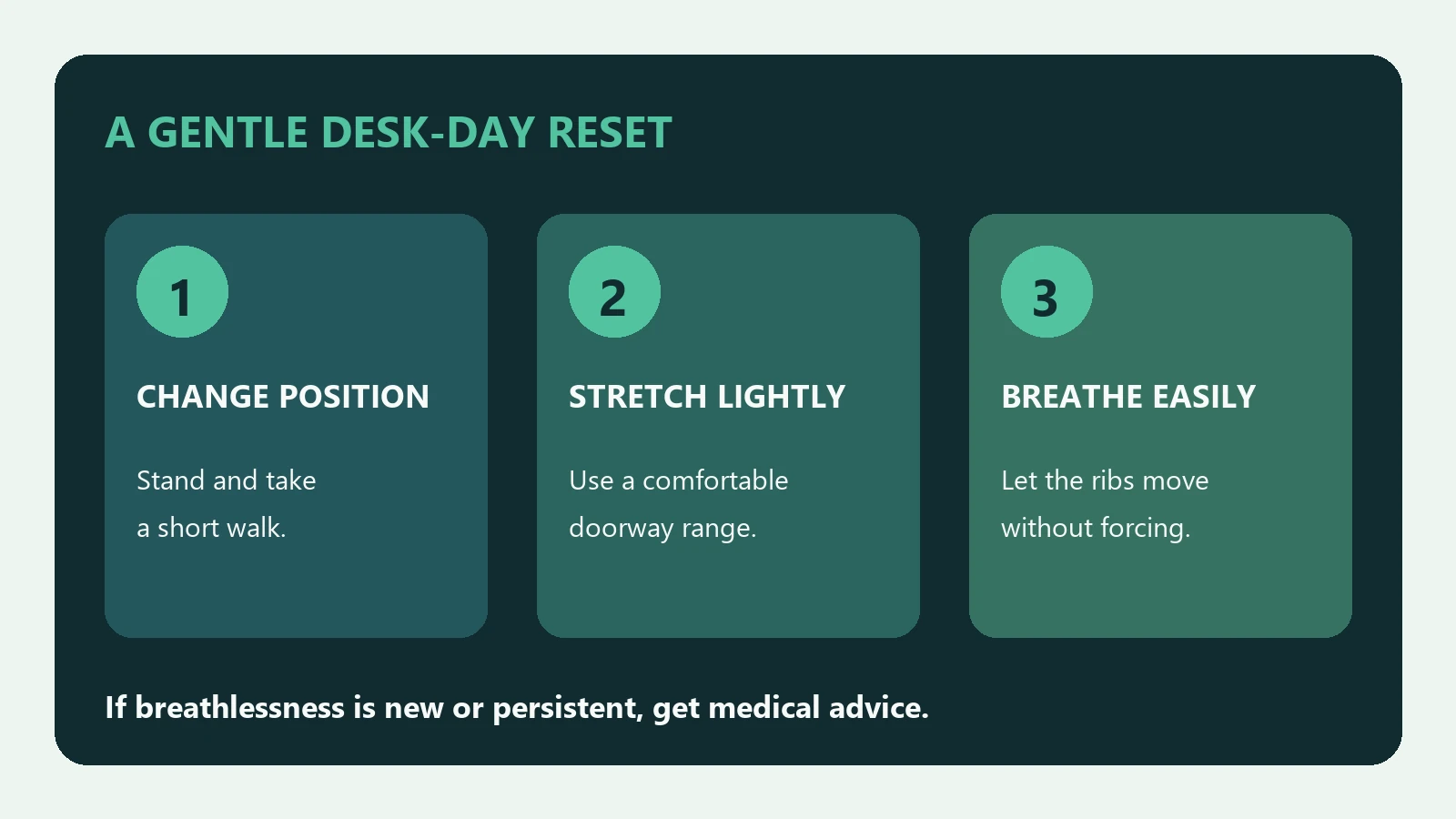
Long desk sessions keep the body in one pattern for a long time. A practical response is to vary that pattern. Stand up, walk a little, roll the shoulders, and reach in a comfortable range. If you like the doorway stretch, add it after the walk. There is no evidence here that an exact hourly alarm is necessary or that missing one will let the pectoralis minor “tighten back up.”
It may help to place the screen where you can see it without repeatedly jutting the head forward, keep frequently used items within easy reach, and change sitting positions. Ergonomic changes can reduce irritation, but they do not replace movement or diagnose breathing problems. A well-set chair is one tool among many. The best posture may be the next comfortable posture you move into.
For general activity, short breaks can add movement to an otherwise sedentary day. They are not interchangeable with an exercise program. Our article on exercise and a day of sitting explains how movement breaks fit beside regular physical activity. If your shoulders repeatedly ache, a physical therapist can assess whether mobility, strength, workstation setup, or another issue deserves attention.
Keep the routine boring enough to repeat: get up; move for a minute or two; try one gentle chest stretch if it is comfortable; return to normal breathing. A noticeable “deeper” breath afterward may reflect sensation and relaxed breathing rather than a measured change in lung function. That can still be worthwhile, as long as the explanation stays honest.
What a doorway stretch cannot tell you
It cannot tell you whether your lungs are healthy, whether your breathing pattern is abnormal, or whether the pectoralis minor is “chronically tight.” Those questions require the right clinical history and, sometimes, examination or testing. A self-stretch is a movement experiment, not a diagnostic test.
It also cannot prove that rib position has changed permanently. The short-term pectoralis-minor studies measured immediate or brief program effects in selected participants. The COPD study used a broader program and a clinical group. The thoracic self-mobilization study found different results for chest expansion and pulmonary function. None licenses a promise that 20 to 30 seconds per side will meaningfully increase anyone’s ability to move air.
The most defensible claim is that chest and upper-back mobility may affect how a breath feels and how the chest wall moves, while the link to lasting respiratory improvement from a doorway stretch alone remains unproven. A useful article should correct the visual’s overstatement rather than repeat it as settled fact.
Breathlessness has many possible causes. Do not assume posture is the reason for a persistent or new breathing symptom.
When should you seek medical care?
Seek prompt medical advice for new, worsening, or recurring shortness of breath, wheezing, chest tightness, or a cough that persists, especially when symptoms interrupt normal activities. Asthma and other respiratory conditions can produce symptoms that a stretch will not resolve. Describe when the problem occurs, what else you feel, and what makes it better or worse.
Call emergency services for severe trouble breathing, chest pain, fainting, confusion, or other alarming sudden symptoms. Do not continue stretching or breathing drills while waiting for serious symptoms to pass. The National Heart, Lung, and Blood Institute advises clinical evaluation for frequent or sudden breathing symptoms and emergency help when breathing is fast and hard despite usual treatment in people with COPD.
If the issue is simply that you feel stiff after sitting, a gentle movement break is reasonable. If the issue is that you cannot catch your breath, it deserves a different response. Knowing the difference protects you from a well-meant social-media tip becoming a missed diagnosis.
The takeaway
The pectoralis minor connects the ribs to the shoulder blade, and posture or chest mobility can influence the mechanics and sensation of breathing. Research supports some changes in shoulder posture or chest expansion with exercise programs, but it does not show that a quick doorway stretch reliably improves lung function. Try a gentle stretch and comfortable breathing if they feel helpful; keep moving throughout the day; and seek care when breathlessness is new, persistent, or severe.
Sources
- Borstad and Ludewig, 2006, comparison of three pectoralis-minor stretches.
- Hasan and colleagues, 2023, rounded-shoulder stretching and strengthening trial.
- Scapulothoracic exercise trial, 2024, chest mobility and respiratory measures in men with COPD.
- Thoracic self-mobilization study, 2015, chest expansion versus pulmonary function.
- Forward head posture study, 2019, thoracic shape and respiratory measures.
- Hopper and colleagues, 2019, diaphragmatic breathing and stress review.
- Kwon and colleagues, 2026, randomized-trial review of diaphragmatic breathing.
- Breathing techniques review, 2024, adults with serious respiratory illness.
- NHLBI asthma symptoms, guidance on breathing symptoms.