

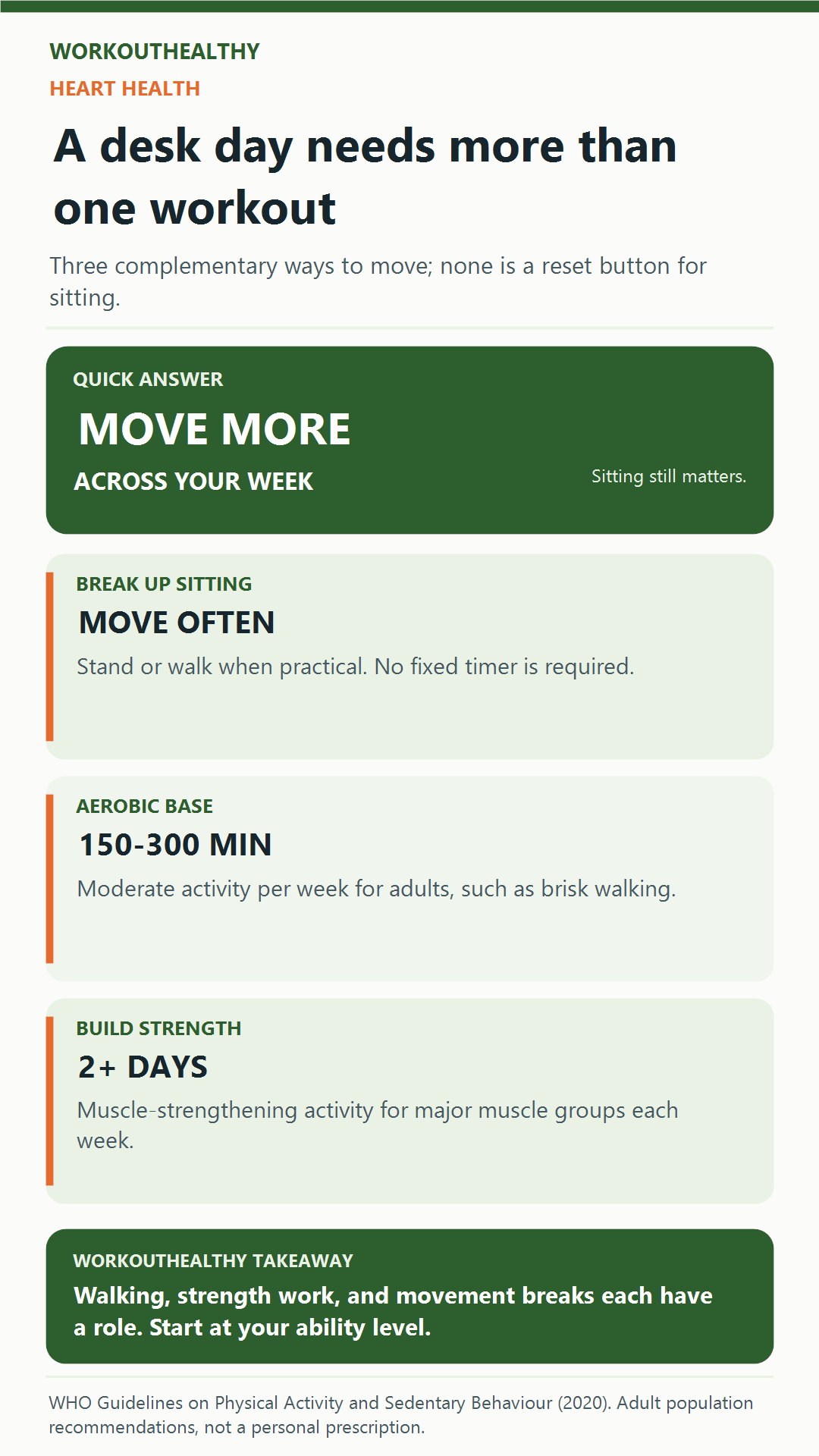
To counteract sitting all day, add movement where the day allows and keep a regular aerobic and strength routine. There is no proven exchange rate in which one workout erases a fixed number of seated hours.
A walking break, a longer walk, and a strength session can all help in different ways. The choice card below gives realistic options without turning every desk break into a timed requirement.
How to counteract sitting all day: a workday choice card
Pick one option at each point if it fits your job, energy, and mobility. These examples were not tested as a complete program and do not treat pain or cancel health risk.
| Moment | If you can leave the chair | If you cannot leave the chair or have limited mobility |
|---|---|---|
| Commute or arrival | Walk part of the route or take a comfortable lap before work. | Use comfortable arm, shoulder, or leg movements that fit your ability and setting. |
| Between tasks | Stand, refill water, or walk to another room when practical. | Change position and move parts of the body you can move comfortably. |
| Lunch | Take a short outdoor or indoor walk, alone or with a coworker. | Choose a seated movement break or accessible route if available. |
| After work | Walk at a sustainable pace or do a planned strength session. | Choose an accessible aerobic or resistance activity suited to your health and equipment. |
You do not need to complete every row to have a useful day. If frequent breaks are impossible, use the moments you control and build a weekly activity pattern around them.
Can a workout cancel eight hours of sitting?
No study establishes a personal formula for cancelling seated time. The 2016 Ekelund pooled cohort analysis found that higher activity attenuated the association between long sitting time and mortality, but it was observational and cannot promise that any one person’s seated day becomes harmless.
The World Health Organization guidelines recommend limiting sedentary time and replacing some of it with activity of any intensity. They also recommend 150 to 300 minutes of moderate aerobic activity a week, or a vigorous equivalent, plus muscle-strengthening activity on at least two days.
Those are population targets, not a reason to reject a short walk or slower starting pace. More activity can be helpful even when a person’s schedule makes the full target difficult.
A sedentary day is one part of a longer pattern, and studies often measure that pattern through self-report. Your risk cannot be calculated from a single day in a chair or reduced to a precise exercise-minute balance.
Choose movement breaks without a strict timer
The WHO does not prescribe a universal “stand every 30 minutes” rule. A reminder can help someone who forgets to move, but it is a personal cue rather than a medical threshold.
Try a short walk, a position change, or comfortable seated movement when a natural break appears. If standing worsens symptoms, do not assume the problem is a weak core or force more standing; a clinician can assess persistent pain or balance trouble.
Movement breaks add opportunities across the day. They do not make a later workout unnecessary, and missing one break does not erase the value of that workout.
Walking pace: useful context, not a pass-fail test
Brisk walking can count toward moderate-intensity aerobic activity, but “brisk” should fit the person. The CDC talk test says that during moderate effort you can talk but not sing.
A leisurely walk still adds movement, and it may be an appropriate starting point after inactivity. As a familiar route becomes easier, you can consider more time, a little more pace, or more frequent walks without copying another person’s speed target.
Step counts can help establish a personal baseline, but they are not a clinical score. Our guide to choosing a walking amount explains why there is no universal daily mileage, and our steps-and-mortality review separates associations from individual promises.
Where strength training fits
The American Heart Association scientific statement reports average cardiovascular risk-factor benefits from resistance exercise. That evidence does not make lifting a substitute for prescribed medicine or individual cardiac care.
A manageable full-body routine might involve supported leg, push, and pull movements on separate days during the week. The exact exercises and effort should fit the person’s ability, especially with known heart disease, balance limits, or pain.
Walking and strength work serve complementary purposes. Our indoor walking guide explains how to judge aerobic effort when outdoor walking is inconvenient.
One illustrative week
A desk worker starting from little planned activity might take a short comfortable walk on several days, use a movement opportunity during work when possible, and schedule two manageable strength sessions. The workday card supplies choices, while the weekly plan supplies continuity.
Over time, walking or another aerobic activity can grow toward the WHO’s population target. The path can include shorter sessions; it does not require making up missed minutes with an exhausting workout.
If a week is disrupted, resume at a level you can repeat. A sustainable habit is more useful than treating one seated day as a debt that must be repaid immediately.

What about discomfort from sitting?
Online suggestions for back or neck discomfort often assume that posture is the cause. A comment thread cannot diagnose why someone hurts, and stretching is not a proven universal treatment.
Changing position may feel better for some people. Persistent or worsening pain, numbness, weakness, or symptoms affecting daily life deserve an individual assessment rather than a fixed online “desk posture” diagnosis.
When symptoms change the plan
Stop activity and seek urgent medical care for chest pain, fainting, or severe or unusual breathlessness. If you have established heart disease, a recent cardiac event, or activity restrictions, ask your clinical team before substantially increasing exercise intensity.
For most generally healthy desk workers, the practical start is a comfortable movement option and a repeatable week. The goal is to build activity, not to pass a daily chair-time test.
What the evidence cannot promise
Guidelines describe patterns associated with better outcomes across populations; they do not guarantee a result for one person. The cohort research cannot tell you exactly how many minutes of walking offset one hour of sitting.
Faster walkers may differ from slower walkers in health and capacity, so pace associations should not be used to shame someone moving slowly. Nor can an exercise break alone treat an underlying cause of pain.
The useful conclusion is simpler: move when you reasonably can, keep aerobic and strength activity in the week, and adapt the plan to your health and circumstances.
Sources
- Ekelund et al., 2016 pooled cohort analysis of sitting, activity and mortality.
- World Health Organization, 2020 physical activity and sedentary behavior guidelines.
- CDC, measuring physical activity intensity.
- American Heart Association, 2023 resistance exercise statement.
This article is for general information only and is not medical advice. If you have a medical condition or concerning symptoms, ask a qualified clinician about an activity plan that fits you.