
A twenty minute walking workout you can do in your living room does not look like much on paper.
No jumping, no equipment, no weights, just marching in place to music while a video sets the pace.
That simplicity is exactly why so many people search for indoor, low impact walking routines instead of heading outside or hitting the gym floor.
The question worth asking is whether a workout this gentle can actually do anything for your heart.
Research on walking intensity, cadence, and joint health gives a clear, if modest, answer.
What a Low Impact Walking Workout at Home Actually Is
A low impact walking workout is built around continuous stepping patterns performed indoors, usually set to music, with no running, jumping, or high impact moves.
The Improved Health video behind this article uses marching in place, gentle side steps, and light arm movement set to Celtic music for twenty minutes.
Nothing in it requires more floor space than a yoga mat, and no equipment is needed at all.
It works entirely indoors. It never touches a sidewalk or a track.
For people who cannot or do not want to walk outside, whether that is because of weather, safety, mobility limits, or simply not having a safe place nearby, this format is a genuine substitute for a walk, not a lesser version of one.
If you have ever looked into how many miles you should walk a day, most of that guidance quietly assumes you are already walking outdoors on a sidewalk or a track.
A home walking workout starts from a different place entirely, indoor space, no set distance, and a video that tells you when to speed up.
The best cardio workout is the one you will actually do. For a lot of people, that means twenty minutes in a living room instead of a walk that depends on the weather.
Why Moderate Intensity Cardio Still Trains Your Heart
Cardiovascular fitness improves when your heart works harder than it does at rest for a sustained stretch of time, not necessarily when you sprint or jump.
Walking briskly raises your heart rate into what researchers call a moderate intensity zone.
That zone is usually described using the talk test, meaning you can still talk in short sentences but you could not comfortably sing.
Staying in that zone for a sustained period is enough to strengthen the heart muscle, improve circulation, and support healthy blood pressure over time.
You do not need to jump to get there. Impact and intensity are not the same thing.
A low impact walking workout can raise your heart rate into that same moderate zone without any of the joint stress that comes from running or jumping cardio.
Breaking up long stretches of sitting with a session like this also matters on its own, a point covered in more depth in the discussion of whether standing is better than sitting.
How Fast You Need to Walk for It to Count
Researchers measure walking intensity in a very specific way, by counting how many steps you take per minute, a number called cadence.
A systematic review published in the Journal of Sports Medicine pulled together multiple studies on walking cadence and moderate intensity exercise (Slaght et al., 2017).
It found that a cadence of roughly 100 steps per minute was generally enough for most adults to reach moderate intensity, defined using a measure of oxygen use called METs.
Older adults sometimes needed a slightly higher cadence to reach that same intensity level.
Taller and shorter people also needed somewhat different cadences, since stride length changes how much ground each step covers.
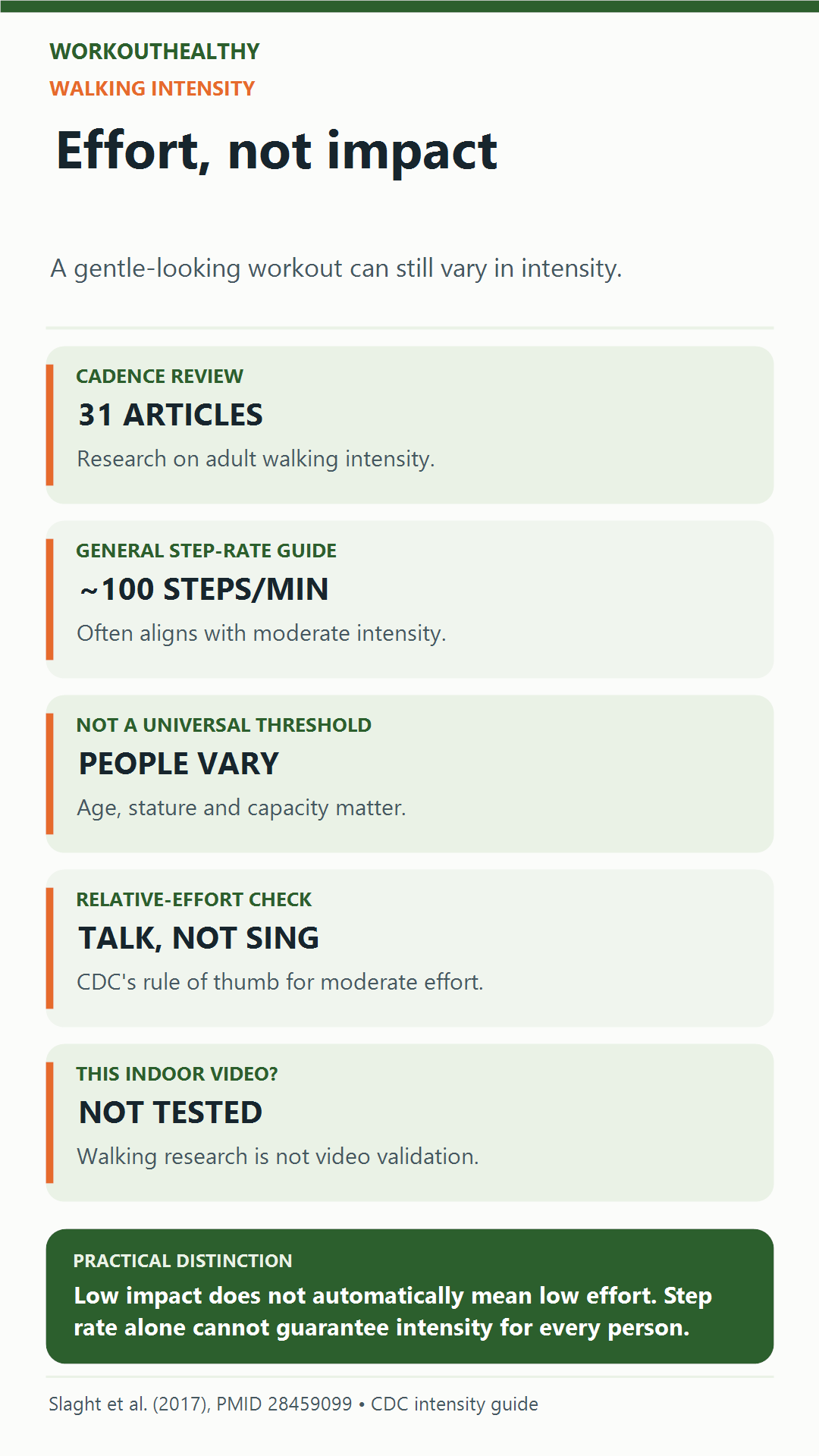
The review examined walking cadence as a practical guide to exercise intensity. It did not establish that walking at a particular cadence reduces mortality risk.
About 100 steps per minute is a population-level starting point for moderate intensity, not a personal threshold or a guarantee. Your breathing, fitness level, and comfort also matter when judging effort.
This lines up with separate research on daily step counts and mortality, which found a similar pattern of real, measurable benefit that levels off rather than climbing forever.
A twenty minute home workout that keeps you moving continuously at a lively pace, closer to marching than strolling, sits inside the range this research points to.
What the Evidence Shows for People With Joint Pain
One of the biggest draws of a low impact walking workout is that it avoids the repeated pounding that running, jumping, or plyometric cardio puts through the knees and hips.
A 2025 systematic review and meta analysis in BMC Musculoskeletal Disorders looked specifically at aerobic exercise in people with knee osteoarthritis (Su et al., 2025).
It found that weight bearing aerobic activities like walking produced greater improvements in cardiovascular fitness than non weight bearing options like cycling or water exercise.
Those improvements were measured using oxygen consumption and six minute walk distance, two standard fitness markers.
The improvement was real, but modest, and it did not reach the threshold researchers consider a clinically meaningful difference on its own.
The same review found that non weight bearing exercise was less likely to trigger joint pain during a session.
That helps explain why walking programs sometimes saw lower adherence than swimming or cycling programs in people with more advanced joint damage.
The practical takeaway is not that walking is risky for joints. Most research still treats it as one of the safer cardio options available.
But pain during a session is a signal worth listening to, not a sign to push through it.
A Mood Benefit Worth Mentioning
Cardiovascular fitness is not the only reason people stick with a walking habit.
A 2024 systematic review and meta analysis in JMIR Public Health and Surveillance looked at forty four trials on walking and depressive symptoms, along with twenty six trials on walking and anxiety symptoms (Xu et al., 2024).
It found that walking produced a meaningful reduction in both, and the effect was larger in people who started with higher levels of depression.
When walking was compared directly to other forms of exercise, the mood benefits were roughly similar rather than walking being uniquely better than everything else.
A twenty minute home session set to music will not replace treatment for a diagnosed mood disorder.
But it is one more reason a short daily walking workout is worth the time, even on days when your only real goal is to feel a little less anxious.
What This Research Does Not Prove
None of the studies above were done on the specific twenty minute Celtic music video that inspired this article, so it would be inaccurate to claim that exact workout has been studied.
The research instead applies to walking as a category, moderate intensity, weight bearing cardio performed continuously, and this format is one version of that category.
It also does not prove that walking alone will produce significant weight loss without any change to diet.
Exercise’s role in weight change tends to be smaller than most people expect, since diet usually drives the bigger share of the result.
It does not replace strength training either.
Walking builds cardiovascular fitness.
It does not build meaningful muscle mass or bone density the way resistance training does.
And none of this research can tell you how a specific joint, back, or heart condition will respond, since studies report averages across groups of people, not guarantees for any one individual.
Low impact tells you how your feet meet the floor, not whether the pace is enough for a cardio stimulus. The talk test and your own response matter more than the playlist.
Common Mistakes People Make With Indoor Walking Workouts
The most common mistake is treating a slow shuffle as equivalent to a brisk walk.
Cadence matters more than most people realize, so aim for a pace that feels lively rather than leisurely, closer to a fast walk than a stroll.
Another mistake is skipping the arm movement that many of these videos build in.
Swinging your arms raises your heart rate more than stepping in place alone.
Cutting that out quietly lowers the intensity of the whole session without you noticing.
A third mistake is doing the workout on a hard, unpadded surface like bare tile or concrete.
That can be harder on the knees and ankles than working out on a cushioned mat, carpet, or supportive shoe.
Wearing real athletic shoes indoors, rather than socks or flat slippers, also matters more than it seems.
A fourth mistake is stopping the moment the video ends instead of easing your heart rate down gradually.
Who Should Check With a Doctor Before Starting
Walking is one of the lowest risk forms of exercise there is, but low risk is not the same as no risk for every single person.
Anyone with a diagnosed heart condition, particularly one involving arrhythmia, heart failure, or a recent cardiac event, should get clearance from a doctor before starting a new cardio routine, even a gentle one.
People with balance disorders, inner ear conditions, or a history of falls should be cautious with any workout that includes side stepping or quick direction changes.
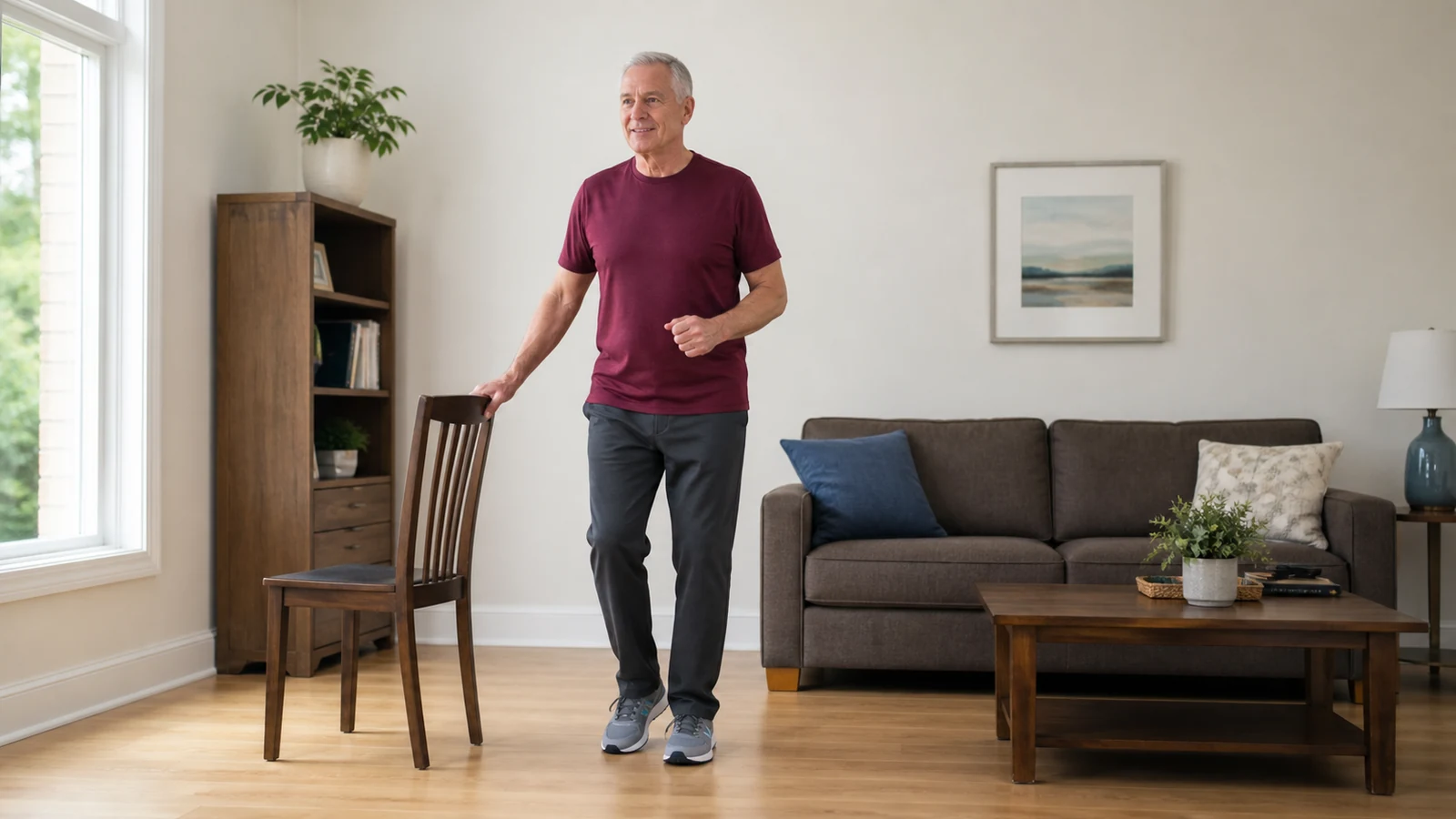
An early session done near a wall or a sturdy chair for support is a reasonable way to test the waters.
Anyone recovering from a recent hip or knee surgery should follow their surgeon’s or physical therapist’s specific timeline rather than a general fitness video, since recovery pacing varies enormously from person to person, as seen even in Misty Copeland’s hip replacement recovery.
If you feel chest pain, dizziness, or unusual shortness of breath during a session, stop.
Treat that as a medical question, not a fitness one.
How to Structure a 20 Minute Low Impact Walking Workout at Home
A simple, evidence informed structure works better than randomly marching around your living room for twenty minutes.
Start with two to three minutes of slow marching in place to warm up your joints and gradually raise your heart rate.
Keep your arms relaxed during this phase and focus on posture, standing tall rather than hunching toward a screen.
For the next twelve to fourteen minutes, aim for continuous movement at a pace that lines up with the cadence research above, roughly 100 to 110 steps per minute for most adults.
Add arm swings, gentle side steps, and light knee lifts if the video you are following includes them.
These add intensity without adding impact.
A useful way to check your pace without counting steps is the talk test.
If you can hold a conversation but cannot sing along comfortably, you are likely in the right zone.
If you can sing without any effort at all, pick up the pace a little.
In the final three to four minutes, slow your pace back down and let your heart rate ease off gradually instead of stopping abruptly.
Finish with thirty seconds of gentle stretching for your calves and hips if you have the space to do it.
Doing a session like this three to five times a week is a reasonable, sustainable target based on general moderate intensity activity guidelines, not on anything specific to this particular video.
Pair it with a couple of strength sessions each week if your goal is broader fitness rather than cardio alone.
Watch the Original Video
Get the next evidence check. Subscribe to WorkoutHealthy Insider for practical explanations behind popular fitness claims.
References
Slaght, J., Sénéchal, M., Hrubeniuk, T. J., Mayo, A., & Bouchard, D. R. (2017). Walking cadence to exercise at moderate intensity for adults: A systematic review. Journal of Sports Medicine, 2017, Article 4641203. https://doi.org/10.1155/2017/4641203
Su, S., Yu, C. C. W., Zhou, E. F. M., Liu, J. Y., & Fu, S. N. (2025). Effect of aerobic exercise on cardiopulmonary fitness among people with knee osteoarthritis: A systematic review and meta-analysis. BMC Musculoskeletal Disorders, 26(1), Article 549. https://doi.org/10.1186/s12891-025-08746-1
Xu, Z., Zheng, X., Ding, H., Zhang, D., Cheung, P. M. H., Yang, Z., Tam, K. W., Zhou, W., Chan, D. C. C., Wang, W., & Wong, S. Y. S. (2024). The effect of walking on depressive and anxiety symptoms: Systematic review and meta-analysis. JMIR Public Health and Surveillance, 10, Article e48355. https://doi.org/10.2196/48355
This article is for general information only and is not medical advice. If you have an injury, ongoing pain, or a medical condition, talk to a doctor or physical therapist before you change how you train or eat.