

Most of us were taught to touch our toes and hold it before we did anything else.
That habit came from gym class, and it has been surprisingly hard to kill.
Long static holds immediately before a maximal effort may temporarily reduce strength, but shorter holds inside a complete warm up often have little practical effect.
None of this means stretching is bad or that flexibility does not matter.
For strength work, the useful question is how long you stretch, what comes next in the warm up, and whether the session demands maximal force.
Here are seven reasons the stretch first habit deserves a rethink.
1. It Temporarily Lowers How Much Force You Can Produce
A meta analysis pooling 104 studies found that pre exercise static stretching reduced maximal strength by about 5.4 percent on average.
Explosive performance dropped by about 2 percent, and power by about 1.9 percent.
Those are averages across many tests, so the effect on your particular squat may be larger or smaller.
That older average does not describe every stretch. A 2024 meta analysis found a small maximal strength reduction overall, with larger effects after longer bouts, but no general reduction in jumping or sprinting performance.
The effect was largest in tests of maximal isometric force, where the muscle has to produce everything it has against something that will not move.
For an athlete chasing a maximal lift, the size and timing of a stretch matter; a brief hold during a full warm up is not equivalent to a prolonged isolated stretch.
2. Prolonged Holds Need More Caution
The same review found the effect tracked closely with how long each stretch was held.
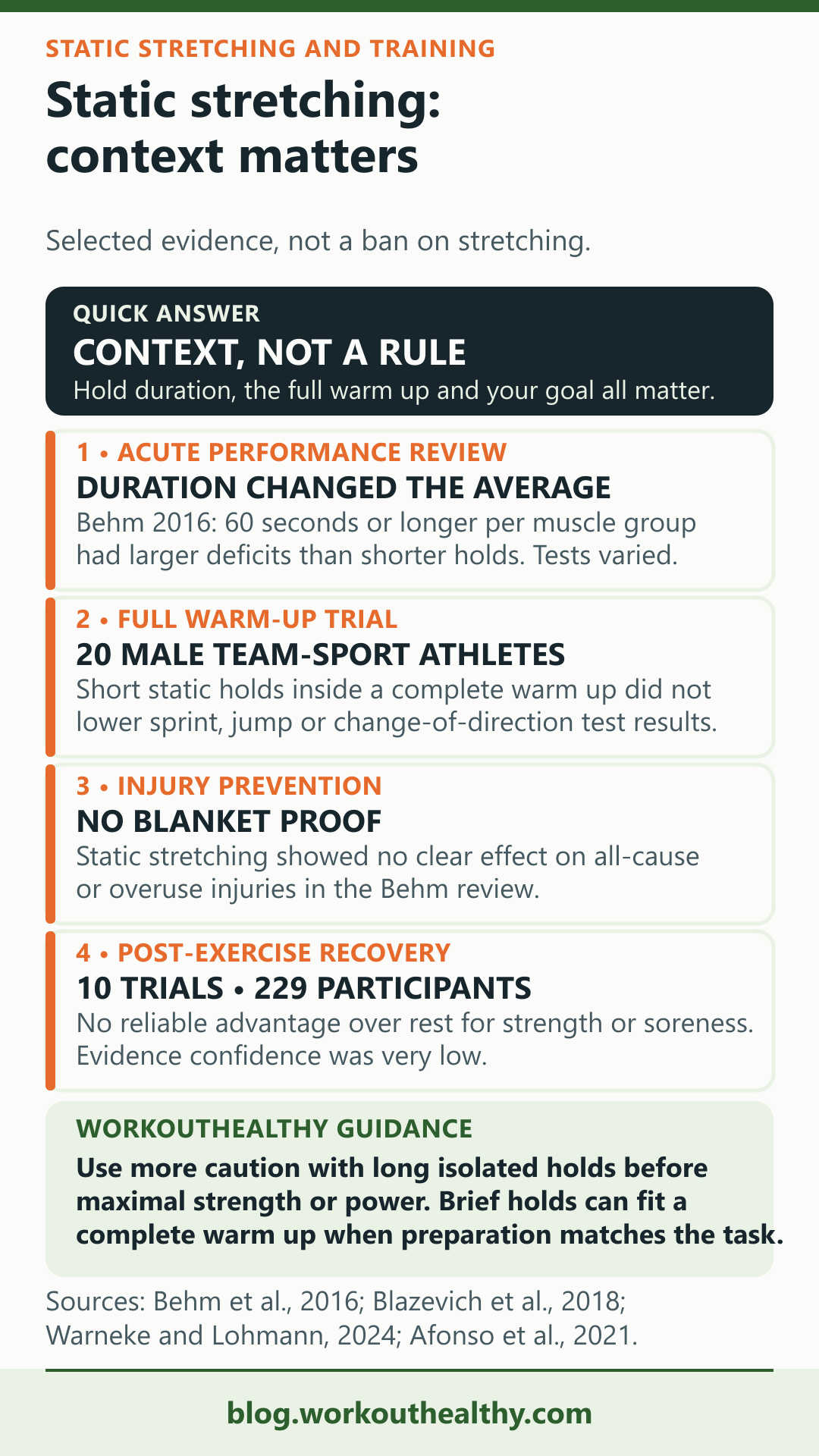
The more consistent concern is prolonged stretching, especially bouts of at least 60 seconds per muscle group immediately before maximal strength testing.
Short holds of 30 seconds or less showed much smaller effects, and in some tests almost none.
A two minute hold just before a heavy effort deserves more caution than a brief hold followed by movement and progressive warm up sets.
Total time also matters, because stretching six muscle groups for a minute each adds up fast.
If you insist on stretching first, keep each hold brief and move on.
3. Static Stretching Alone Is Not a Full Warm Up

A warm up is supposed to raise muscle temperature, get blood moving and wake up the nervous system.
A static hold may increase range of motion, but on its own it does not provide the gradual, task-specific preparation a warm up should include.
Reviewers recommend judging static stretching inside a complete warm up rather than treating it as the entire warm up.
The word warm up is doing a lot of unearned work in the phrase warm up stretch.
You can test this yourself on a cold morning by noticing how cold you still are after five minutes of stretching.
A few minutes on a bike changes that immediately.
4. A Stretch Alone Is Not an Injury-Prevention Plan
Injury prevention is a common reason to stretch, but the effect of a stretch alone is difficult to separate from the rest of a warm up.
Evidence that static stretching alone prevents injury is mixed and depends on the activity. Some reviews suggest brief static holds may have a place in a complete warm up for sports with high muscle strain demands, but they are not a stand alone injury prevention plan.
What does appear to lower injury rates is a structured warm up that includes progressive movement and some strength work.
Do not assume a single stretch is the ingredient responsible for any benefit from a multicomponent program.
Reviewers have pointed out that most stretching and injury studies were small, used different definitions of injury, and often looked at military recruits rather than gym members.
Programs that have actually cut injury rates in sport combine running drills, balance work, jumping and strength exercises.
Because these programs combine several elements, their results cannot isolate the effect of stretching.
Static stretching alone is not a complete warm up. Brief holds can still fit when they are followed by movement and progressive practice of the task ahead.
5. A Dynamic Warm Up Does the Same Job Better
Moving through a range of motion under control raises temperature and prepares the nervous system at the same time.
Leg swings, walking lunges, hip circles, arm circles and progressively heavier warm up sets all do this.
The movements should look like a slower version of what you are about to do, not a separate workout.
Dynamic movement is a practical default for preparing a lifting session, while prolonged isolated static holds can reduce immediate maximal strength. A short hold inside a complete warm up is a different case.
If you want a rule of thumb, move the joint rather than parking it at the end of its range.
Start with several minutes of easy movement, then add task-specific warm up sets. Adjust the length to the session and how prepared you feel.
6. Context Matters More Than the Stretch Itself
This is the nuance that almost never makes it into the argument.
In a 2018 trial, adding short muscle stretching inside a full dynamic warm up produced no meaningful effect on athletic performance at all.
Many earlier protocols tested stretching in isolation, which limits how directly those results apply to a complete warm up.
So a brief stretch tucked into a real warm up is not the problem people think it is.
This is why the honest version of the advice is not never stretch but do not make stretching the whole warm up.
Context changed the answer, which is a good reminder that single study headlines rarely survive contact with the full literature.
7. It Eats the Time Your Warm Up Actually Needs
Most people have a fixed amount of time before they start training.
Ten minutes spent on static holds is ten minutes not spent on light sets of the movement you are about to do.
Warm up sets are the single most specific preparation available, because they rehearse the exact pattern under increasing load.
They also tell you something useful, because a warm up set that feels heavy is information about the day ahead.
A structured plan makes that easy to build in, which is one reason we recommend following a complete training program rather than assembling a session on the spot.
What This Evidence Does Not Prove
It does not prove that static stretching is harmful in general.
The strength effect is acute, but its duration varies with the stretching protocol and what happens afterward.
Most of these studies measured single maximal efforts such as a vertical jump or a one repetition max, not how a full training session goes.
They also used trained and active young adults far more often than beginners, older adults or people rehabbing an injury.
For someone recovering from a shoulder problem, a gentle stretch before training may well be the right call even if it costs a percent of peak force.
And nothing here says flexibility is unimportant, only that the best time to build it is not thirty seconds before a heavy set.
Regular stretching done at other times does improve range of motion over weeks, and that is a real benefit worth having.
A Warm Up That Actually Works
Start with five minutes of easy general movement such as a bike, a brisk walk or a rowing machine.
Follow that with dynamic movements that take the joints you are about to use through their range.
Then do two to four warm up sets of your first exercise, adding load each set and keeping the repetitions low.
If a specific area feels tight, a short hold of twenty to thirty seconds inside that sequence is fine.
If you want longer static stretching for flexibility, after training or a separate session may avoid an immediate pre-lift tradeoff. Do not count on it to prevent soreness or speed recovery: a review of randomized trials found no clear advantage over rest for those outcomes.
If a lift feels limited by range rather than by strength, changing the exercise is often smarter than forcing the range, which is the thinking behind our guide to choosing squat alternatives by goal.
Tracking what you did before each session makes it obvious which routine leaves you feeling ready, which is one of the things worth putting in a training log.
Common Mistakes People Make With This
The biggest one is swinging to the other extreme and skipping the warm up entirely.
The second is treating dynamic warm up as a euphemism for bouncing at the end of a stretch, which is a different and riskier thing.
The third is pushing through a stretch that causes pain or symptoms rather than staying within a tolerable range of motion.
A fourth is doing the same generic warm up before every session regardless of what the session contains.
A fifth is treating an average from maximal-effort tests as a prediction for every set of moderate-load repetitions. Those are different outcomes.
A sixth is treating a cold static stretch as the entire pre-run warm up instead of gradually increasing movement and pace.
Who Should Talk to a Doctor or Physical Therapist First
See a professional before changing your warm up if you have a joint that regularly gives way, locks or swells after training.
The same applies if you have had a recent muscle tear, a joint replacement, a spinal surgery or a diagnosed hypermobility condition.
People with hypermobility often feel tight and stretch more, which can make the underlying problem worse rather than better.
Nerve symptoms such as numbness, tingling or shooting pain during a stretch are a reason to stop and get it looked at.
And if pain is present at rest, that is a medical question rather than a warm up question.
Older adults starting resistance training after a long gap are also worth a checkup, mostly for the training itself rather than the stretching.
None of this is a reason to avoid movement, and in almost every case the answer is a modified warm up rather than no warm up.
Watch the Original Video
Want the rest of the warm up story? Subscribe to WorkoutHealthy Insider for practical explanations behind popular fitness claims.
References
Behm, D. G., Blazevich, A. J., Kay, A. D., & McHugh, M. (2016). Acute effects of muscle stretching on physical performance, range of motion, and injury incidence in healthy active individuals: A systematic review. Applied Physiology, Nutrition, and Metabolism, 41(1), 1 to 11. https://doi.org/10.1139/apnm-2015-0235
Blazevich, A. J., Gill, N. D., Kvorning, T., Kay, A. D., Goh, A. G., Hilton, B., Drinkwater, E. J., & Behm, D. G. (2018). No effect of muscle stretching within a full, dynamic warm-up on athletic performance. Medicine & Science in Sports & Exercise, 50(6), 1258 to 1266. https://doi.org/10.1249/MSS.0000000000001539
Simic, L., Sarabon, N., & Markovic, G. (2013). Does pre-exercise static stretching inhibit maximal muscular performance? A meta-analytical review. Scandinavian Journal of Medicine & Science in Sports, 23(2), 131 to 148. https://doi.org/10.1111/j.1600-0838.2012.01444.x
Warneke, K., & Lohmann, L. H. (2024). Revisiting the stretch-induced force deficit: A systematic review with multilevel meta-analysis of acute effects. Journal of Sport and Health Science, 13(6), 805 to 819. https://doi.org/10.1016/j.jshs.2024.05.002
Afonso, J., et al. (2021). The effectiveness of post-exercise stretching in short-term and delayed recovery of strength, range of motion and delayed onset muscle soreness: A systematic review and meta-analysis of randomized controlled trials. Frontiers in Physiology, 12, 677581. https://doi.org/10.3389/fphys.2021.677581
Medical disclaimer: This article is general health and fitness information, not medical advice. If you have an injury, ongoing pain, a medical condition, or a rehabilitation plan, ask a doctor or physical therapist how to warm up and stretch for your situation.