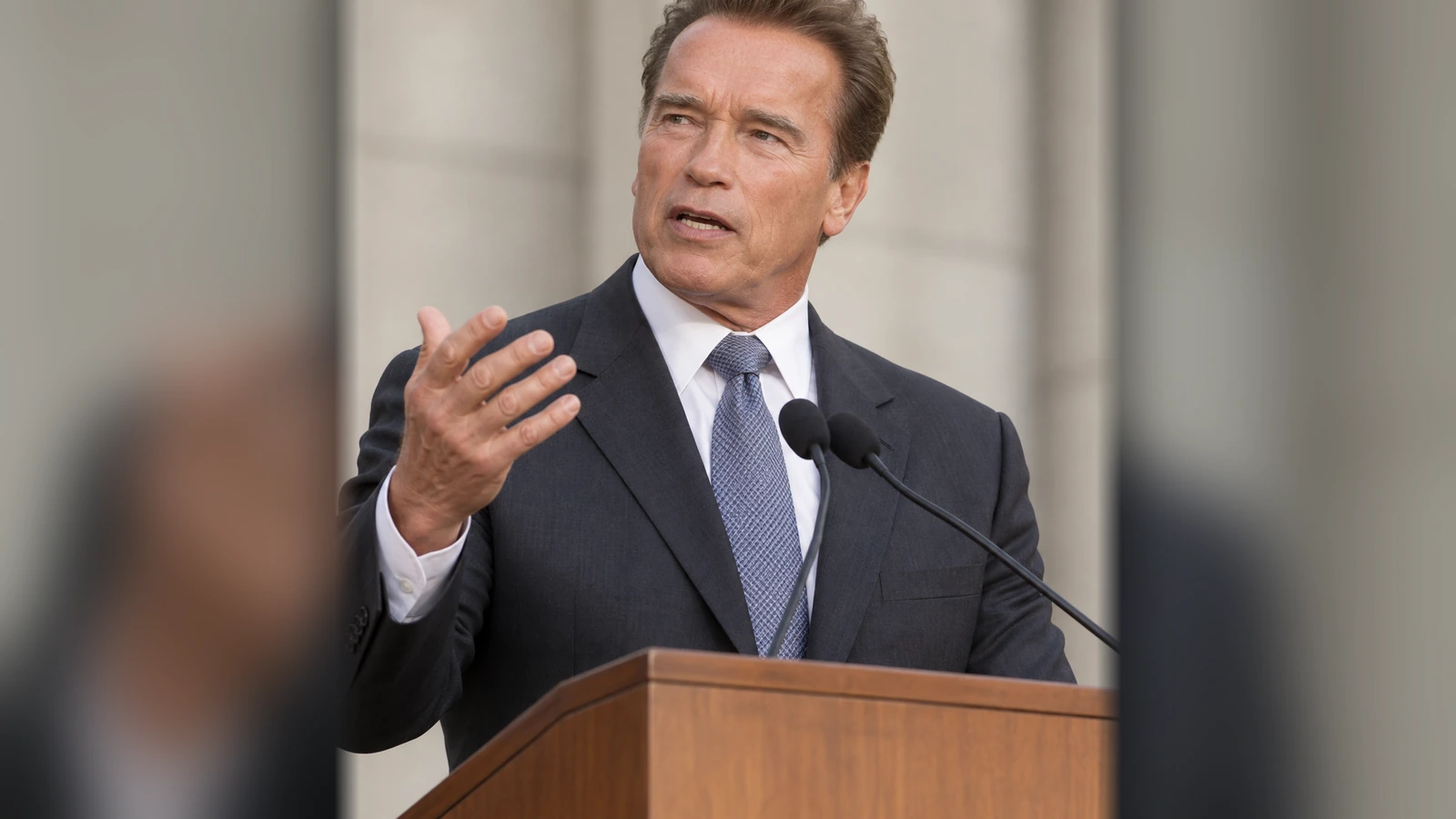

In 2009, Arnold Schwarzenegger gave the commencement speech at the University of Southern California.
He was governor of California at the time, and he used the speech to share six rules he said guided his life.
Clips of that talk are still widely shared online as a motivational speech.
The rules were meant for graduates, but they map neatly onto sticking with a hard training goal.
This article checks what he actually said, what holds up, and where one piece of his advice deserves a caution.
The Six Rules as Arnold Gave Them
Published transcripts of the USC speech list the six rules this way:
- Trust yourself.
- Break the rules.
- Don’t be afraid to fail.
- Don’t listen to the naysayers.
- Work your butt off.
- Give something back.
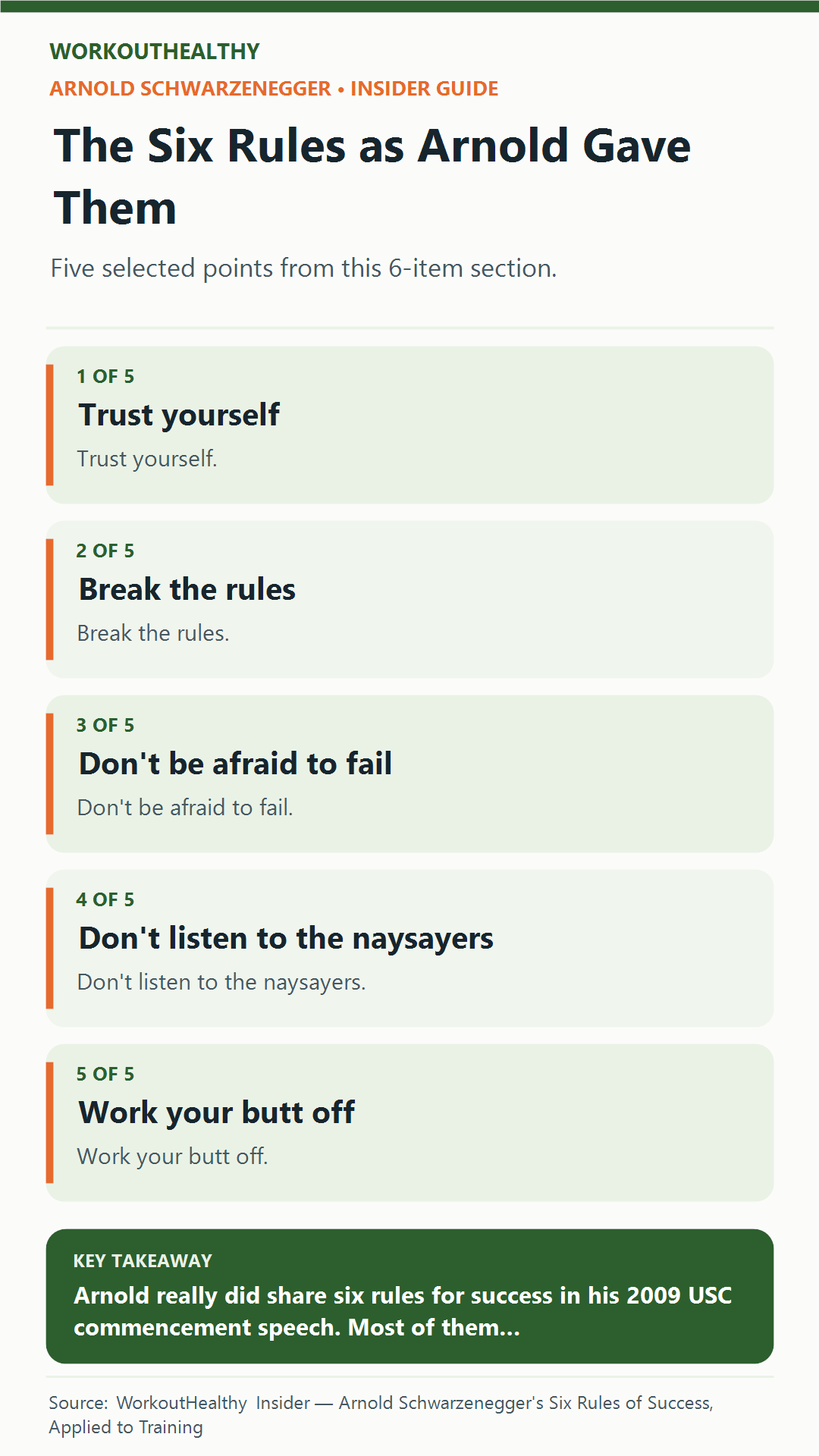
One small correction to the popular social post: the fifth rule is “work your butt off,” not “work like hell.”
The meaning is the same, but it is worth quoting him accurately.
Where the Rules Came From
Arnold built the list from his own path.
He left Austria, won seven Mr. Olympia titles, became a movie star, and was elected governor.
Arnold has often described being doubted along the way, including in Hollywood, which helps explain rule four.
On rule one, he told graduates to “dig deep down and ask yourselves, who do you want to be?”
He added, “Not what, but who.”
On rule four, he urged them to “pay no attention to the people that say it can’t be done.”
“You can’t climb the ladder of success with your hands in your pockets.”
What the Rules Mean for Training
Trust yourself means choosing a goal that fits you, not one borrowed from social media.
Break the rules can mean ignoring outdated gym dogma, as long as you still respect safety.
Don’t be afraid to fail means a missed rep or a bad month is information, not a verdict.
Don’t listen to the naysayers means tuning out people who say you are too old, too busy, or too out of shape.
Work your butt off means steady effort over time, not one heroic week.
Give something back can mean coaching a friend, volunteering, or helping someone else start.
The Rule That Needs a Caution
In the “work your butt off” section, Arnold said: “You sleep six hours and have 18 hours left.”
That line works as a pep talk. As sleep advice, it is shaky for most people.
A 2022 meta analysis by Craven and colleagues pooled 69 studies on sleep loss and physical performance.
On average, performance dropped by about 7.6 percent after acute sleep loss.
Staying up all night and waking up earlier than usual both hurt performance.
The longer people had been awake before exercising, the worse they tended to do.
Strength, power, endurance, and skill tasks were all affected.
So if your goal is to train hard, cutting sleep to find extra hours can backfire.
What Research Says About Giving Back
Arnold’s sixth rule has some interesting support.
A 2013 review by Jenkinson and colleagues looked at the health of volunteers.
In pooled cohort studies, volunteers had about a 22 percent lower risk of death over the follow up period.
Cohort studies also linked volunteering with better mental health and life satisfaction.
The controlled trials in the review did not show consistent health benefits, though.
That means volunteering is linked with better outcomes, but it is not proven to cause them.
Healthier people may simply be more likely to volunteer.
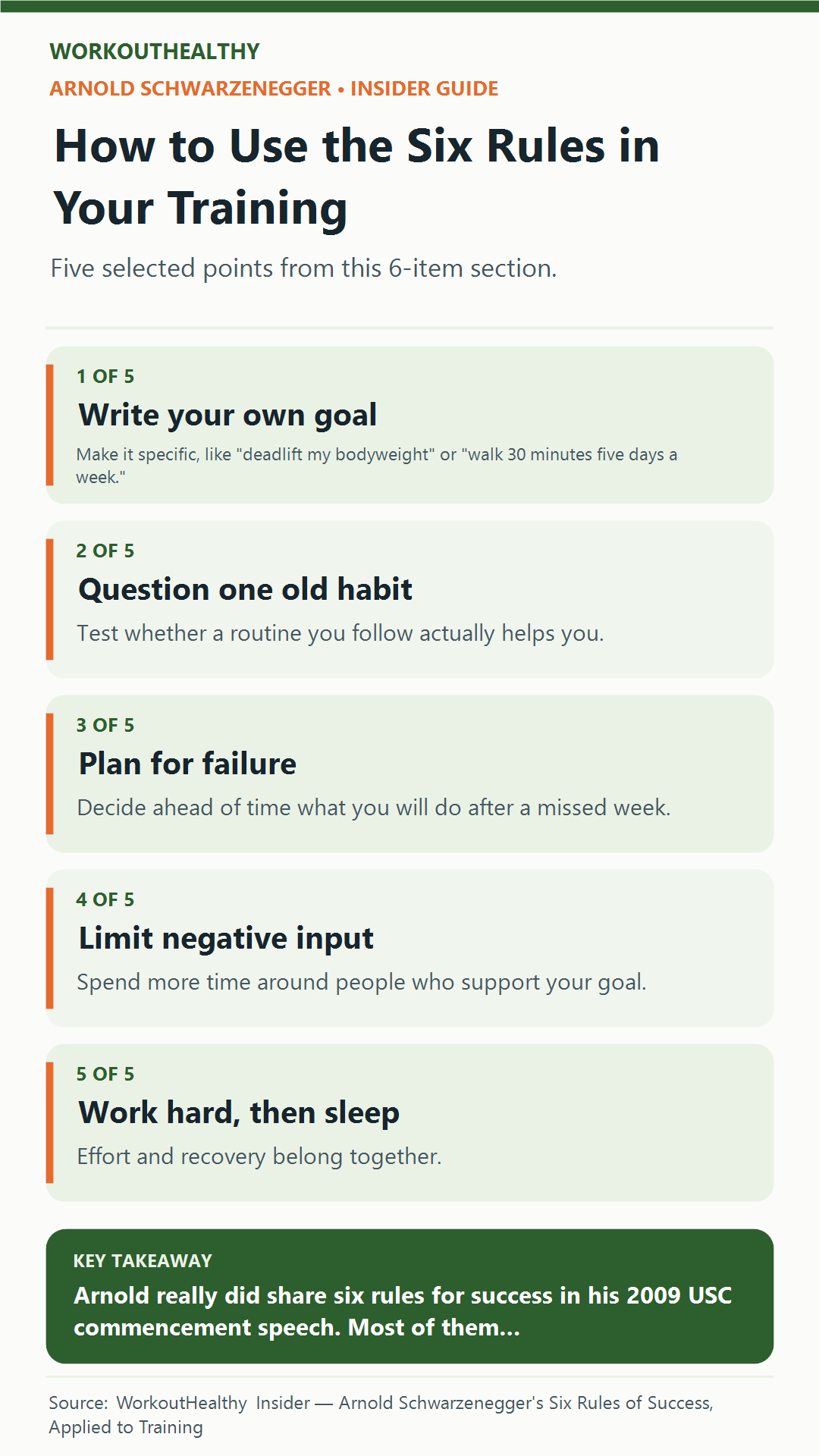
How to Use the Six Rules in Your Training
- Write your own goal. Make it specific, like “deadlift my bodyweight” or “walk 30 minutes five days a week.”
- Question one old habit. Test whether a routine you follow actually helps you.
- Plan for failure. Decide ahead of time what you will do after a missed week.
- Limit negative input. Spend more time around people who support your goal.
- Work hard, then sleep. Effort and recovery belong together.
- Bring someone along. Invite a friend to train, or share what you have learned.
For a different side of Arnold, see our article on how Arnold’s diet has changed over the years.
Goal setting advice from another athlete is covered in our piece on Bo Jackson’s goal setting advice.
If you are starting later in life, our strength plan for your 40s is a practical first step.
Naysayers Versus Good Feedback
Rule four is easy to misuse.
A naysayer tells you a goal is impossible for you. A good coach tells you how to reach it more safely.
Those are very different messages.
If a doctor says to wait on heavy lifting after surgery, that is not negativity.
It is a plan.
If a friend says you are too old to start running, that is the kind of voice Arnold meant.
A simple test helps: does the comment come with a better path, or only a no?
Failure as Part of the Process
Rule three fits training especially well.
Every strength program includes sets you cannot finish and weeks that go badly.
Lifters who treat those moments as data tend to adjust and keep going.
Lifters who treat them as proof they cannot succeed often quit.
Writing down what happened, and one change for next time, turns a failed session into a useful one.
What the Speech Does Not Prove
A commencement speech is inspiration, not a training plan.
Arnold’s results also came with rare genetics, years of full time training, and resources most people do not have.
Ignoring naysayers is useful, but ignoring a doctor or a qualified coach is not.
Anyone with pain, a heart condition, or another health issue should get expert input before pushing hard.
The Bottom Line
Arnold really did share six rules for success in his 2009 USC commencement speech.
Most of them translate well to fitness: trust your goal, accept failure, tune out doubters, and work steadily.
His six hours of sleep line is the one to skip, since research shows sleep loss hurts performance.
And giving back may be good for you too, even if the evidence is still mostly observational.
Want more stories like this? Subscribe to WorkoutHealthy Insider for practical explanations behind popular fitness claims.
References
- Craven, J., McCartney, D., Desbrow, B., Sabapathy, S., Bellinger, P., Roberts, L., & Irwin, C. (2022). Effects of acute sleep loss on physical performance: A systematic and meta-analytical review. Sports Medicine, 52(11), 2669 to 2690. https://doi.org/10.1007/s40279-022-01706-y
- Jenkinson, C. E., Dickens, A. P., Jones, K., Thompson-Coon, J., Taylor, R. S., Rogers, M., Bambra, C. L., Lang, I., & Richards, S. H. (2013). Is volunteering a public health intervention? A systematic review and meta-analysis of the health and survival of volunteers. BMC Public Health, 13, 773. https://doi.org/10.1186/1471-2458-13-773
- Schwarzenegger, A. (2009). Commencement address [Speech]. University of Southern California, Los Angeles, CA.
This article is for general information only and is not medical advice. If you have an injury, ongoing pain, or a medical condition, talk to a doctor or physical therapist before you change how you train or eat.