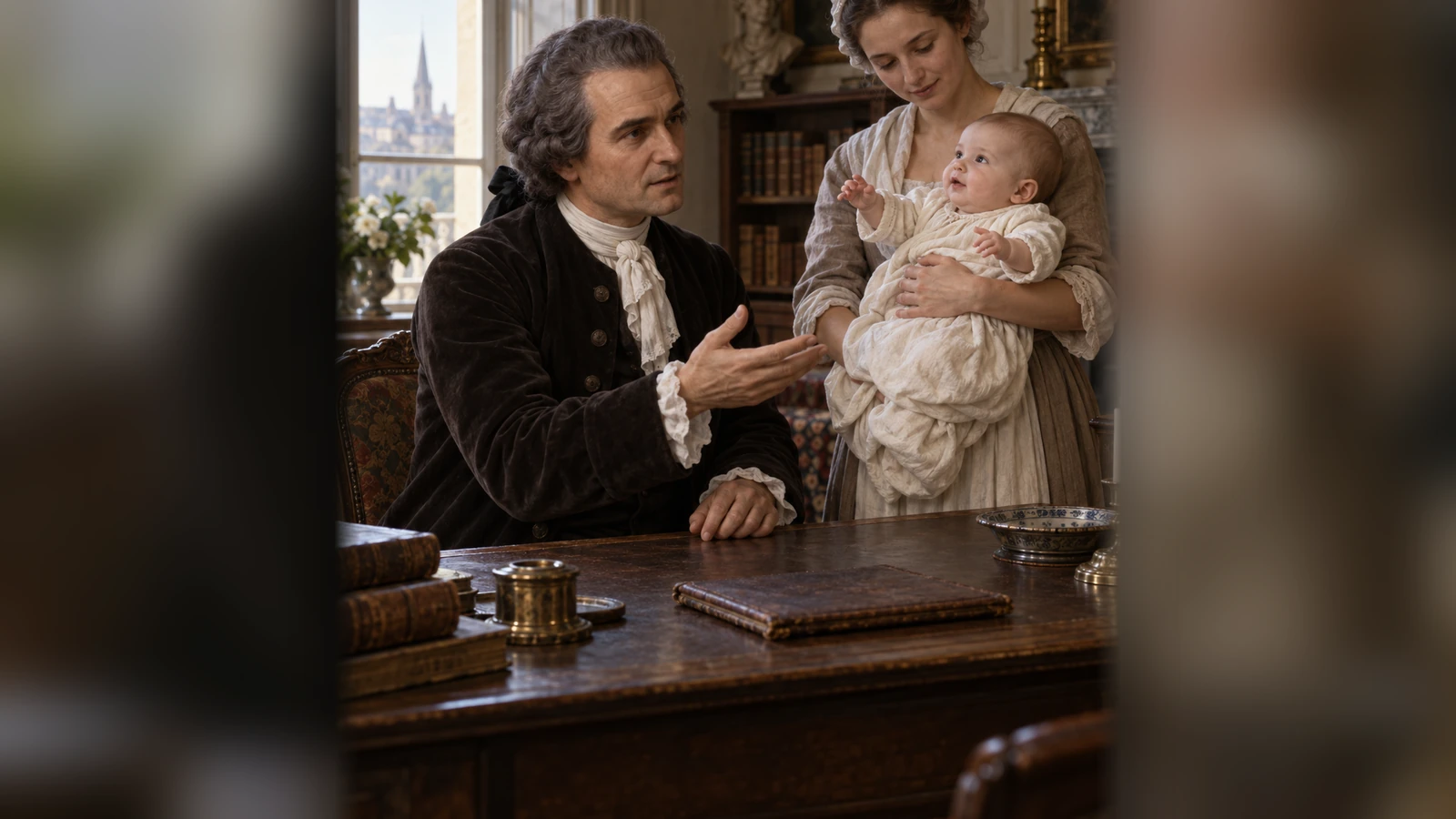

In 1762, a Genevan writer took aim at one of the oldest habits in baby care.
Jean-Jacques Rousseau argued that newborns should not be bound tightly in swaddling bands.
He wanted babies to kick, stretch, and move from their first weeks of life.
A widely shared version of this idea says modern experts fully agree with him.
The real picture is more interesting.
Rousseau was right about movement, but the story of swaddling has changed a lot since his time.
What Rousseau Wrote in Emile
The idea comes from Emile, or On Education, Rousseau’s long book about raising a child.
In the first book, he describes what happened to a newborn in his day.
In the Barbara Foxley translation, he writes that the child “is wrapped in swaddling bands, laid down with its head fixed, its legs stretched out, and its arms by its sides.”
He also says the baby “has hardly begun to move and stretch its limbs, when it is deprived of its freedom.”
So the attribution is solid. This is Rousseau’s own argument, in his own book.
What He Suggested Instead
Rousseau did not just complain. He offered an alternative.
He recommended “loose and flowing flannel wrappers, which leave its limbs free and are not too heavy to check his movements.”
For sleep, he suggested a big, well padded cradle where the baby “can move easily and safely.”
As the child grew stronger, he wanted the baby to crawl about the room and stretch its limbs.
That is close to what many parents now call floor time.
Movement is how a body learns what it can do, and that lesson starts long before the first step.
Where Rousseau Went Too Far
Rousseau also claimed that places where children were swaddled were full of people who were “hump-backed,” “lame,” “bow-legged,” and “rickety.”
That claim does not hold up well.
A 2007 systematic review in Pediatrics by Bregje van Sleuwen and colleagues looked at the research on swaddling.
It found that swaddling does not influence rickets onset or bone properties.
In other words, the research does not support the idea that wrapping a baby causes rickets.
So his broad claim about deformity mixed a real concern with a lot of guesswork.
What Modern Research Says About Swaddling
Here is the twist. Swaddling never went away, and in some countries it has grown more popular.
The same review found that swaddled infants, in general, arouse less and sleep longer.
It also reported benefits for preterm infants, including better motor organization.
But the review flagged real risks too.
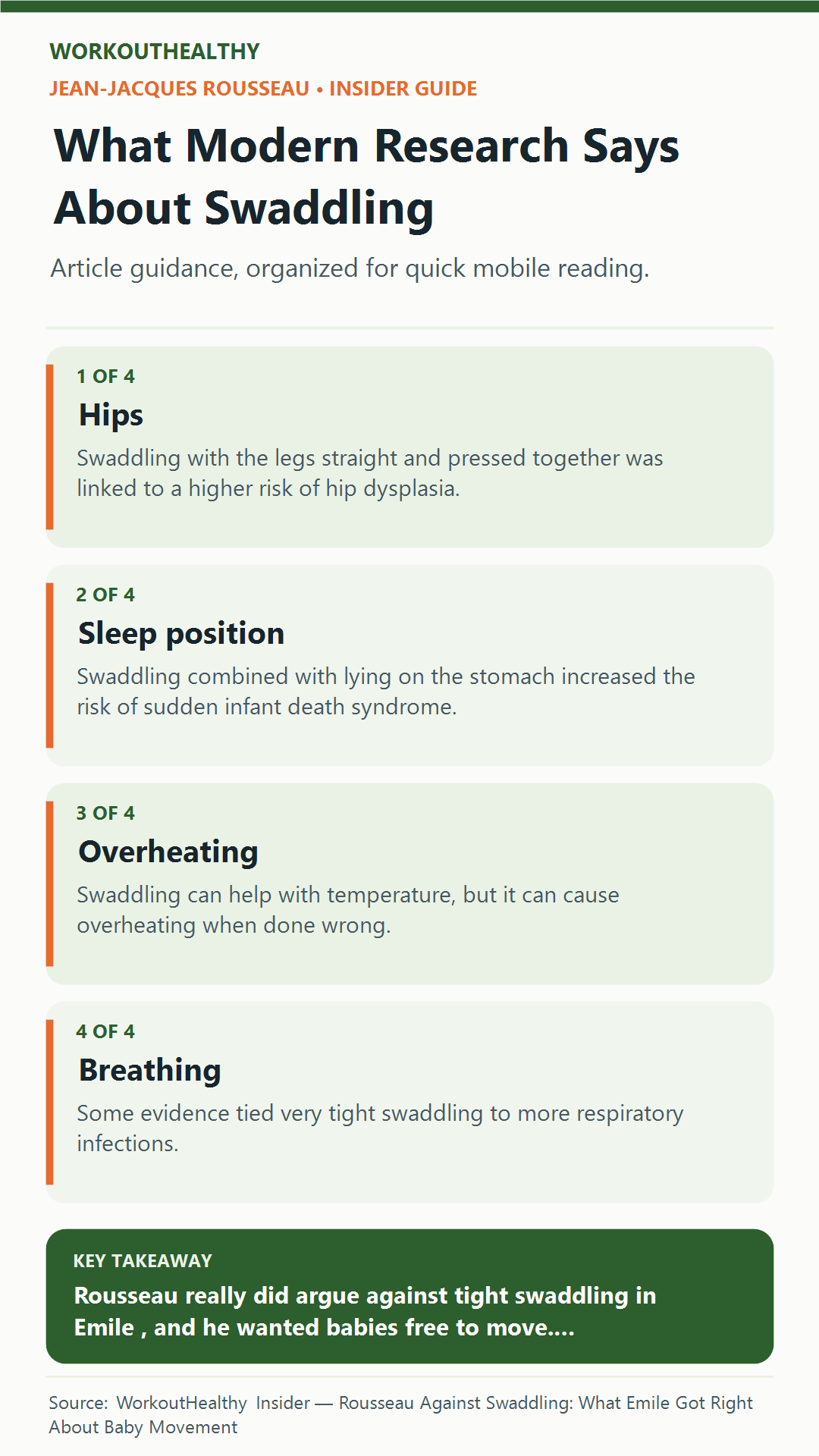
- Hips. Swaddling with the legs straight and pressed together was linked to a higher risk of hip dysplasia.
- Sleep position. Swaddling combined with lying on the stomach increased the risk of sudden infant death syndrome.
- Overheating. Swaddling can help with temperature, but it can cause overheating when done wrong.
- Breathing. Some evidence tied very tight swaddling to more respiratory infections.
The authors said parents should stop swaddling if infants attempt to turn.
Notice how the hip finding echoes Rousseau. The danger comes from legs that are held straight and still.
What Research Says About Free Movement
The modern version of Rousseau’s crawling advice is tummy time.
That means awake, supervised time lying on the stomach.
A 2020 systematic review by Hewitt and colleagues pulled together 16 studies with 4,237 participants.
It found tummy time was positively linked with gross motor development and total development.
It was also linked with a lower BMI z score and with preventing brachycephaly, a flattening of the back of the head.
Results were unclear for some areas, such as thinking skills, social skills, and walking.
That is a fair summary of where the science sits. Active floor time helps, but it is not a cure for everything.
What This Does Not Prove
- It does not prove swaddling is harmful. Done carefully and for young babies, it can have benefits.
- It does not prove Rousseau understood the science. His conclusion was partly right for reasons he could not have tested.
- It does not set a strict schedule. The research links tummy time to better outcomes but does not settle one perfect dose.
How Parents Can Apply the Idea Today
The spirit of Rousseau’s advice still works if you pair it with modern safety guidance.
- Give daily floor time. Short, supervised tummy time sessions while the baby is awake are a simple start.
- Leave room for the hips. If you swaddle, make sure the legs can bend up and out rather than being held straight.
- Stop when rolling starts. Once a baby tries to turn over, it is time to stop swaddling.
- Keep sleep safe. Place babies on their backs to sleep, whether or not they are swaddled.
- Watch the temperature. Avoid heavy layers that could make a baby too hot.
- Let crawling happen. A safe, open floor space invites the stretching and exploring Rousseau described.
Free movement matters at every age.
Adults can borrow the same idea with three simple positions that undo a day of sitting.
Many toddlers sit in a deep squat with ease, and our look at the deep resting squat explains what that position can and cannot do for grown ups.
Who Should Be Careful
Parents of premature babies should follow the advice of their care team.
Babies with known hip problems, or a family history of hip dysplasia, need guidance from a pediatrician.
Any baby who struggles with tummy time, or seems unusually stiff or floppy, should be checked by a doctor.
This article is not a guide to infant sleep, so talk with your pediatrician about safe sleep practices.
The Bottom Line
Rousseau really did argue against tight swaddling in Emile, and he wanted babies free to move.
His warning about widespread deformity went beyond the evidence.
Modern research shows swaddling has both benefits and risks, especially for the hips and sleep safety.
His core idea still stands: babies need daily chances to move, stretch, and explore.
Want more stories like this? Subscribe to WorkoutHealthy Insider for practical explanations behind popular fitness claims.
References
- Hewitt, L., Kerr, E., Stanley, R. M., & Okely, A. D. (2020). Tummy time and infant health outcomes: A systematic review. Pediatrics, 145(6), e20192168. https://doi.org/10.1542/peds.2019-2168
- Rousseau, J.-J. (1762). Emile, or education (B. Foxley, Trans.). Project Gutenberg. https://www.gutenberg.org/files/5427/5427-h/5427-h.htm
- van Sleuwen, B. E., Engelberts, A. C., Boere-Boonekamp, M. M., Kuis, W., Schulpen, T. W. J., & L’Hoir, M. P. (2007). Swaddling: A systematic review. Pediatrics, 120(4), e1097 to e1106. https://doi.org/10.1542/peds.2006-2083
This article is for general information only and is not medical advice. If you have an injury, ongoing pain, or a medical condition, talk to a doctor or physical therapist before you change how you train or eat.