
How often should you train each muscle group? There is no single required frequency for muscle growth when weekly work is the same. Training a muscle more often can help you distribute sets across shorter sessions, but frequency alone did not produce a meaningful average hypertrophy advantage in the 2019 matched-volume review.
A practical choice is to start with a schedule you can perform and recover from, then adjust how weekly work is distributed. The example below explains one, two and three sessions without turning any of them into a universal prescription.
The same weekly sets on three schedules
Imagine nine hard sets for one chosen muscle group over a week. Nine is only an arithmetic example, not a target or evidence-based optimum for every reader.
| Sessions for that muscle | One way to distribute nine sets | Practical tradeoff |
|---|---|---|
| One | 9 sets in one session | Fewer training days for that muscle, but a longer block of work at once. |
| Two | 4 sets in one session, 5 in another | Shorter blocks with space to practice the movement again. |
| Three | 3 sets in each session | Smaller blocks that require more frequent scheduling. |
All three rows total nine sets; the table changes their placement, not their number. It does not prove that every set is equally effective regardless of exercise, effort, rest or recovery.
If the one-day block is too long for your time or technique, spreading work may be useful. If more sessions create a scheduling burden, a simpler week can be easier to sustain.
What frequency studies actually found
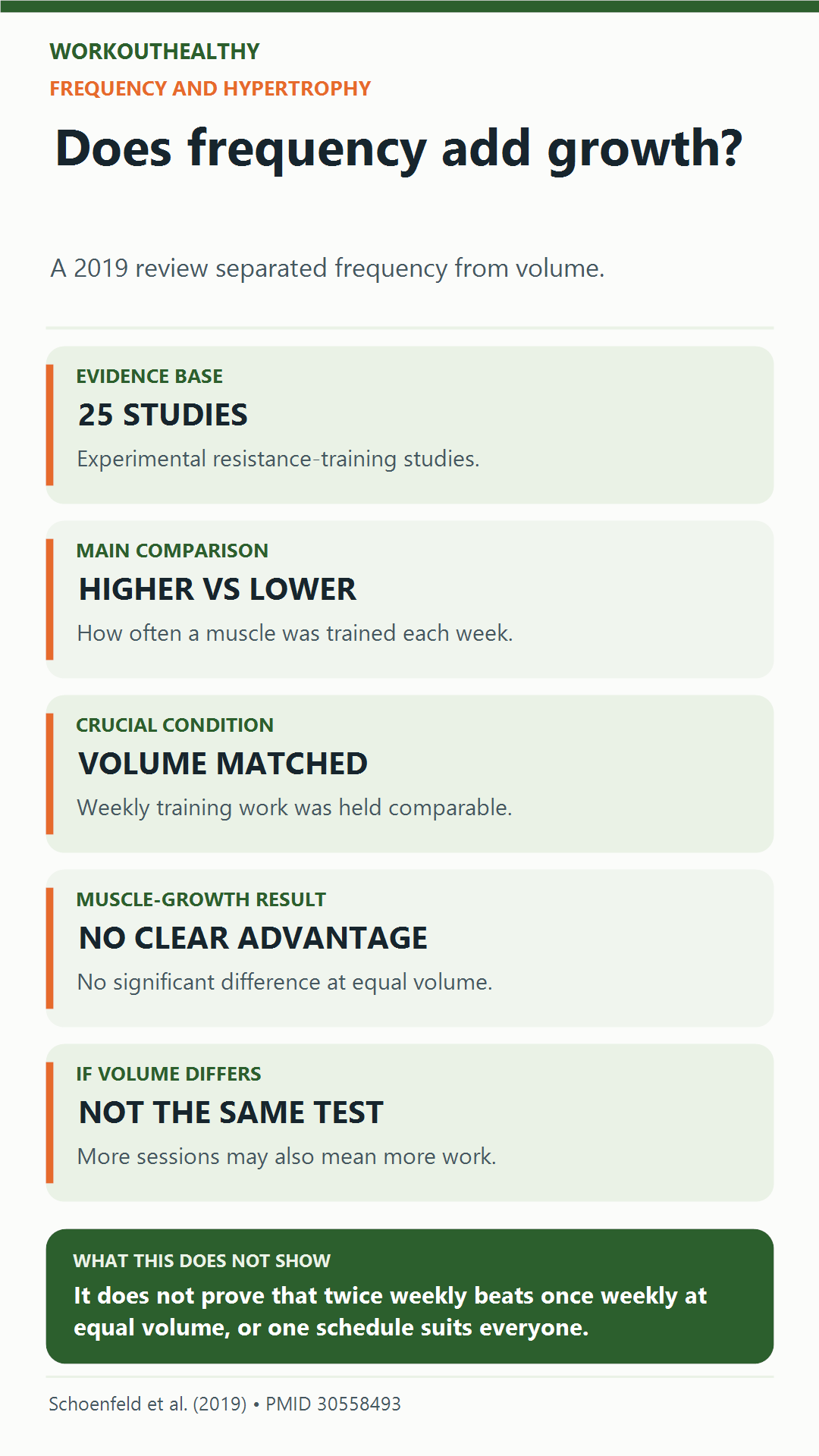
An older 2016 meta-analysis suggested that twice-weekly muscle training produced more growth than once weekly in its volume-equated comparisons. The later 2019 review of 25 studies found no significant or meaningful frequency effect when weekly volume was equated, while higher frequency looked modestly better in comparisons that did not match volume.
That distinction resolves a common source of conflicting advice: adding days sometimes also adds sets. The 2019 result does not prove that training each muscle once weekly is ideal for everyone; it shows that the number of days alone was not a reliable independent growth lever in those studies.
For strength in a particular lift, practice frequency may raise a different question about skill and technique. This article’s direct evidence comparison is muscle hypertrophy, so it should not be treated as a complete strength-sport prescription.
Volume, load and recovery still matter
Weekly volume is often summarized as hard sets per muscle, although compound exercises and effort make personal counting less exact. The 2017 volume meta-analysis found an overall association between more weekly sets and greater hypertrophy, but its three set-count categories showed only a trend (P = .074), not a precise dose ladder.
A separate eight-week trial in 34 trained men found that more sets increased some measures of muscle size more than fewer sets, while strength differences were less clear. Neither source defines one ideal weekly set total for a reader; our guide to sets per muscle group per week examines that separate question in more detail.
Training load and set effort are different from frequency. A low- versus high-load review found similar average hypertrophy across loads under its studied conditions, with heavier loads favoring strength tests; it does not mean any light, easy set counts as equal work.

A small schedule worksheet
- Choose the muscle group and the exercises you want to repeat.
- Record the weekly sets you actually perform, along with repetitions, load and how controlled the later repetitions feel.
- Try placing that same planned work on one, two or three sessions, using the table only as an example of the math.
- Compare session length, technique, recovery and consistency before you add more total work.
If one session regularly becomes rushed or your later sets lose control, distribute the work differently or reduce it. If three visits are hard to keep, a schedule with fewer sessions can be more useful than a theoretically perfect calendar you cannot follow.
How the original video fits
The Hypertrophy Academy video discusses volume, intensity, frequency and warning signs during an energy deficit. Its “seesaw” is a useful reminder that time and recovery are finite, but a specific two-day requirement does not follow from the matched-volume hypertrophy review.
Energy availability is a separate consideration: a 2022 meta-analysis found that energy deficits impaired average lean-mass gains during resistance training more clearly than strength gains. It did not identify a personal calorie target, and individual nutrition decisions belong with a qualified dietitian when needed.
Watch the source video
Sources
- Schoenfeld, Grgic and Krieger (2019), frequency and hypertrophy meta-analysis.
- Schoenfeld, Ogborn and Krieger (2016), earlier frequency meta-analysis.
- Schoenfeld, Ogborn and Krieger (2017), weekly volume meta-analysis.
- Schoenfeld et al. (2019), volume trial in trained men.
- Schoenfeld et al. (2017), low- and high-load training meta-analysis.
- Murphy and Koehler (2022), energy-deficit and resistance-training meta-analysis.
This article is for general fitness information, not medical or individualized nutrition advice. If you have an injury, ongoing pain or a medical condition, ask a qualified professional before changing your training.