
How many sets per muscle group per week should you do? Count the challenging working sets that train each muscle across the whole week, then use that total to plan and adjust your training.
Around 10 weekly sets per muscle is a research-based reference when emphasizing muscle growth in healthy adults, not a minimum required to benefit or a guarantee of more growth.
If you are new to strength training, a smaller consistent schedule can be a sensible place to start. This guide shows how to count direct and overlapping work, then walks through two filled weekly set ledgers that you can adapt with a qualified coach.
What counts as a weekly set?
A working set is a set in which the exercise is challenging enough to be useful for your training goal. Do not count easy warmups, stretching or every casual repetition as equal to a hard working set.
For each muscle, add the working sets from all sessions in the week. If you train chest with two sets of pressing on Monday and two on Thursday, that is four direct chest sets that week.
| Term | Example | How to record it |
|---|---|---|
| Direct set | A bench or floor press for chest; a curl for biceps | Record one set for the main muscle you intend to train. |
| Indirect or overlapping set | Triceps assist a press; biceps assist a row | Record the overlap separately instead of silently treating it as a full isolation set. |
| Warmup | An easy first set before your working weight | Log it if helpful, but keep it out of the challenging-set total. |
Compound exercises make set counting less exact than simple arithmetic suggests. A recent meta-regression compared research models that treated indirect sets as one, half or zero; the half-set model fit that pool best, but it does not mean every row gives every biceps muscle exactly half a useful set.
The simplest personal ledger lists direct sets and notes the overlapping exercises beside them. Use any half-set estimate as a rough planning aid, not as a biological measurement.
What does the research say about a weekly target?
The American College of Sports Medicine’s 2026 position stand suggests about 10 sets per muscle group each week when the goal is to emphasize hypertrophy. It also stresses that training should fit the person’s goals, enjoyment and ability to keep participating.
A 2017 meta-analysis associated more weekly sets with greater average muscle growth. Its comparison of under five, five to nine and at least 10 sets showed a statistical trend rather than a conclusive three-step dose ladder, so those buckets are not personal thresholds.
A newer meta-regression of 67 studies also found average gains with more volume, alongside diminishing returns. The participants were mostly young adults and mostly men, so the pooled pattern cannot specify your exact best number of sets.
For general health, showing up regularly matters more than reaching a hypertrophy target. If a schedule leaves you unusually sore, degrades technique or crowds out recovery, adding sets just to hit a number is unlikely to be a useful next step.
Two-day example: a small full-body starting ledger
This is an editorial example, not a tested program. It shows how Monday and Thursday sessions translate into a weekly count while leaving room to practice form and see how you recover.
| Exercise | Monday | Thursday | Weekly sets | Main muscle recorded |
|---|---|---|---|---|
| Squat variation | 2 | 2 | 4 | Quads |
| Romanian deadlift variation | 2 | 2 | 4 | Hamstrings |
| Bench or floor press | 2 | 2 | 4 | Chest |
| Row variation | 2 | 2 | 4 | Upper back |
| Overhead press | 1 | 1 | 2 | Shoulders |
| Calf raise | 2 | 2 | 4 | Calves |
| Curl | 1 | 1 | 2 | Biceps |
The direct-set ledger is quads 4, hamstrings 4, chest 4, upper back 4, shoulders 2, calves 4 and biceps 2. Also note four weekly row sets that involve the biceps, plus four press sets and two overhead-press sets that involve the triceps.
That overlap is why a direct biceps total of two does not mean the arms did only two useful sets of work. The program also gives the triceps no dedicated isolation sets, which may be fine for a general starter but worth noticing if arm growth is a specific goal.
Four-day example: where the weekly total changes
This example has an upper session on Monday and Thursday and a lower session on Tuesday and Friday. It is a larger training commitment, so it is an option to assess against time, skill and recovery rather than a required next level.
| Exercise | Sets per relevant session | Sessions per week | Weekly direct sets |
|---|---|---|---|
| Bench or floor press, chest | 3 | 2 upper days | 6 |
| Row, upper back | 3 | 2 upper days | 6 |
| Overhead press, shoulders | 2 | 2 upper days | 4 |
| Curl, biceps | 2 | 2 upper days | 4 |
| Triceps extension, triceps | 2 | 2 upper days | 4 |
| Squat variation, quads | 3 | 2 lower days | 6 |
| Romanian deadlift variation, hamstrings | 3 | 2 lower days | 6 |
| Calf raise, calves | 2 | 2 lower days | 4 |
Chest, upper back, quads and hamstrings each have six direct sets in this example. The arm ledger separately shows four direct biceps sets plus six overlapping row sets, and four direct triceps sets plus six overlapping chest presses and four overhead presses.
Do not add all those arm overlaps as if they were identical to curls or extensions. If a specific muscle needs more attention after a period of consistent training, adding one set to each of its two weekly sessions changes its direct total by two, which is a manageable change to track.
How to decide whether to add, hold or reduce sets
- Write down what you already do. Record the exercise, challenging sets, repetitions, load and which muscle you are counting as the main target for four weeks.
- Keep the week repeatable. If missed sessions are common, make the schedule easier to maintain before increasing the number of sets.
- Check technique and recovery. If form deteriorates, pain develops or fatigue persists, pause the planned increase and get qualified help when appropriate.
- Change one variable at a time. If a muscle is a priority and progress has stalled despite consistent practice and recovery, add a small amount of direct work and observe the response.
Progressive overload does not require increasing weight every workout. Better control, another repetition at the same load or a small sustainable set increase may also show progress over time.
If your pressing options are limited, our floor press versus bench press guide can help you select the version that fits your setup. The set ledger still works the same way once you choose a movement.

What about load, strength and the video’s other claims?
Andy Galpin’s video also discusses progressive overload, strength and long-term health. Those are useful contexts, but the number of sets per muscle group each week answers a narrower programming question.
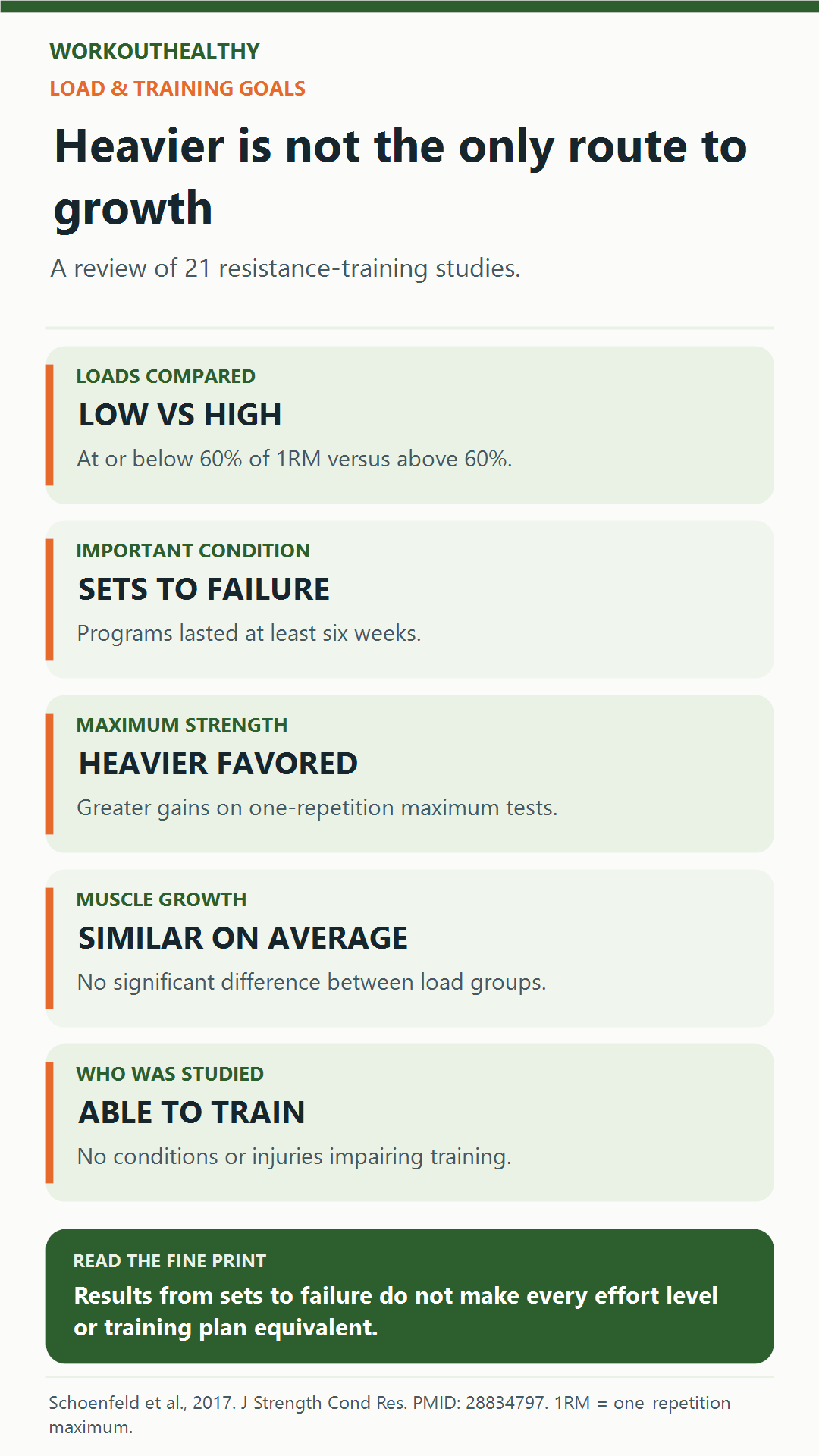
Heavier loads generally have an advantage for improving a heavy one-repetition maximum, while lighter and heavier loads can both support muscle growth when training is sufficiently challenging. The existing study graphic below summarizes that load comparison; it is not a chart of the ideal weekly set count.
Research on resistance training and lower mortality is largely observational, so it cannot establish that a specific number of weekly sets extends an individual’s life. The 30 to 60 minutes per week discussed in one review is an observed association range, not a minimum training dose or a personal longevity prescription.
Weekly sets also do not determine fat loss by themselves. Food intake, activity and other circumstances affect body weight, so the ledger should be used to plan strength training rather than promise a body-composition result.
Watch the original video
When to get individual guidance
Stop an exercise that causes new or worsening pain, and ask a qualified clinician about training if you have a medical condition or symptoms that affect exercise safety. A qualified strength professional can also help with technique, workload and a plan tailored to your history.
This article is general fitness information, not medical advice or a personal training prescription.
References
- American College of Sports Medicine. 2026 resistance-training position-stand summary.
- Pelland et al. Weekly volume, frequency and direct versus indirect set meta-regressions. Sports Medicine, 2026.
- Schoenfeld, Ogborn and Krieger. Weekly training volume and muscle growth meta-analysis. Journal of Sports Sciences, 2017.
- Schoenfeld et al. Low-load versus high-load resistance training systematic review. Journal of Strength and Conditioning Research, 2017.
- Momma et al. Muscle-strengthening activity and mortality risk systematic review. British Journal of Sports Medicine, 2022.