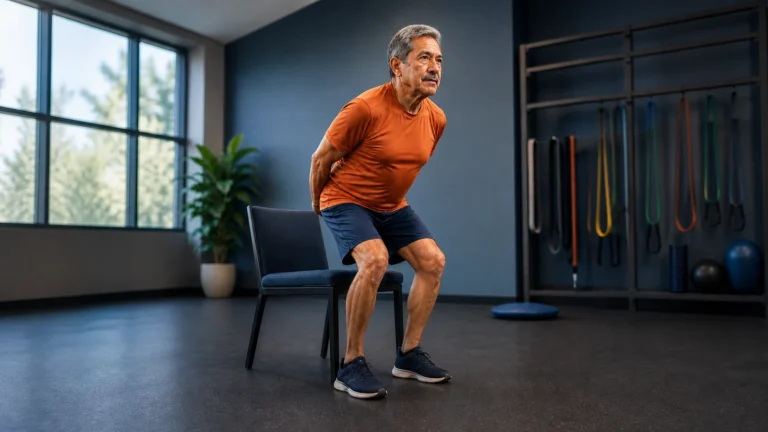

A video from the HuMed channel makes a simple claim.
Strength training is not optional as you age.
The video features Dr. Heather Hinshelwood in conversation with host David Spiro, MD.
Together they frame lifting weights as a tool for healthy aging and metabolic health.
Exercise science offers a way to test that claim.
Here is what the actual peer reviewed research says about it.
What the Video Claims
The video’s title states that strength training is essential for healthy aging and metabolic health.
Dr. Heather Hinshelwood is presented as the expert voice in the discussion.
Public medical licensing records confirm she is a real, actively licensed physician holding an MD.
Her board certified specialty on file is emergency medicine, not geriatrics or endocrinology.
The accompanying Facebook creative describes a move from emergency medicine to prevention. We could verify the emergency-medicine credential, but not that specific career transition, so this article does not treat the transition as an established biographical fact.
That does not make her observations about strength training wrong.
It does mean her on camera comments are a framing, not a peer reviewed citation.
This article treats the video’s claims that way, as a starting point rather than proof.
Below is what independently verified research actually shows about the same topic.
What Real Research Shows About Strength Training and Muscle Loss
Muscle loss with age has a name: sarcopenia.
A large group of aging researchers formally defined it in a 2019 consensus paper (Cruz-Jentoft et al., 2019).
They describe sarcopenia as a progressive loss of muscle strength, muscle mass, and physical performance.
It is not just cosmetic.
The consensus links sarcopenia to falls, disability, and loss of independence in daily tasks.
Our deeper look at why people lose weight and muscle mass together covers how this process actually shows up day to day.
One of the strongest tests of reversing sarcopenia came from a 1994 trial in frail nursing home residents (Fiatarone et al., 1994).
Researchers put frail elderly adults, some in their nineties, through 10 weeks of high intensity resistance training.
Average muscle strength rose by 113 percent.
Walking speed and stair climbing power improved as well.
This was not a young, healthy sample chasing bigger arms.
These were nursing home residents, some using walkers before the study began.
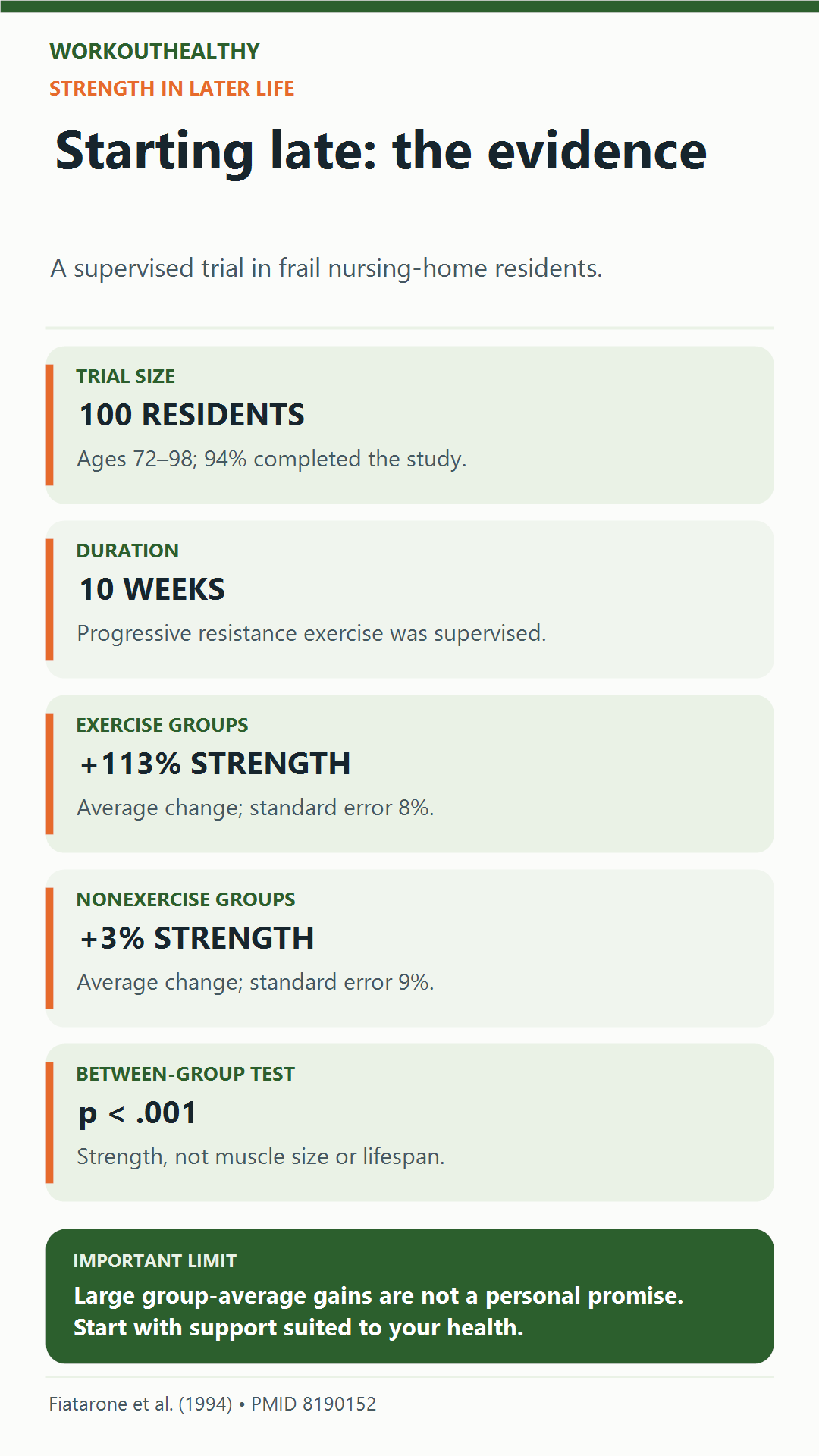
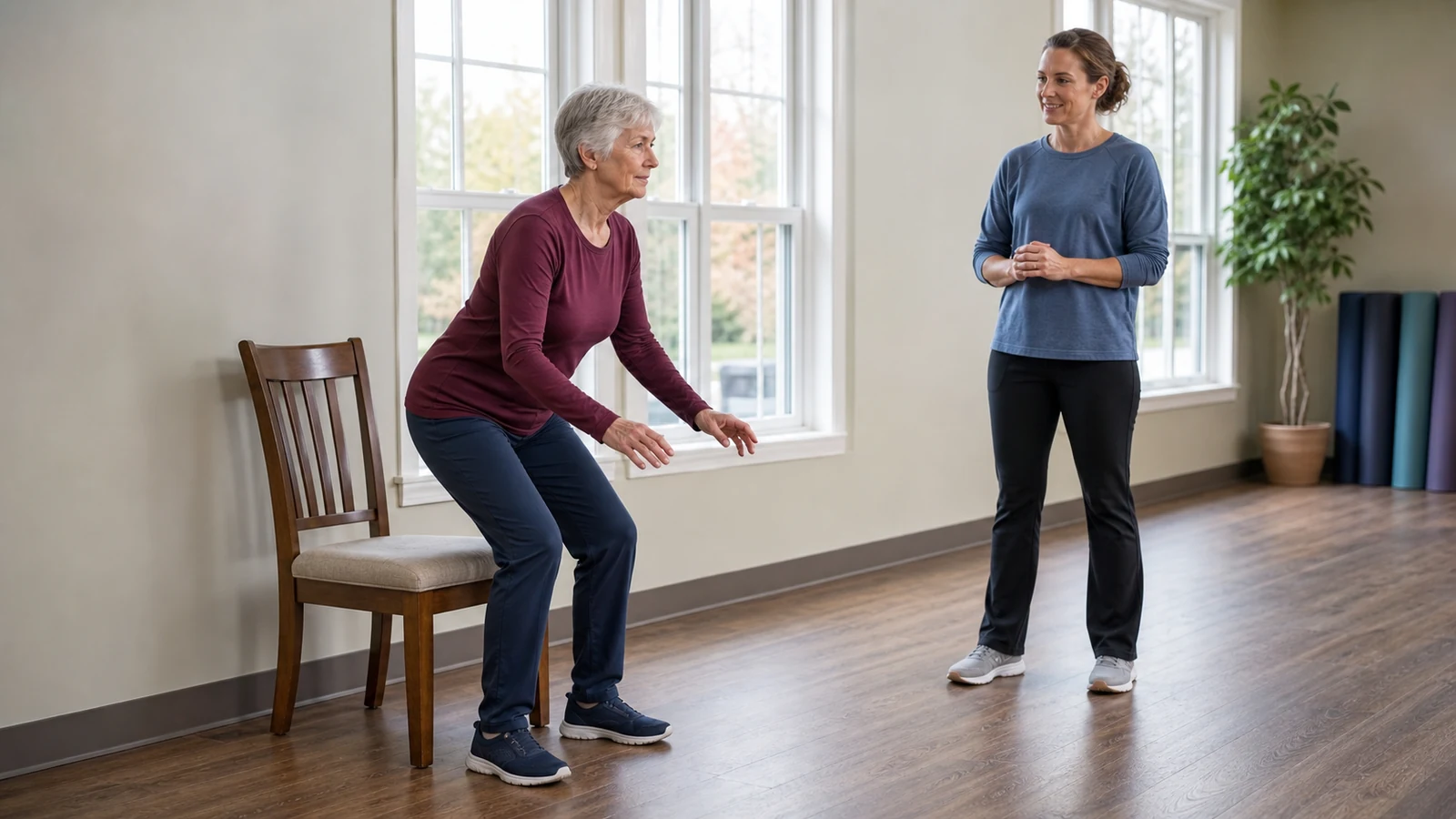
Even frail adults in their eighties and nineties responded to a structured strength program with real gains in strength and walking speed.
That single trial is not an outlier.
A meta-analysis pooling many resistance training trials in older adults reached a similar conclusion (Peterson et al., 2010).
Across that pooled data, structured resistance training produced consistent, meaningful strength gains in adults over 50.
The effect held across men and women and across a wide range of starting fitness levels.
Strength training clearly works against age related muscle loss, and it works across many different studies, not just one.
The next question is whether that same muscle mass changes how the body handles blood sugar.
What Real Research Shows About Strength Training and Metabolic Health
One review pulled together decades of resistance training research across many health markers (Westcott, 2012).
It found consistent improvements in body composition, blood pressure, and blood lipid levels, not just muscle size.
Muscle tissue is not just for moving.
It is also one of the largest storage sites for blood sugar in the entire body.
Researchers analyzed a large national health survey and compared muscle mass with insulin resistance (Srikanthan and Karlamangla, 2011).
People with more relative muscle mass had lower insulin resistance.
They were also less likely to have prediabetes.
This pattern held even after the researchers adjusted for body fat.
The association with relative muscle mass persisted after statistical adjustment for body fat, but this survey could not establish cause and effect.
A second study looked at how muscle and fat mass relate to survival, not just blood sugar (Srikanthan, Horwich, and Tseng, 2016).
Researchers tracked cardiovascular deaths across a large sample using body composition data.
Higher muscle mass was linked to a lower risk of cardiovascular death.
Higher fat mass moved the risk in the opposite direction.
Neither study proves that lifting weights alone caused the difference.
Both studies are observational, not controlled experiments.
But together they add real weight to the idea that muscle is a working metabolic tissue, not just a cosmetic one.
The Mechanism
Why would muscle mass affect blood sugar and long term health at all?
Skeletal muscle is the largest site in the body for clearing glucose after a meal.
More working muscle means more places for the body to store incoming sugar safely.
Resistance training also raises resting metabolic rate, the calories your body burns at rest.
Researchers measured this directly in older adults after 12 weeks of resistance training (Campbell et al., 1994).
Participants gained lean muscle mass and their resting metabolic rate rose along with it.
Their daily energy needs increased even though they were not more active outside the gym.
That measured change in resting metabolic rate does not by itself prove protection against long-term fat gain; eating patterns and total activity still matter.
Resistance training also changes things inside the muscle cell itself.
Repeated loading increases how well muscle fibers respond to insulin.
That makes each pound of muscle better at pulling sugar out of the bloodstream.
More muscle and better functioning muscle both point in the same direction.
How Much Strength Training Is Enough
Global health authorities have already weighed in on dosing.
The World Health Organization’s 2020 physical activity guidelines recommend muscle strengthening activity on two or more days a week (Bull et al., 2020).
Those guidelines call for training that works all the major muscle groups, not just one favorite lift.
They apply this recommendation to adults of every age, including older adults with existing health conditions.
Two sessions a week is a floor, not a ceiling.
It is also a realistic starting point for someone who has never lifted anything heavier than groceries.
The guidelines do not require a gym, a coach, or expensive equipment to count.
Bodyweight movements and resistance bands satisfy the same recommendation as barbells do.
What matters more than the tool is whether the major muscle groups get real, progressive work over time.
How lifting, cardio, and Pilates can fit together
The Facebook post mentions combining weightlifting, cardio, and Pilates. The evidence in this article directly supports progressive resistance training; it does not test one exact three-part program.
Cardio and lifting address different goals. The WHO physical-activity guidelines recommend 150 to 300 minutes of moderate aerobic activity each week, plus strengthening of major muscle groups on at least two days. Walking or cycling can supply aerobic work; appropriately scaled lifting can supply strength work. Our guide to power walking as cardio explains how pace changes that aerobic side.
Pilates may add controlled movement, trunk strength, and balance practice, depending on the class and person. It should not automatically be counted as a replacement for all aerobic activity or progressive resistance training. Someone starting later in life can choose a mix they enjoy, progress slowly, and adapt movements for pain or balance needs.
For a closer look at that optional piece, see what Pilates research in older adults found. For a practical strength example, our deadlifting after 50 guide shows how a hip hinge can be scaled.
What This Evidence Does Not Prove
None of this proves that watching one video will change your health.
The Fiatarone trial ran for only 10 weeks in a closely supervised setting.
Real world adherence outside a research lab tends to be lower than that.
The insulin resistance and mortality studies are observational, not controlled trials.
They show a strong association between muscle mass and better metabolic markers.
They cannot prove that building muscle, by itself, causes people to live longer.
People with more muscle may also eat differently, sleep more, or carry fewer chronic illnesses.
Those factors are hard to fully separate out in survey based research.
Strength training is also not a fix for every metabolic problem a person might have.
Diet, sleep, and existing conditions like diabetes still matter enormously.
The honest summary is that strength training helps, not that it replaces medical care.
Common Mistakes
Many older adults treat strength training as an all or nothing decision.
They either avoid weights completely or jump into a program built for a 25-year-old.
Both extremes raise the risk of injury or of quitting within a few weeks.
Another common mistake is skipping the legs and lower body entirely.
Falls and hip fractures are strongly tied to weak legs, not weak arms.
A third mistake is chasing soreness instead of chasing consistency.
Feeling extremely sore after a workout is not a sign the workout worked.
It can just as easily be a sign the load increased too fast.
Slow, steady progress beats a punishing first session almost every time.
Who Should Be Extra Careful
Anyone with uncontrolled high blood pressure should check with a doctor before lifting heavy.
The same goes for anyone recovering from a recent joint replacement or fracture.
People with osteoporosis need specific guidance on which movements are safe for the spine.
Anyone with existing heart disease should get medically cleared before higher intensity effort.
People returning to exercise after a long inactive stretch should start lighter than they think they need to.
A physical therapist or physician can help build a program around existing limitations.
None of these conditions rule out strength training entirely.
They just change how it should start.
A Practical Takeaway
You do not need a gym membership to start building strength.
Two to three short sessions a week is enough to see real change.
Bodyweight squats, wall pushups, and resistance bands all count as strength training.
Focus on the major muscle groups first: legs, back, chest, and core.
Add a small amount of extra weight or resistance every week or two, not every session.
If stairs, floors, or getting out of a chair feel harder than they used to, pay attention to that.
Track how those daily tasks feel every few weeks instead of only tracking the scale.
Edith Connor did not start lifting until her sixties and still went on to set a Guinness World Record.
Her story illustrates that starting later in life does not automatically mean starting too late, though one person’s experience is not a prediction for everyone.
Give any new routine at least eight to twelve weeks before judging whether it is working.
Strength gains and daily energy tend to show up before big changes on a scale do.
Consistency over months and years, not intensity in any single session, is what actually changes how you age.
Watch the Original Video
Want more like this? Subscribe to WorkoutHealthy Insider for practical explanations behind popular fitness claims.
References
Bull, F. C., Al-Ansari, S. S., Biddle, S., Borodulin, K., Buman, M. P., Cardon, G., Carty, C., Chaput, J. P., Chastin, S., Chou, R., Dempsey, P. C., DiPietro, L., Ekelund, U., Firth, J., Friedenreich, C. M., Garcia, L., Gichu, M., Jago, R., Katzmarzyk, P. T., Lambert, E., Leitzmann, M., Milton, K., Ortega, F. B., Ranasinghe, C., Stamatakis, E., Tiedemann, A., Troiano, R. P., van der Ploeg, H. P., Wari, V., & Willumsen, J. F. (2020). World Health Organization 2020 guidelines on physical activity and sedentary behaviour. British Journal of Sports Medicine, 54(24), 1451 to 1462. https://doi.org/10.1136/bjsports-2020-102955
Campbell, W. W., Crim, M. C., Young, V. R., & Evans, W. J. (1994). Increased energy requirements and changes in body composition with resistance training in older adults. The American Journal of Clinical Nutrition, 60(2), 167 to 175. https://doi.org/10.1093/ajcn/60.2.167
Cruz-Jentoft, A. J., Bahat, G., Bauer, J., Boirie, Y., Bruyere, O., Cederholm, T., Cooper, C., Landi, F., Rolland, Y., Sayer, A. A., Schneider, S. M., Sieber, C. C., Topinkova, E., Vandewoude, M., Visser, M., Zamboni, M., & the Writing Group for the European Working Group on Sarcopenia in Older People 2 (EWGSOP2). (2019). Sarcopenia: Revised European consensus on definition and diagnosis. Age and Ageing, 48(1), 16 to 31. https://doi.org/10.1093/ageing/afy169
Fiatarone, M. A., O’Neill, E. F., Ryan, N. D., Clements, K. M., Solares, G. R., Nelson, M. E., Roberts, S. B., Kehayias, J. J., Lipsitz, L. A., & Evans, W. J. (1994). Exercise training and nutritional supplementation for physical frailty in very elderly people. New England Journal of Medicine, 330(25), 1769 to 1775. https://doi.org/10.1056/NEJM199406233302501
Peterson, M. D., Rhea, M. R., Sen, A., & Gordon, P. M. (2010). Resistance exercise for muscular strength in older adults: A meta-analysis. Ageing Research Reviews, 9(3), 226 to 237. https://doi.org/10.1016/j.arr.2010.03.004
Srikanthan, P., Horwich, T. B., & Tseng, C. H. (2016). Relation of muscle mass and fat mass to cardiovascular disease mortality. The American Journal of Cardiology, 117(8), 1355 to 1360. https://doi.org/10.1016/j.amjcard.2016.01.033
Srikanthan, P., & Karlamangla, A. S. (2011). Relative muscle mass is inversely associated with insulin resistance and prediabetes. Findings from the Third National Health and Nutrition Examination Survey. The Journal of Clinical Endocrinology and Metabolism, 96(9), 2898 to 2903. https://doi.org/10.1210/jc.2011-0435
Westcott, W. L. (2012). Resistance training is medicine: Effects of strength training on health. Current Sports Medicine Reports, 11(4), 209 to 216. https://doi.org/10.1249/JSR.0b013e31825dabb8
This article is for general information only and is not medical advice. If you have an injury, ongoing pain, or a medical condition, talk to a doctor or physical therapist before you change how you train or eat.