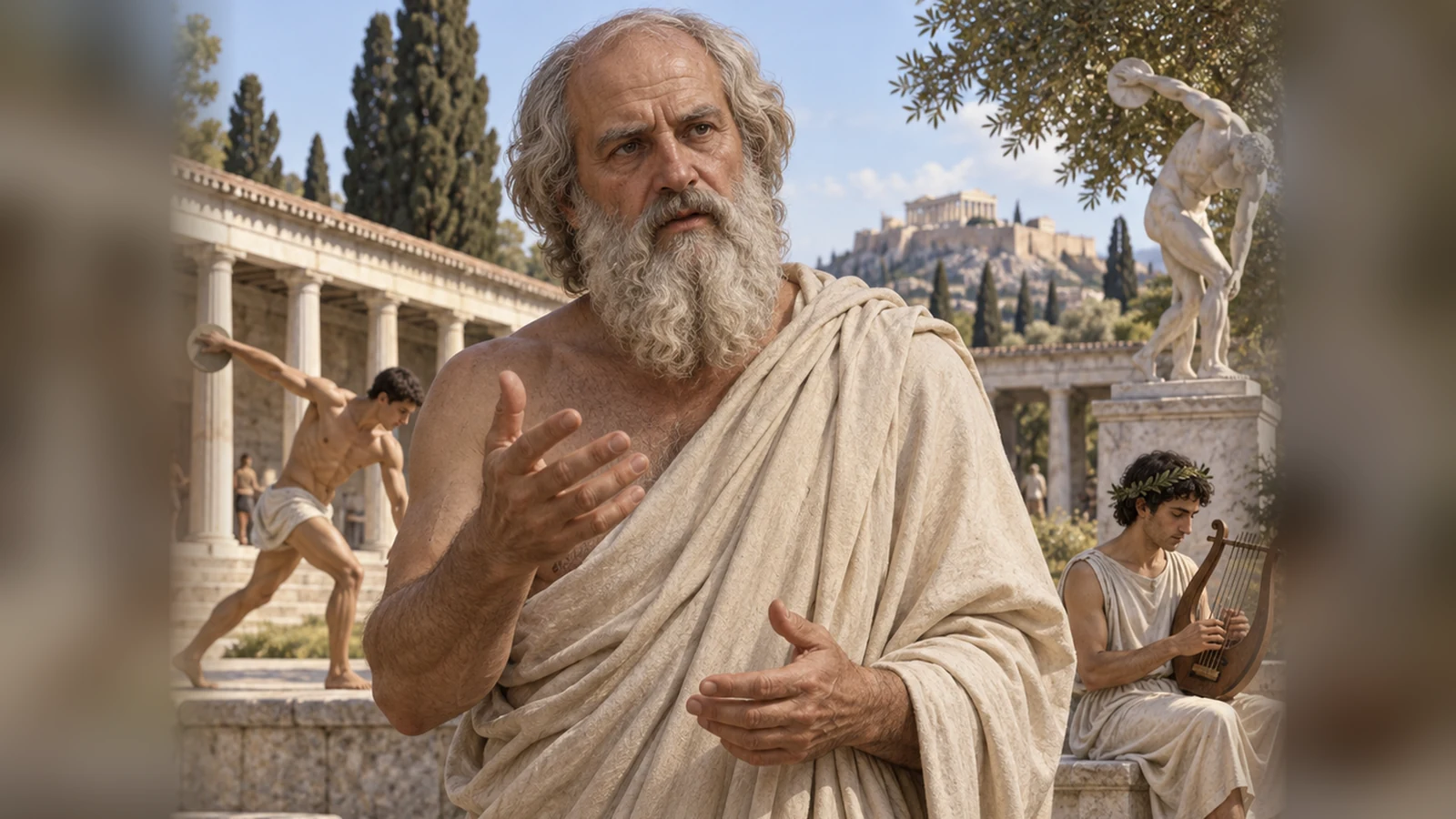

Plato is best known for ideas about justice, truth, and the soul.
He also had strong views on physical training.
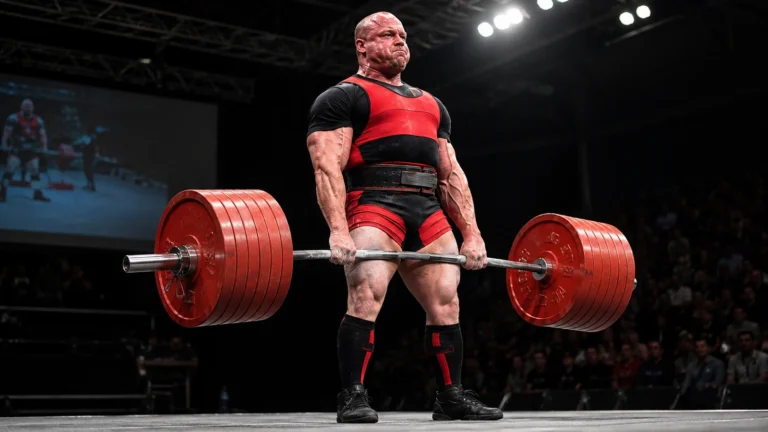
A popular post says Plato taught that true fitness means balancing hard physical training with mental and intellectual growth.
That is close to what he wrote, with one important twist.
Who Plato Was
Plato was born in Athens around 428 or 427 BCE and died there around 348 or 347 BCE.
As a young man he met Socrates, who became his teacher and greatest inspiration.
Around 383 BCE he founded a school called the Academy, near the sacred olive grove of Hecademus.
Aristotle later studied there and became just as famous.
An ancient biographer, Diogenes Laertius, claimed the name “Plato” was a nickname that referred to his broad, sturdy build.
Modern scholars widely regard that story as false, so it is best treated as a legend.
Where the Idea Comes From
The clearest source is Book III of Plato’s Republic, written in Athens in the 4th century BCE.
In the dialogue, the character Socrates discusses how young guardians of an ideal city should be educated.
Their schooling has two main parts, which Plato calls gymnastic and music.
Gymnastic means physical training.
Music, for the Greeks, covered far more than songs, including poetry and other arts of the Muses.
What Plato Actually Said
Socrates warns about leaning too hard on either side.
In Benjamin Jowett’s translation, “the mere athlete becomes too much of a savage.”
Meanwhile, “the mere musician is melted and softened beyond what is good for him.”
He then describes the two arts as gifts meant to be tuned together, like strings on an instrument.
“He who mingles music with gymnastic in the fairest proportions, and best attempers them to the soul, may be rightly called the true musician and harmonist.”
So the core claim holds. Plato did argue for balance between physical and cultural training.
The Twist Most People Miss
Plato did not frame this as body versus mind in the modern sense.
In this passage, both gymnastic and music are aimed at shaping the soul.
Physical training was tied to courage and spirit.
Music was tied to gentleness and self control, and the goal was a soul that held both in harmony.
Too much of one made a person harsh. Too much of the other made a person soft.
That is a character argument as much as a fitness argument.
Plato wanted citizens who could be both brave and wise, and he saw training and culture as the tools to get there.
Today we might call that a well rounded life.
Plato’s later work, the Laws, also discusses training.
We focused on the Republic passage and did not verify specific lines from the Laws.
What Research Says About Exercise and the Mind
Modern science links physical activity and mental function more directly than Plato did.
Researchers can now measure memory, attention, and processing speed before and after an exercise program.
A 2018 meta analysis by Northey and colleagues looked at exercise trials in adults over 50.
It included 39 studies in the review, and pooled data from 36 of them.
Exercise improved cognitive function, with a small to moderate effect size of 0.29.
Aerobic exercise, resistance training, multicomponent training, and tai chi all showed significant benefits.
Sessions of 45 to 60 minutes, at least at moderate intensity, were linked to better results.
The review also found that the benefit held regardless of which area of thinking was tested.
It also held whether or not participants already had some cognitive decline.
That supports a modern version of Plato’s advice. Training the body appears to help the mind as well.
What the Research Does Not Prove
This research shows that exercise can help thinking. It does not test Plato’s idea about character.
No trial shows that heavy training alone makes people “savage.”
Plato’s warning is best read as a reminder about balance in life, not a medical claim.
How to Balance Body and Mind Today
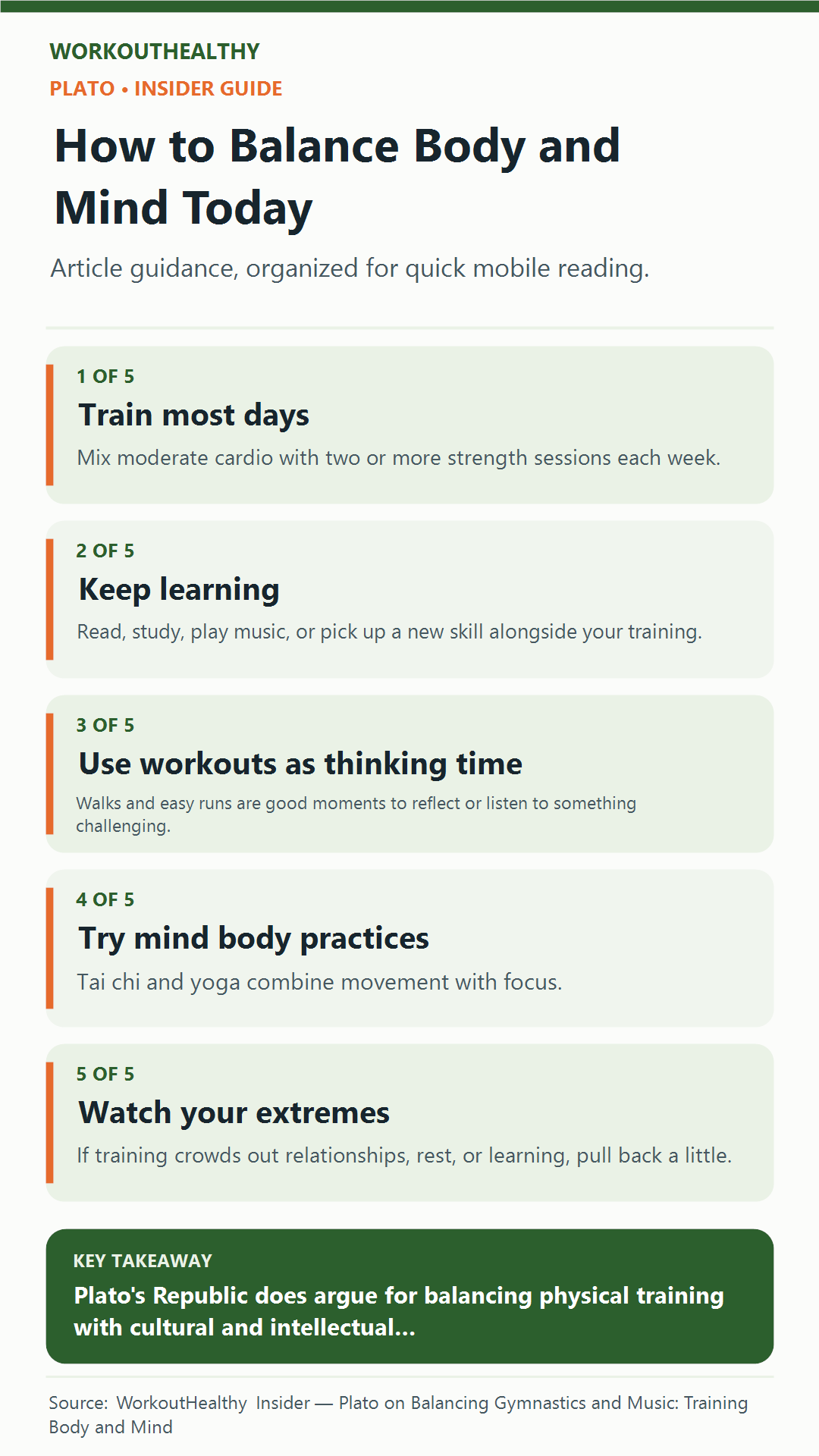
- Train most days. Mix moderate cardio with two or more strength sessions each week.
- Keep learning. Read, study, play music, or pick up a new skill alongside your training.
- Use workouts as thinking time. Walks and easy runs are good moments to reflect or listen to something challenging.
- Try mind body practices. Tai chi and yoga combine movement with focus.
- Watch your extremes. If training crowds out relationships, rest, or learning, pull back a little.
For an example of movement as a lifelong habit, read what a 104 year old woman says keeps her healthy.
If your training has stalled after a set program, see what to do after a 90 day workout program ends.
Common Mistakes
- Treating the gym as your whole identity. Plato’s point was that one sided training leaves a person incomplete.
- Skipping exercise for mental work. Long hours at a desk without movement cost both body and mind.
- Expecting instant brain gains. Cognitive benefits in studies came from weeks to months of regular training.
Who Should Be Careful
Exercise is not a replacement for treatment of depression, anxiety, or memory problems.
Anyone with these concerns should talk with a doctor and use exercise as one part of a wider plan.
People who are new to training, or who have heart or joint conditions, should start at a comfortable level and build up slowly.
If exercise starts to feel compulsive, or you feel anxious when you miss a session, that is worth discussing with a professional.
The Bottom Line
Plato’s Republic does argue for balancing physical training with cultural and intellectual education.
He framed it as shaping character, not just building a fit body or a sharp mind.
Modern research adds that regular exercise can improve thinking, especially in adults over 50.
Train your body, feed your mind, and do not let either one crowd out the other.
Want more stories like this? Subscribe to WorkoutHealthy Insider for practical explanations behind popular fitness claims.
References
- Northey, J. M., Cherbuin, N., Pumpa, K. L., Smee, D. J., & Rattray, B. (2018). Exercise interventions for cognitive function in adults older than 50: A systematic review with meta-analysis. British Journal of Sports Medicine, 52(3), 154 to 160. https://doi.org/10.1136/bjsports-2016-096587
- Plato. (n.d.). The Republic, Book III (B. Jowett, Trans.). The Internet Classics Archive. http://classics.mit.edu/Plato/republic.4.iii.html
- Wikipedia contributors. (n.d.). Plato. In Wikipedia. Retrieved September 16, 2026, from https://en.wikipedia.org/wiki/Plato
This article is for general information only and is not medical advice. If you have an injury, ongoing pain, or a medical condition, talk to a doctor or physical therapist before you change how you train or eat.