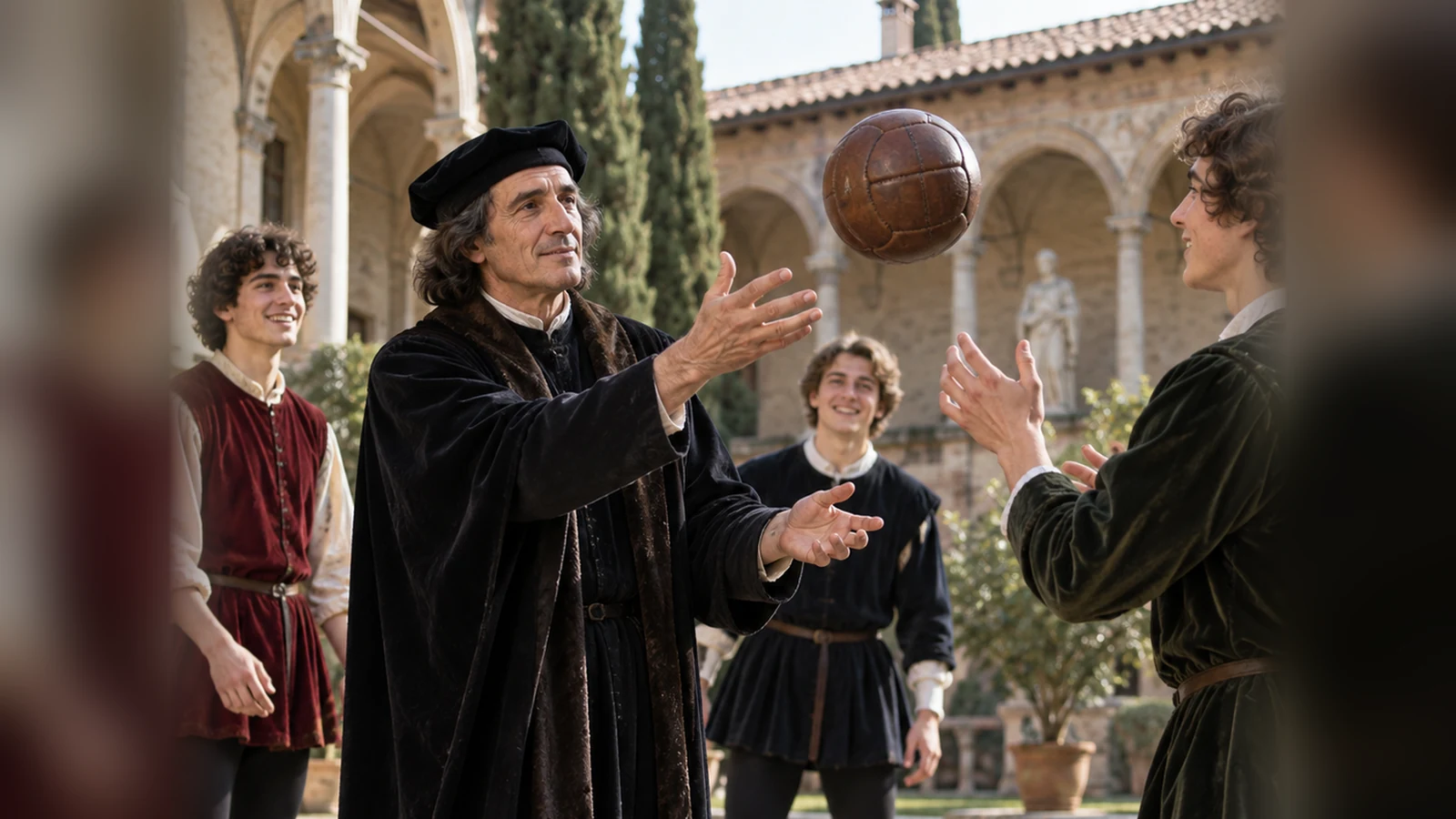

Six hundred years ago, a teacher in northern Italy ran a school where games mattered almost as much as grammar.
His name was Vittorino da Feltre.
His school in Mantua became known as La Casa Giocosa, often translated as “the pleasant house.”
A popular post says he built fencing, riding, ball games, and swimming into his students’ regular school days.
The broad idea holds up well.
A few details deserve a closer look, and modern research on active kids adds useful context.
This article covers who he was, what his students did, and what science says about active school days.
A Teacher Hired by a Marquis
Vittorino was born in 1378 and died in 1446.
In 1423, Gianfrancesco Gonzaga, the ruler of Mantua, invited him to teach the Gonzaga children.
Vittorino agreed, and the court tutoring grew into a full school.
Britannica notes that about 70 other children enrolled alongside the young Gonzagas.
They included boys from other noble families and poor boys chosen for their ability.
The pupils boarded at the school. Calling it secular would be misleading: historical accounts describe Christian teaching and regular religious observances alongside its humanist curriculum.
What Students Actually Did for Exercise
Every source agrees that physical training was part of the plan.
Encyclopedia.com says Vittorino regarded physical training as an integral part of a complete education.
The Catholic Encyclopedia adds two useful details.
Pupils were given exercise chosen mostly according to their needs, and sometimes their tastes. Some general exercises were required in all kinds of weather.
It also says Vittorino himself took part in the field games.
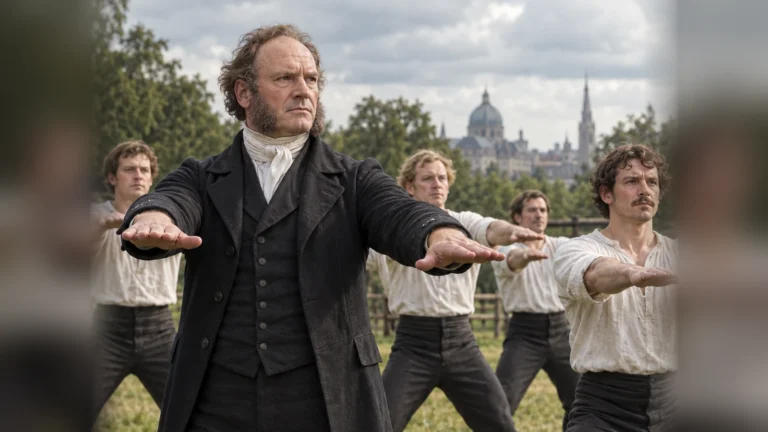
Modern summaries list games, fencing, running, horse riding, swimming, and ball games among the activities.
That list matches the popular post closely.
Checking the Word “Daily”
Here is where some care is needed.
The sources we reviewed confirm regular, required exercise, even in bad weather.
We could not confirm from those sources that every one of the named sports happened every single day.
It is more accurate to say exercise was a regular, built in part of school life.
The exact weekly schedule is not something we could verify.
Readers who want more detail can look for William Harrison Woodward’s 1897 English study of Vittorino and other humanist teachers.
Why a Renaissance School Cared About Bodies
Vittorino drew on ancient Greek ideas about developing both body and mind.
His goal was a complete person, healthy in body, strong in character, and rich in mind.
He also adapted teaching to each child’s ability and needs, which was unusual for his time.
Britannica notes he used no corporal punishment, another break from the norm.
Choosing exercise to fit each student’s needs fits that same pattern.
What the “Pleasant House” Was, and Was Not
The appealing name can make Vittorino’s school sound like a modern recreation center. It was still a demanding Renaissance boarding school, with Latin, Greek, mathematics, music, and other subjects in its curriculum.
Treccani’s account places it within a humanist program joined to Christian education. The older Catholic Encyclopedia likewise describes religious exercises as a regular part of the day. That context matters: describing the school as the first secular boarding school obscures a central feature of the institution.
The historical sources also describe differences in who could attend. Children from the Gonzaga court and other elite families studied there, while some children from poorer families were admitted. That was unusual for a court setting, but it was not a modern universal public school.
His use of games was more than a break from books. The account says he joined field games himself and chose some exercises around pupils’ needs. Those details suggest an educator trying to shape a whole day and a whole person, not simply checking off a sports quota.
At the same time, the sources do not give us a reliable day-by-day timetable of fencing, riding, swimming, and ball games. The most defensible historical claim is that physical activity had a regular place in his teaching, not that each named sport occurred daily.
A school day that leaves room for play is not a lesser school day. It may be the more complete one.
What Modern Research Says About Active Kids
In 2016, a large review led by Joseph Donnelly examined physical activity, fitness, thinking skills, and school performance in children aged 5 to 13.
The authors found that most research supports a benefit of fitness and physical activity on children’s cognitive function.
They concluded that physical activity has a positive influence on cognition and on brain structure and function.
For grades and test scores, the picture was less clear.
The review rated the effect of activity and physical education on academic achievement as neutral.
Importantly, it found no sign that more physical activity hurts thinking or school achievement.
That matters whenever schools consider trimming recess or gym to make time for class work.
A second review, by Lubans and colleagues and also published in 2016, looked at why activity might help young people’s minds.
The strongest evidence it found was for better physical self perceptions, which came along with improved self esteem.
That supports Vittorino’s view that physical training shapes character and confidence, not only muscles.
What the Evidence Does Not Show
Neither review tested fencing, riding, or swimming in a Renaissance style school.
The Donnelly review also noted many weak study designs and too few randomized trials.
The Lubans review found that few studies had looked at brain based or behavior based explanations.
So the research supports the spirit of Vittorino’s plan, not every detail of it.
It also cannot tell us whether his students did better because of the exercise, the teaching, or the privileges many of them already had.
What Schools Can Reasonably Take From the Research
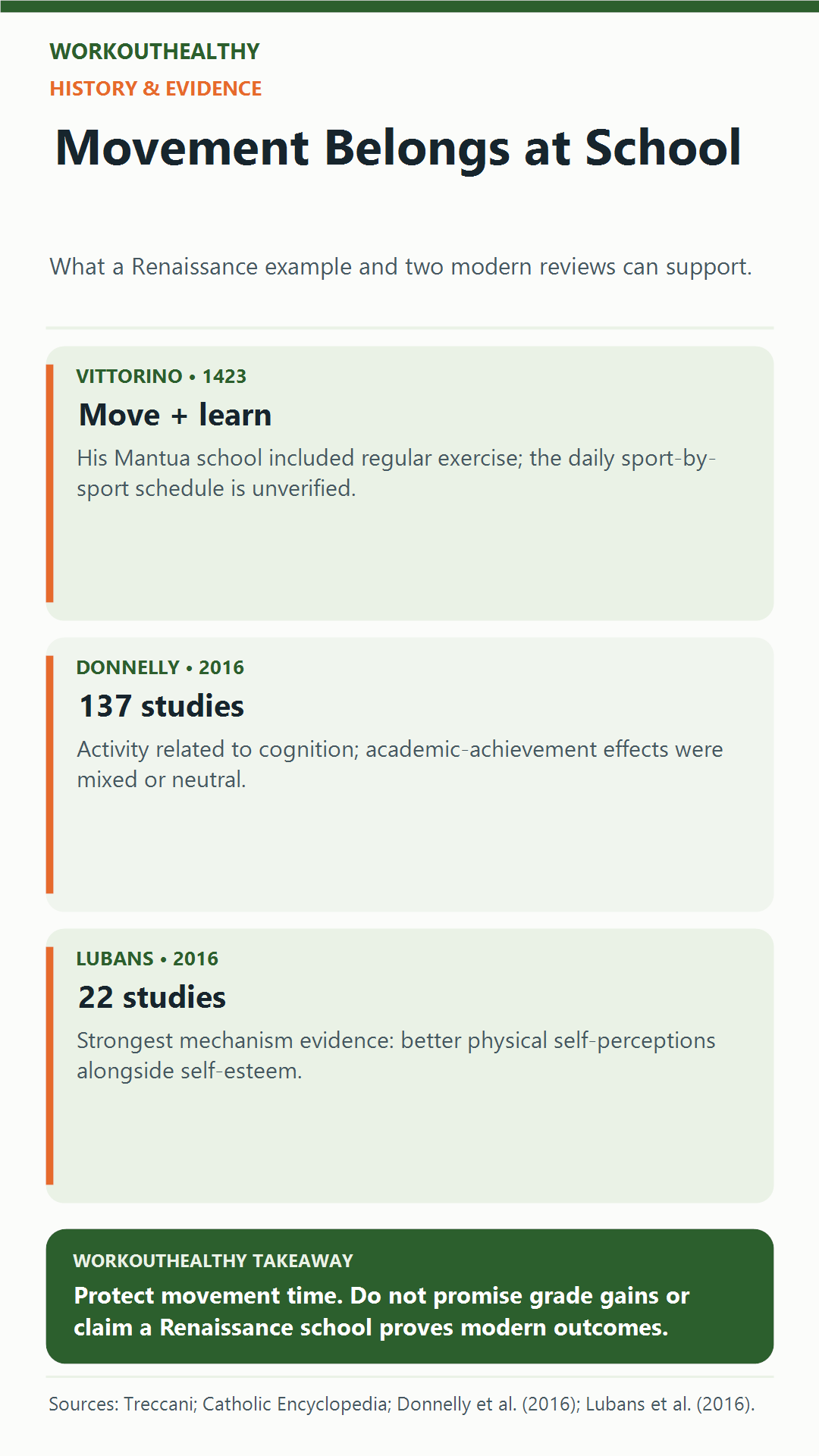
The Donnelly review examined 137 studies of activity, fitness, cognition, and achievement in children. Its conclusion was not that every extra minute of gym raises test scores. It found positive associations for cognition, but the controlled studies of academic achievement were mixed.
That is why the review rated the academic-achievement effect of physical education as neutral. Neutral is still useful: the available evidence gave no indication that more activity harms learning, even when schools worry about losing classroom time.
The reviewers also warned about study quality. Many studies were small or lacked strong randomization, and measures of activity and outcomes differed. They called for better work on when activity fits best within the school day, rather than declaring one perfect timetable.
The Lubans review asked a different question: how might activity affect cognition or mental health? Across 22 studies, the strongest evidence concerned physical self-perceptions, often alongside higher self-esteem. Evidence for proposed brain and behavior mechanisms was too limited to draw firm conclusions.
Put together, the reviews support making room for varied, enjoyable movement without promising better grades or treating exercise as a remedy for every child’s mental-health needs. Schools can protect recess and physical education because movement matters in its own right, while measuring educational outcomes honestly.
Vittorino’s school offers a historical analogy, not proof of a modern intervention. Its boarding schedule, family circumstances, teaching practices, and cultural expectations were too different to isolate exercise as the cause of a particular outcome.
How to Bring the Idea Into Kids’ Lives Today
- Protect movement time. Treat recess, gym, and sports as part of learning, not a reward to be taken away.
- Offer variety. Mix running games, ball sports, swimming, and skill work, much as Vittorino’s students did.
- Match activities to the child. Some kids need confidence building, others need a new challenge.
- Keep some outdoor time in most weather. Dress for conditions and use common sense in extreme heat or cold.
- Let adults join in. Vittorino played the field games himself, and kids notice when adults move too.
- Break up long sitting. Short movement breaks between lessons are easy to add at home or school.
For simple ways to undo long stretches in a chair, see three positions that undo a day of sitting.
Families who want structured, varied sessions can borrow ideas from our look at what circuit training actually delivers.
Common Mistakes Schools and Parents Make
- Cutting activity to add class time. The research above found no sign that activity harms learning.
- Offering only one sport. A single option leaves out kids who would thrive in another.
- Using exercise as punishment. Extra laps as a penalty can teach kids to dislike moving.
- Ignoring individual needs. Kids with health conditions may need adjusted activities, not exclusion.
The Bottom Line
Vittorino da Feltre ran a Renaissance school where physical training stood beside books.
Sources confirm regular, required exercise, with activities like fencing, riding, swimming, and ball games.
The claim that each sport happened daily is harder to confirm.
Modern reviews link activity with some cognitive benefits, but controlled studies of academic achievement are mixed. More movement does not appear to cost children academically.
His centuries old idea still deserves a place in every child’s week.
Want more stories like this? Subscribe to WorkoutHealthy Insider for practical explanations behind popular fitness claims.
References
- Donnelly, J. E., Hillman, C. H., Castelli, D., Etnier, J. L., Lee, S., Tomporowski, P., Lambourne, K., & Szabo-Reed, A. N. (2016). Physical activity, fitness, cognitive function, and academic achievement in children: A systematic review. Medicine and Science in Sports and Exercise, 48(6), 1197 to 1222. https://doi.org/10.1249/MSS.0000000000000901
- Lubans, D., Richards, J., Hillman, C., Faulkner, G., Beauchamp, M., Nilsson, M., Kelly, P., Smith, J., Raine, L., & Biddle, S. (2016). Physical activity for cognitive and mental health in youth: A systematic review of mechanisms. Pediatrics, 138(3), e20161642. https://doi.org/10.1542/peds.2016-1642
- Britannica. Vittorino da Feltre. https://www.britannica.com/biography/Vittorino-da-Feltre
- Catholic Encyclopedia. Vittorino da Feltre. Catholic Answers. https://www.catholic.com/encyclopedia/vittorino-da-feltre
- Woodward, W. H. (1897). Vittorino da Feltre and other humanist educators. Cambridge University Press.
- Treccani. (n.d.). Vittorino da Feltre. https://www.treccani.it/enciclopedia/vittorino-da-feltre/
This article is for general information only and is not medical advice. If you have an injury, ongoing pain, or a medical condition, talk to a doctor or physical therapist before you change how you train or eat.