
Weight lifting after 60 can improve strength, and a beginner does not have to start with heavy barbells. The first goal is to find movements you can perform with control, then adjust the challenge as you learn how your body responds.
This guide gives an illustrative first session and a four-week decision path for adults starting later in life. It is general information, and a person with pain, recent surgery or fracture, repeated falls, or a medical condition may need an individual plan first.
Weight lifting after 60: the first-session card
A strength session can use body weight, machines, bands, or handheld weights. Choose equipment you can set up securely and ask a qualified trainer or physical therapist for a form check if you are unsure.
| Movement pattern | Home or supported option | Gym option | First-session question |
|---|---|---|---|
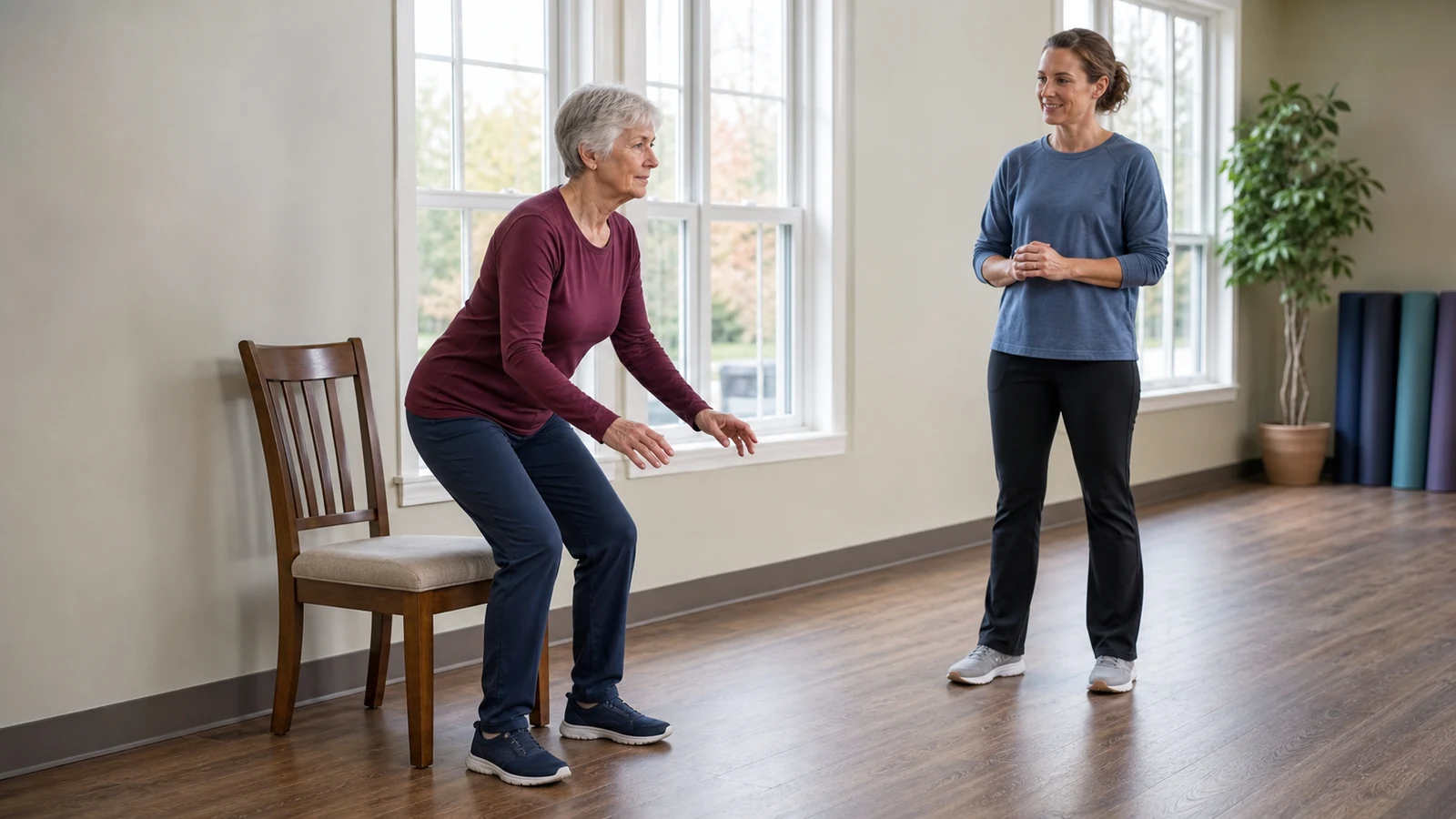
| Stand up and sit down | Chair rise from a sturdy chair, using armrests as needed | Supported chair rise or a light leg-press machine | Can I move smoothly without losing balance or provoking pain? |
| Push | Wall push-up | Light chest-press machine | Can I keep a comfortable range and breathe normally? |
| Pull | Supervised band row with a secure setup | Seated row machine | Can I pull without shrugging or jerking? |
| Rise through the ankles | Heel raise with both hands on a sturdy counter | Supported heel raise | Can I control the lowering phase with support? |
For a simple trial session, do a few comfortable repetitions of each movement, rest as needed, and leave effort in reserve. The card is an editorial example rather than a studied exercise prescription, and a clinician may choose different movements for a specific condition.
A band row requires a secure anchor and safe setup; if you cannot arrange that confidently, use a supervised gym machine or ask for another pulling option. Do not treat the first day as a strength test.
A four-week decision path
There is no rule that everyone should add weight every week. Use the same basic movement patterns long enough to notice how they feel, then change one thing only when control and recovery are satisfactory.
| Week | What to practice | Decision before progressing |
|---|---|---|
| 1 | Learn the setup and a comfortable range, with support where needed. | Could you complete the movements with control and normal breathing? |
| 2 | Repeat the movements on separate days and record what felt easy or difficult. | Did discomfort, unusual fatigue, or balance trouble appear afterward? |
| 3 | If prior sessions went well, consider a small change such as one extra comfortable repetition. | Did the change preserve technique and ordinary recovery? |
| 4 | Retest an everyday marker such as a comfortable chair rise and review the log. | Is the plan still appropriate, or would form advice or another movement help? |
This is a decision aid, not a four-week trial protocol or a promise of measurable improvement by week four. Keep the week the same or scale it back if the prior step does not fit your response.
General activity guidance suggests muscle-strengthening work on at least two days a week, with aerobic and balance activity also in the mix. A first-time lifter can start slowly and discuss the right amount with a clinician when health conditions or medicines affect activity.
What older-adult strength research actually tested
The well-known 1994 Fiatarone trial randomized 100 frail nursing-home residents to combinations of supervised progressive resistance exercise and nutrition intervention. Over 10 weeks, strength rose by an average of 113% in the exercise groups versus 3% in the nonexercise groups; stair-climbing power also improved.
That result does not mean an unsupervised beginner doing this card should expect a 113% gain. The participants, supervision, equipment, intensity, and baseline frailty differed from many readers’ circumstances.
A 2010 meta-analysis combined 47 older-adult resistance-training studies and found average strength improvements. A more recent 2025 network meta-analysis included 102 trials and 4,754 community-dwelling older adults; machines, free weights, bands, body weight, and mixed approaches all showed strength benefits versus no intervention.
The network review ranked machine-based training highest on average, but that ranking does not make machines mandatory for every person. Suitability, access, preference, and a safe challenge still matter when choosing a starting method.
How to judge progress without a scale or fixed deadline
Choose one or two repeatable observations that matter to you, such as how controlled a chair rise feels, whether you can carry groceries more comfortably, or whether a chosen machine setting feels easier. Record the movement and context so you can compare like with like.
Daily function can change for many reasons, and no single marker proves that a program is working. A trainer or therapist can help interpret a plateau, especially if you are also recovering from illness or managing pain.
Our separate discussion of walking and leg strength after 60 explains the lower-body context. This article covers the whole-body lifting decision, and neither one replaces walking or balance practice.
Strength, aerobic activity, and other movement
The federal Office of Disease Prevention and Health Promotion advises older adults to combine aerobic activity, strength on at least two days, and balance work, starting slowly when inactive. Walking, cycling, or another comfortable activity can supply the aerobic part; lifting adds a different challenge.
Pilates may be an enjoyable form of movement, but a class varies in whether it provides enough aerobic or progressive strength work for a particular goal. Choose the pieces that fit your ability and interests rather than assuming one activity does every job.
The HuMed conversation discusses strength training as part of healthy aging and metabolic health. Evidence from older-adult exercise trials supports strength gains, while broad claims about preventing diabetes, dementia, or early death need separate outcome evidence and cannot be promised to an individual.
When to get individual advice
Ask a clinician or physical therapist to tailor the plan after a recent operation or fracture, with significant joint pain, repeated falls, or a condition that changes exercise tolerance. Medicines and symptoms can also affect the safe starting point.
Stop exercising if you develop chest pain, fainting, or severe or unusual breathlessness, and seek prompt medical help (American Heart Association warning signs). Call emergency services for persistent chest pain, fainting during exercise, or severe trouble breathing (NHS fainting guidance; NHS breathing guidance).
Breathing normally, using stable support, and starting with manageable effort are more useful beginner priorities than matching someone else’s lifting numbers. The aim is a routine you can understand, repeat, and revise.
About the original doctor interview
The HuMed video features Heather Hinshelwood and host David Spiro discussing strength training and aging. Their discussion raises a useful question, but the evidence for this article comes from exercise trials and public-health guidance.
A physician’s biography is not enough to decide how a reader should start lifting. No single interview establishes a universal training schedule.
Watch the original video
Sources
- Office of Disease Prevention and Health Promotion, older-adult activity guidance.
- Fiatarone et al., 1994 randomized trial in frail older adults.
- Peterson et al., 2010 meta-analysis of older-adult resistance training.
- Wiedenmann et al., 2025 network meta-analysis of resistance modalities.
- American Heart Association, activity warning signs; NHS, fainting emergency guidance; NHS, breathing emergency guidance.
This article is for general information only and is not medical advice. If you have an injury, ongoing pain, or a medical condition, ask a clinician or physical therapist about training that fits your situation.