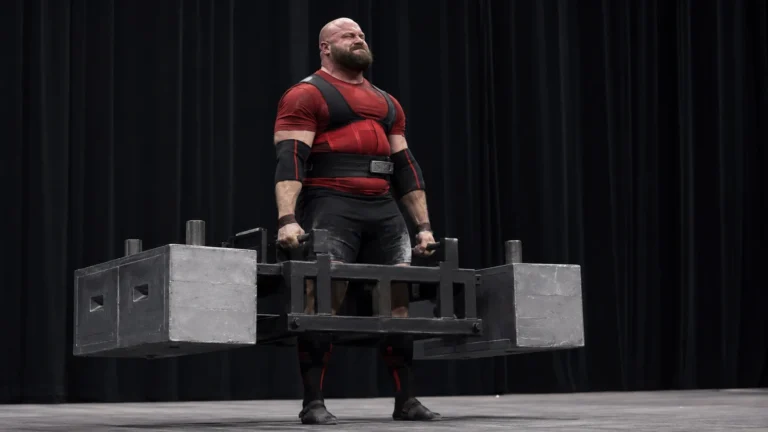

A physical therapist on YouTube says three exercises beat walking for leg strength after 60.
The video has spread widely on Facebook.
It makes a bold claim.
Strength training beats walking, hands down, for building leg strength as you age.
Is that actually true?
We dug into the real research on walking, resistance training, and leg strength in older adults.
Here is what the science actually supports, and where the video’s framing goes further than the evidence.
What the Video Claims
The video comes from a channel called PrimeMotion.
A person presented as a physical therapist walks through three exercises.
The pitch is that these three moves build leg strength faster than walking does.
The video frames walking as a fine habit that does not do much for leg strength on its own.
It suggests older adults need something more targeted to protect their legs from decline.
That framing comes from the video itself, not from a cited study.
The video does not name a specific published trial behind the “better than walking” claim.
So we went looking for what real research says instead.
What Real Research Shows About Resistance Training and Leg Strength
The core idea in the video is not new.
Exercise scientists have studied resistance training in older adults for decades.
A 2010 meta-analysis pooled 47 randomized and nonrandomized resistance-training studies involving 1,079 adults aged 50 or older (Peterson et al., 2010).
It found that progressive resistance training reliably increases muscle strength in older adults.
The average strength gain across the pooled trials was large, not marginal.
This held true across a wide age range, including adults well past 60.
Results varied across studies, and the review associated higher training intensity with larger gains.
That is strong evidence that structured resistance work builds real strength in this age group.
Across 47 pooled studies, resistance training improved multiple strength measures in adults aged 50 or older, though individual results varied.
What Real Research Shows About Walking Versus Resistance Training
Walking is genuinely good for you.
Research on daily step counts links more walking to a lower risk of early death, as we cover in our daily steps and mortality breakdown.
Walking also supports heart health, blood sugar control, and mood.
But walking and resistance training are not interchangeable for building leg strength.
A 2015 systematic review and meta-analysis examined gait speed after resistance, coordination, and multimodal exercise in healthy older adults (Hortobágyi et al., 2015).
Across 42 studies, all three approaches improved gait speed to a similar degree.
That review did not directly compare these programs with walking-only training or establish that resistance exercise was superior for gait speed.
Walking alone places a fairly light mechanical load on the leg muscles compared to loaded strength work.
That matters because strength gains respond mainly to mechanical tension, not distance covered.
Resistance training supplies a more direct progressive strength stimulus than an ordinary level-ground walk. That is a training-principle inference, supported by the resistance-training strength trials, not a result established by the 2015 gait-speed review.
The exact “3 exercises beat walking” framing is the video’s own marketing language, not a line from any study. Walking remains valuable for aerobic activity and daily function.
The Mechanism
Muscle adapts to the specific demand you place on it.
Walking asks your leg muscles to produce a small, repeated force over a long stretch of time.
That is a solid stimulus for endurance and circulation.
It is a weak stimulus for building maximum strength or muscle size.
Resistance exercises such as a controlled squat or sit-to-stand ask the leg muscles to produce greater force than an ordinary level-ground walk; a seated leg extension can add a focused quadriceps challenge.
That higher mechanical tension is what signals muscle fibers to get stronger and, over time, larger.
This matters more with age because of sarcopenia, the gradual loss of muscle mass and strength tied to getting older (Cruz-Jentoft et al., 2019).
Sarcopenia is not just cosmetic muscle loss.
It is linked to slower walking speed, higher fall risk, and loss of independence.
Loaded resistance exercise is one of the few interventions shown to directly counter this decline.
Our piece on losing weight and muscle mass goes deeper into how that muscle loss happens.
Walking helps maintain general fitness, but it does not load the muscle enough to reverse sarcopenia on its own.
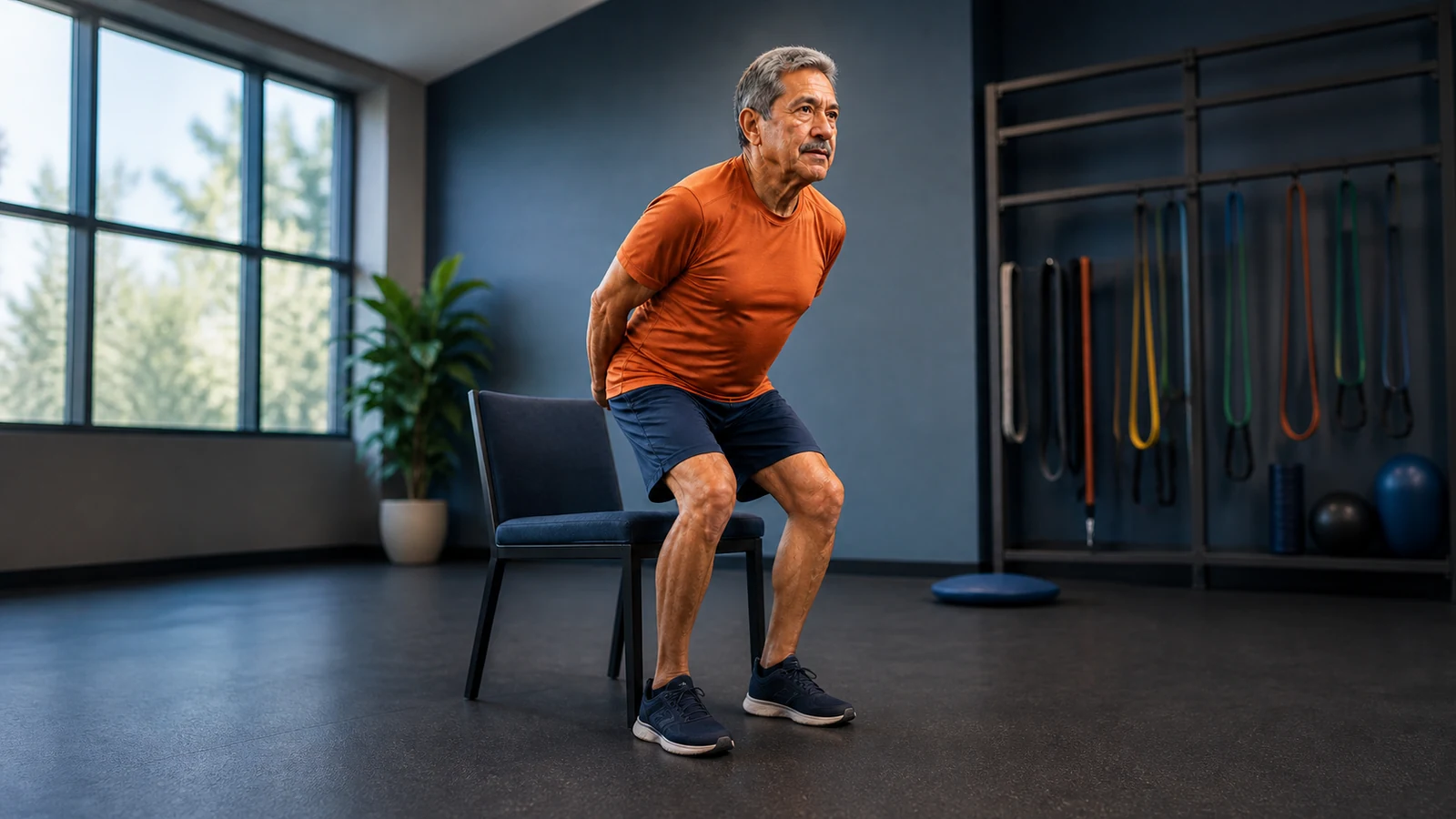
The three moves in the post: sit-to-stand, squat, and leg extension
The related Facebook post describes a sit-to-stand, a controlled squat, and a seated leg extension. These moves do different jobs; none is a proven magic replacement for walking.
A sit-to-stand practices rising from a chair, a task many adults need repeatedly each day. Use a sturdy chair, put both feet on the floor, and start with support if balance is uncertain.
A controlled squat trains hip and knee extension through a range that can be adjusted to ability. A shallow squat to a chair may be a better starting point than trying to squat deeply.
A seated leg extension emphasizes the quadriceps. It can be a useful accessory for someone whose clinician or physical therapist considers it appropriate, but it does not by itself train every muscle or balance demand involved in getting up or climbing stairs.
The training principle is specificity: practicing a task helps that task. The Fiatarone trial described above found that supervised progressive resistance training improved strength and stair-climbing power in frail older adults (Fiatarone et al., 1994). It did not test this exact three-move social-media routine or prove that a leg extension is necessary.
The practical goal is to choose movements that safely challenge the legs and can be progressed over time. Someone with knee pain, falls risk, or a recent injury may need a therapist to adapt the exercise selection.
Muscle mass, not just strength.
Strength and muscle size are related but not identical.
A separate meta-analysis looked specifically at lean body mass, not just strength scores (Peterson et al., 2011).
It found that resistance training increases lean body mass in aging adults, on average.
The effect size was modest per program, but consistent across trials.
That matters because more lean mass generally means a larger base of tissue available to produce force.
A classic trial pushed this question further, testing resistance training in frail adults in their 80s and 90s (Fiatarone et al., 1994).
Participants who did high-intensity resistance training gained substantial leg strength.
Many also improved how fast they could walk and how easily they climbed stairs.
That trial is decades old now, but it remains one of the clearest demonstrations that even very old, frail adults respond to resistance training.
The goal was never the exercise for its own sake.
It was the functional payoff: walking speed, stair climbing, and daily independence.
Leg Strength, Balance, and Fall Prevention
Falls are a leading cause of injury in adults over 60.
Weak legs are one of the strongest predictors of fall risk.
A major Cochrane review pooled data from over one hundred trials on exercise and falls (Sherrington et al., 2019).
It found that exercise programs reduce the rate of falls among community-dwelling older adults.
Programs that combined balance training with resistance exercise for the legs produced some of the strongest results.
Walking programs alone showed weaker or inconsistent effects on fall rates in that same review.
That is a meaningful distinction for anyone over 60 who is deciding how to spend limited exercise time.
Exercises that challenge leg strength and balance together appear to do more for fall prevention than walking by itself.
Exercise programs that build leg strength and challenge balance together show some of the most consistent reductions in fall rates among community-dwelling older adults.
What This Evidence Does Not Prove
This research does not prove that walking is bad for you.
Walking still carries real cardiovascular, metabolic, and mental health benefits.
Our guide to how many miles you should walk a day covers those benefits in more depth.
The evidence also does not prove that PrimeMotion’s specific three exercises are the best possible choices.
The comparative research supports resistance training in general, not any one creator’s specific routine.
Most of the strongest trials used supervised programs with trained staff and controlled loads.
Results from a short online video, done without supervision, may look different in practice.
The research also cannot say how quickly any one person will see results.
Individual response to strength training varies with genetics, health status, and starting fitness.
Finally, none of this proves that dropping walking in favor of lifting alone is the right trade.
The best supported approach in the literature combines both, rather than replacing one with the other.
Common Mistakes
Doing too much too soon is the most common mistake.
Older adults new to resistance training often start with too much weight or too many reps.
That raises injury risk and can sour someone on strength training entirely.
Skipping a warm up is another common mistake, especially for stiff joints in the morning.
Confusing soreness with progress is a third mistake.
Muscle soreness is not required for strength gains, and constant soreness can signal overtraining.
Many people treat a single bodyweight squat or chair rise as a one-time challenge instead of a practice they can repeat and gradually progress.
Consistency over months is what produces the strength changes seen in the research, not a single hard session.
Some people also drop walking entirely once they start lifting.
The online debate over weightlifting versus cardio gets a lot of attention, but the research supports doing both.
Who Should Be Extra Careful
Anyone with an existing joint replacement should get clearance from their surgeon first.
People with uncontrolled high blood pressure should check with a doctor before heavy lower body lifting.
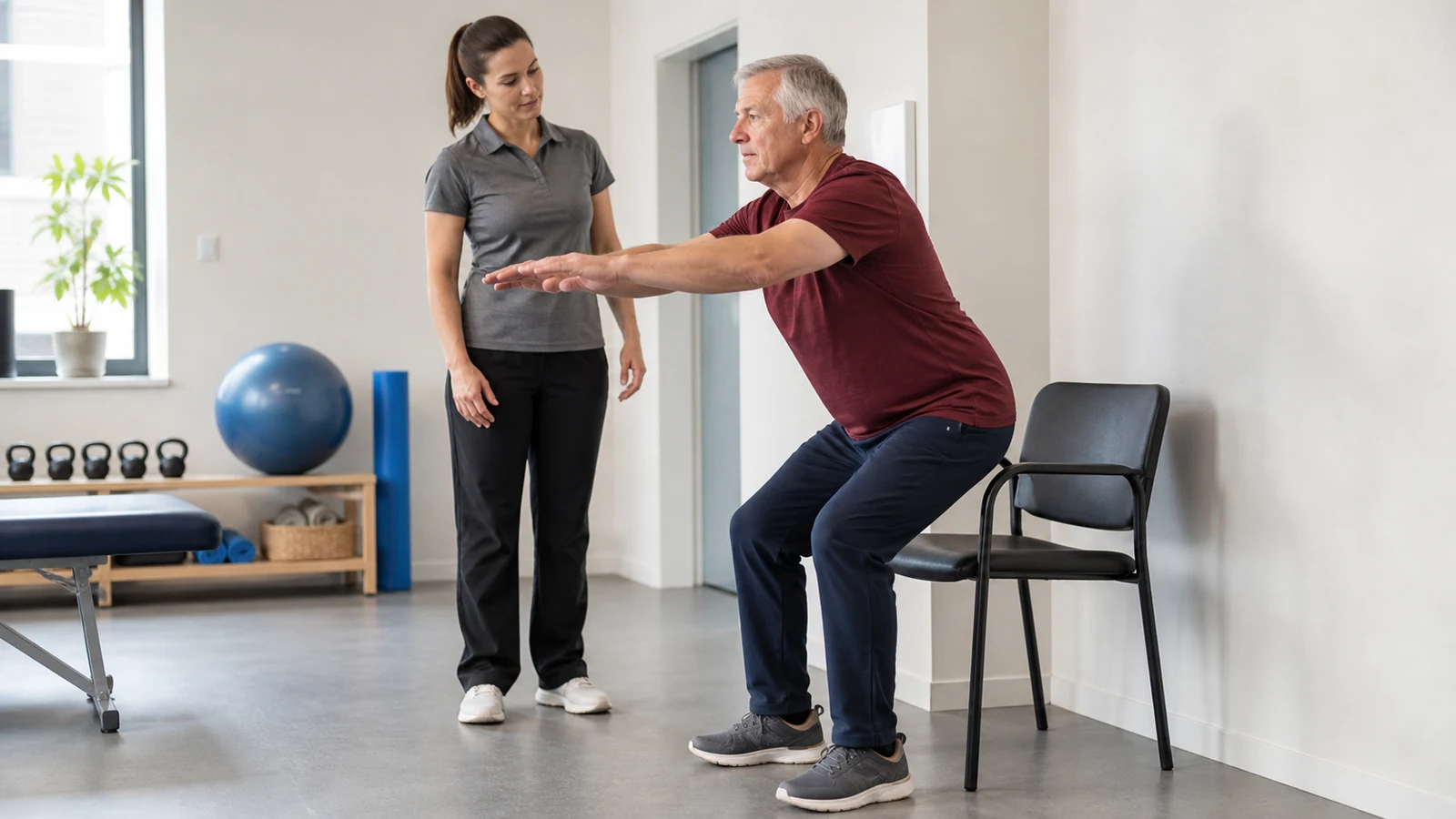
Anyone with a recent fall, dizziness, or balance problems should start with supervised sessions.
A physical therapist can screen for issues a video cannot catch, like poor knee tracking or one-sided hip weakness.
People with osteoporosis need exercises chosen carefully, since some loaded movements carry more spine risk than others.
Anyone recovering from surgery should follow their own rehabilitation timeline, not a generic online routine.
If chest pain, shortness of breath, or joint pain shows up during exercise, that is a signal to stop and get checked.
A Practical Takeaway
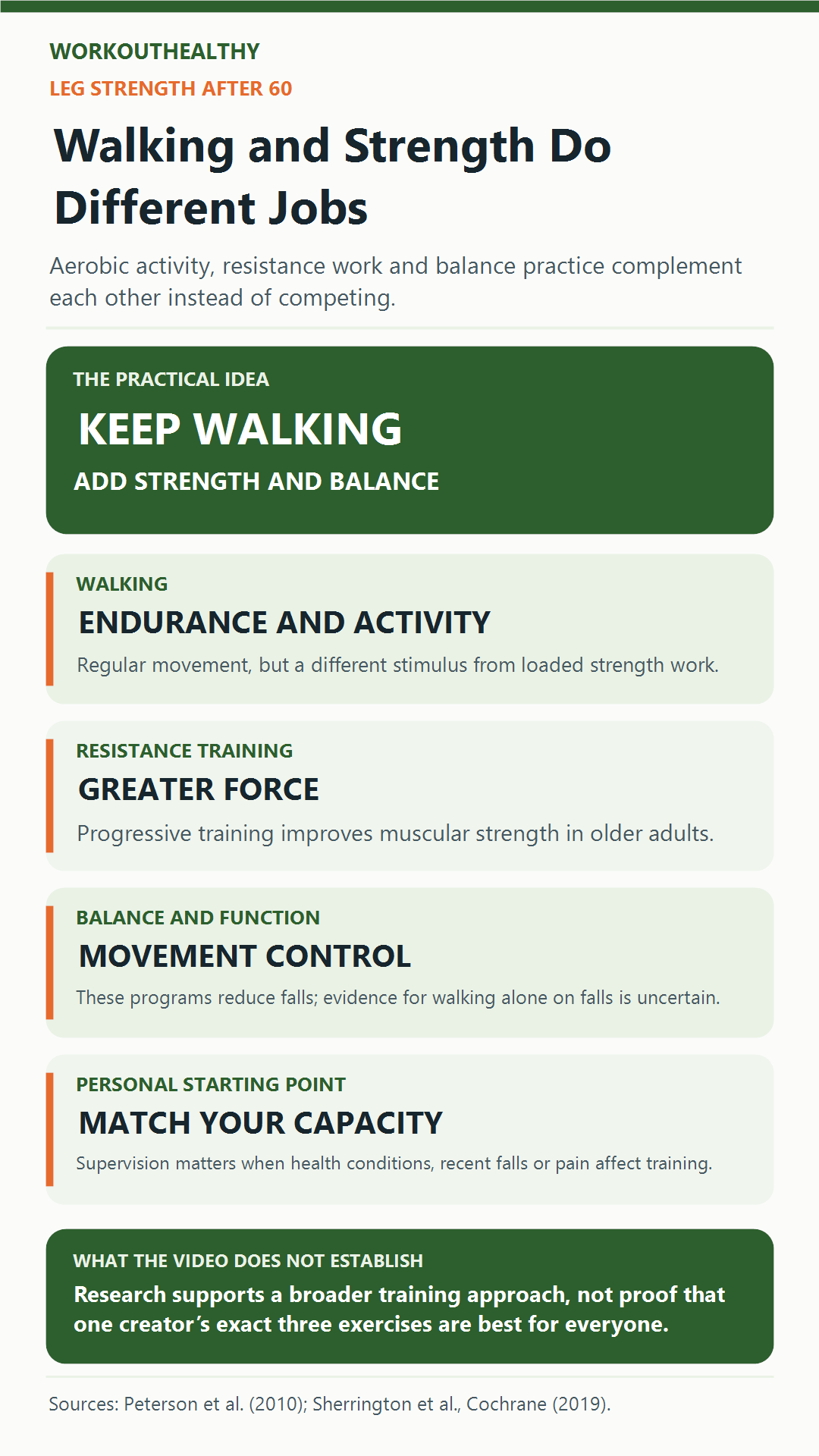
Keep walking.
It is still one of the easiest ways to stay active and support heart health.
Add two or three sessions of leg focused resistance training each week.
Supported sit-to-stands and controlled squats can be reasonable starting points; a seated leg extension can be an optional quadriceps exercise when it fits the person’s needs and equipment.
Progress slowly by adding reps first, then adding load once form is solid.
A short, carefully built strength routine with real supervision beats a hard movement done with bad form.
Strength training later in life is not too late to start.
Our profile of Edith Connor, who took up barbell training in her sixties, shows that starting later still produces real results.
The goal is not choosing walking or lifting.
The goal is doing both, consistently, for years.
Watch the video
Want more like this? Subscribe to WorkoutHealthy Insider for practical explanations behind popular fitness claims.
References
Cruz-Jentoft, A. J., Bahat, G., Bauer, J., Boirie, Y., Bruyère, O., Cederholm, T., Cooper, C., Landi, F., Rolland, Y., Sayer, A. A., Schneider, S. M., Sieber, C. C., Topinkova, E., Vandewoude, M., Zamboni, M., & Writing Group for the European Working Group on Sarcopenia in Older People 2 (EWGSOP2). (2019). Sarcopenia: revised European consensus on definition and diagnosis. Age and Ageing, 48(1), 16 to 31. https://doi.org/10.1093/ageing/afy169
Fiatarone, M. A., O’Neill, E. F., Ryan, N. D., Clements, K. M., Solares, G. R., Nelson, M. E., Roberts, S. B., Kehayias, J. J., Lipsitz, L. A., & Evans, W. J. (1994). Exercise training and nutritional supplementation for physical frailty in very elderly people. New England Journal of Medicine, 330(25), 1769 to 1775. https://doi.org/10.1056/NEJM199406233302501
Hortobágyi, T., Lesinski, M., Gäbler, M., VanSwearingen, J. M., Malatesta, D., & Granacher, U. (2015). Effects of three types of exercise interventions on healthy old adults’ gait speed: A systematic review and meta-analysis. Sports Medicine, 45(12), 1627 to 1643. https://doi.org/10.1007/s40279-015-0371-2
Peterson, M. D., Rhea, M. R., Sen, A., & Gordon, P. M. (2010). Resistance exercise for muscular strength in older adults: A meta-analysis. Ageing Research Reviews, 9(3), 226 to 237. https://doi.org/10.1016/j.arr.2010.03.004
Peterson, M. D., Sen, A., & Gordon, P. M. (2011). Influence of resistance exercise on lean body mass in aging adults: A meta-analysis. Medicine and Science in Sports and Exercise, 43(2), 249 to 258. https://doi.org/10.1249/MSS.0b013e3181eb6265
Sherrington, C., Fairhall, N. J., Wallbank, G. K., Tiedemann, A., Michaleff, Z. A., Howard, K., Clemson, L., Hopewell, S., & Lamb, S. E. (2019). Exercise for preventing falls in older people living in the community. Cochrane Database of Systematic Reviews, 2019(1), CD012424. https://doi.org/10.1002/14651858.CD012424.pub2
This article is for general information only and is not medical advice. If you have an injury, ongoing pain, or a medical condition, talk to a doctor or physical therapist before you change how you train or eat.