
A video from William Health Insights makes a big promise.
It says there is one exercise every adult over 60 should do every day.
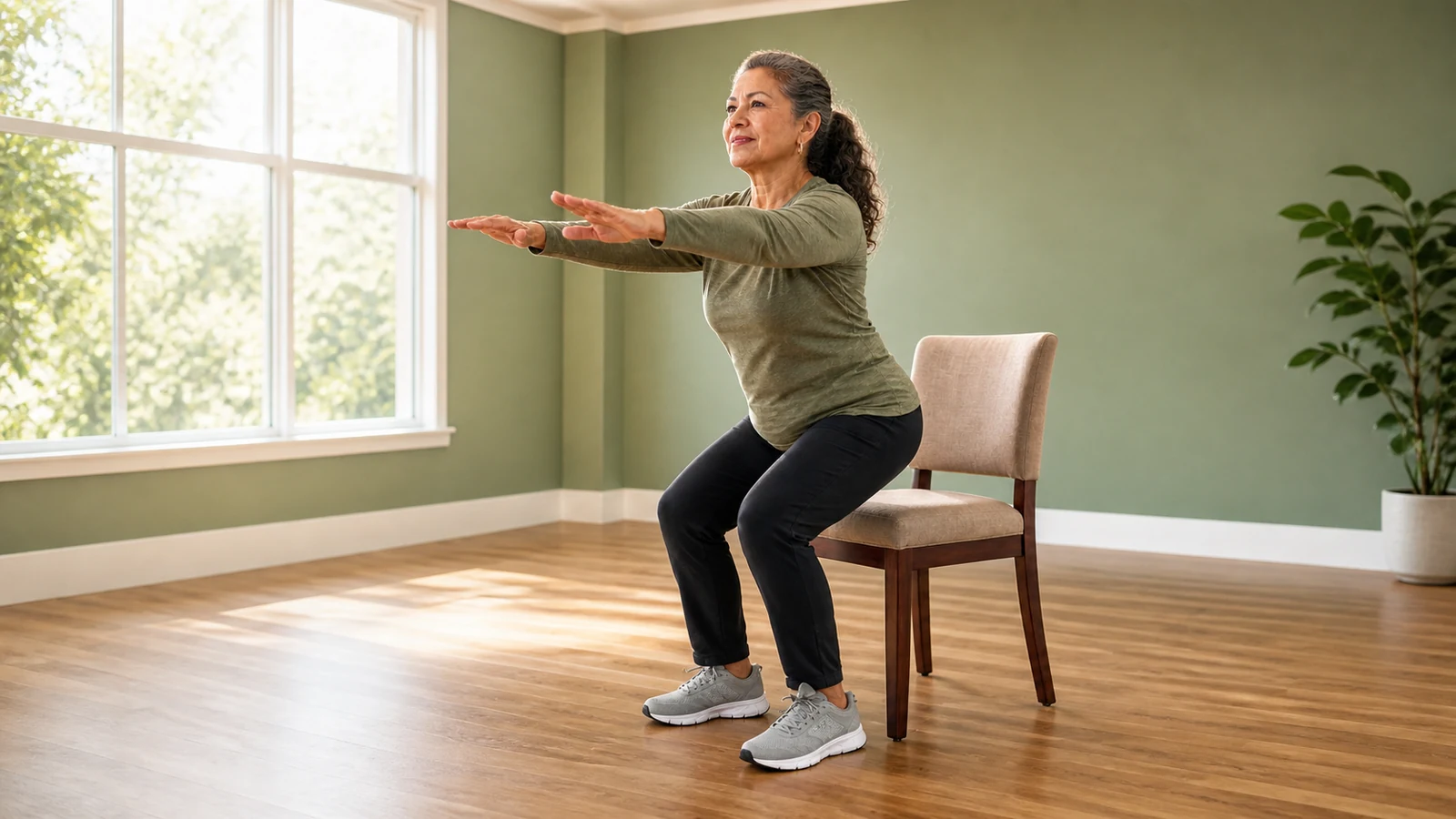
That exercise is the chair squat, also known as the sit to stand.
It looks almost too simple to change your health this much.
The idea is that one simple daily movement could matter more than a complicated workout plan.
That claim is worth checking against real evidence before you build a habit around it.
What the Video Claims
The video argues that standing up and sitting down from a chair builds real leg strength.
It claims doing this daily can improve balance and lower the risk of falling.
The video also says this one move can help older adults stay independent longer.
It frames the chair squat as a simple test you can do at home, no gym required.
What the Research Actually Shows
The chair squat is not just a trend someone picked at random.
Researchers have studied a version of this movement for decades under a different name.
It is often called the sit to stand test, or the chair stand test.
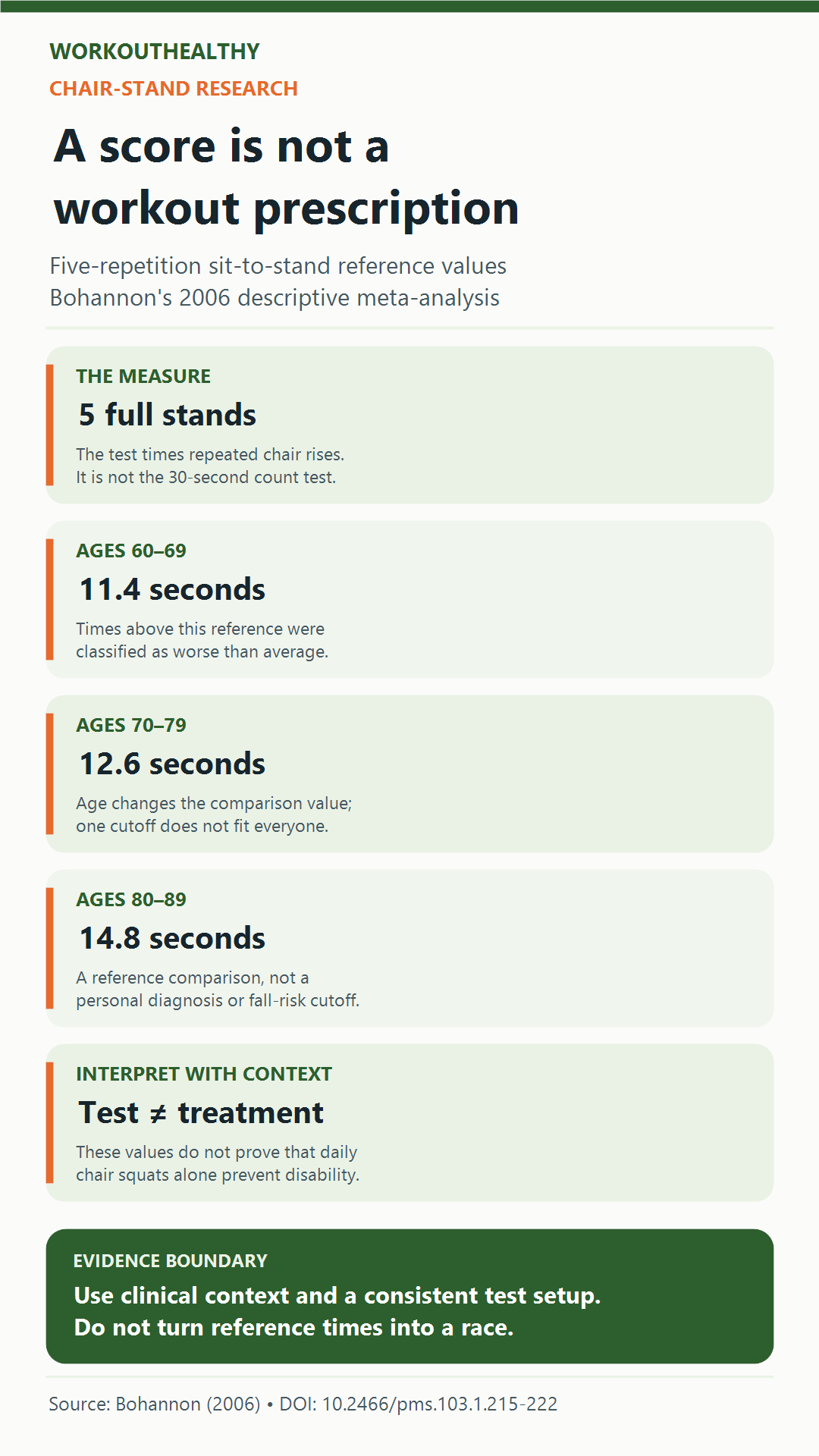
One widely cited review pooled data on the five repetition version of this test in older adults (Bohannon, 2006).
That review set reference times for how fast healthy older adults can rise from a chair five times in a row.
A separate study built and validated a 30 second version of the same idea (Jones, Rikli, and Beam, 1999).
It counts how many full stands a person can complete in half a minute.
That test is now used around the world to measure lower body strength in older adults.
It is part of a larger battery of tools called the Fullerton Functional Fitness Test, built for community dwelling seniors (Rikli & Jones, 1999).
So the chair squat you see in a fitness video is really a well studied clinical tool.
The simple chair squat is the same movement scientists have used for decades to measure how well an older body can function.
Why the Chair Squat Works
The chair squat trains several major muscle groups at once.
It works the quadriceps, the muscles on the front of your thighs.
It also works the glutes and the muscles around your hips.
Your core has to stay tight to keep you balanced through the move.
This combination is why researchers use it as a stand in for general lower body strength.
Leg strength is closely tied to how well someone can walk, climb stairs, and get up off the floor.
You can see this idea in action in our breakdown of the four flight stair climb test, another simple move that predicts real world function.
Researchers also care about muscle power, not just raw strength.
Power is how quickly your muscles can produce force, not just how much force they can produce.
Rising from a chair with speed draws directly on that kind of power.
Muscle power tends to fade faster with age than muscle strength alone.
Some researchers believe that quick, controlled power like this may help you catch yourself if you start to trip.
A slower response could give a small stumble more time to turn into a fall.
Weaker legs are one of the clearest warning signs doctors look for in aging patients.
That is part of why a plain bodyweight movement gets so much research attention.
What a Strong Sit to Stand Score Predicts
Chair stand performance is not just about your legs on that one day.
It has been linked to bigger outcomes down the road.
One large study combined chair stand results with other physical tests in older adults (Cesari et al., 2009).
It found that low scores on tests like the chair stand were linked to higher risk in the years that followed.
Those risks included new disability, hospital stays, and death.
Another landmark study built a battery of tests that included a version of the chair stand (Guralnik et al., 1994).
People who scored low on that battery were far more likely to be admitted to a nursing home within the next four years.
They were also more likely to die during the study period than people with higher scores.
These are not small effects buried in one lab.
They come from studies that followed thousands of older adults for years.
What This Evidence Does Not Prove
It is worth being honest about what these studies actually show.
They mostly measured how well someone could already perform the sit to stand.
Then they tracked what happened to that person’s health over time.
That is called an observational study, not a controlled experiment.
It shows a strong link between leg strength and better outcomes.
It does not prove that doing chair squats daily, on its own, causes those better outcomes.
People with stronger legs may also be healthier overall for other reasons too.
The video calls this the one daily habit every adult over 60 needs.
That specific framing comes from the video, not from a single controlled trial.
Good research still supports lower body strength training in general for older adults.
It just does not single out one exercise, done once a day, as a fix for everything.
Is One Exercise a Day Really Enough
Public health guidelines do not point to just one movement.
General exercise guidelines for older adults call for muscle strengthening work on two or more days a week.
They also call for it to cover the major muscle groups, not just the legs.
A single daily chair squat mostly trains the lower body.
It does little on its own for the arms, shoulders, or back.
Walking is another piece many guidelines mention alongside strength work.
Our look at daily steps and mortality risk covers how that piece fits into the bigger picture.
Losing muscle with age, sometimes called sarcopenia, is also about more than the legs.
Our article on losing weight and muscle mass looks at that broader picture and how to protect muscle as you age.
None of this means the chair squat is a bad daily habit.
It works best as one piece of a bigger routine, not as a total replacement for one.
Common Mistakes People Make
Many people rush through the movement to squeeze in more reps.
Speed is not the goal when you are first learning the chair squat.
Control matters more than how fast you can stand up.
Another common mistake is using momentum by rocking hard before standing.
That can put extra strain on the knees and lower back.
Some people also let their knees cave inward as they rise.
That inward knee movement is a common cause of knee pain over time.
Skipping a full sit down between reps is another mistake.
Tapping the chair lightly instead of sitting fully removes some of the strength benefit.
Holding your breath during the effort is another common mistake.
Breathing out as you stand can help you stay steady and avoid a spike in blood pressure.
Control matters more than speed, and a full sit down between reps matters more than the total number of reps you can rush through.
Some people only do this move occasionally instead of building it into a routine.
Like most strength work, consistency matters more than any single perfect session.
Who Should Check With a Doctor First
Not everyone should jump straight into daily chair squats without guidance.
Anyone with a recent hip, knee, or back surgery should ask a doctor first.
People with severe knee arthritis may need a modified version of the move.
Anyone with uncontrolled dizziness or a history of fainting should also check in first.
If you use a walker or cane full time, a physical therapist can help you find a safe starting point.
People recovering from a major joint replacement should follow their own recovery plan first.
You can see how demanding that kind of recovery can be in our look at Misty Copeland’s hip replacement recovery.
People with osteoporosis or a history of fractures should also ask about safe form first.
Anyone on medication that affects blood pressure or balance should be extra careful when standing up quickly.
Anyone with new, unexplained pain during the movement should stop and get it checked.
A doctor or physical therapist can also help if standing up already causes pain.
How to Do the Chair Squat Safely
Start with a sturdy chair that will not slide or tip.
A chair with arms can help you feel more stable at first.
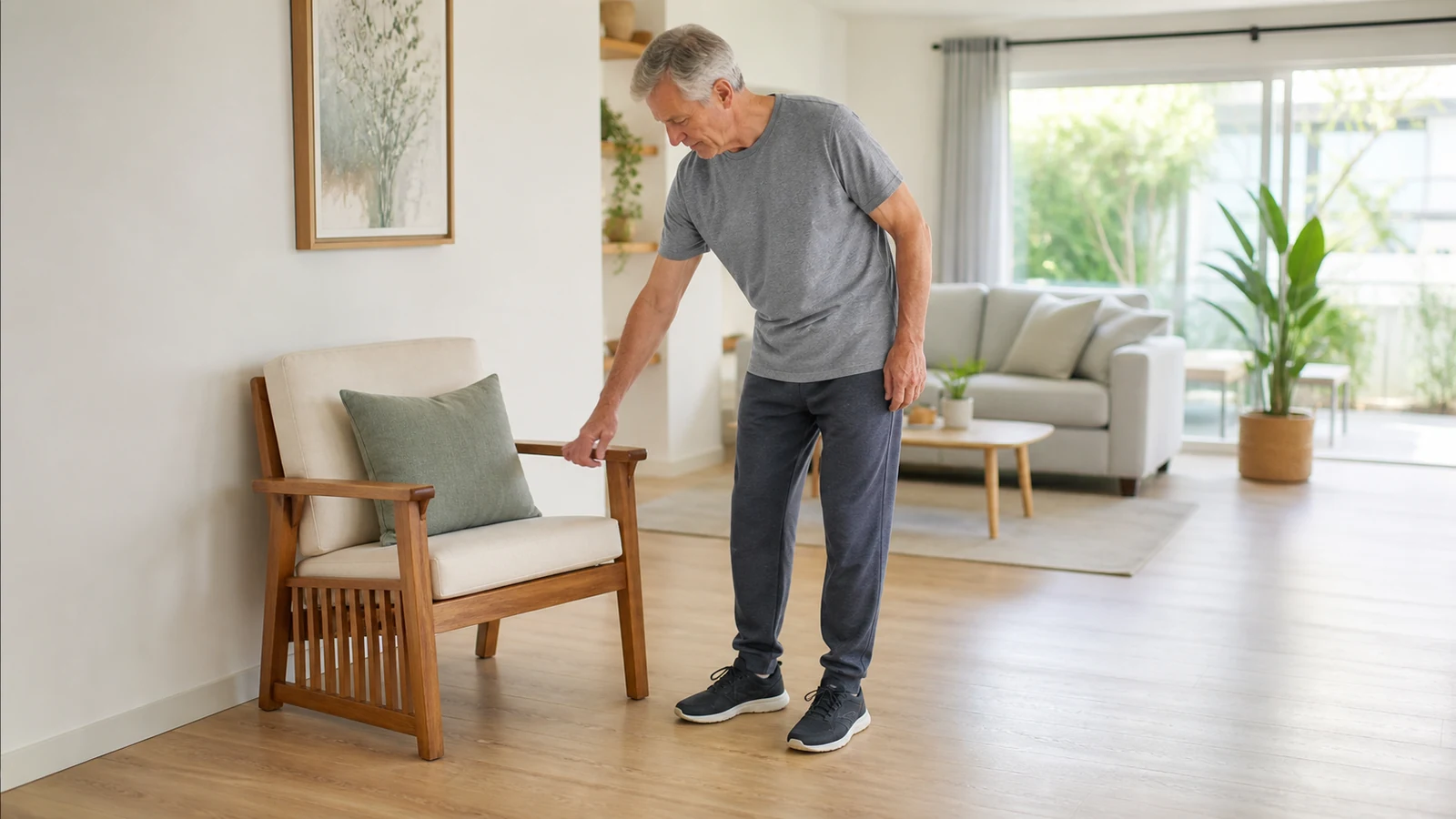
Sit toward the front edge of the chair with your feet flat on the floor.
Keep your feet roughly hip width apart.
Lean your chest slightly forward before you start to rise.
Push through your heels and stand up slowly and with control.
Try to avoid using your hands to push off your knees.
Once standing, pause for a moment before you sit back down.
Lower yourself with control instead of dropping into the seat.
Aim for a full sit down each time, not just a light tap.
If a standard chair feels too low at first, start with a taller chair or add a firm cushion.
A higher seat means your knees have less work to do on the way up.
You can lower the seat height gradually as you get stronger.
If balance is a concern, try practicing near a wall or a sturdy counter.
Lightly resting your fingertips on that surface adds safety without doing the work for you.
If a full stand feels too hard right now, a partial range of motion is a fine place to start.
Even standing up halfway and sitting back down can build real strength at first.
Beginners can start with 5 to 8 repetitions once a day.
You can build up slowly from there as it starts to feel easier.
Pairing this with a short daily walk adds even more benefit over time.
Try to make the chair squat part of a daily routine, like brushing your teeth.
Over time you can add more reps or slow the movement down for more challenge.
If it ever starts to feel too easy, ask a physical therapist about safe ways to progress.
Watch the Original Video
Want more like this? Subscribe to WorkoutHealthy Insider for practical explanations behind popular fitness claims.
References
Bohannon, R. W. (2006). Reference values for the five-repetition sit-to-stand test: A descriptive meta-analysis of data from elders. Perceptual and Motor Skills, 103(1), 215 to 222. https://doi.org/10.2466/pms.103.1.215-222
Cesari, M., Kritchevsky, S. B., Newman, A. B., Simonsick, E. M., Harris, T. B., Penninx, B. W., Brach, J. S., Tylavsky, F. A., Satterfield, S., Bauer, D. C., Rubin, S. M., Visser, M., & Pahor, M. (2009). Added value of physical performance measures in predicting adverse health-related events: Results from the Health, Aging and Body Composition Study. Journal of the American Geriatrics Society, 57(2), 251 to 259. https://doi.org/10.1111/j.1532-5415.2008.02126.x
Guralnik, J. M., Simonsick, E. M., Ferrucci, L., Glynn, R. J., Berkman, L. F., Blazer, D. G., Scherr, P. A., & Wallace, R. B. (1994). A short physical performance battery assessing lower extremity function: Association with self-reported disability and prediction of mortality and nursing home admission. Journal of Gerontology, 49(2), M85 to M94. https://doi.org/10.1093/geronj/49.2.m85
Jones, C. J., Rikli, R. E., & Beam, W. C. (1999). A 30-s chair-stand test as a measure of lower body strength in community-residing older adults. Research Quarterly for Exercise and Sport, 70(2), 113 to 119. https://doi.org/10.1080/02701367.1999.10608028
Rikli, R. E., & Jones, C. J. (1999). Development and validation of a functional fitness test for community-residing older adults. Journal of Aging and Physical Activity, 7(2), 129 to 161. https://doi.org/10.1123/japa.7.2.129
This article is for general information only and is not medical advice. If you have an injury, ongoing pain, or a medical condition, talk to a doctor or physical therapist before you change how you train or eat.