
Coaches often say sports build character.
That idea has a long history, and two Victorian writers helped make it famous.
Charles Kingsley and Thomas Hughes are the names most tied to a movement called Muscular Christianity.
A popular post says they taught that sport and physical training build moral character, not just muscle.
That is a fair summary, with a few details worth getting right.
Where the Phrase Came From
Neither man coined the label in a speech or book of his own.
The term became well known through a review of Kingsley’s novel Two Years Ago.
The review, by barrister T.C. Sandars, ran in the Saturday Review on February 21, 1857.
The phrase had appeared slightly earlier, but that review made it popular.
Kingsley did not like it at first.
In his reply, he called the term “painful, if not offensive.” He later used it favorably on occasion.
Who the Two Writers Were
Charles Kingsley lived from 1819 to 1875.
He was a Church of England clergyman, a novelist, and a professor of modern history at Cambridge.
His best known books include Westward Ho! and The Water-Babies.
Thomas Hughes lived from 1822 to 1896.
He was a barrister, judge, politician, and author.
He attended Rugby School starting in 1834, where he excelled at sports more than at scholarship.
Later in life, he founded a settlement called Rugby, Tennessee, in 1880.
The Book That Spread the Idea
In 1857, Hughes published Tom Brown’s School Days.
It is a semi-autobiographical novel set in the 1830s at Rugby School.
The story pairs physical development, boldness, fighting spirit, and sociability with Christian morality and idealism.
The book brought the school story genre to a much wider audience.
Its popularity also helped spread rugby football beyond the school.
In Meiji era Japan, it became a widely used English textbook for high school students.
Hughes spelled out the philosophy more directly in Tom Brown at Oxford, published in 1861.
The Muscular Christians have hold of the old chivalrous and Christian belief, that a man’s body is given to him to be trained and brought into subjection, and then used for the protection of the weak.
In his view, a strong body was a tool for serving others, not a goal in itself.
He returned to these themes in The Manliness of Christ in 1879.
What Research Says About Sport and Character
Modern researchers do not usually say “moral character.” They study self-esteem, social skills, and life skills.
A 2013 systematic review by Eime and colleagues looked at 30 studies on youth sport.
The most common benefits reported were higher self-esteem, better social interaction, and fewer depressive symptoms.
Team sports were linked with better psychological and social outcomes than individual activities.
The authors suggested this may be because team sports are social.
A 2017 meta-study led by Nicholas Holt pulled together 63 qualitative studies on positive youth development through sport.
It found benefits across personal, social, and physical areas.
Relationships with adults, peers, and parents helped create the right climate.
So did activities that deliberately built life skills and helped kids carry them into other parts of life.
The model distinguishes between implicit processes and explicit ones.
In plain terms, some lessons are simply absorbed through play, while others are taught on purpose.
What Research Does Not Show
Most studies in the Eime review were cross-sectional, a single snapshot in time.
That design cannot prove that sport caused the benefits.
Kids who are already confident and social may simply be more likely to join teams.
The Holt findings also suggest that character is not automatic.
It depends a lot on the coaches, the climate, and whether skills are taught on purpose.
Poorly run programs can teach the opposite lessons.
A coach who mocks mistakes or rewards cheating sends a very different message than one who values effort and fairness.
The sport is the setting. The adults shape what kids take from it.
Where the Victorian Version Falls Short
The Victorian version was rooted in English public school life and focused on boys and men.
Its ideal stressed physical manliness, chivalry, and masculinity of character.
That framing left many people out of the picture.
Modern youth sport aims to include girls, boys, and kids of all abilities and backgrounds.
The core idea that sport can shape values holds up best when it is applied to everyone.
How to Build Character Through Sport Today
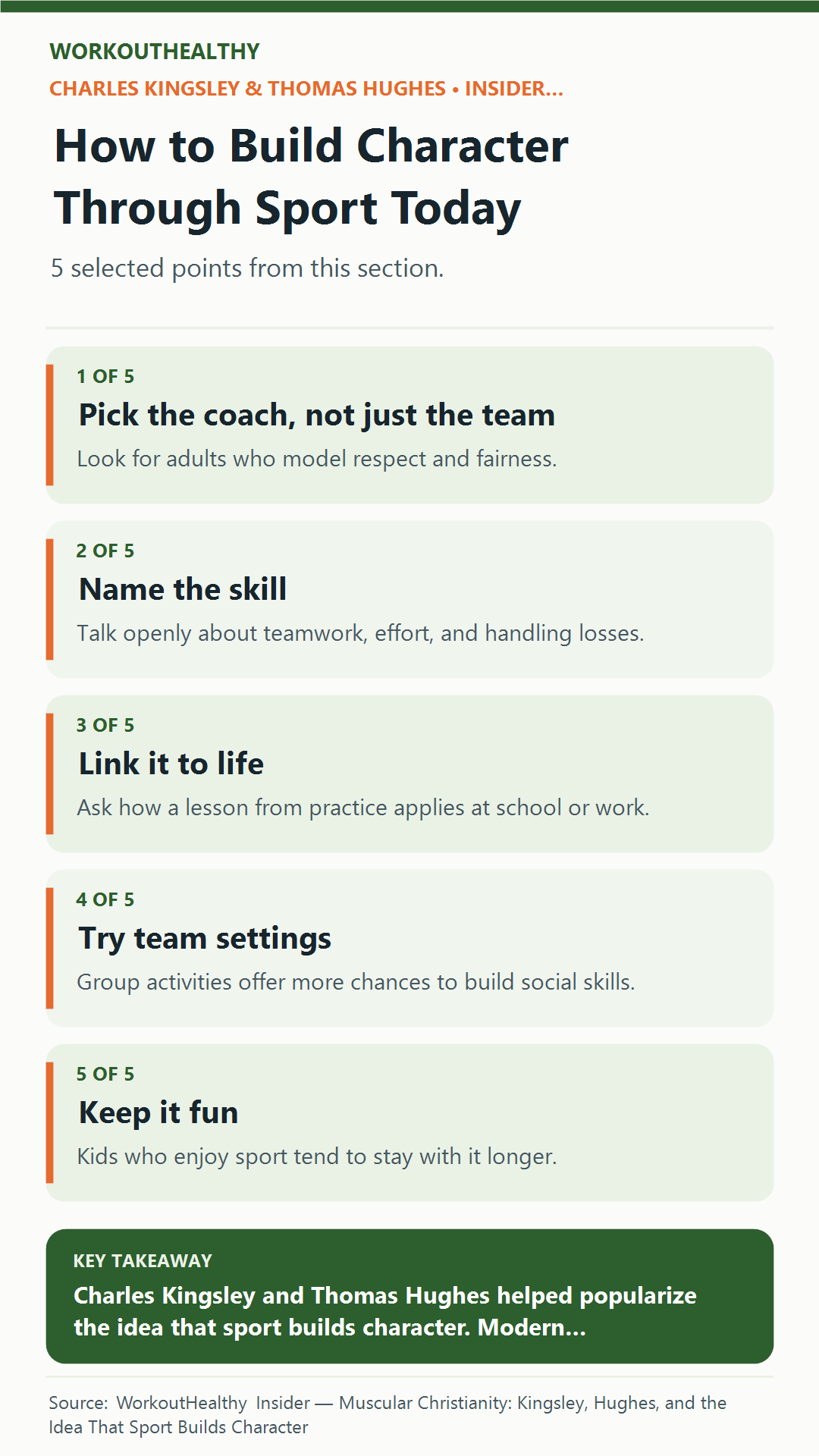
- Pick the coach, not just the team. Look for adults who model respect and fairness.
- Name the skill. Talk openly about teamwork, effort, and handling losses.
- Link it to life. Ask how a lesson from practice applies at school or work.
- Try team settings. Group activities offer more chances to build social skills.
- Keep it fun. Kids who enjoy sport tend to stay with it longer.
- Serve others. Hughes’s idea of strength for helping others still works as a goal.
Adults can use goals the same way, as in Bo Jackson’s goal setting advice.
If you like training with a group, see an honest look at whether CrossFit is for you.
Common Mistakes
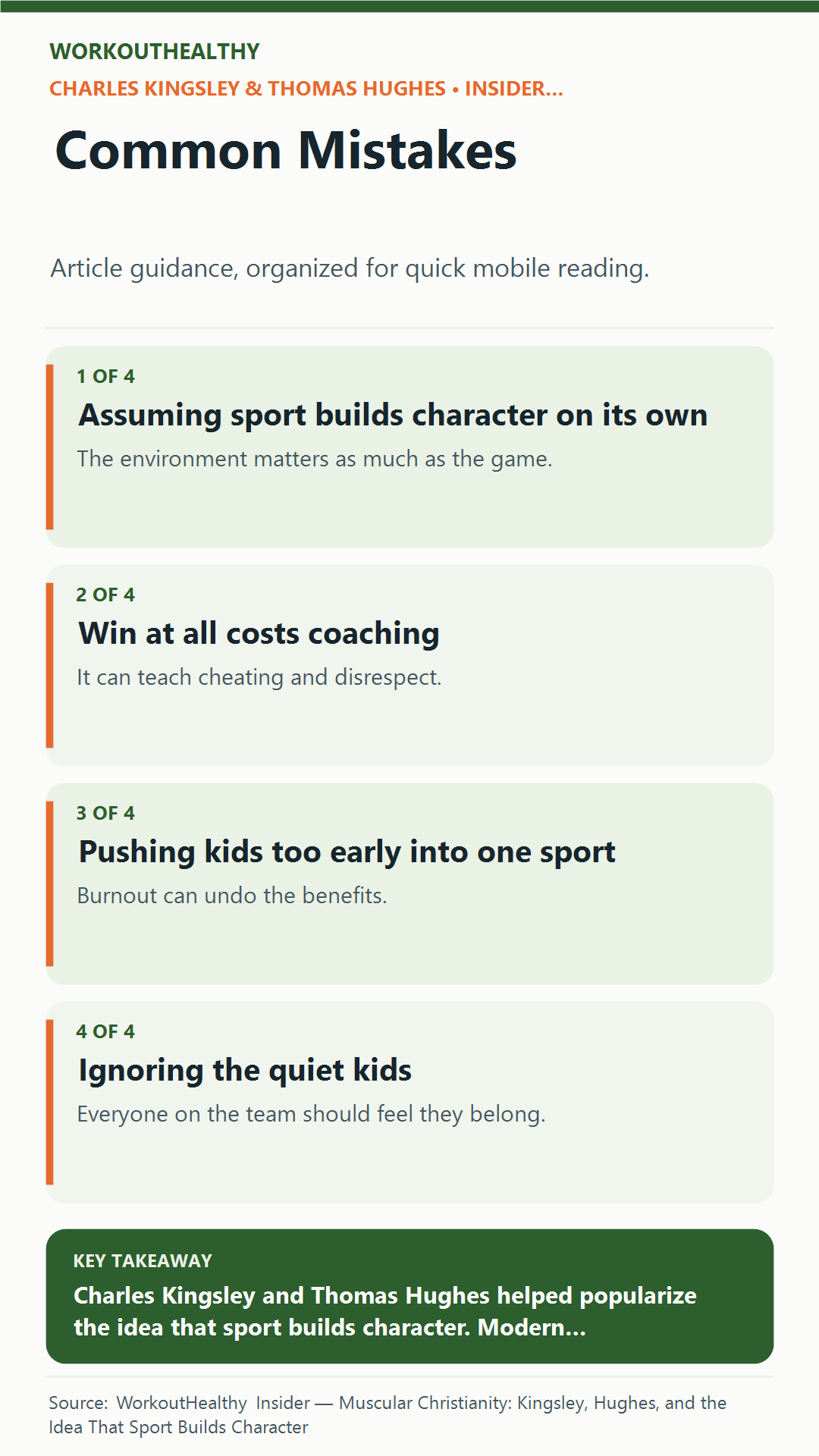
- Assuming sport builds character on its own. The environment matters as much as the game.
- Win at all costs coaching. It can teach cheating and disrespect.
- Pushing kids too early into one sport. Burnout can undo the benefits.
- Ignoring the quiet kids. Everyone on the team should feel they belong.
Who Should Be Careful
Children with health conditions should get a checkup before starting a new sport.
Parents should watch for signs of harsh coaching, bullying, or pressure that stops being healthy.
The Bottom Line
Charles Kingsley and Thomas Hughes helped popularize the idea that sport builds character.
Modern research links youth sport with better self-esteem and social skills, especially in teams.
Those benefits depend on good coaching and a supportive climate, not on sport alone.
Want more stories like this? Subscribe to WorkoutHealthy Insider for practical explanations behind popular fitness claims.
References
- Eime, R. M., Young, J. A., Harvey, J. T., Craike, M. J., & Payne, W. R. (2013). A systematic review of the psychological and social benefits of participation in sport for children and adolescents: Informing development of a conceptual model of health through sport. International Journal of Behavioral Nutrition and Physical Activity, 10, 98. https://doi.org/10.1186/1479-5868-10-98
- Holt, N. L., Neely, K. C., Slater, L. G., Camiré, M., Côté, J., Fraser-Thomas, J., MacDonald, D., Strachan, L., & Tamminen, K. A. (2017). A grounded theory of positive youth development through sport based on results from a qualitative meta-study. International Review of Sport and Exercise Psychology, 10(1), 1 to 49. https://doi.org/10.1080/1750984X.2016.1180704
- Hughes, T. (1857). Tom Brown’s school days.
- Hughes, T. (1861). Tom Brown at Oxford.
- Wikipedia contributors. (n.d.). Muscular Christianity. In Wikipedia. Retrieved September 16, 2026, from https://en.wikipedia.org/wiki/Muscular_Christianity
- Wikipedia contributors. (n.d.). Tom Brown’s School Days. In Wikipedia. Retrieved September 16, 2026, from https://en.wikipedia.org/wiki/Tom_Brown%27s_School_Days
This article is for general information only and is not medical advice. If you have an injury, ongoing pain, or a medical condition, talk to a doctor or physical therapist before you change how you train or eat.