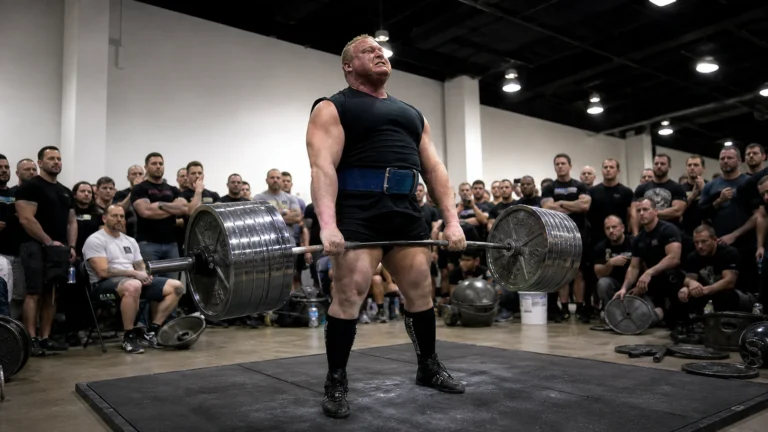
CrossFit is a good fit if you want coached group training, respond well to variety, and show up more reliably when a class is waiting for you.
It is a poor fit if you are chasing one specific number, dislike being scored in front of people, or cannot resist matching the pace of whoever is fastest in the room.
The injury picture is less alarming than the headlines suggest, but it is not nothing, and it depends heavily on who is coaching.
What follows is the honest version, including the parts that make both the fans and the critics uncomfortable.
What actually happens in a CrossFit class?
A class runs about an hour and follows a predictable shape, even though the training itself changes daily.
The coach leads everyone through a warm up, then a skill or strength piece, then the workout of the day, then a short cool down.
The workout is scored, usually by time, rounds completed, or total reps, and the results go on a whiteboard.
Movements come from three buckets that get mixed together in different combinations.
| Bucket | Typical movements | What it demands |
|---|---|---|
| Barbell and dumbbell | Squat, deadlift, press, clean, snatch, thruster | Technique under load, and more technique once you are tired |
| Gymnastics and bodyweight | Pull up, push up, dip, box jump, handstand work, rope climb | Relative strength and shoulder tolerance |
| Machines and running | Row, bike, ski, jump rope, short runs | Aerobic capacity and pacing judgment |
The defining feature is not any single movement.
It is that the whole room does the same session at the same time, at whatever load and volume each person has been assigned.
That structure is the source of most of the benefits and most of the problems.
Is the injury risk as bad as you have heard?
The honest answer is that it depends entirely on which number you look at, and the two common numbers measure different things.
Prevalence asks how many people reported an injury over some window of time.
Incidence asks how many injuries happened per 1,000 hours of training, which is the figure that lets you compare one activity to another.
| Study | Sample | What it reported |
|---|---|---|
| Weisenthal et al. (2014) | 386 survey respondents | 19.4 percent reported an injury over 6 months, most often shoulder, low back, or knee |
| Feito et al. (2018) | 3,049 participants in 42 countries | 30.5 percent reported an injury over 12 months, but only 0.27 to 0.74 injuries per 1,000 training hours |
| Claudino et al. (2018) | Systematic review of the published literature | Reported injury prevalence across studies ranged from 19 to 74 percent, with incidence of 1.9 to 3.1 per 1,000 hours |
Read the table again and notice that the prevalence figures sound frightening while the hourly figures sound ordinary.
Both can be true at once, because CrossFit participants tend to train a lot of hours, and a lot of hours means more chances for something to go wrong even at a low rate per hour.
One finding is worth pulling out on its own.
Feito and colleagues found that participants with less than six months of experience had markedly higher injury rates than those with more than five years.
That is the opposite of what the popular story says, which is that CrossFit hurts people because they push too hard for too long.
The riskier stretch appears to be the beginning, when technique is thinnest and enthusiasm is highest.
Why do the injury studies disagree so much?
Because almost all of them are retrospective surveys, and retrospective surveys have known weaknesses that nobody has fixed yet.
People who fill out a fitness survey are not a random sample of everyone who ever tried the class, and people who quit after getting hurt are the least likely to be reachable.
Recall is the second problem, since you are asking someone to remember a year of aches and decide which ones counted as injuries.
The definition of injury itself is not standardized, so one study counts any pain that changed training while another counts only time lost.
Then there is the denominator, which is where the biggest distortion hides.
Nobody measured training hours in these studies.
They were estimated, and in the 2018 analysis the reported rate moved from 0.27 to 0.74 per 1,000 hours depending only on which assumption about weekly training was used.
The same injuries produced a number that nearly tripled based on a modeling choice.
The broader review is blunt about the state of the evidence.
Claudino and colleagues found that only 9 percent of the studies they examined scored above half on a standard reporting checklist, and only 6 percent reached a higher level of evidence at low risk of bias.
That same review found no significant improvement in body composition measures across the pooled studies, while reporting consistent evidence for higher community feeling, satisfaction, and motivation among participants.
The fair conclusion is not that CrossFit is dangerous or that it is safe. It is that the research is too thin to support either headline, and anyone quoting one number at you has skipped the part where the numbers disagree.
How much does the coach change the picture?
More than any other variable you can actually control.
In the 2014 study, participants who said a trainer was present all of the time reported a 14.6 percent injury rate, compared with 31.0 percent for those supervised only some of the time.
Treat that as a direction rather than a precise effect, because it is self reported and observational, and gyms with better coaching probably differ in other ways too.
Still, the direction matches what anyone who has watched a crowded class would predict.
The practical issue is that CrossFit gyms are independently owned and licensed, so the sign on the building tells you almost nothing about the standard inside.
Two gyms in the same city can run the same posted workout with completely different coaching, class sizes, and tolerance for sloppy reps.
The questions you would ask before hiring a coach are the same questions worth asking here, and our guide to deciding whether you need a personal trainer covers how to separate a good coach from an expensive one.
What does scaling actually mean in practice?
Scaling is the mechanism that lets a room of mixed abilities do the same workout, and it is the single most misunderstood part of the model.
Every movement has a regression.
A pull up becomes a ring row, a barbell becomes a dumbbell, a heavy load becomes a light one, and thirty rounds becomes fifteen.
Done properly, scaling preserves the intended stimulus rather than producing a watered down version of the session.
The failure is rarely technical and almost always social.
Nobody wants to be the person scaling while the whiteboard fills up, so people take the prescribed load when they should not.
A coach who assigns the scale is doing the job.
A coach who merely offers it and lets the room decide has handed the decision to the least qualified person to make it.
Two situations deserve extra conservatism regardless of what the class is doing.
High rep Olympic lifts performed against a clock are technically demanding at exactly the moment your technique is worst.
Kipping pull ups load the shoulder in a way that a strict pull up does not, and building them before you own a handful of strict reps is a common way to end up with a cranky shoulder.
What are you really paying for?
A CrossFit membership usually costs several times what a standard commercial gym charges for unlimited access.
The comparison is misleading, though, because you are not buying the same product.
A big box membership buys you access to equipment and nothing else.
A CrossFit membership buys you coached class time on a fixed schedule, which is closer to small group personal training than to a gym membership.
Price it per coached hour and the gap narrows considerably.
Whether that is a good trade depends on one honest question about yourself.
If you would otherwise show up three times a week with a plan and execute it, you are paying a premium for something you already have.
If you would otherwise not show up at all, or would wander between machines without a plan, the coaching and the schedule are the product and they may be worth it.
Who does it suit, and who should pick something else?
This is where most articles get vague, so here is a direct version.
| Probably a good fit | Probably a poor fit |
|---|---|
| You need a scheduled class to actually show up | You are chasing one specific number, such as a squat max or a marathon time |
| You want general fitness rather than one narrow outcome | You dislike being scored or compared in public |
| You get bored quickly and quit programs that repeat | You are early in rehab from a joint injury without clearance to train |
| You came from team sport and miss the group | You cannot stop yourself from matching the fastest person present |
| You want to be coached rather than left alone | Your schedule rarely lines up with class times |
The specificity point deserves a sentence of its own, because it is the most legitimate criticism of the model and it has nothing to do with safety.
A program that trains many qualities at once will not build any one of them as fast as a program that trains only that quality.
If your goal is a bigger deadlift or a faster half marathon, a focused plan beats varied class work, and that is a scheduling fact rather than an insult.
Recovery is the other honest limit, since three to five hard sessions a week is a real load on top of a job and a family.
People who go from nothing to five classes a week in their first month tend to discover this the hard way, and our piece on what rest days actually do is worth reading before you buy the unlimited option.
The community effect is the part critics underrate.
It is also the one outcome the research supports most consistently, and it belongs in the same category as the well documented advantages of training alongside a partner.
Adherence is the only training variable that beats every other one, and a program you enjoy enough to keep doing will outperform the perfect program you abandon in March.
What should you ask on a drop-in visit?
Almost every gym will let you try a class or watch one, and an hour of watching answers more than a week of reading reviews.
Ask these before you sign anything.
- What are the coaching credentials of the person running this class, and how long have they coached here?
- How many people are in a typical class, and how many coaches are on the floor for that many?
- What does the beginner on ramp involve, and how many sessions before someone joins a regular class?
- How would you scale today’s workout for someone who cannot do a pull up?
- What happens if I tell you mid workout that something hurts?
- Can I try a class before committing to a contract, and what are the cancellation terms?
Then stop asking and just watch the last three minutes of the workout.
That is when fatigue strips technique down to whatever the gym has actually trained, and it tells you more about the coaching standard than any answer you will be given.
Look for whether the coach is still correcting people or has switched to watching the clock and cheering.
Look for whether anyone gets told to stop, drop weight, or cut a round short.
A gym where nobody ever scales mid workout is not a gym full of exceptional athletes.
Get the next evidence check.
Five practical fitness stories worth your time, every Friday.
One email a week. No product pitches. Unsubscribe in one click.
References
Claudino, J. G., Gabbett, T. J., Bourgeois, F., Souza, H. S., Miranda, R. C., Mezêncio, B., Soncin, R., Cardoso Filho, C. A., Bottaro, M., Hernandez, A. J., Amadio, A. C., & Serrão, J. C. (2018). CrossFit overview: Systematic review and meta-analysis. Sports Medicine Open, 4(1), 11. https://doi.org/10.1186/s40798-018-0124-5
Feito, Y., Burrows, E. K., & Tabb, L. P. (2018). A 4-year analysis of the incidence of injuries among CrossFit-trained participants. Orthopaedic Journal of Sports Medicine, 6(10), 2325967118803100. https://doi.org/10.1177/2325967118803100
Weisenthal, B. M., Beck, C. A., Maloney, M. D., DeHaven, K. E., & Giordano, B. D. (2014). Injury rate and patterns among CrossFit athletes. Orthopaedic Journal of Sports Medicine, 2(4), 2325967114531177. https://doi.org/10.1177/2325967114531177
Medical disclaimer: This article is for general information only and is not medical advice. If you have an injury, ongoing pain, or a medical condition, talk to a doctor or physical therapist before you change how you train or eat.