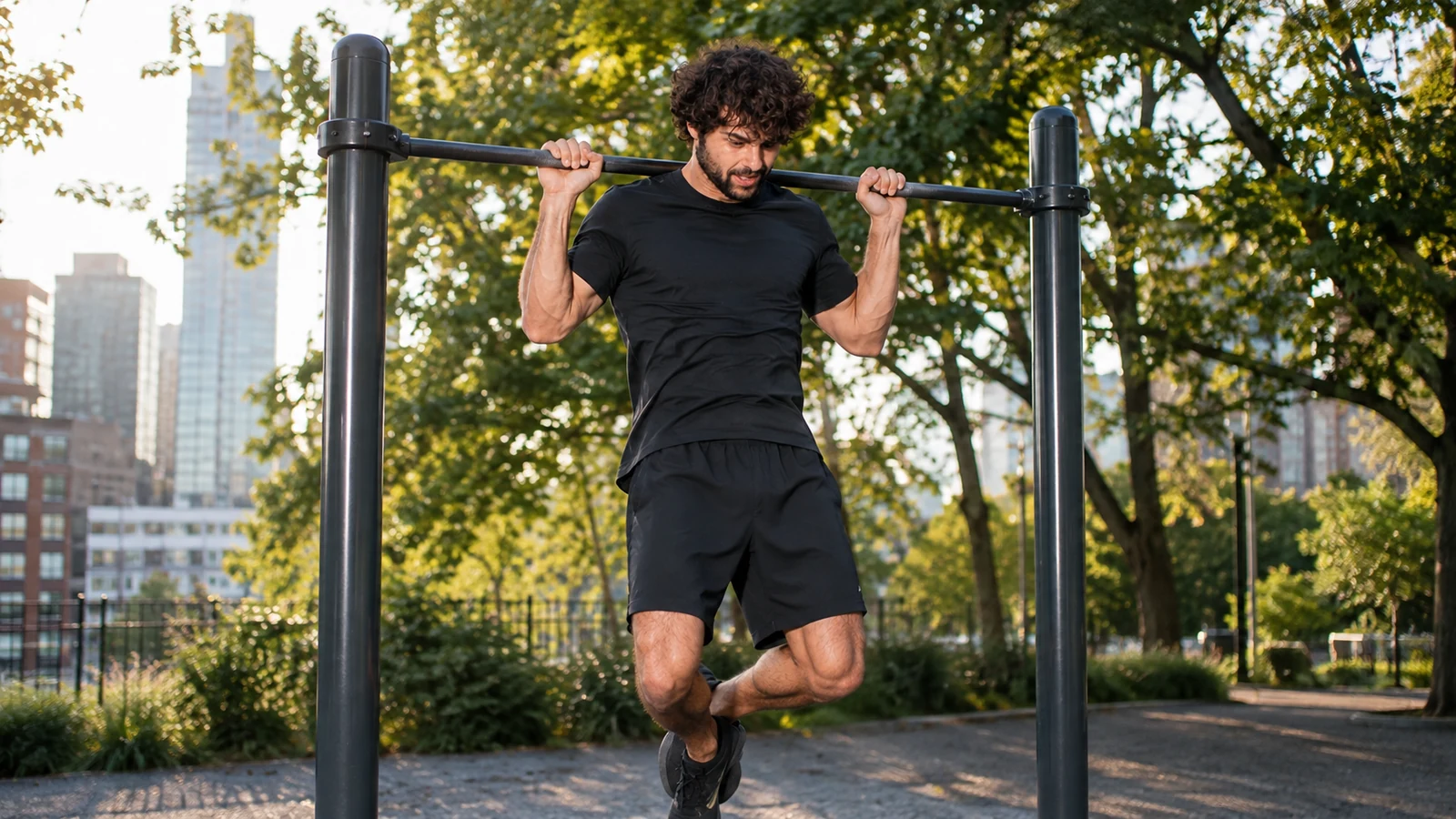

Noah Centineo is preparing to play a young version of John Rambo, and his training plan skips the heavy machines entirely.
Centineo, best known for his lead roles in the To All the Boys film franchise and for playing Atom Smasher in Black Adam, was cast in August 2025 as young John Rambo in an upcoming prequel film.
He also previously exited the role of He-Man in a planned Masters of the Universe adaptation in 2021, and has since taken on a mix of action leaning parts, including the title role in Netflix’s The Recruit.
Rambo is one of action cinema’s most physically demanding roles, built on lean, functional strength rather than bodybuilder size.
Reports on Centineo’s current training describe a program leaning on bodyweight basics, push ups and pull ups taken to failure, paired with reverse lunges and plank variations.
Pilates reportedly rounds out the program, adding core control and mobility that pure strength work tends to miss.
Nothing about the plan requires a gym membership or specialized equipment.
That accessibility is a big part of the appeal for anyone reading about the routine and wondering whether they could try something similar themselves.
The original Rambo character, played by Sylvester Stallone starting in 1982, became a defining example of lean, hardened action physicality in Hollywood, and any new take on the role invites direct comparison to that legacy.
Building a body that can plausibly carry that comparison, without relying on the same training era’s methods, is part of what makes Centineo’s reported approach worth a closer look.
What Centineo’s Training Reportedly Looks Like
The core of the reported routine centers on classic bodyweight movements taken close to muscular failure.
Push ups target the chest, shoulders, and triceps.
Pull ups build the back and biceps, along with real grip strength.
Reverse lunges add single leg strength and balance, which matters for a role built around athletic, controlled movement rather than straight line power.
Plank variations reportedly round out the core work, building the kind of trunk stability that supports nearly every other movement in the program.
Pilates adds a different kind of training on top of that foundation, emphasizing controlled movement, breathing, and core engagement in a way that traditional strength training does not always address directly.
On the nutrition side, reports describe Centineo keeping things simple with whole foods rather than tracking macros closely, favoring meals like steak and eggs, chicken and rice, and a protein shake after training.
That kind of straightforward approach to food lines up with the no frills, no gym theme of the training plan as a whole.
Why a No Gym Approach Fits the Role
Bodyweight training has a real appeal beyond its accessibility.
The same push up and pull up progressions used in a reported celebrity training plan are available to almost anyone willing to do them consistently, without a gym membership or specialized equipment standing in the way.
That accessibility does not mean the training is easy.
Bodyweight exercises taken to failure, especially pull ups, remain genuinely demanding even for people with a strength training background.
For an action role, a no gym approach also has a practical benefit tied directly to how the body ends up moving on screen.
Bodyweight training builds strength through a body’s own natural ranges of motion and stabilization patterns, which tends to translate well to the kind of controlled, athletic movement stunt work and action choreography require.
It also carries a practical production advantage.
A training plan that does not depend on a fully equipped gym can travel with an actor to different filming locations far more easily than one built around specific machines or heavy free weight setups.
What the Research Says About Bodyweight Training
Bodyweight training is sometimes dismissed as less effective than lifting weights, but the research does not support that assumption, at least for building real strength.
A study published in the Journal of Strength and Conditioning Research tested a progressive calisthenic push up program against a traditional bench press program in moderately trained men over several weeks, measuring both upper body strength and muscle thickness (Kotarsky et al., 2018).
The researchers found that progressive calisthenic push up training produced strength improvements comparable to traditional bench press training, showing that bodyweight movement can build real, measurable strength when the difficulty is progressed over time.
Muscle does not care whether resistance comes from a barbell or your own body weight, as long as the training is genuinely challenging and progressed over time.
Pull ups specifically have their own supporting research.
A study using surface electromyography, a method that measures electrical activity in working muscles, compared muscle activation patterns and elbow joint motion across pull up, chin up, and a rotational pull up variation (Youdas et al., 2010).
That research confirmed that pull up style exercises meaningfully activate the back, shoulder, and arm muscles, supporting their use as a legitimate strength building tool rather than just an endurance test.
What This Evidence Does Not Prove
The push up study involved moderately trained men over a period of weeks, not months of preparation for a specific film role.
It also measured chest and triceps strength specifically, not the full body demands an action role actually places on someone.
Neither study measured Centineo directly, and reports on his specific training volume, exact exercise selection, and weekly schedule have not been independently verified through a published training log.
What the research does support is the broader claim underlying his reported approach.
Bodyweight training, done consistently and progressed over time, can build real strength without a gym, even if the exact program details for this specific role remain unconfirmed.
How This Compares to General Fitness Guidance
Most people do not need to train like they are preparing for an action film, but the underlying lesson still applies broadly.
Bodyweight training is one of the most accessible entry points into structured exercise, requiring no equipment and very little space.
The same principles that apparently guide Centineo’s reported routine, working close to failure, progressing difficulty over time, and pairing strength work with mobility focused training like Pilates, apply just as well to a beginner working out in a small apartment as to an actor preparing for a physically demanding role.
The difference is mostly intensity and volume, not the underlying structure of the program.
Common Mistakes People Make With Bodyweight Training
The most common mistake is treating bodyweight training as automatically easier than lifting weights and never progressing the difficulty.
Standard push ups and pull ups eventually stop being challenging for anyone who trains them consistently, and progress stalls without a plan to make them harder over time.
A second mistake is poor form, especially on pull ups, where momentum and partial range of motion can substitute for real strength without a person noticing.
Slow, controlled repetitions through a full range of motion build far more strength than fast, incomplete ones.
A third mistake is skipping a real strength foundation before attempting advanced bodyweight skills, like one arm push up progressions or muscle ups.
Building toward those advanced movements too quickly raises injury risk, particularly in the shoulders and elbows.
People also tend to neglect leg training in bodyweight programs focused heavily on upper body pushing and pulling.
Lunges, single leg squats, and calf work all deserve a regular place in a well rounded bodyweight routine, not an afterthought.
How to Build a Bodyweight Training Program
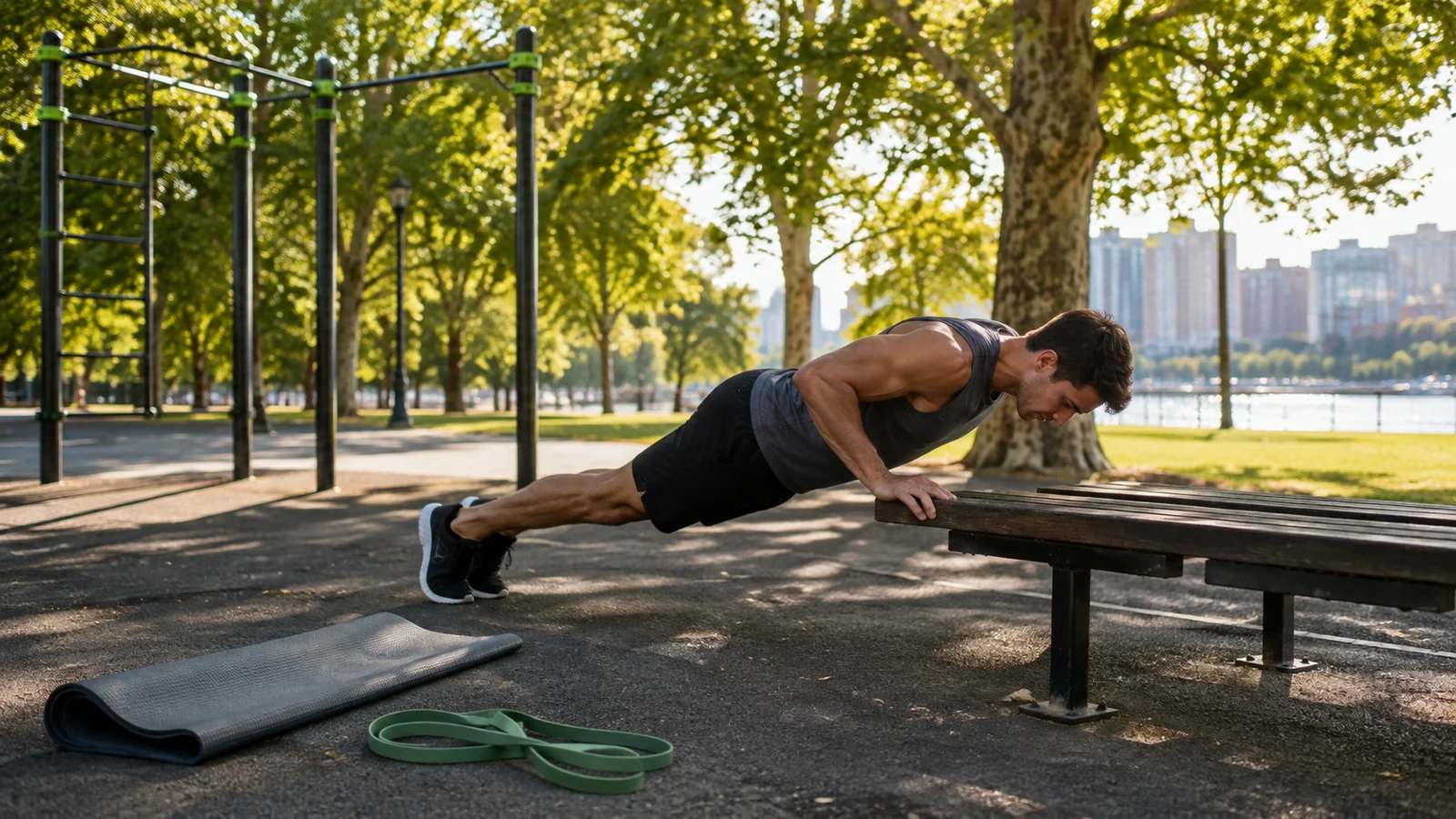
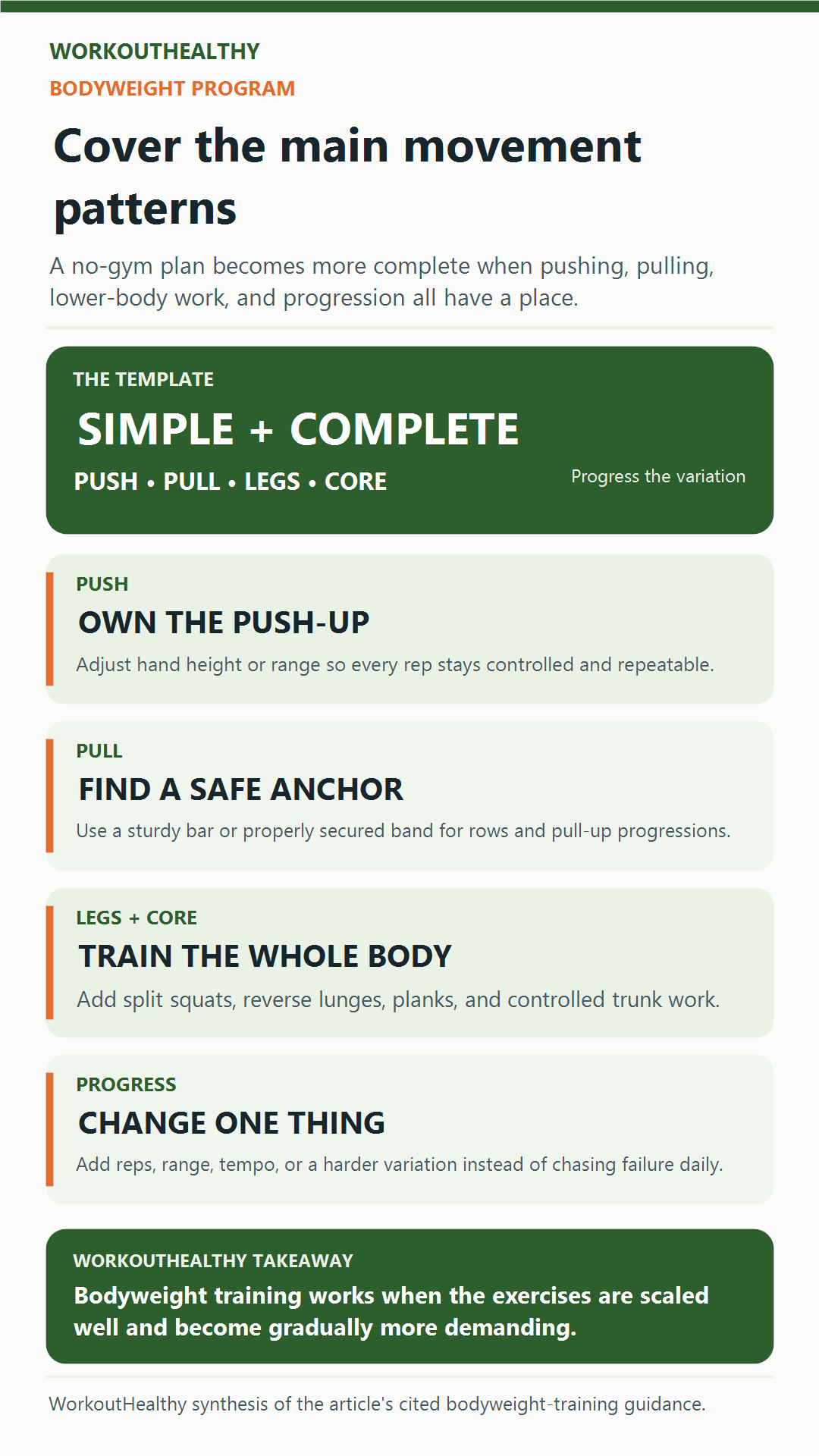
Start with the basics, standard push ups, pull ups or assisted pull ups, lunges, and planks, and master good form before adding difficulty.
Track your reps over time and aim to gradually increase either the number of reps or the difficulty of the variation you are doing.
If a standard pull up feels out of reach, start with an assisted version using a resistance band or a pull up assist machine, and progress from there.
Add plank and core variations two to three times a week, since trunk stability supports nearly every other movement in a bodyweight program.
Consider adding a class like Pilates once or twice a week for mobility, breathing control, and a different style of core engagement than straight strength work provides.
Our guide on what the research actually says about Pilates covers what the evidence supports and where it falls short.
Progress toward harder variations gradually, moving from knee push ups to standard push ups to decline push ups, for example, rather than jumping straight to the hardest version of an exercise.
Rest at least one full day between sessions targeting the same muscle groups to allow real recovery.
Fuel the training with enough protein and total food intake to support recovery, using simple, whole food meals rather than an overly complicated plan.
Consistency matters more than any single meal or workout, so build a routine you can realistically sustain for months, not just a few weeks.
If you plateau or want a more structured plan, working with a qualified trainer can help design a program suited to your specific goals.
Our guide on how to decide whether you need a personal trainer walks through what to look for.
References
Kotarsky, C. J., Christensen, B. K., Miller, J. S., & Hackney, K. J. (2018). Effect of progressive calisthenic push-up training on muscle strength and thickness. Journal of Strength and Conditioning Research, 32(3), 651-659.
Youdas, J. W., Amundson, C. L., Cicero, K. S., Hahn, J. J., Harezlak, D. T., & Hollman, J. H. (2010). Surface electromyographic activation patterns and elbow joint motion during a pull-up, chin-up, or Perfect-Pullup rotational exercise. Journal of Strength and Conditioning Research, 24(12), 3404-3414.
This article is for general educational purposes and is not a substitute for personalized advice from a qualified fitness professional.
Anyone new to pull ups or advanced bodyweight movements should progress gradually and consider guidance from a qualified trainer to reduce injury risk.