

Miley Cyrus built her career on her voice.
In 2019, that voice went almost completely silent for weeks at a time.
She underwent vocal cord surgery that year, tied to ongoing complications from tonsillitis.
The procedure forced her to pause both recording and live performances while she recovered.
Doctors required strict vocal rest afterward. That meant she could not perform.
For a stretch of time, she could barely speak above a whisper.
She has described that forced stillness as an unexpected turning point in her life, not just a professional setback.
What Actually Happened
Cyrus has dealt with vocal health issues publicly more than once over her career.
In 2019, complications connected to tonsillitis led to vocal cord surgery.
She postponed scheduled performances, including a planned appearance at a major music festival that year, while she went through the procedure and the recovery period that followed.
Vocal cord surgery is a serious medical procedure, not a routine fix.
Singers rely on precise, repeated vibration of the vocal folds to produce their sound.
Any surgery in that area carries real risk to future vocal quality if recovery is rushed or mishandled.
Cyrus waited until she was medically cleared before returning to the stage and the studio.
She has connected that recovery period to other decisions she made about her health afterward, including choosing sobriety.
She has spoken about the forced pause giving her space to reconsider habits and choices she might not have examined otherwise.
Why This Matters Beyond the Music Industry
Most readers are not professional singers, and that is worth saying plainly.
Still, the underlying lesson in Cyrus’s story applies to almost anyone who uses their voice heavily for work.
Teachers, coaches, call center workers, public speakers, and anyone who talks for hours a day put real, repeated strain on the same small muscles and tissues a singer relies on.
Vocal fold tissue is delicate. It vibrates hundreds of times per second during normal speech, and even more during singing.
Chronic overuse, whether from a demanding job or from pushing through illness, can lead to the same kinds of injuries that eventually require medical intervention, including surgery in more severe cases.
Cyrus’s story is a high profile example of a much more common problem. Vocal strain rarely announces itself with dramatic symptoms right away.
It tends to build slowly, through habits like talking over background noise, skipping hydration, or working through hoarseness instead of resting.
What She Has Said About the Experience
Cyrus has described the vocal rest period as one of the hardest stretches of her career, precisely because performing and recording are so central to her identity.
She has also described it as valuable in hindsight, even though it did not feel that way at the time.
She has talked about learning to sit with stillness during that period, rather than pushing through it the way she might have handled a setback earlier in her career.
She has said the experience reshaped how she thinks about protecting her voice long term, not just recovering from a single injury.
That framing, protecting the instrument rather than just performing through pain, is a theme she has returned to in discussing her health since.

The Science Behind Voice Rest and Vocal Recovery
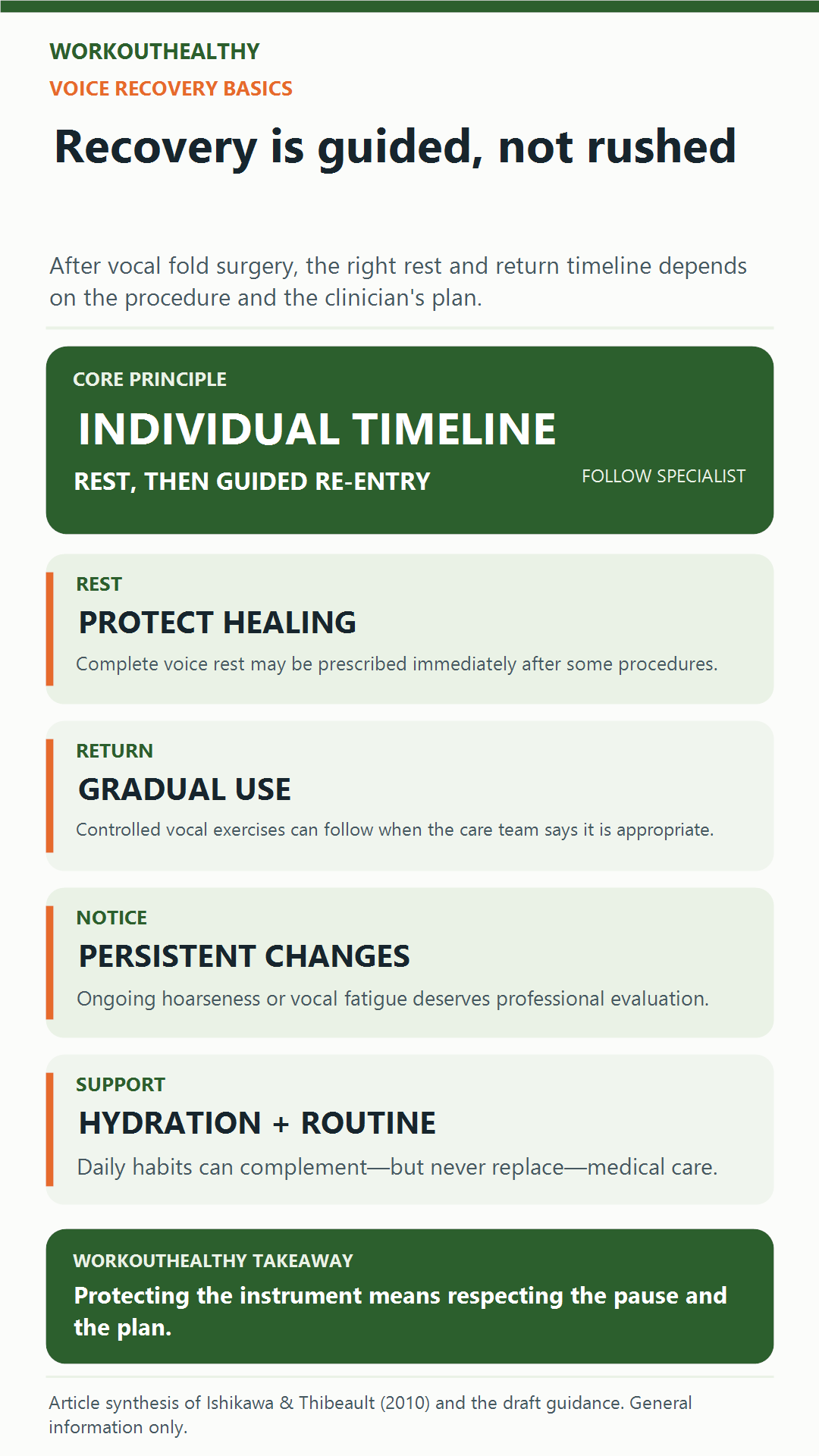
Voice rest is a common recommendation after vocal fold surgery, but the science behind exactly how much rest helps is more nuanced than a simple prescription.
A 2010 review published in the Journal of Voice examined the existing research comparing voice rest to early vocal exercise after vocal fold injury or surgery (Ishikawa & Thibeault, 2010).
The review found that both complete voice rest and controlled, gradual vocal use have supporting evidence, depending on the type of injury and the specific surgical procedure involved.
Complete silence for a period of time is still commonly recommended immediately after certain surgeries, since vocal fold tissue needs time to heal without added vibration and friction.
The review also noted that the exact duration of recommended rest varies by surgeon, injury type, and severity, which is part of why treatment plans are individualized rather than standardized across every case.
What the research is clear about is this: rushing back to full vocal use before tissue has healed raises the risk of long term vocal damage, including scarring that can permanently change a singer’s voice.
That risk is part of why professional guidance, not personal preference, generally drives the timeline for returning to singing after vocal surgery.
The Science Behind Exercise and Recovery-Focused Habits
Separately, Cyrus has connected her 2019 health pause to broader choices about sobriety and wellness.
Exercise as a support for recovery from substance use has become a genuine area of scientific study, not just informal wisdom.
A 2015 review published in The American Journal of Drug and Alcohol Abuse examined exercise-based approaches to supporting recovery from substance use disorders (Linke & Ussher, 2015).
The review found consistent evidence that structured physical activity can help reduce cravings and improve mood during recovery.
It also pointed to a plausible biological mechanism: exercise affects some of the same brain reward pathways involved in substance use, which may help explain part of the benefit.
The review noted that exercise appeared to help through several channels at once, including better sleep, reduced anxiety, and a stronger sense of routine during a period when daily structure can otherwise feel unstable.
How This Compares to General Guidance
Ear, nose, and throat specialists and speech-language pathologists generally agree that a structured, gradual return to vocal activity works better than an all-or-nothing approach for most patients recovering from vocal fold surgery.
That typically starts with a defined period of complete rest, followed by carefully guided vocal exercises before any return to singing or heavy vocal use.
Addiction medicine specialists similarly tend to describe exercise as a helpful, complementary tool within a broader recovery plan, rather than a stand-alone treatment on its own.
In both cases, the common thread is the same: gradual, professionally guided progress tends to outperform trying to push straight back to full activity too soon.
Who Should Talk to a Doctor First
Anyone experiencing ongoing hoarseness, vocal fatigue, or voice changes lasting more than two to three weeks should see a doctor or an ear, nose, and throat specialist.
That is especially true for singers, teachers, and anyone whose work depends heavily on their voice.
Anyone recovering from vocal fold surgery should follow their surgeon’s specific timeline for vocal rest and gradual return to use, rather than a generic guideline found online.
People considering exercise as part of a recovery plan from substance use should talk with a doctor or treatment professional before making major changes to their routine.
This is especially important during early recovery, since physical stress from intense exercise can interact with other aspects of health during that period.
Exercise should never replace prescribed treatment, therapy, or medical care for either vocal health or substance use recovery.
If you or someone you know is struggling with substance use, the Substance Abuse and Mental Health Services Administration operates a free, confidential national helpline at 1-800-662-4357.
How to Support Your Own Recovery and Wellness Habits
If you rely on your voice for work, learn the early warning signs of vocal strain, including persistent hoarseness, a lower than normal pitch, or vocal fatigue after light use.
See a specialist early rather than waiting for symptoms to resolve on their own.
If you are recovering from any surgery, follow the specific rest and rehabilitation timeline your own doctor gives you, even if it feels slower than you would like.
Consider how physical activity fits into a broader wellness routine, not as a replacement for treatment, but as a genuine complement to it.
Our guide on how many miles to walk a day is a reasonable, low pressure starting point if you are rebuilding a routine after a difficult stretch.
Build consistency before intensity. A short daily walk kept up for months does more for long term habit change than one intense session kept up for a week.
Pay attention to sleep and stress management alongside any physical activity plan, since both affect recovery in ways that are easy to overlook.
Give yourself permission to treat a forced pause, whether from illness, surgery, or burnout, as a genuine opportunity to reassess habits, not just an inconvenience to push through.
Stay hydrated throughout the day if your voice gets heavy daily use. Dry vocal folds are more prone to irritation and injury than well hydrated tissue.
Warm up your voice before demanding use, the same way you would warm up before a workout.
Gentle humming or light vocal exercises before a big presentation, a shift teaching, or a performance can reduce strain.
Notice your own early warning signs. A voice that sounds rougher than usual by the end of the day is worth paying attention to, not ignoring until it becomes a bigger problem.
If you are supporting someone else through a health pause, whether a vocal injury, a surgery recovery, or early sobriety, patience matters more than urgency.
Recovery timelines are rarely as fast as anyone would like them to be.
References
Ishikawa, K., & Thibeault, S. (2010). Voice rest versus exercise: A review of the literature. Journal of Voice, 24(4), 379-387.
Linke, S. E., & Ussher, M. (2015). Exercise-based treatments for substance use disorders: Evidence, theory, and practicality. The American Journal of Drug and Alcohol Abuse, 41(1), 7-15.
This article is for general information only.
Details of any individual’s personal medical, vocal, or recovery history are drawn from public reporting and have not been independently verified in every particular.
This is not personal medical advice.
Anyone experiencing vocal health issues, recovering from surgery, or navigating recovery from substance use should talk with a qualified healthcare provider first.
If you or someone you know needs support, the Substance Abuse and Mental Health Services Administration’s National Helpline is available free and confidential at 1-800-662-4357.