
Every lifter knows the spot where a heavy rep slows down and stalls.
In the early 1960s, Bob Hoffman sold American lifters a plan to attack that spot head on.
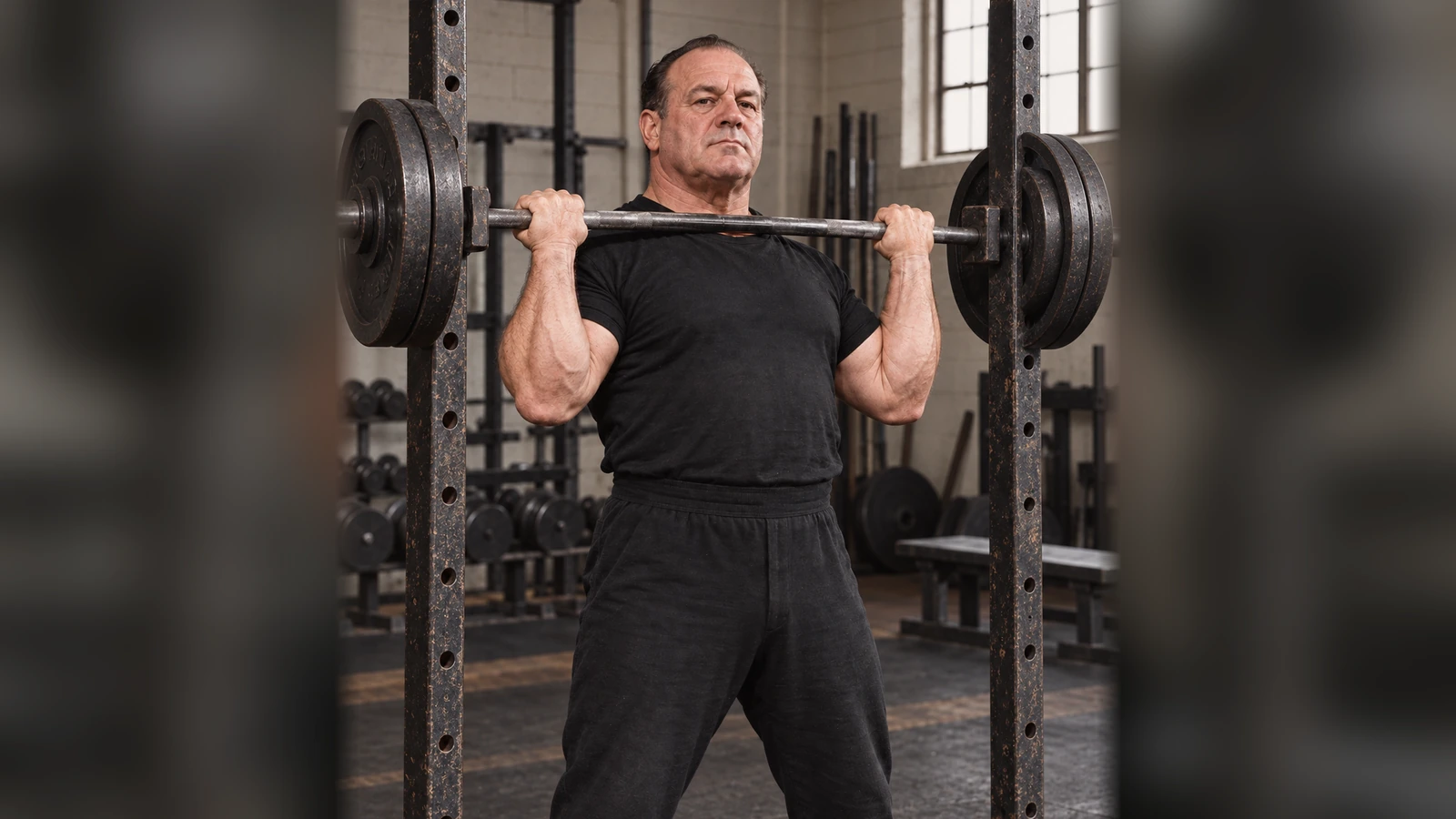
Set the bar against the pins of a power rack, push or pull as hard as you can, and hold.
He called it Functional Isometric Contraction, and he made big promises about it.
The core idea still has a place in training today. The promises and the story around them need a closer look.
Who Bob Hoffman Was
Bob Hoffman lived from 1898 to 1985.
He built the York Barbell company in York, Pennsylvania, and started Strength & Health magazine in 1932.
He also coached the American Olympic weightlifting team between 1936 and 1968.
The International Weightlifting Federation later named him the “Father of World Weightlifting.”
He also sold protein supplements, and medical experts criticized some of his marketing claims as misleading.
What the 1962 System Actually Said
Hoffman published Functional Isometric Contraction in 1962.
The text describes a single all out contraction of about 12 seconds for each exercise.
Its main argument was that strength should be built “in the position the strength was to be used.”
The key tool was a power rack sold by York.
Hoffman wrote that lifters could train as often as six times a week without tiring.
He also claimed users could gain strength and muscle “two to four times as fast” as usual.
He even predicted that “All weight lifting records will be broken in the next two years.”
The book names lifter Louis Riecke as a main test subject, and lists physician John Ziegler on the development team.
Why the Idea Caught On
The pitch was simple and appealing.
A session could take only a few minutes, with one hard effort per exercise.
It promised to fix the exact spot where a lifter kept failing.
For busy people, that sounded like a shortcut worth buying.
The Part of the Story Often Left Out
Ziegler matters here for another reason.
He worked with Ciba to develop the anabolic steroid methandrostenolone, sold as Dianabol, in 1958.
His Wikipedia biography says he gave it to the entire U.S. Olympic weightlifting team at the 1960 Rome Games.
He later said he wished he had never done that work.
So some York lifters were being given steroids in the same era isometrics were being promoted.
That makes it hard to credit the fast gains of that time to rack holds alone.
Isometric holds are a useful tool. They were never the miracle they were sold as.
What Research Says About Joint Angle Specificity
The central claim, that holds build strength at the angle you train, does have support.
In a small 1989 study, Kitai and Sale had six women train their calf muscles isometrically at one ankle angle.
They did two sets of ten 5 second maximal contractions, three times a week for six weeks.
Voluntary strength rose at the training angle and the two nearest test angles only.
Those nearest angles were just 5 degrees away in each direction.
The authors concluded that a neural mechanism explained this angle specific effect.
In plain terms, your nervous system gets better at that exact position first.
Can Isometrics Build Muscle Too?
Many people assume holds only help strength at one angle. The research is more positive than that.
A 2019 systematic review by Dustin Oranchuk and colleagues looked at 26 isometric training studies lasting at least three weeks.
Training at longer muscle lengths produced more muscle growth than the same amount of training at shorter lengths.
Long length training also carried over better to dynamic performance.
Contracting with fast, explosive intent improved rapid force production more.
High intensity contractions, at 70 percent of maximum or more, were needed to improve tendon structure and function.
For more on that last point, see our look at how a 6 second hold can build tendon strength.
What Isometrics Do Not Do
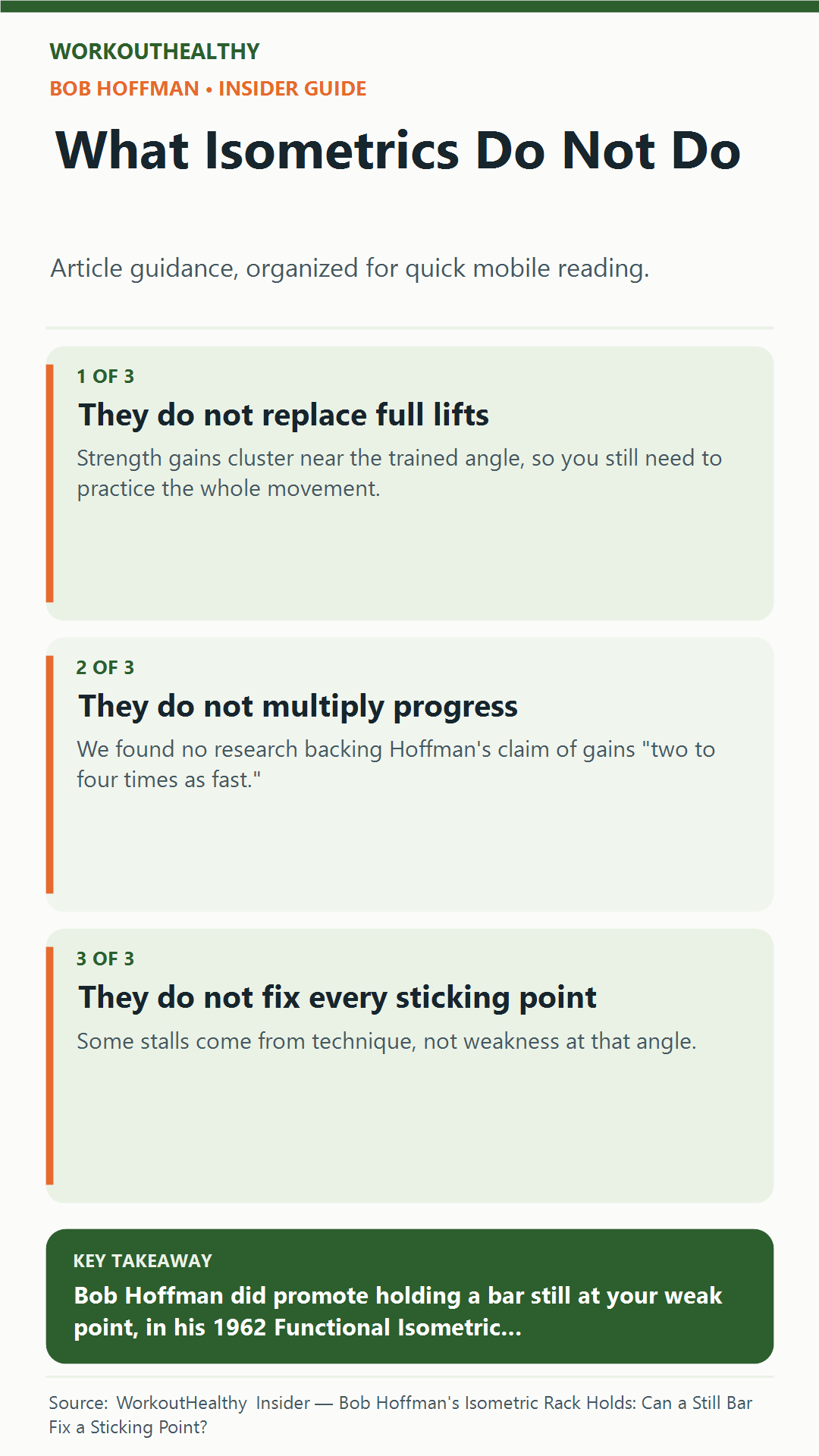
- They do not replace full lifts. Strength gains cluster near the trained angle, so you still need to practice the whole movement.
- They do not multiply progress. We found no research backing Hoffman’s claim of gains “two to four times as fast.”
- They do not fix every sticking point. Some stalls come from technique, not weakness at that angle.
How to Use Rack Holds Today
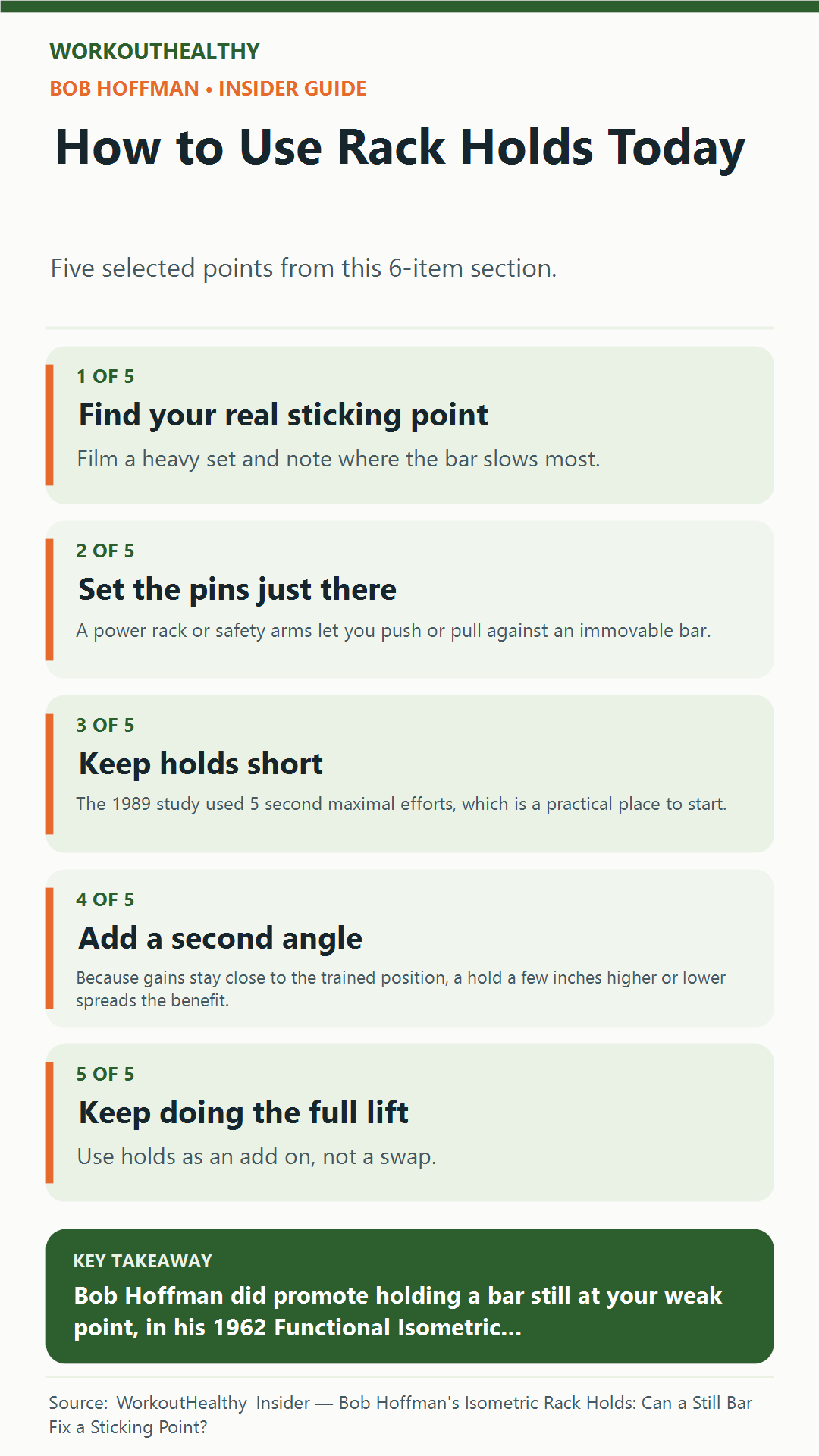
- Find your real sticking point. Film a heavy set and note where the bar slows most.
- Set the pins just there. A power rack or safety arms let you push or pull against an immovable bar.
- Keep holds short. The 1989 study used 5 second maximal efforts, which is a practical place to start.
- Add a second angle. Because gains stay close to the trained position, a hold a few inches higher or lower spreads the benefit.
- Keep doing the full lift. Use holds as an add on, not a swap.
- Ramp up effort. Build to a max push over a second or two instead of yanking.
If a full squat or pull is not right for you now, our guide to deadlift alternatives matched to your goal offers other options.
Who Should Be Careful
Maximal isometric efforts can raise blood pressure sharply, especially if you hold your breath.
People with high blood pressure or heart disease should get medical advice before trying all out holds.
Anyone with a current back, knee, or shoulder injury should work with a physical therapist on angles and effort.
Lighter wall sits are a gentler entry point, as our article on one minute wall sits explains.
The Bottom Line
Bob Hoffman did promote holding a bar still at your weak point, in his 1962 Functional Isometric Contraction system.
Research supports the core idea that isometric strength gains are strongest near the trained angle.
It also shows holds can build muscle and tendon, especially at longer muscle lengths.
Hoffman’s speed claims were never shown, and steroid use in that era clouds the early results.
Use rack holds as a focused tool, and keep training the full lift.
Want more stories like this? Subscribe to WorkoutHealthy Insider for practical explanations behind popular fitness claims.
References
- Hoffman, B. (1962). Functional isometric contraction.
- Kitai, T. A., & Sale, D. G. (1989). Specificity of joint angle in isometric training. European Journal of Applied Physiology and Occupational Physiology, 58(7), 744 to 748. https://doi.org/10.1007/BF00637386
- Oranchuk, D. J., Storey, A. G., Nelson, A. R., & Cronin, J. B. (2019). Isometric training and long-term adaptations: Effects of muscle length, intensity, and intent: A systematic review. Scandinavian Journal of Medicine & Science in Sports, 29(4), 484 to 503. https://doi.org/10.1111/sms.13375
- Wikipedia contributors. (n.d.). John Bosley Ziegler. In Wikipedia. Retrieved September 16, 2026, from https://en.wikipedia.org/wiki/John_Bosley_Ziegler
This article is for general information only and is not medical advice. If you have an injury, ongoing pain, or a medical condition, talk to a doctor or physical therapist before you change how you train or eat.