
Early last century, a strongman known for training against chains and straps built a reputation for strength that outran his size.
Modern researchers have since studied the same idea under a plainer name: overcoming isometrics, meaning pushing or pulling with maximal effort against something that will not move.
What “Overcoming Isometrics” Means
In a normal lift, a joint moves through a range of motion against resistance.
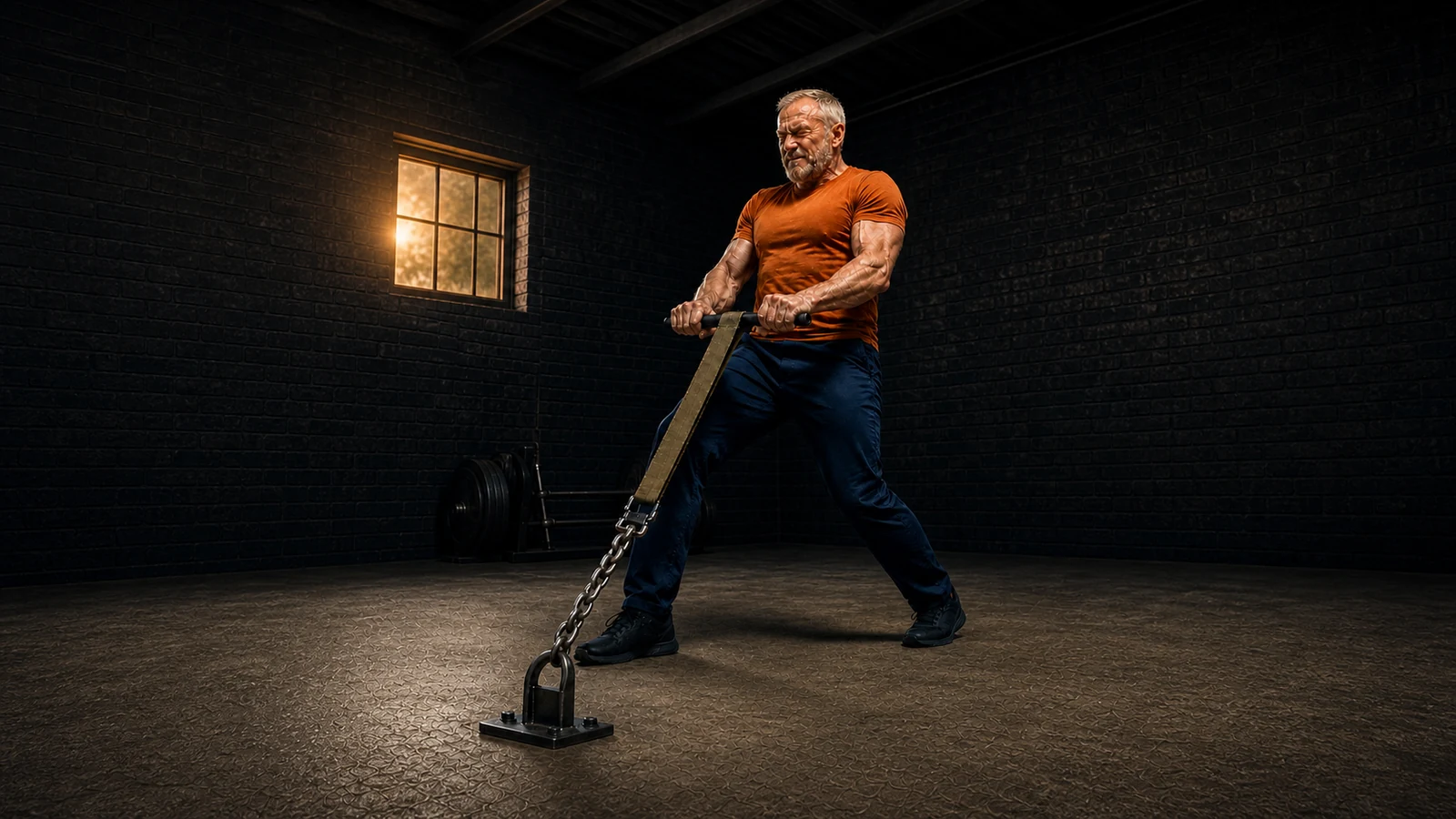
In an overcoming isometric, you push or pull as hard as possible against an immovable object, like a strap anchored to a fixed point, so no movement happens at all.
The appeal is that a short, maximal effort hold can create very high muscle tension without the joint speed and impact of a normal lift.
That combination is part of why researchers have looked at it for tendon health specifically.
What a 12-Week Study Actually Measured
A frequently cited study on isometric training and tendons followed eight men through 12 weeks of unilateral knee extension training, four days a week, holding each contraction at high effort for short periods (Kubo et al., 2001).
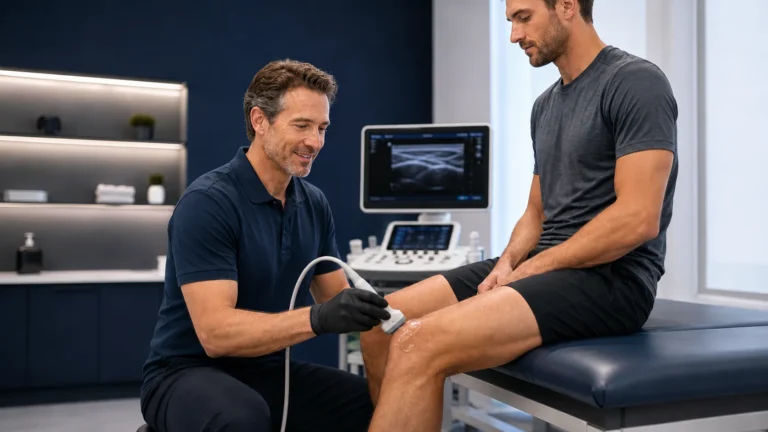
Researchers used ultrasound imaging to measure how much the tendon stretched under a standardized load before and after training.
By the end of the 12 weeks, tendon stiffness had increased from about 67.5 to 106.2 newtons per millimeter, a jump of roughly 57 percent.
Muscle strength rose by about 34 percent over the same period, and the rate at which the muscle could develop force also improved.
A stiffer tendon is not a cosmetic change. It is a structure that transmits force faster and more efficiently from muscle to joint.
Why a Stiffer Tendon Matters
Tendons connect muscle to bone, and their stiffness affects how quickly force gets transmitted when a muscle contracts.
A more compliant, “loose” tendon delays that transmission slightly, while a stiffer one passes force through faster.
That helps explain why isometric training has also been linked to faster force development, not just bigger strength numbers on a slow test.
It is a plausible mechanical reason overcoming isometrics might benefit explosive movements too, alongside the strength gain itself.
What a Larger Review of Tendon Studies Adds
A single study on eight men is a narrow window into tendon adaptation.
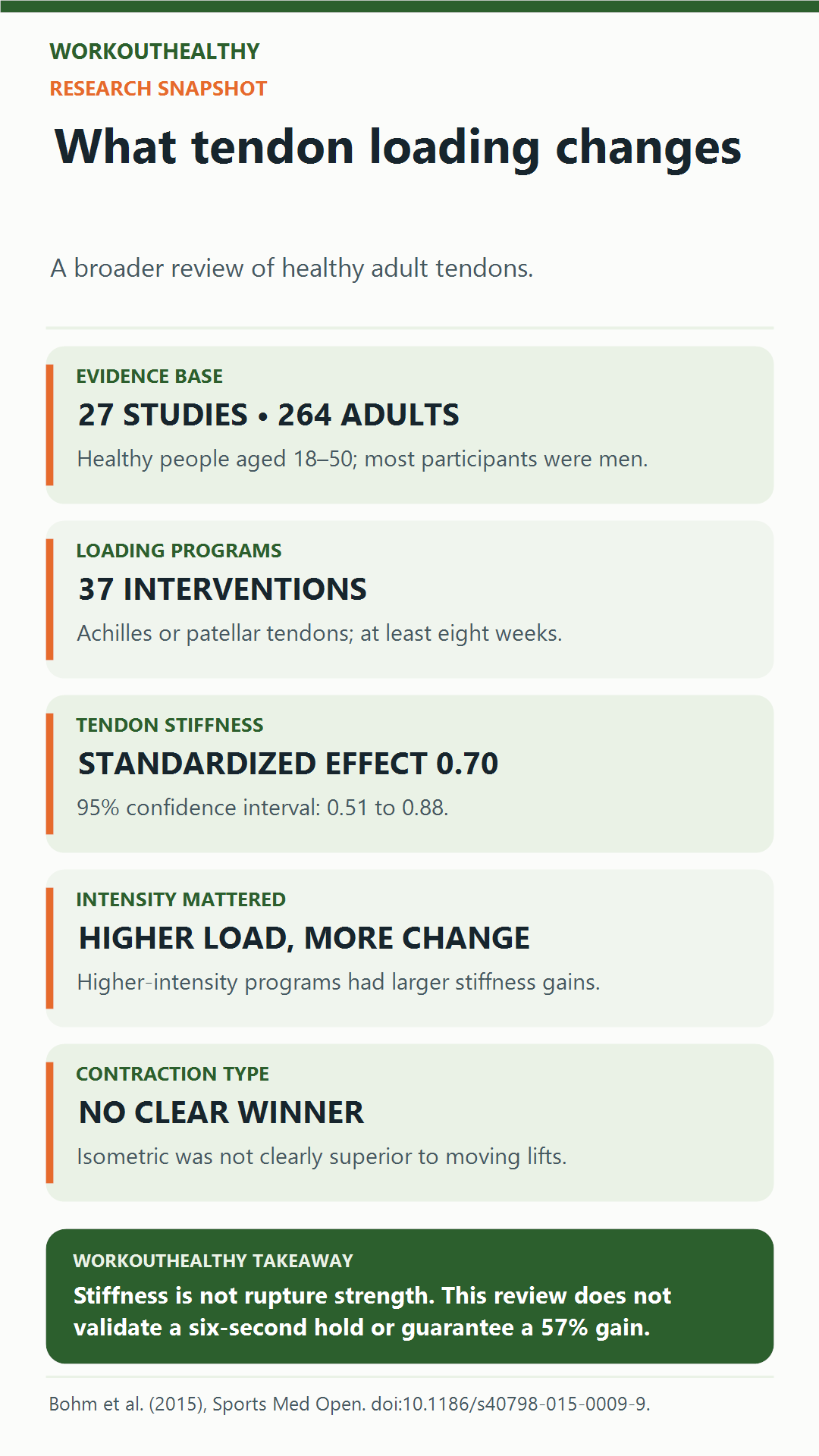
A systematic review and meta-analysis that pooled many exercise intervention studies on tendon loading in healthy adults gives a much wider view of what actually drives the change (Bohm et al., 2015).
The review’s central finding was about intensity, not contraction type.
Loading at high effort, above roughly 70 percent of a person’s maximum, produced far larger tendon adaptations than lower intensity loading.
Whether the contraction was isometric, like the knee extension holds in the Kubo study, or a normal moving lift with an eccentric and concentric phase, made little difference once intensity was high enough.
Duration mattered too.
Programs lasting 12 weeks or longer tended to produce somewhat larger effects than shorter ones, though real adaptation was already visible within about 8 weeks in the pooled data.
That timeline lines up closely with the 12-week protocol that produced the 57 percent stiffness increase in the original study.
What This Means for “Overcoming” Isometrics Specifically
Put the two studies together and a more complete picture appears. Overcoming isometrics are not a uniquely magical way to build tendon stiffness.
They are one effective way to hit the intensity threshold that actually drives the adaptation, because pushing against an immovable object makes it easy to generate near maximal tension safely.
A heavy, slow, moving lift taken to a similarly high effort could plausibly produce a similar tendon response, based on the broader review’s finding that contraction type mattered less than intensity.
Overcoming isometrics are a convenient, joint friendly tool for reaching high tension. They are not the only tool that can get there.
Overcoming Isometrics vs. Yielding Isometrics
Not every isometric hold is the same kind of exercise.
An overcoming isometric, the type in this research, means pushing or pulling against something that genuinely cannot move, like a strap fixed to the floor.
All the tension comes from your own effort.
A yielding isometric is different.
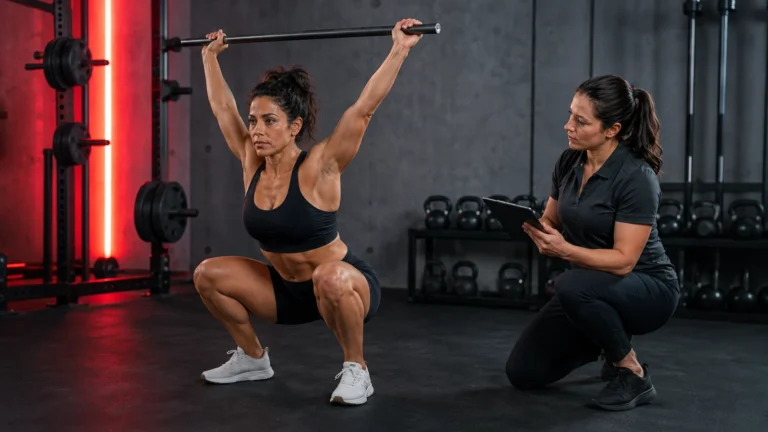
It means holding a position under a load that could move if you let it, like the bottom of a squat with a barbell on your back, or a wall sit under your own bodyweight.
The tension there comes from resisting the load, not from pushing as hard as you can against something fixed.
Both types load the tendon, but overcoming isometrics let you reach a much higher percentage of your true maximum effort, since there is no weight limiting how hard you can push.
That is likely why researchers use overcoming isometrics specifically when they want to study tendon adaptation to very high intensity loading.
What This Study Does Not Show
Eight young men performing one specific knee extension protocol is a narrow group to generalize from.
The study does not by itself prove that older lifters or injured athletes get the same tendon response, even though that population is often mentioned around this training method.
It also measured one joint and one specific loading pattern.
A different joint, hold duration, or effort level could plausibly produce a different result, and this study alone cannot tell you which variations matter most.
Common Mistakes People Make With Maximal Isometrics
The most common mistake is skipping the warm up because the exercise looks simple.
A cold tendon and muscle asked to produce near maximal force with no movement at all is a setup for a strain, especially early in a session.
A second mistake is holding the breath through the entire contraction.
Straining against a fixed object while holding your breath drives blood pressure up sharply, on top of the effort of the hold itself, which is an unnecessary added stress for most people.
A third mistake is doing every session at one single joint angle.
Strength and tendon adaptation from an isometric hold are fairly specific to the joint angle trained, so repeating the exact same angle every session concentrates stress on one point in the tendon instead of spreading it out.
A fourth mistake is expecting fast results.
The tendon changes in the underlying research built up gradually over 8 to 12 weeks of consistent training.
A tendon adapts more slowly than muscle does, so judging this method after a week or two is judging it before it has had time to work.
How to Try a Maximal Isometric Hold Safely
Warm up thoroughly before any maximal effort hold, since you are asking a joint to handle near-peak tension without the buildup a normal set provides.
Build up to true maximal effort over a few sessions rather than pushing to your limit on the first try.
Rotate the exercises and joint angles you use for this kind of work, the same way you would with any other training method, so you are not repeatedly stressing one tendon at one exact angle.
A qualified coach can help you fit maximal isometric work into an existing program without overreaching.
The evidence supports overcoming isometrics as one real tool for tendon stiffness and force development, not a replacement for a full training program.
How to Progress Overcoming Isometrics Step by Step
Start with a submaximal effort for your first one or two sessions, aiming for about 70 to 80 percent of what feels like your hardest possible push, held for 5 to 10 seconds.
This lets tendon and connective tissue adapt to the sensation of a hard, unmoving contraction before you go all out.
Once that feels controlled and pain free the next day, move to true maximal effort holds.
A common structure is 3 to 5 holds of 5 to 10 seconds each, with a full minute or more of rest between holds, two to three times a week for a given joint.
Increase total weekly exposure gradually, either by adding one more hold or a few extra seconds every one to two weeks, rather than adding both at once.
Track your effort with a simple log noting the joint angle, hold length, and how the joint felt afterward, so you can spot a pattern before a small ache becomes a real problem.

You are progressing correctly if your maximal effort feels stronger over the weeks and any post session soreness fades within a day or two.
A joint ache that shows up during the hold itself, or soreness that lingers and worsens instead of fading, is a signal to reduce intensity or frequency at that angle before pushing further.
Who Should Check With a Doctor First
Anyone with a current tendon injury, a history of tendon rupture, or a joint condition that flares with high tension should check with a doctor or physical therapist before adding maximal isometric holds.
Pushing near maximal effort against an immovable object puts real, concentrated stress through the tendon and joint, which is not the right stimulus for tissue that is already irritated.
People with uncontrolled high blood pressure or a cardiovascular condition should also be cautious, since holding a maximal contraction, especially while holding the breath, can raise blood pressure sharply during the effort itself.
For another look at how a training method’s real evidence compares to its online reputation, see our breakdown of what a meta-analysis actually found about jump training and muscle growth, and our review of resistance training research and brain health.
Watch the Original Video
Get the next evidence check. Subscribe to WorkoutHealthy Insider for practical explanations behind popular fitness claims.
References
Bohm, S., Mersmann, F., & Arampatzis, A. (2015). Human tendon adaptation in response to mechanical loading: A systematic review and meta-analysis of exercise intervention studies on healthy adults. Sports Medicine – Open, 1, Article 7. https://doi.org/10.1186/s40798-015-0009-9
Kubo, K., Kanehisa, H., Ito, M., & Fukunaga, T. (2001). Effects of isometric training on the elasticity of human tendon structures in vivo. Journal of Applied Physiology, 91(1), 26 to 32. https://doi.org/10.1152/jappl.2001.91.1.26
This article is for general information only and is not medical advice. If you have an injury, ongoing pain, or a medical condition, talk to a doctor or physical therapist before you change how you train or eat.