
Hiring a personal trainer is really two decisions, and most articles only cover the second one.
The first decision is whether you need one at all. The second is how to tell a good one from an expensive one.
Getting started can feel intimidating if you have little history of physical activity, no background in exercise science, and not much confidence walking into a gym.
A good trainer solves that. A bad one takes your money and wastes your time.
Do You Actually Need a Personal Trainer?
Plenty of people reach their goals without paying anyone, and plenty of other people spend a year not reaching them because nobody ever corrected a single thing they did.
It helps to know what you are actually aiming at before you decide. The CDC baseline for adults is 150 minutes of moderate-intensity activity a week plus 2 days of muscle-strengthening work, which is a target a lot of people can reach without hiring anyone.
The two lists below are meant to be read together. Find yourself in one of them before you start interviewing anybody.
A trainer is probably worth the money if
- You are a first-time exerciser, or you have been sedentary for a long stretch and are effectively starting over.
- You are training for a sport you know little about, where technique carries most of the risk.
- You dislike exercising and need someone else to own the structure so that you actually show up.
- You have a goal with a real deadline attached to it, such as a job fitness test, a season, or an event you have already entered.
- The people around you do not support the change you are trying to make, so accountability has to come from somewhere else.
- You have lost the motivation you used to have and cannot seem to get it back on your own.
- You have trained for years and stopped progressing, which is a coaching problem at least as often as it is an effort problem.
If you have been sitting most of the day for years, it is worth understanding what the research says about standing versus sitting before you assume the fix is a gym membership and a coach.
You can probably go it alone if
- You are an experienced exerciser with modest goals and no artificial deadline.
- You are healthy, self-directed, and already train or compete on a regular schedule.
- You have a routine that is both effective and interesting enough that you keep doing it.
- You have a training partner who brings real knowledge to the session, not just company.
- Your daily life is active enough to hold the fitness level you want.
- The people close to you support how you live, so accountability is not the missing piece.
That fourth item does more work than people expect, and the case for training with a workout partner is worth reading before you assume a paid trainer is the only option.
If your plan is mostly walking, our guide to how many miles to walk a day will give you a target without anyone billing you for it.
If an injury or a health condition is part of the picture
This is the one place where the first answer is not a trainer.
A personal trainer is not a clinician. The federal Bureau of Labor Statistics notes that physical therapists enter the field with a Doctor of Physical Therapy degree and that all states require them to be licensed, which is a different profession with different training and different legal responsibility.
If you are coming back from an injury, clearance to resume training belongs to the clinician who treated it, not to you and not to a trainer.
If you have a chronic health condition, the CDC advises talking with your doctor about the types and amounts of physical activity that are right for you.
A good trainer will raise all of this in the first conversation and will want to work from whatever your doctor or physical therapist has already said. A trainer who waves the question away has told you something useful about how they work.
The most useful thing a trainer does in a first meeting is ask questions they might not like the answers to. In my view, a trainer in a hurry to sell you a package has already skipped the part that mattered.
What a Good Trainer Actually Provides
A personal trainer is one half of a team, and you are the other half.
You still do the work and feel every bit of it. What a trainer adds comes down to five things.
- Direction. They can picture a result and build a plan that gets there.
- Experience. They have taken other people through the stretch of road you are standing at the start of.
- Confidence. Instead of being on your own, you are attached to someone at ease in a place that sits outside your comfort zone.
- Encouragement. They keep belief in the goal alive on the days it would otherwise slip.
- Motivation. Their own standards and conduct set the tone for the session.
A trainer should instruct like a coach, set an example like a captain, and enforce boundaries like a referee.
Personable and professional are both good. Idle chat that eats the session and lets you go slack is not.
The job is to move you toward the things you do not yet know how to do, could be doing better, or have not been disciplined enough to do alone. Becoming friends is a bonus, as long as it does not quietly replace the working relationship.
What the Job Looks Like Session to Session
The professional responsibilities are unglamorous and specific.
- Establish your goals and assess what you can currently do.
- Build a structured plan and keep you on it.
- Set expectations you both agree to, then deliver clear instruction.
- Check that you understood, and answer your questions without making you feel stupid for asking.
- Watch your performance closely rather than watching a phone.
- Pull you back when you are overeager and push when you are stalling.
- Stay ready to correct, stop, or catch you mid-exercise.
- Say so plainly when the effort was genuine.
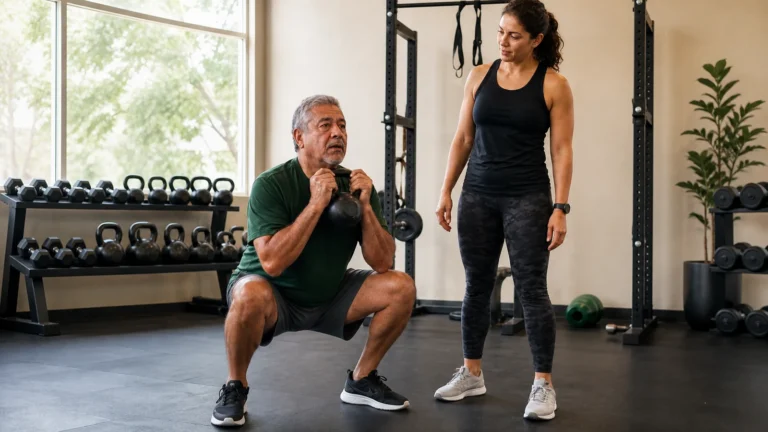
Good coaching covers not only which exercises to do but how to do them, including the small assist that keeps a rep safe or salvages a set.
The opposite failure is worth naming too. A trainer can do real damage by never challenging a client and by indulging unfounded fears instead of working through them.
Over time, a trainer who is paying attention will learn your capabilities, your limits, and your body language well enough to read your breaking point before you say a word.
Expect an education in the etiquette of wherever you train, whether that is a pool, a track, a field, or a weight room. A room full of people oblivious to each other is a distracted, inefficient, and slightly hazardous room.
Stripping the plates off a machine when you are done is a small thing, and a good trainer will still insist on it.
How to Vet a Trainer Before You Pay
Meet the person first, and treat the meeting as an interview running in both directions.
Share your history and your intentions honestly, including the unflattering parts.
Then ask about theirs: education, sports background, availability, current client load, and written recommendations you can actually read.
Do they know what hard work feels like? Can they be firm with you, or will they go soft the first time you complain?
Do they care whether you get where you said you wanted to go, or are they content to be paid either way?
Four ways a trainer falls short
These four failure modes are worth memorizing, because each one is invisible on a website and obvious in a conversation.
- Can do, cannot teach. They are in tremendous shape and have never had to explain to anyone how they got there.
- Certified, never competed. They hold certifications with no history of athletic competition or of preparing anyone for it.
- Knowledgeable, poor communicator. The information is all there, and none of it reaches you.
- Wrong temperament. They lack the patience or the empathy to mentor someone through mental or physical difficulty.
There is also a matching problem that has nothing to do with quality. A lifelong swimmer may be the wrong coach for an aspiring bodybuilder, and an excellent bodybuilder may be of limited use to a first-time triathlete.
What a certification does and does not tell you
Certification is a floor, not a ceiling.
The Bureau of Labor Statistics lists a high school diploma as the typical entry-level education for fitness trainers and instructors, and notes that personal trainers usually must be certified before they begin working with clients.
So a certification tells you that someone cleared the minimum bar an employer asks for. It does not tell you whether they can teach, whether they will arrive prepared, or whether they understand your sport.
Ask which organization issued the credential, when it was last renewed, and what the renewal actually required.
What a Personal Trainer Cannot Do for You, and Who Handles Each One
Nearly everything written about hiring a trainer is a list of what they can do for you.
The more useful list is the one almost nobody publishes, because it is the list that prevents both disappointment and harm.
The table below is a WorkoutHealthy planning framework, not an industry standard. It exists so you can tell the difference between a trainer who is underdelivering and a trainer who is being asked for something that was never part of the job.
| What you might want | Can a trainer deliver it? | Who actually handles it |
|---|---|---|
| Changing your shoulder width, limb length, or frame | No | Nobody. Skeletal proportion is a limit you train around, not through. |
| Clearing you to train again after an injury | No | The clinician who treated the injury. |
| Explaining pain that shows up during training | No | A doctor or a licensed physical therapist. |
| Setting a diet around a medical condition | No | A physician or a registered dietitian. |
| Guaranteeing a specific look by a specific date | No | Nobody. Anyone promising it is selling, not coaching. |
| Teaching technique and correcting it in real time | Yes | The trainer. This is the core of the job. |
| Building a plan and adjusting it as you change | Yes | The trainer. |
| Holding you to a schedule you keep trying to skip | Partly | The trainer can hold the line, but they cannot attend for you. |
| Supplying motivation you have never had | Partly | A trainer supplies structure. Sustained motivation stays yours. |
The first row is the one that catches people out. Some body transformations are simply not available, and the honest version of that conversation happens before you pay rather than six months in.
The rows marked no are also the rows where a trainer who cheerfully says yes should worry you.
Read the table the other way and it becomes a scorecard. If a trainer is delivering on the yes rows and is honest about the no rows, you are getting what you paid for.
This is also why results, on their own, are a fair but imperfect way to judge a trainer.
Results depend on a trainee who shows up and follows instruction, so judging a trainer purely on outcomes is unfair when the effort was half-hearted. As the saying goes, it takes two to tango.
Judge the coaching instead. Judge whether the instruction is clear, whether corrections happen in the moment, and whether the plan changes when your situation changes.
A trainer is worth paying for when they change what you do, not when they change how you feel about what you were already doing. If nothing about your technique or your plan is different after a month, you are buying company.
What to Expect Once You Have Hired One
Once the money is changing hands, the standard is simple to state and easy to check.
- They do not let you casually skip sessions or endlessly rearrange a schedule you agreed to.
- They bring their own enthusiasm rather than borrowing yours.
- They offer constructive criticism even when it will annoy you.
- They give you undivided attention for the length of the session.
Trust takes a little time to build, and it is worth building.
A trainee who believes they will be corrected, and caught if it comes to that, can finally stop holding effort back.
Personal training helps experienced people as much as it helps beginners. Whether you are starting from nothing or reaching for a level you have never held, the point is to work with someone who has been where you are trying to go.
Sources
- CDC, Adult Activity: An Overview, for the 150 minutes plus 2 days baseline.
- CDC, Adding Physical Activity as an Adult, for the guidance on chronic conditions and talking with your doctor.
- U.S. Bureau of Labor Statistics, Fitness Trainers and Instructors, for entry-level education and certification.
- U.S. Bureau of Labor Statistics, Physical Therapists, for the degree and licensing requirements.
Medical disclaimer: This article is general training information, not medical advice. If you have an injury, ongoing pain, or a medical condition, talk to a doctor or physical therapist before starting or changing a training program.
Keep reading
If accountability is the piece you are missing, a training partner may do the same job for free.