
A wall sit looks like a simple leg exercise, but your cardiovascular system is working the whole time too.
Holding that position raises your heart rate and blood pressure the way a real bout of exercise does, and researchers have been studying that response closely.
What Happens to Your Body During an Isometric Hold
A wall sit is an isometric exercise, meaning your muscles contract hard without the joint actually moving.
Your heart still has to respond to that effort, so your heart rate and blood pressure climb temporarily, similar to what happens during light or moderate cardio.
That short-term spike is not a side effect to worry about in a healthy person.
It is the same kind of stimulus researchers believe drives some of isometric training’s longer-term benefits.
The Research Behind the Claim
The most relevant evidence comes from a large 2023 analysis in the British Journal of Sports Medicine that pooled roughly 270 randomized controlled trials and about 16,000 participants (Edwards et al., 2023).
The researchers compared aerobic exercise, dynamic resistance training, combined training, high-intensity interval training, and isometric exercise against each other for lowering resting blood pressure.
Isometric exercise training, the category that includes wall sits, came out on top for reducing both systolic and diastolic blood pressure.
That is a notable result, since isometric holds get far less attention in mainstream exercise guidance than running, cycling, or lifting.
A result this large, from this many trials, is hard to wave away as a fluke, even if it still surprises people who assume cardio has to mean movement.
How Hard a Wall Sit Actually Is, Measured
One reason the wall sit works so well for this purpose is that it is more demanding than it looks, and researchers have measured exactly how demanding.
A study of 23 healthy adults tested single two minute wall squats across a range of knee angles, from a shallow 135 degrees to a deep 90 degree bend, and tracked heart rate and blood pressure throughout each hold (Goldring et al., 2014).
At the easiest angle tested, heart rate averaged about 76 beats per minute and systolic blood pressure averaged about 134 millimeters of mercury.
At the hardest angle, a 90 degree bend, heart rate rose to about 119 beats per minute and systolic pressure climbed to about 196 millimeters of mercury.
That is a large jump from one exercise, driven entirely by knee angle. It shows the wall sit is not a fixed, mild stimulus.
How deep you sit changes how hard your cardiovascular system has to work, which matters both for building the training effect and for knowing when to be careful.
How Isometric Training Compares to Other Exercise Types, in Numbers
The size of the difference is worth spelling out.
Across the pooled trials, isometric exercise training reduced resting blood pressure by about 8 millimeters of mercury systolic and 4 millimeters of mercury diastolic on average (Edwards et al., 2023).
Aerobic exercise reduced blood pressure by about 4.5 systolic and 2.5 diastolic.
Dynamic resistance training and high intensity interval training produced similarly sized drops to aerobic exercise.
Combined training, meaning aerobic and resistance work done together, landed in between, at roughly a 6 point systolic reduction.
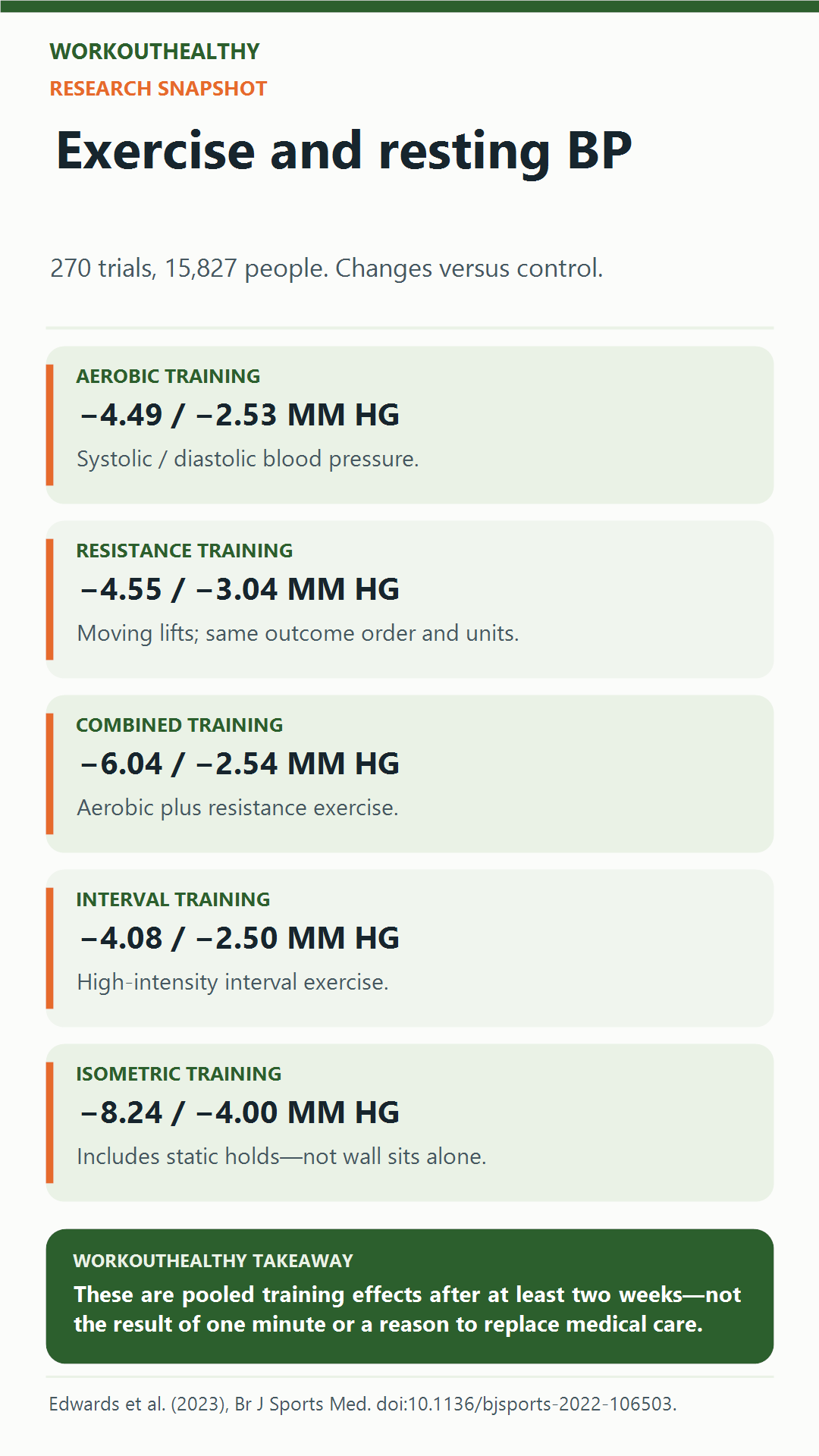
Isometric training’s systolic reduction was close to double what several of the other categories achieved.
That gap is a big part of why the researchers argued that exercise guidelines, which have historically centered on aerobic activity, are overdue for an update that treats isometric training as a genuine first-line option rather than an afterthought.
Why Isometric Holds Might Work So Well
Researchers do not have a single confirmed mechanism, but a few plausible ones keep coming up.
Sustained muscle tension briefly restricts blood flow to the working muscle, and the body’s response to that, repeated over weeks, may improve how blood vessels function at rest.
It is worth being honest that this is still an active research question, not a settled one.
The size of the blood pressure effect is well documented; exactly why it happens is still being worked out.
This is also why isometric training is sometimes grouped with strength training in casual conversation but studied on its own in the research.
A wall sit builds muscular endurance in the legs, but the training adaptation researchers care about most for blood pressure is happening in the blood vessels, not primarily in the muscle tissue itself.
What the Evidence Does Not Prove
A large meta-analysis is powerful, but it pools many different studies with different protocols, so it cannot tell you the exact hold time, frequency, or knee angle that works best for any one person.
The studies it draws on vary in length, in how blood pressure was measured, and in who was included.
Most of the underlying isometric training trials also ran for a matter of weeks to a few months, not years.
Whether the blood pressure benefit holds up over the long run, or whether it fades if someone stops training, is a separate question the current evidence cannot fully answer.
It is also worth noting that most people with genuinely high blood pressure in these trials were still under some form of medical supervision.
The research supports isometric holds as a helpful addition to blood pressure management, not as a replacement for treatment a doctor has already prescribed.
Common Mistakes That Blunt the Benefit or Add Risk
The single biggest mistake is holding your breath.
Straining against a closed airway, sometimes called the Valsalva maneuver, spikes blood pressure far higher than the exercise alone would, and it is an easy habit to fall into once a hold starts to burn.
Another common mistake is letting the knees drift past the toes or pinch inward.
That shifts load onto the knee joint instead of the thigh muscles, which raises injury risk without adding any extra cardiovascular benefit.
Chasing hold time for its own sake is a third mistake.
Two minutes with a caving knee and held breath is worse than a shorter hold done correctly, since the value of the exercise comes from consistent, correct effort, not from a number on a stopwatch.
A fourth mistake is treating one hard session as enough.
The blood pressure trials behind this research involved weeks of repeated sessions, not a single wall sit.
A one time hold will raise your blood pressure briefly while you do it, but the resting blood pressure benefit comes from doing it consistently over time.
How to Do a Wall Sit Safely
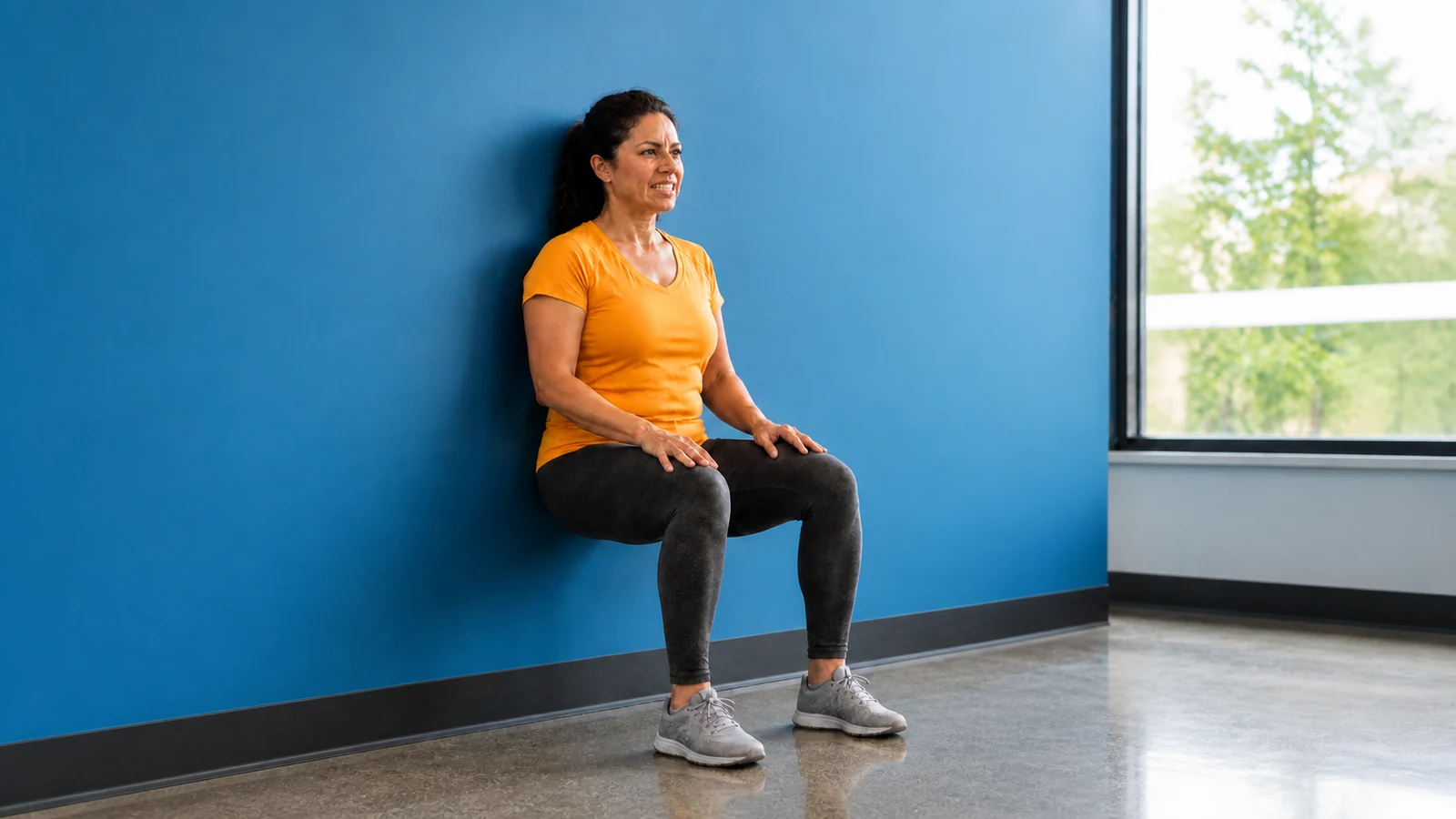
Keep your back flat against the wall, your knees stacked over your ankles rather than pushed forward, and your thighs roughly parallel to the floor.
Breathe steadily throughout the hold instead of holding your breath, since breath holding can spike blood pressure further than the exercise itself.
Start with a duration you can hold with good form, even if that is only 20 or 30 seconds, and build up gradually.
Quality of position matters more than chasing a long hold time.
A wall sit only helps if the position is right. A poorly stacked knee turns a blood pressure tool into a joint problem.
How to Progress a Wall Sit Program Over Time
Once you can hold a shallow wall sit for 30 to 45 seconds with a flat back, steady breathing, and stacked knees, add five to ten seconds every week or two rather than jumping straight to a much longer time.
Small, steady increases let your form stay intact while the stimulus still grows.
After hold time feels manageable, a deeper knee angle is a more useful next step than an even longer hold, since the wall squat research shows that angle drives most of the difference in how hard the exercise is.
Move from a shallow bend toward closer to 90 degrees only once the shallower version feels controlled, not strained.
A simple, evidence aligned starting structure is two to three sessions a week, aiming for a total of several minutes of accumulated holding time per session, broken into two or three sets rather than one long push.
Most of the training studies behind this research used sessions spread across the week rather than a single daily hold, so consistency across the week matters more than any single session.
You are progressing correctly if hold time or knee angle increases gradually, your breathing stays steady throughout, and you do not feel joint pain during or after the hold.
Muscle burn and effort in the thighs are expected.
Sharp or pinching pain at the knee is not, and is a reason to back off the angle or check your form.
Who Should Check With a Doctor First
Isometric holds cause a real, if temporary, rise in blood pressure while you are doing them.
Anyone with uncontrolled high blood pressure, a diagnosed heart condition, or another cardiovascular concern should talk to a doctor before adding regular isometric training to their routine.
People with a knee injury, recent knee surgery, or significant joint pain should also check with a doctor or physical therapist before starting wall sits, since the position places sustained load directly through the knee joint.
For most healthy adults, a wall sit is a low-equipment way to add a proven blood pressure tool alongside other habits.
Our guide to daily walking mileage covers a complementary, lower-intensity option, and our breakdown of standing versus sitting looks at another piece of everyday cardiovascular health.
For a look at another surprising finding about heart rate and a passive-seeming activity, see our article on what the research says about sauna use and heart health.
Watch the Original Video
Get the next evidence check. Subscribe to WorkoutHealthy Insider for practical explanations behind popular fitness claims.
References
Edwards, J. J., et al. (2023). Exercise training and resting blood pressure: A large-scale pairwise and network meta-analysis of randomised controlled trials. British Journal of Sports Medicine, 57(20), 1317 to 1326. https://doi.org/10.1136/bjsports-2022-106503
Goldring, N., Wiles, J. D., & Coleman, D. (2014). The effects of isometric wall squat exercise on heart rate and blood pressure in a normotensive population. Journal of Sports Sciences, 32(2), 129 to 136. https://doi.org/10.1080/02640414.2013.809471
This article is for general information only and is not medical advice. If you have an injury, ongoing pain, or a medical condition, talk to a doctor or physical therapist before you change how you train or eat.