
A WorkoutHealthy Facebook post said a 2021 study found that Pilates could improve strength, balance, mobility, depression, and pain in older adults. That summary points toward a promising body of research, but it compresses several reviews, outcomes, and levels of certainty into one sweeping claim.
Pilates can be a useful option for older adults because exercises can be adapted, progressed, and performed with little equipment. The strongest conclusion is not that it improves everything for everyone. It is that supervised Pilates programs can improve several physical outcomes, while the evidence for preventing actual falls and treating specific health conditions needs more care.
The right program should fit the person’s current balance, strength, mobility, symptoms, and weekly activity. It should also be easy to enter, exit, and modify safely.
Pilates looks useful for several aging-related fitness outcomes, but a promising average is not a guarantee for every person or every condition.
What the viral claim misses
The first correction is that the widely shared 2021 paper was not one new exercise trial in which every participant improved across five categories. It was a systematic review and meta-analysis that combined results from many randomized controlled trials in adults age 60 and older.
Meta-analysis can reveal a pattern that a small trial cannot, but it also combines programs that differ. Studies may use mat Pilates, equipment, different session lengths, different instructors, and participants with different health conditions. One pooled effect does not describe one universal class.
The review’s main physical categories were balance, strength, flexibility, functionality, and risk of falls. Those categories are not identical to the viral list of strength, balance, mobility, depression, and pain. Psychological symptoms and pain have been studied in older Pilates populations, but they should not be folded into this particular result as if every outcome came from the same analysis.
This does not make the post’s central idea wrong. It means the claim needs labels: which review, which outcome, compared with what, and how confident should readers be?
What the 39-study review found
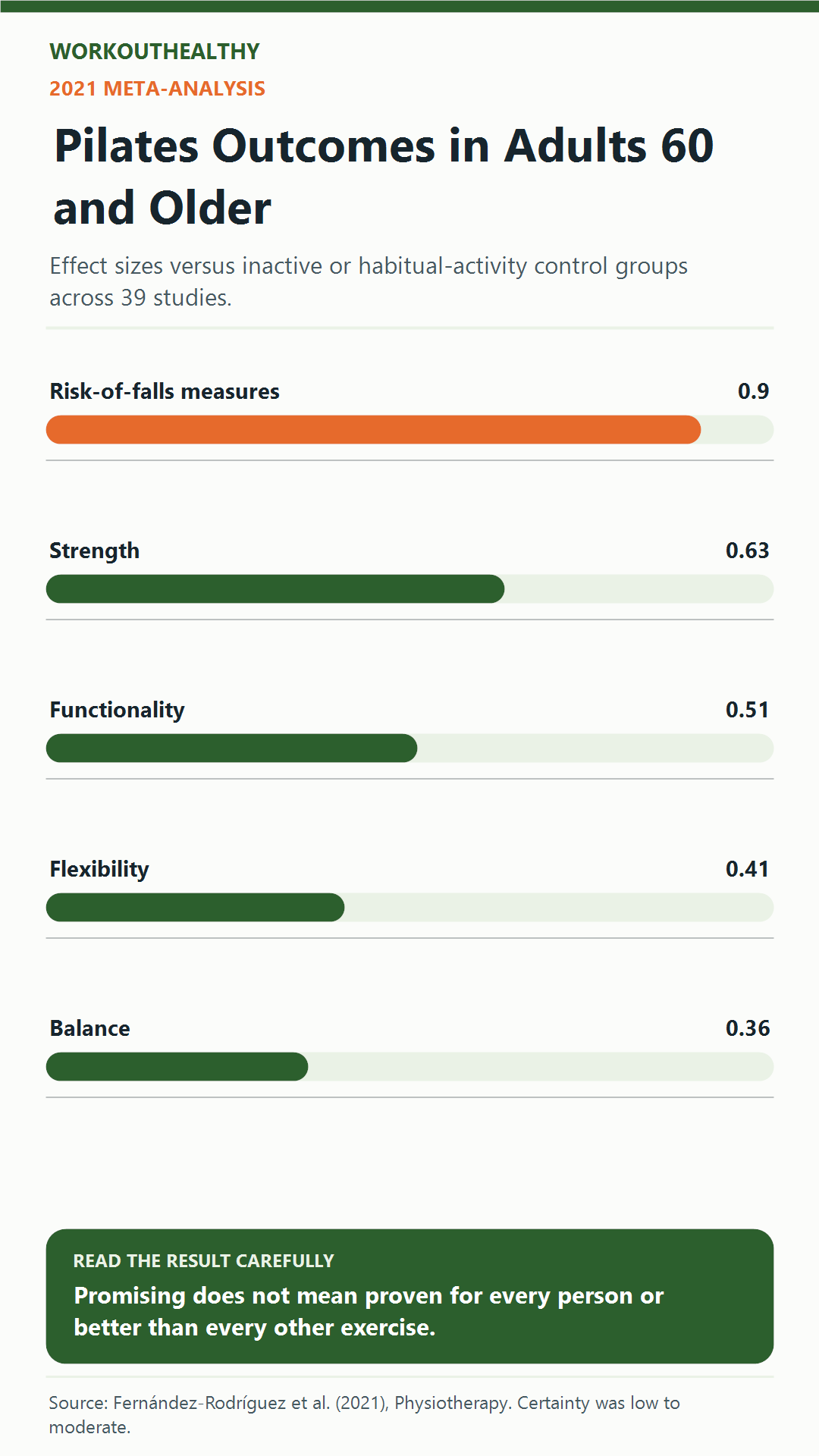
Fernández-Rodríguez and colleagues analyzed 39 randomized controlled trials involving adults age 60 and older. Compared with control conditions, Pilates showed favorable pooled effects for balance, strength, flexibility, functionality, and risk of falls (Fernández-Rodríguez et al., 2021).
The standardized effect estimates were about 0.36 for balance, 0.63 for strength, 0.41 for flexibility, 0.51 for functionality, and 0.90 for fall risk. Standardized values allow researchers to combine tests that use different scales. They do not mean a 36 percent or 90 percent improvement.
The results suggest that strength and functional tasks may improve meaningfully for some participants. Balance and flexibility also moved in a favorable direction. The larger fall-risk estimate deserves special caution because fewer studies and different ways of measuring risk can make a pooled number look more decisive than the real-world question.
A separate 2023 review focused on balance interventions and found that eight of 15 included Pilates programs reported statistically significant balance improvements (Sampaio et al., 2023). That pattern is encouraging, but it also shows why the word “can” is more accurate than “will.” Nearly half of the interventions did not report a significant benefit.
How certain are the results?
The 2021 review rated the certainty as low for balance, flexibility, and functionality, and moderate for strength and fall risk. Low certainty does not mean no effect. It means new, better-designed research could change the estimate substantially.
Common challenges include small samples, short programs, inconsistent Pilates methods, and difficulty blinding participants or instructors to the treatment. If people know they are in the exercise group, expectations and extra attention can influence some outcomes.
The control condition matters too. Pilates compared with no organized exercise answers a different question from Pilates compared with progressive strength training, tai chi, or another supervised program. An improvement over inactivity does not automatically establish superiority over every alternative.
Finally, studies report group averages. A person with severe osteoporosis, recent surgery, painful arthritis, neuropathy, or major balance impairment may respond differently from a healthy, active participant in a community class.
Better balance is not the same as fewer falls
Balance tests may measure how long someone can stand in a position, how far the body can reach without stepping, or how quickly a person can rise, walk, turn, and sit. These are useful signs of physical function.
An actual fall is influenced by more than a test score. Vision, medication, footwear, blood pressure, home hazards, urgency at night, cognition, and unexpected surfaces can all contribute. A program can improve a balance test without yet proving that it prevents injuries or falls over months and years.
An earlier systematic review concluded that Pilates improved balance measures in older adults but found the evidence on actual falls scarce and inconclusive (Moreno-Segura et al., 2018). Later evidence remains encouraging, yet the distinction still matters when discussing prevention.
Someone with recent falls, dizziness, fainting, or new weakness should not rely on an online class as the entire response. A clinician can help identify causes that exercise alone may not address.
Pilates is not a complete weekly plan
A Pilates session may challenge strength, control, flexibility, posture, and balance at once. That efficiency is part of its appeal, but the exact training dose depends on the class. A gentle mat session and a progressive reformer program are not interchangeable.
The U.S. Centers for Disease Control and Prevention recommends that adults age 65 and older combine aerobic activity, muscle-strengthening work, and balance activities each week. Pilates can contribute to the strength and balance parts, but many classes will not provide 150 minutes of moderate aerobic activity (Centers for Disease Control and Prevention, 2025).
Walking is one accessible way to add aerobic work when it is safe and comfortable. The guide to setting a daily walking target explains why pace, time, and consistency are often more useful than chasing one universal mileage number.
Progressive resistance may also be needed when the class stops making the muscles work harder. Bands, machines, free weights, and harder Pilates variations can all provide progression when selected appropriately.
The WorkoutHealthy Pilates fit test
Here is the original-value framework: judge a class with five practical questions before judging Pilates as a category.
Can you enter and exit safely? Floor exercises may be inappropriate when getting down or standing up creates more risk than the exercise itself. A chair, raised table, or equipment-based session can remove that barrier.
Can the instructor scale the movement? A useful instructor offers a smaller range, stable support, lighter resistance, or a different position without treating modification as failure.
Can you identify the progression? Over several weeks, the plan should improve control, range, repetitions, resistance, or task difficulty. Repeating a comfortable class forever may support routine without continuing to build capacity.
Does the session cover your actual needs? A person seeking fall prevention may need standing balance and quick stepping practice. A person with low strength may need more loading. A person who already walks daily may value mobility and control.
Can you recover without worsening symptoms? Normal effort and mild muscle soreness differ from sharp pain, new numbness, dizziness, or symptoms that keep escalating after class. Those signals call for stopping and getting individualized guidance.
How to start more safely
Look for an instructor with experience teaching older adults and modifying for common conditions. Ask how they handle osteoporosis, joint replacement, balance limitations, and difficulty moving to the floor. Credentials matter, but so does a clear answer about scope and referral.
Start with a beginner or fundamentals session. Use a wall, chair, rail, or stable equipment when standing balance is challenged. Avoid breath-holding and fast position changes until the movement feels controlled.
If you want individualized screening, our guide to hiring a qualified personal trainer includes questions about certification, experience, and fit. A physical therapist may be more appropriate when pain, surgery, neurological symptoms, or repeated falls are central.
Consistency is easier when the social environment fits. A friend can provide transportation, shared practice, or simple accountability. The guide to workout partner benefits can help you structure that support without making one person responsible for the other’s safety.
Keep the first goal modest: attend, learn the setup, and finish with good control. Add range or resistance only when the current version is stable. A class that looks less dramatic but can be repeated safely is often the better starting point.
The best Pilates program is not the hardest class. It is the one that safely progresses the abilities you need outside the studio.
The bottom line
The 2021 evidence review supports Pilates as a promising way to improve strength, balance, flexibility, and physical function in adults age 60 and older. It also reported a favorable fall-risk result, though certainty ranged from low to moderate and actual fall prevention remains harder to establish.
The viral five-outcome claim mixes distinct evidence into one sentence. Treat Pilates as one adaptable part of a broader weekly plan, choose a class that matches current capacity, and seek individualized help when pain, medical conditions, or falls make the starting point uncertain.
References
Get the next evidence check.
Five practical fitness stories worth your time, every Friday.
One email a week. No product pitches. Unsubscribe in one click.
Medical disclaimer: This article is general product information, not medical advice. The equipment described here is not a treatment for any condition. If you have an injury, ongoing pain, or a medical condition, talk to a doctor or physical therapist before using any of it.