
Good coach qualities show up in decisions, not just a credential list. A performance coach should explain the goal, show how training is planned, listen to the athlete, and adjust when the athlete’s response changes.
Before paying for coaching, ask to see a sample training block and talk through a difficult week. The scorecard below turns broad qualities such as knowledge and empathy into things you can observe.
Good coach qualities: the quick answer
- Relevant knowledge: They can explain why the sessions fit your sport, level, schedule, and goal.
- Useful feedback: They give specific cues and check whether those cues helped.
- Adaptability: They can change a plan after missed training, poor recovery, or a change in goals.
- Respect: They welcome questions and give the athlete a meaningful voice.
- Clear scope and boundaries: They can explain their qualifications, safeguarding practices, and when another professional should take over.
The International Olympic Committee’s coach-qualities guide already covers knowledge, listening, feedback, and respect. Positive Coaching Alliance emphasizes similar qualities for youth sport, including empathy, emotional regulation, and athlete voice.
Those lists are valuable starting points. This guide focuses on how a person choosing performance coaching can check whether the qualities appear in day-to-day work.
A coach evaluation scorecard you can actually use
Ask each candidate the same questions, then record a concrete example rather than giving points for polished marketing. The “look for” column describes useful evidence, not a validated test or guarantee of future results.
| Quality to check | Question to ask | What to look for | Reason to pause |
|---|---|---|---|
| Goal-specific planning | “Can you show a sample four-week block for someone with a goal like mine?” | A purpose for each session, a way to track progress, and room to adjust the plan. | Only a fixed template or a promised result by a specific date. |
| Feedback and teaching | “What would you change if my technique or performance stalled?” | A specific observation, a clear cue, and a way to check whether it helped. | Criticism without a usable next step. |
| Response to recovery | “What if I sleep badly, miss two sessions, or report unusual soreness?” | Questions about context and a reasoned change when needed. | A rule that every athlete must finish every hard session regardless of circumstances. |
| Athlete voice | “How do we decide whether the plan still fits my goals?” | Regular check-ins and a willingness to explain or revise decisions. | Questions are dismissed or disagreement is punished. |
| Scope and safety | “What is your training background, who do you coach, and when do you refer out?” | Relevant, checkable experience; clear safeguarding rules; referral for medical or rehabilitation issues. | Unverifiable credentials or claims to diagnose and treat problems outside coaching scope. |
None of these answers proves a coach will improve performance or prevent injury. Taken together, they give you a more useful basis for a decision than follower count or an inspirational video.
Test the plan with a real-life week
Imagine you are preparing for a race and have slept poorly for several nights. A useful coach asks about the pattern, your recent training, and how you feel before deciding whether to shorten, change, or move a demanding session.
The exact decision depends on your sport and situation. What matters when evaluating the coach is whether the answer is reasoned and open to new information, rather than a promise that one recovery rule fits everybody.
Now imagine you complete the work but your chosen performance measure stalls. Ask what the coach would inspect first, what they might change, and when they would reassess; that conversation reveals more than a sample workout alone.
For the mechanics of building a block, see our separate guide on how one coach structures a sports performance program. This page helps you evaluate the person and their process.
What the coaching research supports
There is evidence for planning, monitoring, and a constructive coach-athlete relationship, but those strands do not add up to a guaranteed formula. A coach’s conduct should be judged over time, not inferred from one study or one introductory call.
Planning has a purpose, but no magic template
A 2017 meta-analysis pooled 18 studies of periodized versus non-periodized resistance training and found a moderate average advantage for one-repetition-maximum strength. It did not test every sport, every coaching style, or whether a paid coach beats a well-designed self-directed plan.
A sample training block should therefore show how the coach connects sessions to your goal. It need not use one particular periodization model or promise that every week will improve.
Monitoring supports decisions, not injury prediction
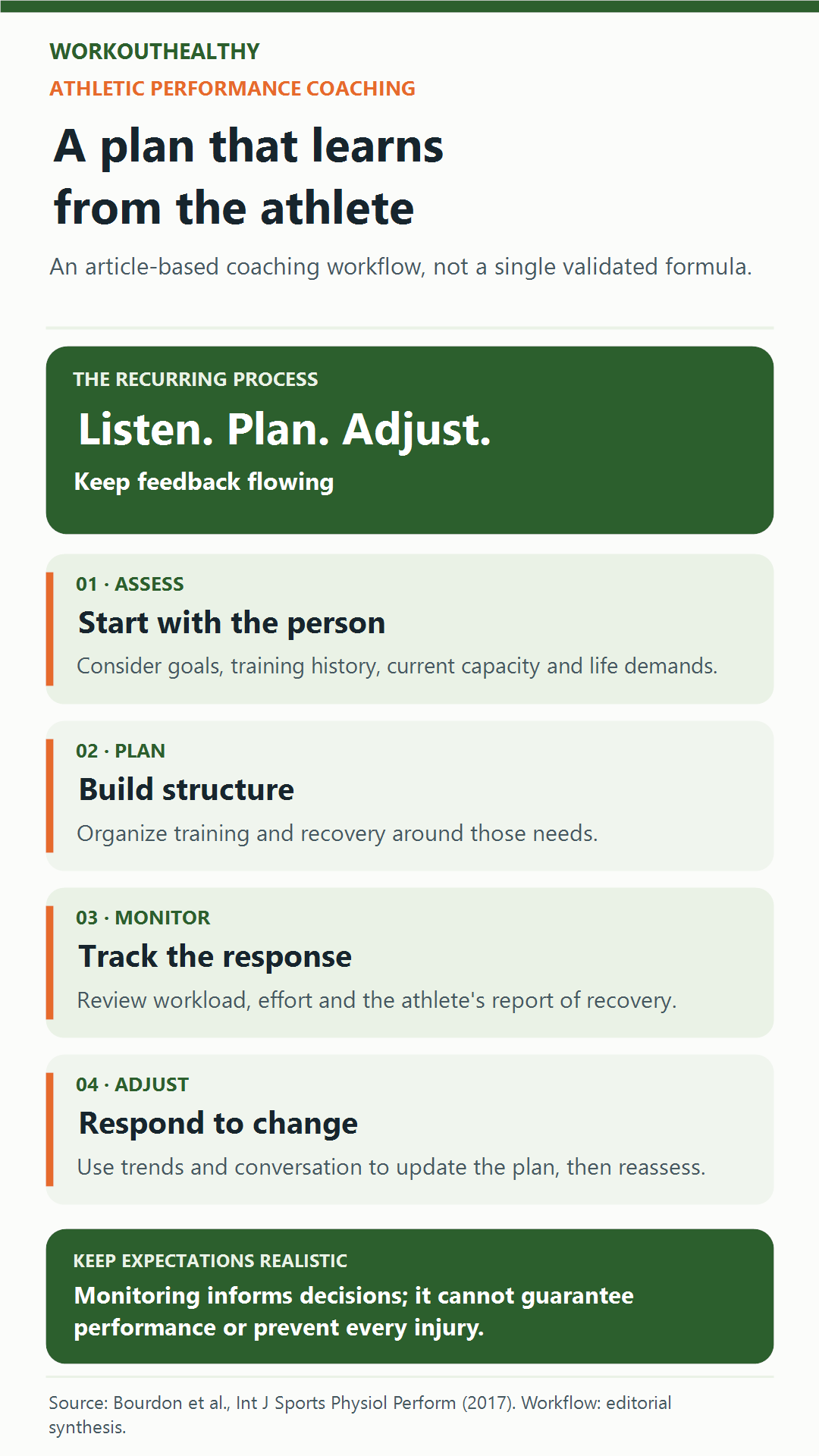
A sports-science consensus statement on training-load monitoring describes tools such as session effort ratings and other workload or wellness measures. Those measures provide context for discussion; no single number can tell a coach exactly who will be injured.
Ask what the coach tracks, why it matters for your goal, and what they would do if the data and your experience disagree. A sensible answer may be simple, especially for a beginner.
Communication matters alongside programming
The IOC guide calls for clear feedback, listening, respect, and athlete input. Positive Coaching Alliance’s youth-sport guide adds empathy, integrity, and emotional regulation, which are especially important when a coach works with young athletes.
Coaches and athletes in a 2024 systematic review of disability sport described relationship factors such as communication and trust in a specific parasport context. That review is useful context, but it does not establish that one scorecard predicts performance for all athletes.
Credentials, safeguarding, and coaching scope
Ask which qualifications are relevant to the sport and setting, whether you can verify them, and what experience the coach has with athletes like you. Competitive success alone is not a coaching qualification, and a certificate alone does not demonstrate how someone teaches.
If the athlete is a minor, ask the club or organization about supervision, reporting routes, and rules for one-to-one contact. The 2024 IOC safeguarding consensus treats safe environments and responses to concerns as organizational responsibilities, not just matters of a coach’s personality.
A coach can adapt training around a known limitation, but diagnosing pain, prescribing treatment, and clearing someone to return after injury belong with an appropriate clinician. If symptoms are new, worsening, or concerning, seek medical assessment before using a coaching plan to push through them.
How to make a hiring decision
- Define the job. Write down your sport, goal, schedule, current training, and any limits a coach should know.
- Request one sample block. Ask what each session is for and what would cause a change.
- Run the bad-week test. Use the sleep or missed-session example to hear the decision process.
- Check experience and boundaries. Verify relevant credentials and ask who handles medical, nutrition, and safeguarding issues.
- Review after a short period. Note whether feedback was specific, whether changes were explained, and whether your input mattered.
There is no universal point score or required program length. The aim is to choose a coach whose actions match your goal and whose process you can understand.
What about the promotional video?
The original Chenet Vincent video promotes athletic performance coaching in broad terms. Its title and description do not document a specific performance result, so this guide does not treat the video as evidence that this individual coach succeeds or fails.
Use the same questions for any coaching offer, including this one. Public marketing is a starting point for questions, not a substitute for checking the service and its fit.
Watch the video
Want more like this? Subscribe to WorkoutHealthy Insider for practical explanations behind popular fitness claims.
Sources
- International Olympic Committee, Qualities of a Great Sports Coach.
- Positive Coaching Alliance, What Makes a Good Coach?
- Williams et al., 2017 periodization meta-analysis.
- Bourdon et al., 2017 training-load monitoring consensus.
- 2024 disability-sport coach-athlete relationship systematic review.
- 2024 IOC safeguarding consensus.
This article is for general information only and is not medical advice. If you have an injury, ongoing pain, or a medical condition, talk with a qualified clinician before changing training in a way that could affect it.