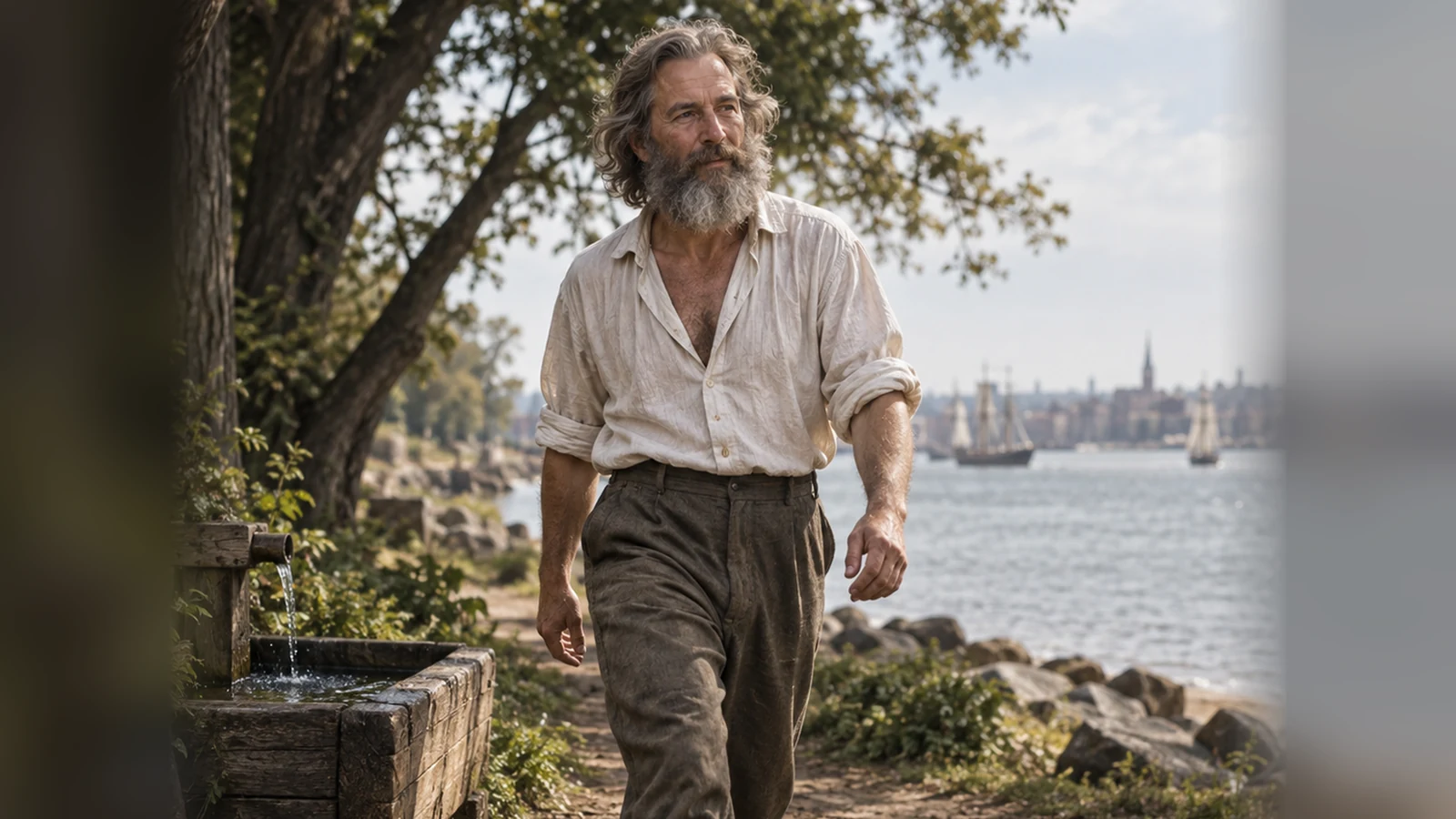

Walt Whitman is known for poetry, not workout tips.
Yet in 1858 he wrote a long newspaper series on how men could build strong, lasting health.
A popular post says Whitman swore by cold bathing, fresh air, and vigorous outdoor exercise.
His own words back that up. The modern science is more mixed than he would have guessed.
The Series Whitman Did Not Sign
The work is called Manly Health and Training.
It ran in 13 parts in the New York Atlas, a weekly paper, from September 12 to December 26, 1858.
Whitman did not use his own name. He signed it “Mose Velsor, of Brooklyn.”
The pen name borrowed from his mother’s family name, Van Velsor.
The Walt Whitman Archive notes that his authorship rests on manuscript evidence, including draft advertisements and his known use of that pen name.
The full series was published online by the Walt Whitman Quarterly Review in 2016, and the New York Times called it the biggest new Whitman discovery in decades.
What He Actually Wrote About Cold Water and Air
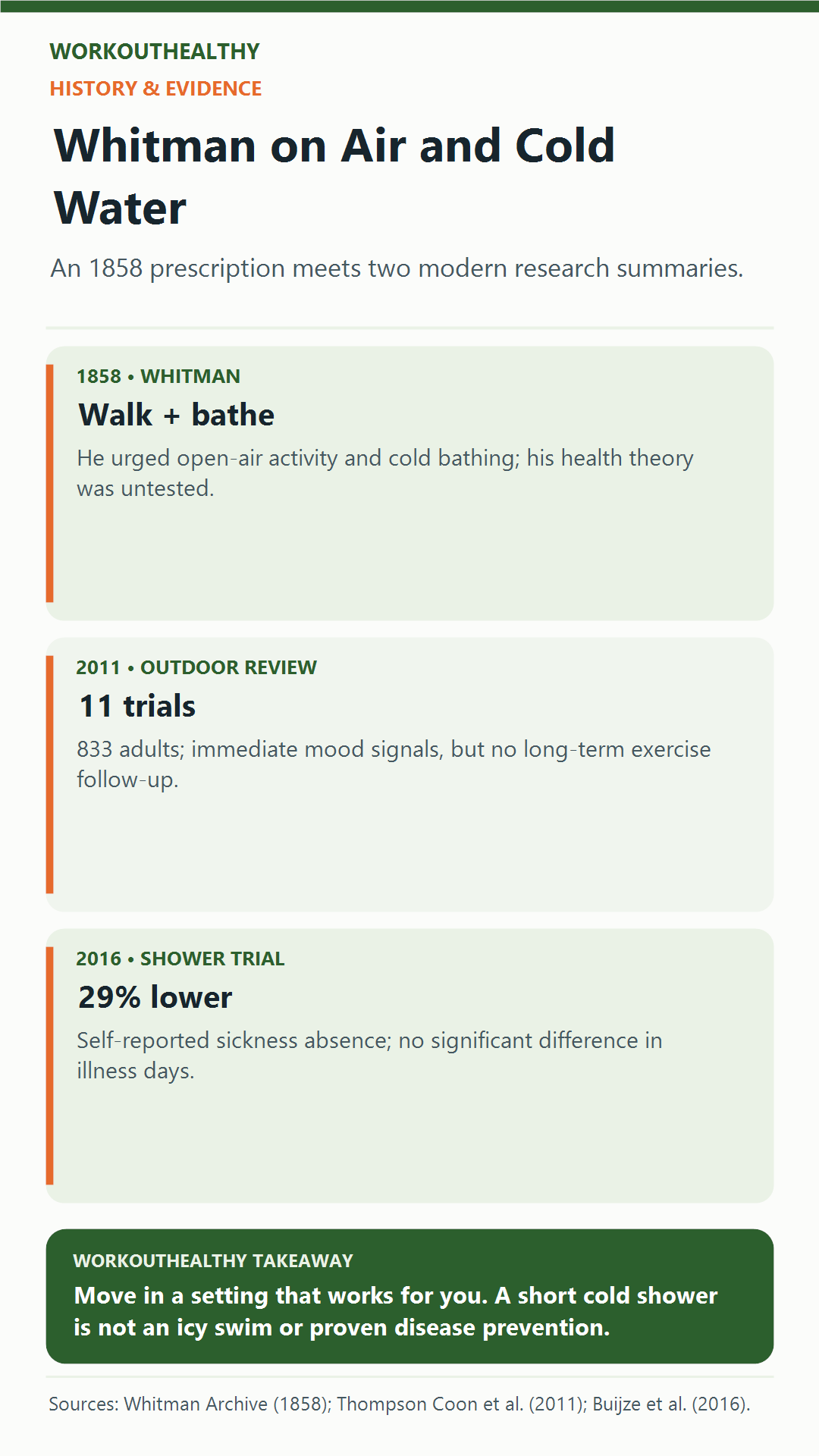
The claim holds up well. One installment, from October 17, 1858, is direct about it.
“Where swimming is not eligible, then bathe,” he wrote.
He added that “the tonic and sanetary effects of cold water are too precious to be foregone in some of their forms.”
He also promised that “the reviving chill of the cold water, will soon come to be welcome.”
On air, he was just as firm.
“Few know what virtue there is in the open air.”
He wanted gyms and training grounds outside, “upon the turf or sand.”
He also urged readers to rely on walking and gentle exercise out of doors as much as possible.
The Rest of His Advice Was Less Timeless
The series is not a modern health guide.
Across its installments, it also praises beards and nude sunbathing, and it urges eating meat almost exclusively.
Writers who have read it called it quirky and even pseudoscientific.
So it helps to separate the parts that aged well from the parts that did not.
Outdoor movement aged well. The cold water claims need a closer look.
Read the 1858 Prescription in Its Own Time
Whitman’s October 17 installment is more specific than the modern slogan “get fresh air.” He proposed outdoor gymnasiums on turf or sand and told readers to walk in the open air when gentler activity was more practical.
That makes his advice recognizable to a modern reader, but it does not make his explanation scientific. The same installment linked health to the nineteenth-century idea that skin pores needed to remain open so perspiration could escape. That theory should not be used to explain why a walk or shower might feel good today.
His remarks on cold water also cover bathing and swimming, not a carefully measured treatment. He offered confidence that the initial chill would become welcome; he did not test a dose, compare groups, or identify who might be harmed.
The distinction matters when a social post compresses the story into a wellness “secret.” Whitman is a historical example of enthusiasm for activity outdoors. He is not evidence that cold water prevents illness or that more extreme exposure brings more benefit.
The Walt Whitman Archive also notes that some material in the series drew on the Water Cure Journal. That is another reason to read the work as a product of its era rather than as a unique, tested protocol.
What Research Says About Exercising Outdoors
A 2011 systematic review by Jo Thompson Coon and colleagues compared exercise outdoors in natural settings with exercise indoors.
It pulled together 11 trials with 833 adults.
Most results favored outdoor activity for mental wellbeing.
People reported more revitalization and positive engagement, plus less tension, confusion, anger, and depression.
Outdoor exercisers also reported more enjoyment and said they were more likely to do it again.
The authors were careful, though. The studies were generally of poor quality.
None of them measured physical wellbeing or whether people kept exercising over time.
So the open air idea has real support for mood and enjoyment. The bigger claims about lasting vigor are still unproven.
What the Outdoor Studies Cannot Answer
The design of those 11 trials narrows the conclusion. Each compared a single bout of walking or running indoors with a similar bout outdoors; the review did not follow people through months of daily training.
Six of the studies included 523 young students. That makes it hard to assume the same size of effect for older adults, people with chronic conditions, or anyone whose outdoor environment is stressful or unsafe.
Participants often knew which setting they were in and rated their own feelings afterward. Those ratings are useful for understanding immediate experience, but they do not establish that outdoor exercise treats depression or produces a lasting physical-health advantage over an equally active indoor routine.
The practical reading is modest: if a safe outdoor route makes movement more pleasant, use it. If weather, accessibility, air quality, or schedule makes indoor exercise easier to repeat, the review gives no reason to abandon that routine.
It is the movement that should remain the main habit. Whitman’s “open air” can be a preference that helps some people stick with it, not a requirement for a worthwhile workout.
What Research Says About Cold Showers
The best known trial on routine cold water is a 2016 randomized trial by Buijze and colleagues in the Netherlands.
The team assigned 3,018 adults to daily cold showers of 30, 60, or 90 seconds, or to a control group.
The assigned routine lasted 30 consecutive days, followed by 60 days in which the cold-shower groups could continue at their discretion.
The cold shower groups reported 29 percent less sickness absence from work than the control group.
However, there was no significant difference in the number of days people actually felt ill.
That is a subtle but important result. Fewer reported work-absence days do not establish that the groups experienced fewer illness days or that cold water prevented infections.
The outcomes were also self reported, which leaves room for bias.
The trial cannot test Whitman’s “tonic” feeling. Calling cold water a proven health shield goes too far.
Why a Cold Shower Is Not an Ice Bath
The trial tested a short cold finish to an ordinary shower in adults aged 18 to 65 without severe comorbidity. It did not test a plunge into icy water, prolonged immersion, or a cold swim.
Those differences change both exposure and risk. A shower leaves a person standing in a controlled room with an easy way to stop. Open water can add waves, depth, poor visibility, and the need to get back to shore while cold.
Even within the shower trial, the measured benefit was self-reported absence from work. It was not a measured improvement in immunity, lifespan, strength, or recovery. The researchers did not find a statistically significant reduction in illness days.
So it would be an evidence leap to say “Whitman was right” about every cold-water practice. The safer conclusion is that a brief shower finish may appeal to some people, while the case for broad medical benefits remains unproven.
Where Cold Water Can Go Wrong
Whitman wrote about the first shock of cold water as something to get used to.
That shock is a real physical response. Sudden cold can trigger gasping and rapid breathing.
The shower trial reported no related serious adverse events among adults aged 18 to 65 without severe comorbidity. It was not designed to establish safety for everyone or for other forms of cold exposure.
Cold open water swimming and ice baths are a different matter, especially for beginners or anyone swimming alone.
Advice from 1858 also came with no safety guidance at all, which is why it carries a caution label today.
How to Borrow Whitman’s Habits Safely
- Keep movement in the plan. If an outdoor walk is safe and enjoyable for you, use it. An indoor walk also counts when conditions make that easier.
- Take some workouts outside. A park, a track, or a trail can make the same session feel more enjoyable.
- Treat cold water as optional. The trial tested 30, 60, or 90 seconds after a warm shower in selected adults; it did not establish a recommended starting dose. Stop if the exposure feels unsafe or unpleasant.
- Skip cold plunges alone. Never swim in cold open water without a partner and a clear exit.
- Keep your food balanced. Ignore the meat only advice and follow current, varied eating guidelines.
- Judge by how you feel. If cold water leaves you shaky, dizzy, or anxious, stop.
Staying active through cold season may matter more than any shower, as our look at exercise and flu and pneumonia risk explains.
Outdoor walking also has other perks, which we cover in walking and the gut microbiome.
On days you cannot get outside, try our guide to quiet home cardio with no equipment.
Who Should Be Careful
People with heart disease or high blood pressure should talk to a doctor before any cold water routine.
The same goes for anyone with Raynaud’s phenomenon, asthma triggered by cold, or a history of fainting.
Pregnant people and older adults should also check with a clinician before trying cold immersion.
Cold showers are not a treatment for any illness, and they should never replace medical care.
The Bottom Line
Walt Whitman really did champion cold bathing, fresh air, and outdoor exercise, writing under the name Mose Velsor.
Small, mostly short-term studies suggest exercise in natural settings can improve immediate self-reported mood and enjoyment compared with indoor activity. The cited review did not establish longer-term benefits.
One large trial found less self-reported sick leave from work after routine cold shower finishes, but no significant reduction in illness days.
Choose movement you can sustain safely. Cold water is optional, and this evidence does not establish a best dose.
Want more stories like this? Subscribe to WorkoutHealthy Insider for practical explanations behind popular fitness claims.
References
- Buijze, G. A., Sierevelt, I. N., van der Heijden, B. C. J. M., Dijkgraaf, M. G., & Frings-Dresen, M. H. W. (2016). The effect of cold showering on health and work: A randomized controlled trial. PLOS ONE, 11(9), e0161749. https://doi.org/10.1371/journal.pone.0161749
- Thompson Coon, J., Boddy, K., Stein, K., Whear, R., Barton, J., & Depledge, M. H. (2011). Does participating in physical activity in outdoor natural environments have a greater effect on physical and mental wellbeing than physical activity indoors? A systematic review. Environmental Science & Technology, 45(5), 1761 to 1772. https://doi.org/10.1021/es102947t
- Walt Whitman Archive. (n.d.). “Manly Health and Training” and the New York Atlas. https://whitmanarchive.org/item/per.00594
- Whitman, W. [Mose Velsor]. (1858, October 17). Manly health and training. New York Atlas. Walt Whitman Archive. https://whitmanarchive.org/item/per.00428
This article is for general information only and is not medical advice. If you have an injury, ongoing pain, or a medical condition, talk to a doctor or physical therapist before you change how you train or eat.