
A cold plunge after lifting may reduce some muscle-growth gains when it is used immediately after sessions across a training program. That finding does not establish what one occasional dip, a cool shower, or a plunge hours later would do.
The useful question is more specific than whether cold water is good or bad: which recovery habit was tested, and what outcome changed? A feeling of recovery and a measurement of muscle growth answer different questions.
This guide separates the tested routine from the claims commonly added to it, including the idea that waiting six hours guarantees the same lifting results.
What did the main cold-plunge trial actually test?
The Roberts and colleagues trial analyzed 21 physically active men after 12 weeks of lower-body strength training twice a week. Twenty-four had started; three withdrew for injuries unrelated to the study.
| Detail | What the researchers used |
|---|---|
| Cold exposure | Waist-deep immersion for ten minutes at about 10.1°C, beginning within five minutes of training. |
| Comparison | Ten minutes of low-intensity stationary cycling. |
| Pattern | The assigned recovery method followed each training session. |
| Result | Both groups increased measured muscle mass, with larger gains and several larger strength improvements in the cycling group. |
A separate nine-man experiment examined early muscle-cell responses after exercise. Those tissue measurements address possible mechanisms, rather than providing another long-term growth trial.
Light cycling was the comparator, rather than rest; these study details are not instructions.
What does the wider muscle-growth evidence add?
A 2024 systematic review and meta-analysis by Piñero and colleagues combined eight interventions lasting four to 12 weeks. All enrolled young adults; seven enrolled only men and one included men and women.
The authors found evidence that immediate postexercise immersion may modestly reduce hypertrophy compared with resistance training under other recovery conditions. They also judged the studies fair to poor using their training-specific quality checklist, while a broader checklist produced more favorable ratings.
The included cold exposure occurred within 15 minutes of exercise, and the authors explicitly left intermittent use and longer delays unresolved. This evidence cannot supply a universal waiting period or a personal percentage of muscle growth lost.
That is a reason to keep the conclusion bounded, rather than to discard it or turn it into certainty. A research summary can identify a concern without pretending every practical follow-up has been tested.
Four claims to check carefully
1. “One plunge cancels the workout.”
This changes the question from a repeated recovery routine to an isolated event. To support that claim, a study would need to test the isolated event and an appropriate later outcome, rather than borrowing a conclusion from a different schedule.
2. “Six hours is guaranteed to protect your gains.”
A precise number is useful only when its supporting comparison is clear. Ask whether researchers actually compared that delay with immediate exposure and no cold exposure, then measured the outcome being promised.
An expert’s suggested schedule may be a judgment under uncertainty, but it should be identified as such. Precision in a recommendation is not proof that the interval was experimentally established.
3. “A cold shower must have the same effect.”
The word “cold” leaves out duration, water temperature, body coverage and timing. Treating any two cold experiences as interchangeable skips the exposure details needed to make the comparison meaningful.
4. “It felt better, so it built more muscle.”
A comfort report answers a comfort question. It does not, on its own, measure the size of a muscle or establish what caused a later change.
The same distinction works in reverse: a finding about muscle size does not settle every question about comfort. Avoid making either outcome stand in for all the others.
Match the answer to the outcome you care about
“Recovery” can refer to several things, so write down the result you mean before assessing a claim. These questions require different measurements:
- Comfort: How did the person describe soreness or how they felt?
- Next-session performance: What task did they perform, when, and compared with which recovery condition?
- Strength: Which strength test changed across the training period?
- Muscle size: Which muscle or body region was measured, by what method, and over how long?
This distinction is useful when talking with a coach about a training plan. A question about preparing for another event tomorrow and a question about building muscle over months do not need to have the same answer.
For related context, our recovery-tools overview compares different recovery claims, while our soreness and workout-progress guide explains why an ache is a limited scoreboard.
Make a four-line evidence card before changing the story
Here is a simple editorial tool for reading the next cold-plunge headline. It is a way to organize a claim, not a validated score or a self-experiment.
Person: Who was studied, and does the headline quietly broaden that population?
Plunge: What exposure was used, including its timing and repetition?
Comparison: What did the other condition involve?
Outcome: What changed, and when was it measured?
Then underline anything the headline adds that your card cannot answer. That missing detail is a question to investigate, rather than permission to fill the blank with a confident rule.
For example, a hypothetical headline promising that a particular waiting period “saves every gain” would need a matching timing comparison and muscle-growth measurement. A study about a repeated immediate routine would leave that claim unfinished.
Research details are not safety instructions
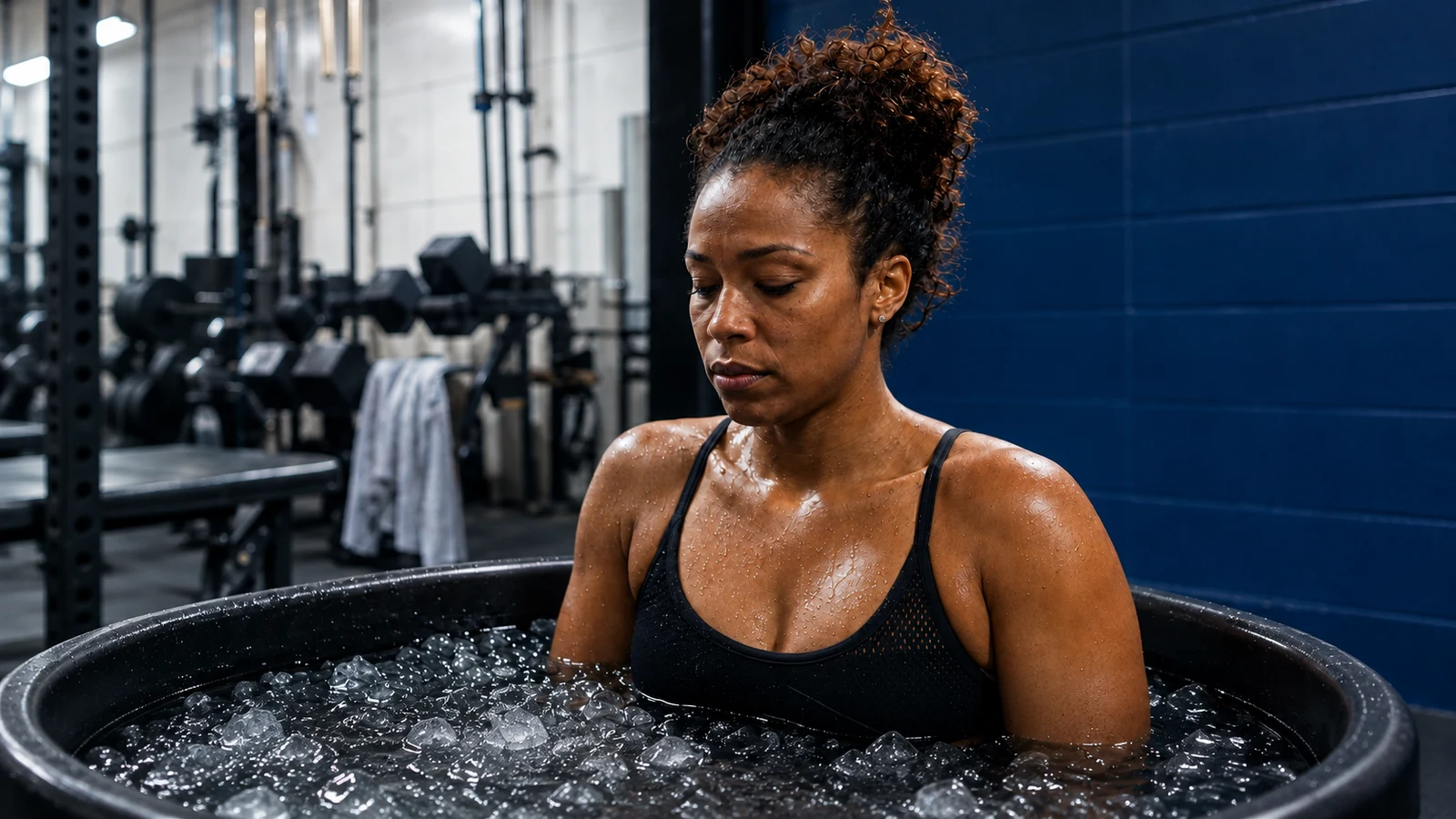
The featured image is an editorial illustration, not a demonstration of a safe temperature, immersion depth or duration. Neither the picture nor the study table establishes whether cold exposure is appropriate for an individual.
The CDC Yellow Book describes involuntary gasping and rapid cooling during cold-water exposure in travel and accidental-immersion settings. That warning is a separate safety issue, and the chapter does not validate a gym-plunge routine.
Keep personal health questions separate from a discussion of training adaptations. This article provides neither medical clearance nor a cold-exposure protocol.
The takeaway
Use the person, exposure, comparison and outcome to keep a claim honest. That makes the evidence useful without treating either a recovery sensation or a precise-sounding timetable as a muscle-growth measurement.
Get the next evidence check.
Five practical fitness stories worth your time, every Friday.
One email a week. No product pitches. Unsubscribe in one click.
References
- Roberts et al. (2015). Cold-water recovery and training adaptations. The Journal of Physiology.
- Piñero, A., et al. (2024). Throwing cold water on muscle growth: A systematic review with meta-analysis of the effects of postexercise cold water immersion on resistance training-induced hypertrophy. European Journal of Sport Science.
- Backer, H. D., & Freer, L. (2025). Heat and Cold Illness in Travelers. CDC Yellow Book.
Medical disclaimer: This article is general fitness information, not medical advice or a cold-immersion safety protocol. If you have a medical condition, an injury or symptoms, ask a qualified clinician whether cold exposure is appropriate for you.