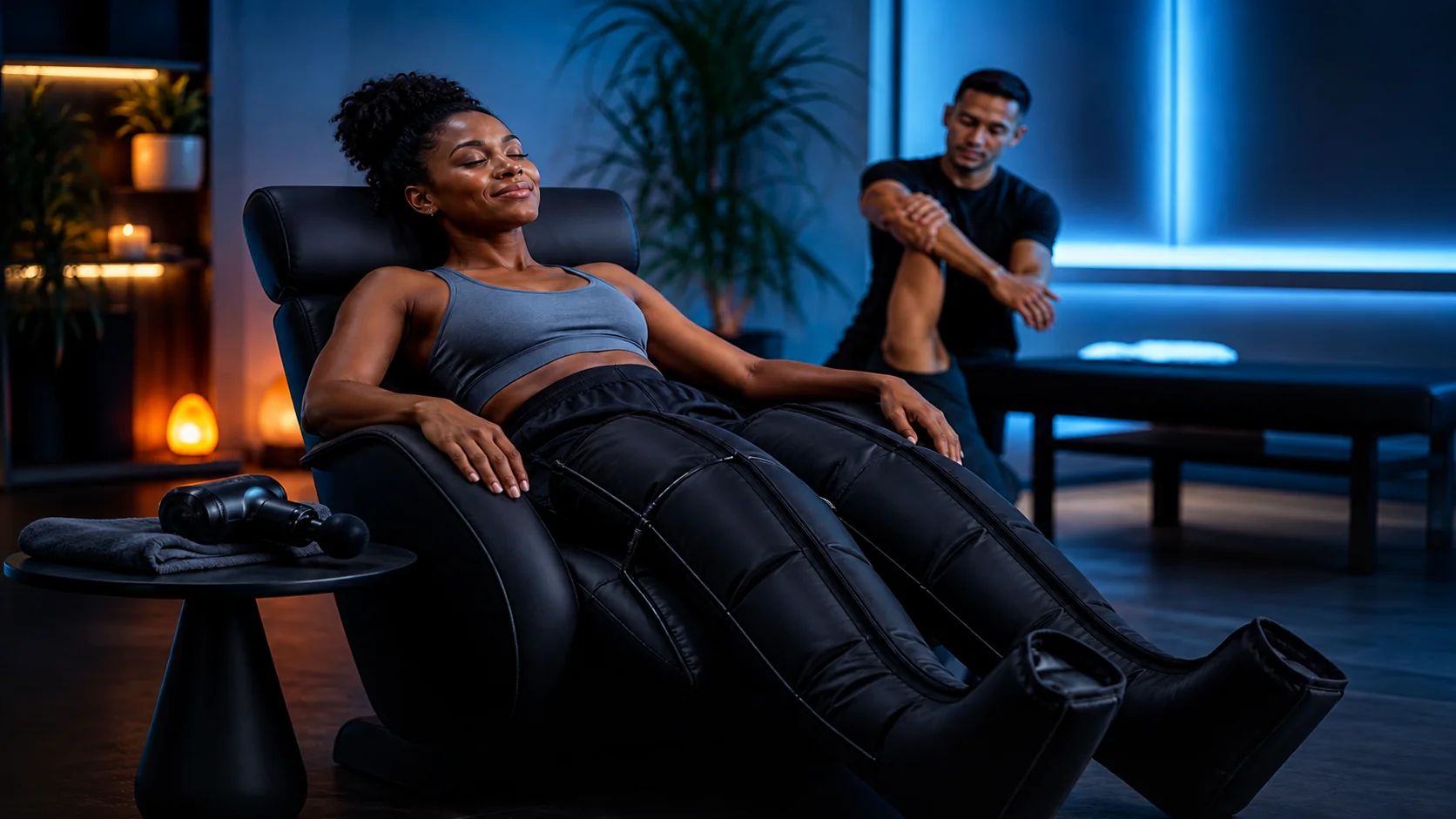

A recent Houston Life segment introduced viewers to a commercial recovery studio built around compression boots, percussive massage guns, and guided stretching sessions.
The pitch is a familiar one in fitness media right now.
Recovery tools like these are often marketed as the missing piece between a hard workout and a full comeback the next day.
That marketing framing deserves a closer look, because the actual research on these three tools tells a more complicated story than “essential missing piece.”
Intermittent pneumatic compression, massage guns, and stretching have published research behind them, and none of that research supports treating any one of them as a required step.
Some studies find modest, short-term benefits under specific conditions. Others find little difference from passive rest on outcomes such as reported pain. Many trials are too small or difficult to blind to settle questions about longer-term recovery.
This article walks through what the evidence on each tool actually says, where the science is still thin, and how to think about recovery gear without overpaying for a promise it cannot fully back up.
What Happens to Muscles After a Hard Workout
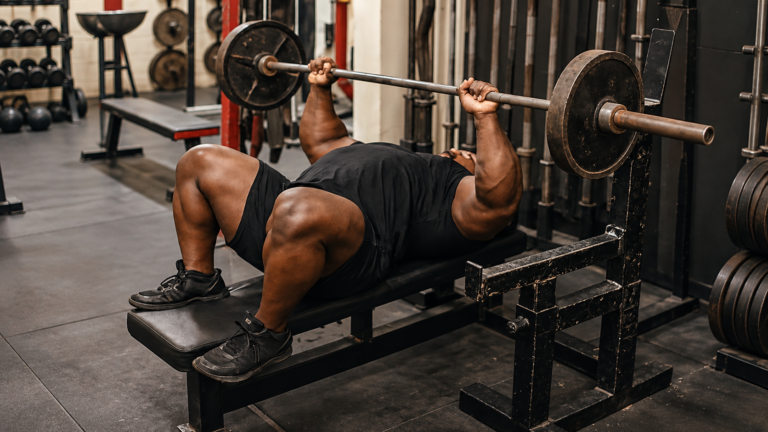
Delayed onset muscle soreness, usually shortened to DOMS, is the stiffness and tenderness that shows up roughly 12 to 48 hours after unfamiliar or unusually hard exercise.
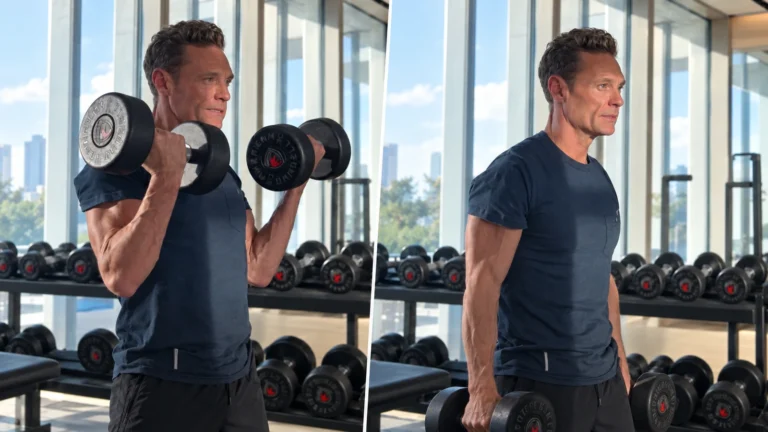
It is most closely tied to eccentric muscle action, the lengthening contraction that happens when you lower a weight, land from a jump, or run downhill.
That lengthening under tension creates microscopic damage to muscle fibers and the connective tissue around them, the same kind of stress that shows up after high-impact plyometric training like box jumps.
The body responds with local inflammation and fluid shifts, which is part of why sore muscles often feel swollen or stiff rather than sharply painful.
Soreness itself is not a reliable measure of how much a workout helped you.
A session can build real fitness with very little next-day soreness, and a sore muscle is not automatically a stronger one two days later.
That distinction matters for this whole topic, because most recovery tools are sold on reducing how sore you feel, which is not the same claim as reducing how long true muscle repair takes.
Compression Therapy: What the Research Actually Shows
Intermittent pneumatic compression uses inflatable boots or sleeves that squeeze and release around the legs in cycles, intended to push fluid and blood back toward the heart.
The proposed mechanism involves fluid movement and circulation, but the key practical question is whether users recover better than people who simply rest.
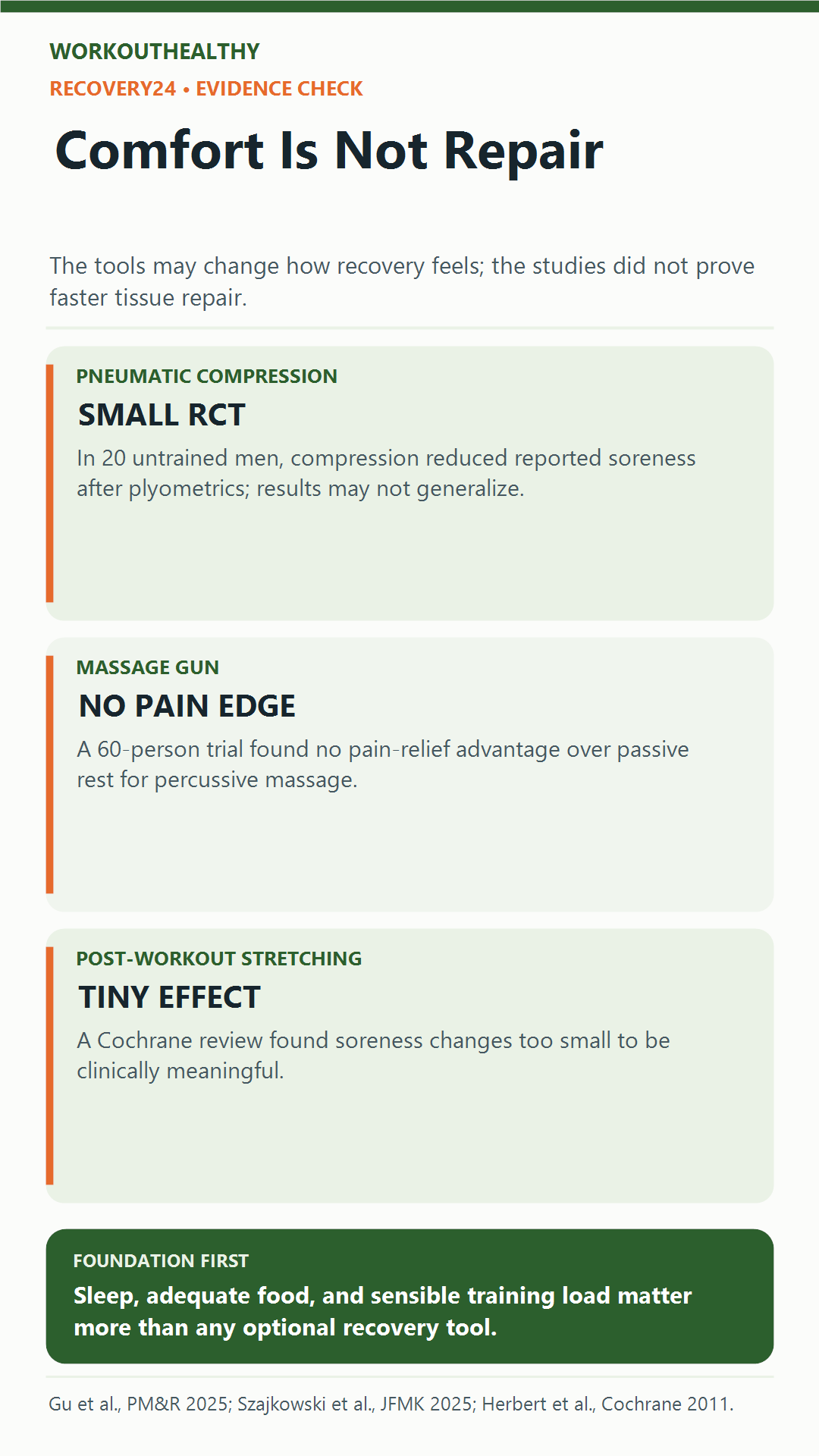
A 2025 randomized controlled trial published in PM&R tested soreness and muscle-function measures after a plyometric workout; it did not directly establish faster clearance of metabolic byproducts.
Gu and colleagues had untrained male college students perform plyometric exercise designed to cause muscle damage, then gave one group 15 minutes of pneumatic compression immediately afterward and again at 24, 48, and 72 hours (Gu et al., 2025).
The compression group reported significantly less muscle soreness than the control group, with the biggest difference showing up 48 to 72 hours after exercise.
That is a genuinely useful finding, but it is one trial, in untrained young men, using one specific exercise protocol.
A separate literature review looking across multiple existing studies on intermittent pneumatic compression for DOMS in active people reached a more cautious conclusion, reporting that the treatment was not consistently effective at reducing soreness across the body of research it examined (Chattalia & Sari, 2022).
Put together, the honest summary is that pneumatic compression has some supporting evidence, but it is not settled, and the size of the benefit looks inconsistent from study to study.
Feeling less sore right after a recovery session is not the same thing as measurably faster muscle repair or better performance the next day. Those are two different claims, and popular recovery tools are usually tested on the first one.
Percussive Massage and Massage Guns: A New Tool With Thin Data
Handheld percussive massage devices, often sold under brand names as “massage guns,” deliver rapid, short pulses of pressure into muscle tissue.
They became popular partly because they let people do at home what used to require a table and a licensed therapist, and partly because the sensation itself feels productive.
The research base is newer and smaller than the research on manual massage or stretching, which makes sweeping claims about massage guns harder to back up with confidence.
A 2025 randomized controlled trial in the Journal of Functional Morphology and Kinesiology compared percussive massage, foam rolling, and passive rest across three groups of participants after a standardized fatigue protocol (Szajkowski et al., 2025).
Foam rolling significantly reduced increased muscle tone and stiffness compared with the other groups.
Percussive massage performed less consistently on those same measures.
Neither foam rolling nor percussive massage outperformed simple passive rest for actual pain relief during the observation period, even though both appeared to speed up recovery of the muscle’s mechanical properties.
That is a meaningful nuance most product marketing leaves out.
A tool can measurably change how a muscle behaves on testing equipment without measurably changing how sore a person reports feeling.
Massage guns are not harmful for most healthy adults when used as directed, and many people genuinely enjoy how they feel on tired muscles, the same kind of subjective relief people describe after a simple foot massage.
The honest position, based on current published research, is that they are a comfort tool with an emerging but still limited evidence base, not a proven shortcut to faster recovery.
Stretching for Recovery: The Modest Reality
Static and guided stretching after exercise is one of the oldest recovery habits in fitness, and it is also one of the most studied.
A widely cited Cochrane systematic review pooled data from multiple controlled studies specifically asking whether stretching before or after exercise prevents or reduces muscle soreness (Herbert et al., 2011).
The reviewers concluded that stretching produces, at most, very small reductions in soreness, and that the effect was too small in most of the pooled studies to be considered clinically meaningful.
That conclusion has held up reasonably well in the years since, including in more recent commentary on exercise recovery practices.
None of this means stretching is worthless.
Guided stretching can improve how a joint feels moving through its range, support general flexibility goals, and give people a low-intensity way to wind down after a hard session.
What it does not do, based on the pooled evidence, is meaningfully prevent or shorten the specific soreness that follows a hard workout.
A stretching-based cooldown is reasonable to enjoy for its own sake.
It is not reasonable to expect it to function as muscle repair.
What This Evidence Does Not Prove
None of the studies above show that these tools speed up actual tissue repair at the cellular level, only that some of them change reported soreness or short-term muscle stiffness on testing equipment.
Soreness and repair are related but separate things, and a lot of recovery marketing quietly treats them as identical.
Sample sizes in this research area also tend to be small, often fewer than 30 to 60 participants per study, and many trials use young, healthy, untrained volunteers rather than experienced lifters or older adults.
That limits how confidently the findings generalize to a 45-year-old recreational lifter or a competitive athlete in a taper week.
Placebo and expectation effects are also a real factor in this kind of research.
People who believe a device is helping them often report feeling better regardless of what is happening physiologically, which is part of why blinded, controlled comparisons matter so much here.
None of this means these tools are useless.
It means the language used to sell them, “essential,” “the missing piece,” “what your recovery is missing,” reaches well past what the underlying studies actually measured.
Common Mistakes People Make With Recovery Tools
The most common mistake is treating a recovery tool as a substitute for the basics that the research consistently supports: adequate sleep, sufficient protein and total calories, and smart management of overall training volume.
A 20-minute session with a compression boot or a massage gun cannot offset a week of five hours of sleep a night.
A second mistake is using these tools as a reason to train harder than usual, on the assumption that better recovery gear buys back the extra fatigue.
Recovery has to roughly match the training dose a person is actually doing, a point that shows up clearly in how Mike Mentzer’s Heavy Duty training system tried to manage fatigue by cutting volume rather than adding more passive recovery on top.
A third mistake is applying percussive massage or heavy pressure directly over an acute injury, a joint, a bone, or a varicose vein, none of which the research protocols above were designed to test.
A fourth mistake is expecting any single passive recovery method, whether it is a massage gun, a sauna session, or a stretching routine, to outperform the fundamentals on its own.
Passive recovery tools work best as a small addition on top of good sleep and sensible programming, not as a replacement for either one.
Who Should Be Cautious With These Tools
People with a diagnosed blood clot, deep vein thrombosis, or a bleeding disorder should talk to a doctor before using pneumatic compression boots, since the devices are built to move fluid and blood flow through the legs.
Pregnant people and anyone with uncontrolled high blood pressure should get medical clearance first as well.
Percussive massage devices are generally not recommended directly over broken skin, a recent fracture, a joint replacement, varicose veins, or an area with reduced sensation.
People taking blood thinners should ask a doctor before using strong percussive pressure on large muscle groups.
Anyone recovering from a recent muscle strain or tear should check with a physical therapist before adding percussive massage or aggressive stretching to that area.
None of these tools are appropriate as a way to mask pain that has a real underlying cause, like a stress fracture or a tendon injury, rather than typical postexercise soreness.
A Practical, Evidence-Based Recovery Routine
Start with the fundamentals the research actually supports most strongly: consistent sleep, adequate protein intake spread across the day, and total training volume that increases gradually rather than in large jumps.
If a compression device is available and there is no medical reason to avoid it, it may be a comfort option after hard lower-body work. One small trial used 15-minute sessions immediately after exercise and on later days; that does not establish an optimal schedule for everyone.
A massage gun may be used gently on healthy muscle tissue according to the device instructions, moving it rather than pressing hard in one spot. Treat it as a comfort measure, not a proven performance intervention; the cited trial does not establish a universal 30-to-60-second dose.
Gentle stretching after training can be a way to wind down or work on flexibility, but the Cochrane review found little meaningful effect on next-day soreness. A universal five-to-ten-minute soreness-prevention dose has not been established.
None of these three tools need to be used every session.
Reserving them for particularly hard training days, a new type of exercise, or a return from time off is a sensible way to use limited evidence without overspending on gear or overselling what it will do.
If soreness is severe, lasts more than four or five days, or comes with sharp pain, swelling in one specific spot, or reduced range of motion, that is a signal to see a doctor or physical therapist rather than reach for a recovery tool.
Watch the Original Video
Want the research behind the recovery trends before you buy the gear? Subscribe to WorkoutHealthy Insider for practical explanations behind popular fitness claims.
References
Houston Life. (2026). Could Recovery Be the Secret to Better Workouts? Inside Recovery24 at 24 Hour Fitness.
Chattalia, V. N., & Sari, N. N. M. (2022). The effectiveness of intermittent pneumatic compression for delayed onset muscle soreness in active people: A literature review. Physical Therapy Journal of Indonesia, 3(1), 26-32. https://doi.org/10.51559/ptji.v3i1.45
Gu, Z., Dai, J., Xu, K., Chen, G., Yang, X., Shen, Y., Yin, Z., & Huang, S. (2025). Effects of intermittent pneumatic compression on delayed onset muscle soreness and recovery of muscular fatigue. PM&R, 17(9), 1080-1090. https://doi.org/10.1002/pmrj.13377
Herbert, R. D., de Noronha, M., & Kamper, S. J. (2011). Stretching to prevent or reduce muscle soreness after exercise. Cochrane Database of Systematic Reviews, (7), CD004577. https://doi.org/10.1002/14651858.CD004577.pub3
Szajkowski, S., Pasek, J., & Cieślar, G. (2025). Foam rolling or percussive massage for muscle recovery: Insights into delayed-onset muscle soreness (DOMS). Journal of Functional Morphology and Kinesiology, 10(3), 249. https://doi.org/10.3390/jfmk10030249
This article is for general information only and is not medical advice. If you have an injury, ongoing pain, or a medical condition, talk to a doctor or physical therapist before you change how you train or eat.