

Soreness does not measure workout progress.
It is an experience worth recording, but it cannot tell you how much strength or muscle a session will produce.
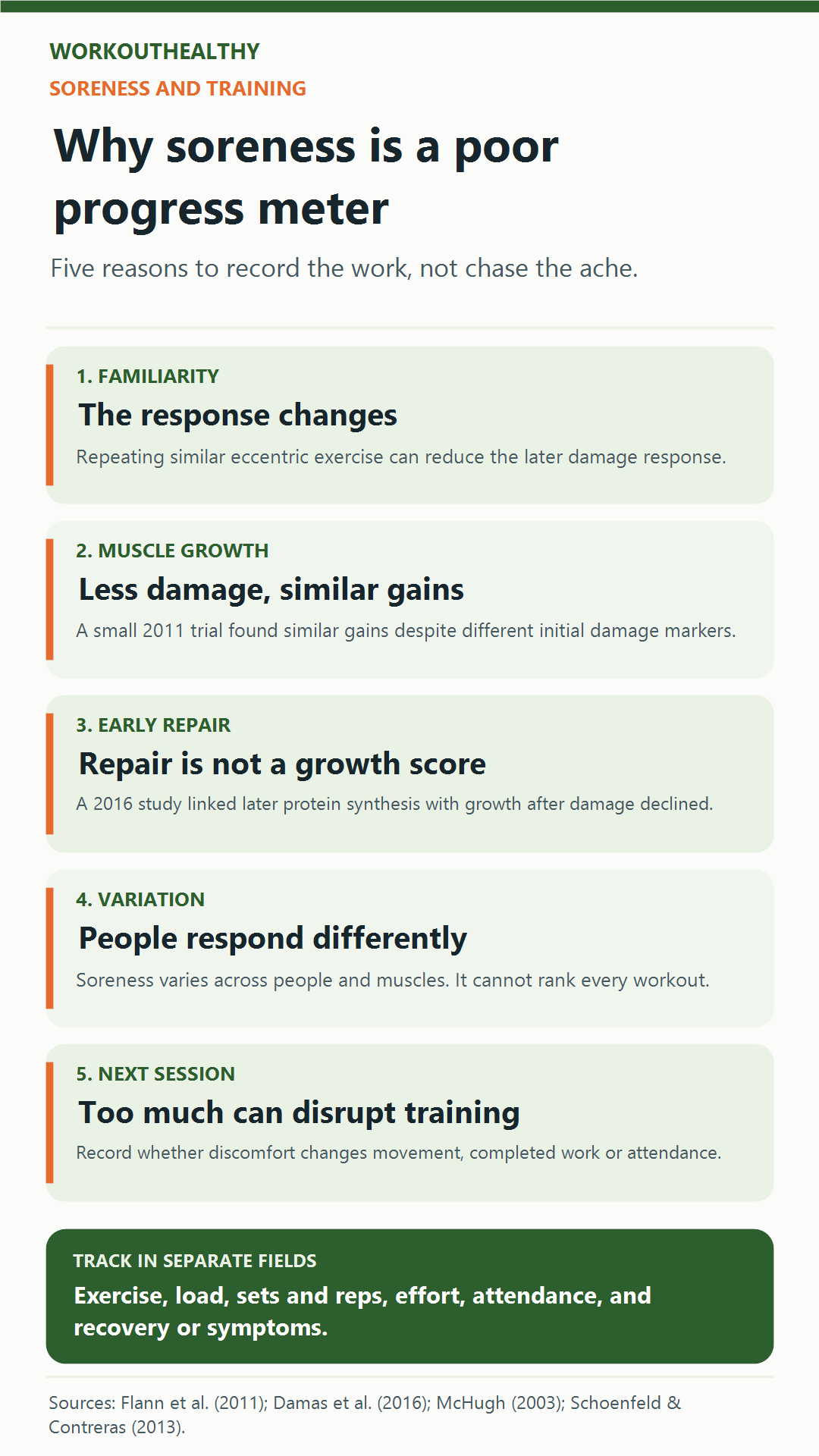
Five problems arise when the ache becomes the target: unfamiliar exercise changes the response, detectable damage is not required for growth, early repair signals can mislead, people experience soreness differently, and excessive discomfort can interfere with later training.
The alternative is a small training record that connects the work you complete to the goal you actually want to improve.
1. Familiarity changes the soreness response
A familiar session can feel different from an unfamiliar one because repeated exposure to eccentric exercise can reduce the damage response to a later similar bout, an adaptation known as the repeated bout effect (McHugh, 2003).
Eccentric contractions occur when a muscle produces force while lengthening, such as during the lowering phase of many resistance exercises.
The repeated bout effect helps explain why less soreness after repeating a movement does not, by itself, mean that the exercise has stopped being useful.
The response depends on the activity and person, so a review of eccentric exercise does not establish a fixed protection period or the same response for every training method (McHugh, 2003).
In your own log, note when you introduce an exercise, change its range of motion or return after time away, because those details help explain why two sessions are difficult to compare.
A useful review asks what changed in the session before assigning meaning to the soreness rating, without assuming that every ache has the same cause.
2. Detectable damage is not required for growth
Flann and colleagues studied 14 healthy university students using a specialized high-force eccentric cycling program, with one group completing three weeks of gradual preparation and the other beginning without that preparation (Flann et al., 2011).
The groups showed different initial soreness and damage markers but no statistically significant difference in their subsequent muscle size or strength gains (Flann et al., 2011).
Quadriceps muscle volume increased by 6.5 percent in the prepared group and 7.5 percent in the initially unprepared group, while strength increased by approximately 25 and 26 percent respectively (Flann et al., 2011).
The study supports the possibility of growth without discernible initial damage, but its small sample and unusual training method limit how precisely the results describe ordinary gym programs.
Those percentages are group averages from that study, not an eight-week forecast for your own lifts or body composition.
The practical implication is to judge the relevant training outcome directly rather than treating initial discomfort as a required checkpoint on the way to improvement.
Record the work you completed before judging the ache that followed.
3. Early repair is different from lasting growth
A separate 2016 study followed ten young men across ten weeks of resistance training, measuring muscle protein synthesis, damage and muscle fibre size at different stages (Damas et al., 2016).
The first exercise response produced the largest measured protein synthesis and damage responses, but those early responses did not correlate with later muscle growth (Damas et al., 2016).
At weeks three and ten, after damage had declined, the protein synthesis response was correlated with hypertrophy, and increases in muscle fibre size were detected at week ten (Damas et al., 2016).
That finding concerns laboratory measurements and timing, not a rule that every sore feeling represents wasted work or that a particular week guarantees growth.
A soreness rating cannot stand in for a muscle biopsy, and a dramatic first session does not provide a measurement of the size change that will follow.
Keep the time scale attached to the question you are asking: next-day discomfort describes a short-term experience, while a change in strength or size needs an appropriate outcome measure over time.
4. Soreness varies across people and muscles
Schoenfeld and Contreras’s 2013 review described a poor relationship between soreness and the extent or timing of exercise-induced damage, alongside differences in how people and muscles experience soreness (Schoenfeld & Contreras, 2013).
The review also discussed a possible role for muscle damage in hypertrophy, so presenting it as proof that damage has no role would misstate its historical interpretation.
Its practical conclusion was narrower: soreness should not serve as a definitive gauge of training results, especially when discomfort becomes excessive (Schoenfeld & Contreras, 2013).
Comparing your soreness with a partner’s therefore leaves several questions unanswered, including whether the same exercise was performed with similar loads, range, effort and previous exposure.
Even within your own week, an ache after one movement is not a common unit that lets you rank every exercise from least to most effective.
Choose a measure connected to your goal, such as the repetitions completed at a recorded load with comparable technique, and retain soreness as a separate observation.
5. Excessive soreness can interfere with training
The 2013 review cautioned that excessive soreness can interfere with subsequent exercise performance and motivation, rather than recommending that lifters actively pursue it (Schoenfeld & Contreras, 2013).
That does not establish a universal number of missed sessions or prove that everyone with soreness has an unsuitable program.
It gives you a concrete question to record: did the discomfort change how you moved, the work you completed or whether you could undertake the next planned activity?
If you repeatedly change the session to produce a new ache, your log also becomes harder to interpret because the exercise and training conditions keep changing.
The American College of Sports Medicine’s 2026 guidance emphasizes consistent resistance training tailored to individual goals, and notes that training to momentary failure does not consistently improve outcomes for the average healthy adult (American College of Sports Medicine [ACSM], 2026).
You can pursue an appropriate training challenge while tracking the actual work and recovery, without adopting soreness or complete exhaustion as a universal success criterion.
What to record in a training log
Keep the record short enough to complete after an ordinary session, using the same fields each time so that later comparisons have a clear basis.
- Exercise and setup: Record the movement, equipment and any meaningful change in range or technique.
- Completed work: Write the load, sets and repetitions actually performed, including units.
- Effort: Add a consistent description of how demanding the sets felt, without confusing an estimate with a precise measurement.
- Attendance: Note whether the planned session happened and the practical reason for a change.
- Recovery and symptoms: Record soreness separately, along with anything that affected movement or the next session.
These fields are an original editorial tracking aid, not a validated score or a complete prescription for load, volume or recovery time.
For example, a hypothetical entry could describe the same dumbbell exercise performed with the same load and setup, followed by one additional controlled repetition in a later comparable session.
That is an observation about performance, while a note saying “more sore today” records a different outcome and cannot replace the repetition count.
You can also record a session that stayed at the same load while its instructions or technique became clearer, because numbers alone may omit the work being learned.
Our guide to five fitness basics when progress stalls covers other factors to consider when reviewing a training plan.
Compare sessions before changing the plan
Review a series of entries under comparable conditions, rather than choosing the most memorable session and making it the standard for every later workout.
If load or repetitions change, check what happened to the exercise setup, rest periods and technique before interpreting the difference as a change in strength.
More weight with a different movement or much shorter range is a different comparison from more weight under the same agreed conditions.
Likewise, a missed workout caused by a schedule conflict requires a different response from a session stopped because of symptoms, even if both leave a blank space in the calendar.
Use the record to identify one specific question for a qualified coach when you need help, such as whether the planned progression still matches your goal and current capacity.
A training record does not diagnose a medical problem or prove a program is effective for every outcome, so keep health questions and training measurements within their proper limits.
For context on exercise outcomes, our guide to low and high repetitions separates strength and muscle size instead of assuming that one number describes both.
A useful training log keeps performance, attendance and symptoms in separate fields.
When discomfort needs medical attention
A general soreness article cannot determine the cause of your pain, and an image of someone holding their back is not a diagnosis.
CDC guidance identifies muscle pain more severe than expected, tea- or cola-colored urine and unusual weakness or exercise intolerance as potential signs of rhabdomyolysis that require immediate medical attention (Centers for Disease Control and Prevention [CDC], 2025).
Symptoms alone cannot confirm the condition, and a healthcare professional needs to evaluate it with appropriate testing (CDC, 2025).
Do not use the absence of one symptom, such as dark urine, as permission to ignore another concerning symptom or continue an unusually difficult session.
Seek appropriate medical advice for unexplained, worsening or recurrent pain, particularly when it changes your normal movement or daily activity.
A log can help you describe the timing and activity involved, but that supporting information does not turn a self-assessment into a diagnosis.
The takeaway
Soreness can provide context about an exercise experience, but it cannot measure the strength or muscle growth produced by that session.
Record the exercise, completed work, effort, attendance and symptoms, then compare the outcome relevant to your goal under conditions you can describe.
If soreness changes the next session, note that consequence and address it appropriately instead of treating a more painful week as automatic evidence of better training.
Get the next evidence check.
Five practical fitness stories worth your time, every Friday.
One email a week. No product pitches. Unsubscribe in one click.
References
American College of Sports Medicine. (2026, March 17). ACSM publishes updated resistance training guidelines. https://acsm.org/resistance-training-guidelines-update-2026/
Centers for Disease Control and Prevention. (2025, January 14). Signs and symptoms of rhabdomyolysis. https://www.cdc.gov/niosh/rhabdo/signs-symptoms/index.html
Damas, F., Phillips, S. M., Libardi, C. A., Vechin, F. C., Lixandrão, M. E., Jannig, P. R., Costa, L. A. R., Bacurau, A. V., Snijders, T., Parise, G., Tricoli, V., Roschel, H., & Ugrinowitsch, C. (2016). Resistance training-induced changes in integrated myofibrillar protein synthesis are related to hypertrophy only after attenuation of muscle damage. The Journal of Physiology, 594(18), 5209-5222. https://doi.org/10.1113/JP272472
Flann, K. L., LaStayo, P. C., McClain, D. A., Hazel, M., & Lindstedt, S. L. (2011). Muscle damage and muscle remodeling: No pain, no gain? The Journal of Experimental Biology, 214(4), 674-679. https://doi.org/10.1242/jeb.050112
McHugh, M. P. (2003). Recent advances in the understanding of the repeated bout effect: The protective effect against muscle damage from a single bout of eccentric exercise. Scandinavian Journal of Medicine & Science in Sports, 13(2), 88-97. https://doi.org/10.1034/j.1600-0838.2003.02477.x
Schoenfeld, B. J., & Contreras, B. (2013). Is postexercise muscle soreness a valid indicator of muscular adaptations? Strength and Conditioning Journal, 35(5), 16-21. https://doi.org/10.1519/SSC.0b013e3182a61820
Medical disclaimer: This article is for general information only and is not medical advice. If you have an injury, ongoing pain, or a medical condition, talk to a doctor or physical therapist before you change how you train or eat.