

Walk into almost any gym and you will see a simple system at work.
A bar, a stack of plates, and the option to add a little more weight next week.
A popular post credits Alan Calvert with creating the first adjustable barbell so lifters could raise the weight in small steps.
Calvert was a real pioneer of adjustable equipment. Calling his the very first is harder to support.
Here is what the record shows, and what modern research says about the idea he sold.
Who Alan Calvert Was
Alan Calvert was an American strength promoter who lived from 1875 to 1944.
In April 1902 he founded the Milo Bar-bell Company.
Records describe a patent for the Milo Adjustable Barbell granted to him in January 1902.
That early bar had a compartment that could be loaded with shot to add weight.
In 1919 he received another patent, this time for adjustable plates of different widths that fit inside a sphere.
In 1914 he started a magazine called Strength, which ran until 1920.
He also wrote books, including The Truth About Weight Lifting in 1911 and Super Strength in 1924.
The Problem He Set Out to Solve
A doctoral dissertation from the University of Texas at Austin, written by Kimberly Ayn Beckwith, explains the situation well.
Interest in muscle building grew after strongman Eugen Sandow’s appearances at the 1893 Chicago World’s Fair.
Yet most exercise books of the time promoted light weight training.
Men who wanted to lift heavier weights could not buy suitable equipment from American sporting goods companies.
Beckwith writes that Calvert solved both problems when he opened the Milo Bar-bell Company in 1902.
He sold adjustable barbells and dumbbells and promoted progressive resistance training to use them.
Was It Really the First Adjustable Barbell?
The popular version says Calvert personally created the first adjustable barbell.
The sources we reviewed do not go that far.
Wikipedia calls him a pioneer in the development of adjustable weightlifting equipment.
It does not claim his design was the first of its kind anywhere.
The safer statement is that Calvert patented and mass marketed an early adjustable barbell in the United States.
That alone was a big deal for lifters who trained at home.
The magic was never in the bar. It was in the permission to add a little more, again and again.
What Progressive Overload Means
Progressive overload is the idea that training must get gradually harder for the body to keep adapting.
An adjustable bar makes that easy, because you can add small amounts of weight over time.
Before that, a lifter with a fixed weight had few ways to raise the challenge besides more reps.
Calvert’s equipment turned gradual loading into a practical routine for ordinary people.
What Modern Research Says
Modern exercise science still treats gradual progression as a core rule.
The American College of Sports Medicine published a position stand on progression models in 2009.
It says progressive resistance training is necessary to keep driving adaptation toward a goal.
It gives a concrete rule for adding weight.
When you can do one to two reps more than your target at a given load, it recommends a 2 to 10 percent increase.
That is the same small step idea Calvert’s adjustable bar made possible.
For novices, the position stand suggests loads that allow 8 to 12 reps, with training two to three days a week.
A 2022 study by Plotkin and colleagues asked whether the load itself must go up.
Forty three people with at least a year of lower body training were split into two groups for eight weeks.
One group tried to add weight while keeping reps the same. The other added reps while keeping the weight the same.
Both did four sets of four lower body exercises twice a week.
Muscle growth and strength changes were similar between the groups.
Strength gains slightly favored adding load, but the difference was of questionable practical importance.
The authors concluded that both approaches appear to be workable ways to progress over an eight week cycle.
What This Does Not Prove
The Plotkin study was short and included trained lifters, so beginners may respond differently.
The ACSM figures are expert recommendations, not fixed laws for every person.
And none of this research tested Calvert’s own equipment or courses.
How to Apply Calvert’s Idea Today
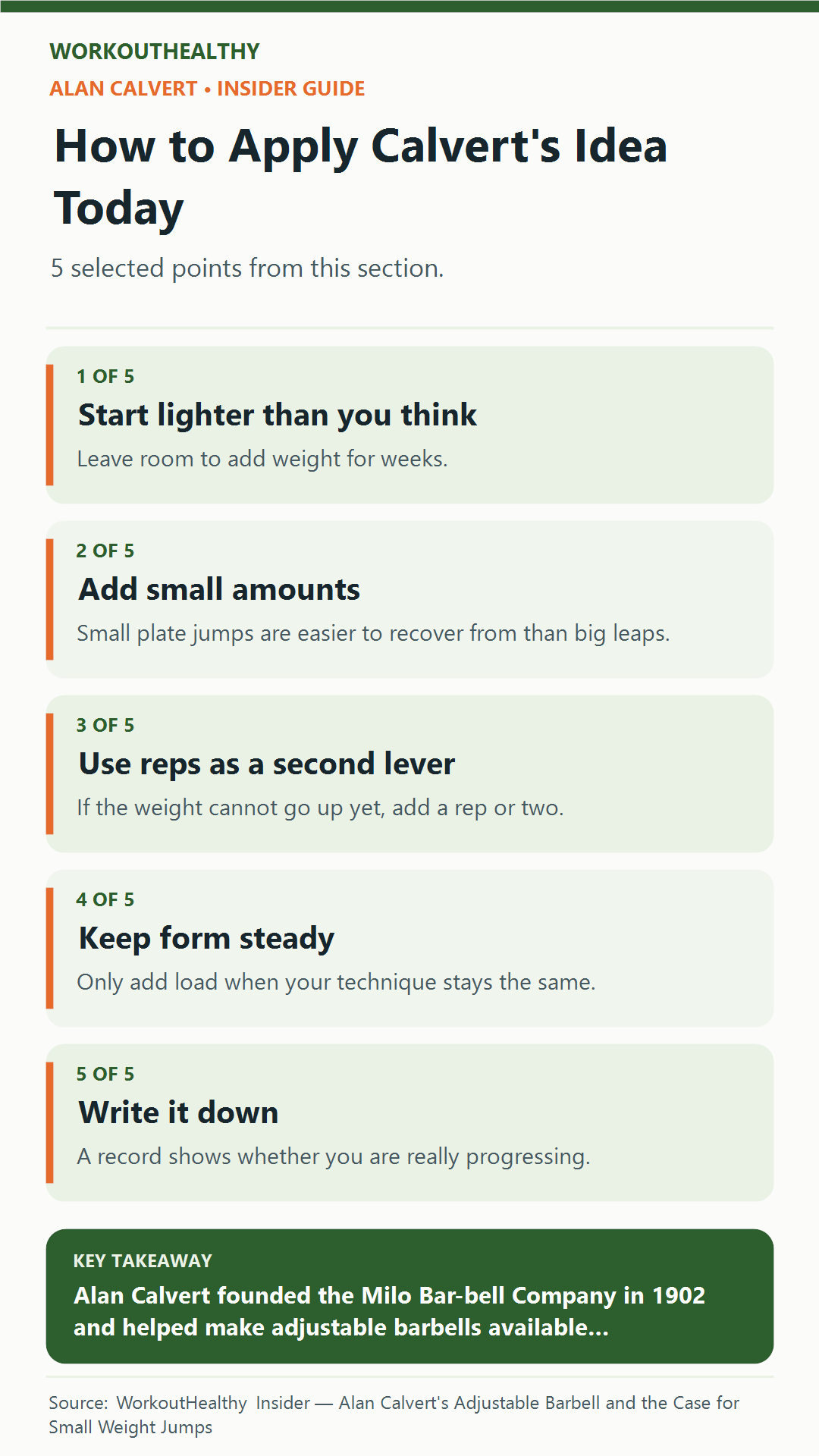
- Start lighter than you think. Leave room to add weight for weeks.
- Add small amounts. Small plate jumps are easier to recover from than big leaps.
- Use reps as a second lever. If the weight cannot go up yet, add a rep or two.
- Keep form steady. Only add load when your technique stays the same.
- Write it down. A record shows whether you are really progressing.
- Expect plateaus. Progress slows with experience, which is normal.
For ideas on choosing the right lower body lift to progress, see our guide to deadlift alternatives matched to your goal.
Newer lifters can also check how to gain muscle when you are naturally skinny.
Common Mistakes
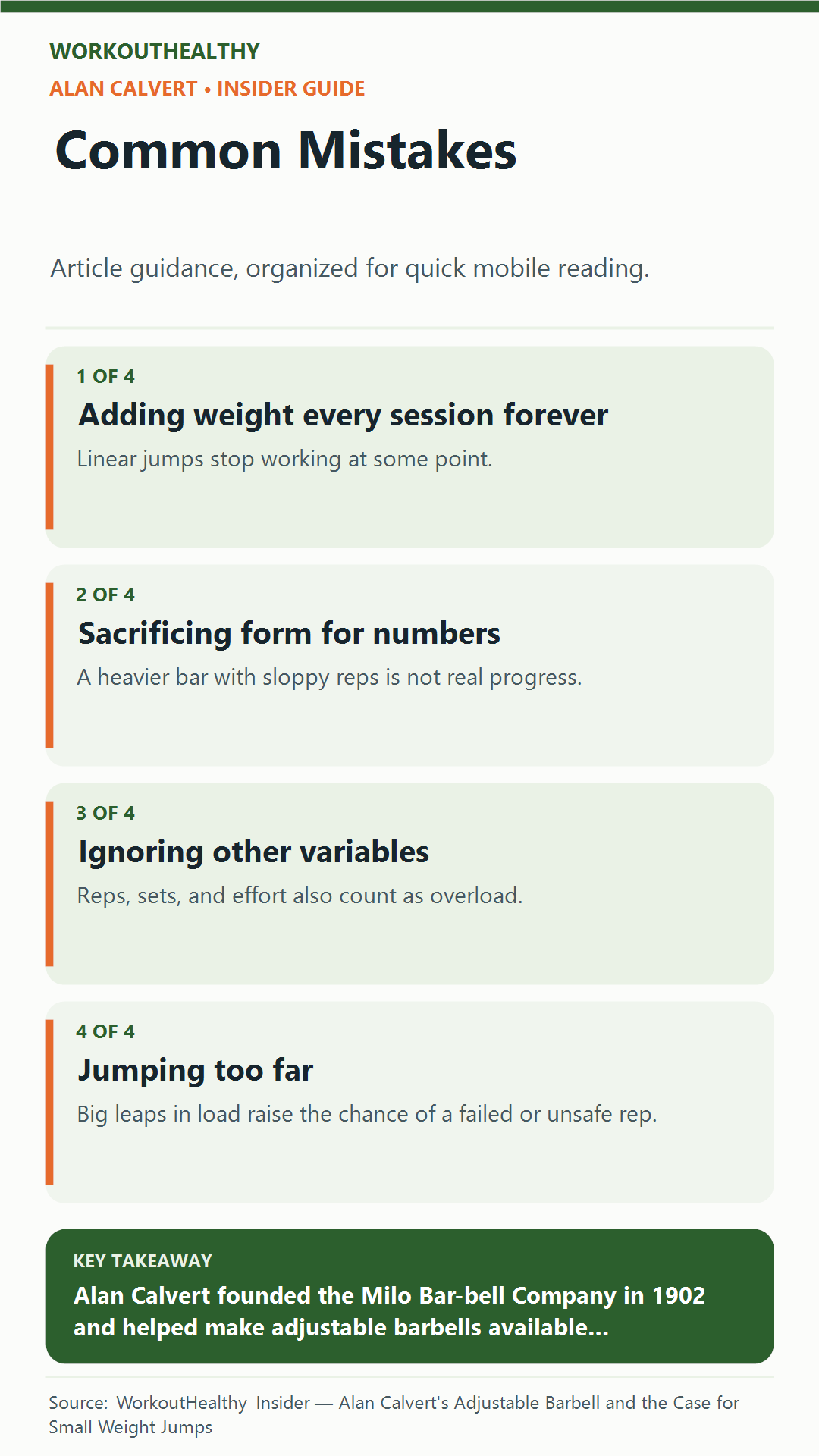
- Adding weight every session forever. Linear jumps stop working at some point.
- Sacrificing form for numbers. A heavier bar with sloppy reps is not real progress.
- Ignoring other variables. Reps, sets, and effort also count as overload.
- Jumping too far. Big leaps in load raise the chance of a failed or unsafe rep.
Who Should Be Careful
People with joint pain, heart conditions, or recent injuries should get medical advice before lifting heavier.
Beginners benefit from coaching on technique before adding much weight.
Use collars on plate loaded bars, and use safety pins or a spotter for heavy pressing and squatting.
The Bottom Line
Alan Calvert founded the Milo Bar-bell Company in 1902 and helped make adjustable barbells available to American lifters.
The record supports calling him a pioneer, not the proven inventor of the first adjustable bar.
His core idea, gradual overload, is still how strength training works.
Want more stories like this? Subscribe to WorkoutHealthy Insider for practical explanations behind popular fitness claims.
References
- American College of Sports Medicine. (2009). Progression models in resistance training for healthy adults. Medicine & Science in Sports & Exercise, 41(3), 687 to 708. https://doi.org/10.1249/MSS.0b013e3181915670
- Beckwith, K. A. (n.d.). Building strength: Alan Calvert, the Milo Bar-bell Company, and the modernization of American weight training [Doctoral dissertation, The University of Texas at Austin]. Texas ScholarWorks. https://repositories.lib.utexas.edu/items/ee9fa78d-5a54-4931-b844-6c2c59eb962e
- Plotkin, D., Coleman, M., Van Every, D., Maldonado, J., Oberlin, D., Israetel, M., Feather, J., Alto, A., Vigotsky, A. D., & Schoenfeld, B. J. (2022). Progressive overload without progressing load? The effects of load or repetition progression on muscular adaptations. PeerJ, 10, e14142. https://doi.org/10.7717/peerj.14142
- Wikipedia contributors. (n.d.). Alan Calvert. In Wikipedia. Retrieved September 16, 2026, from https://en.wikipedia.org/wiki/Alan_Calvert
This article is for general information only and is not medical advice. If you have an injury, ongoing pain, or a medical condition, talk to a doctor or physical therapist before you change how you train or eat.