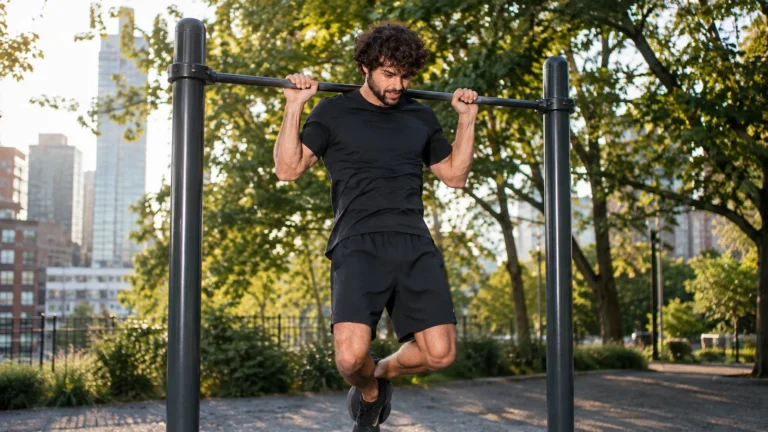
How to gain muscle as a skinny guy: start with a repeatable resistance-training plan, eat enough varied food to support training, include protein regularly, and track what changes over time. “Skinny” describes a body shape, not a diagnosis or a special metabolism, and no fixed calorie number or monthly gain target fits everyone.
If you are losing weight without trying, arrange a clinical assessment; seek advice as soon as possible if other symptoms are present. NHS guidance notes possible medical, medication, nutritional and mental-health causes.
The quick plan
- Choose two or three lifting days you can repeat for several weeks, with a way to practice a squat or knee bend, a hip hinge, a push, and a pull.
- Record the exercise, repetitions, load, and how the set felt; progress gradually when technique and recovery permit.
- Eat regular meals that include satisfying carbohydrate, protein, fat, fruit or vegetables, and enough overall food for your situation.
- Review the training log, appetite, recovery, and any body-size trend you choose to track before changing the plan.
This is a starting framework, not a promise about appearance. Training and eating habits should fit your health, access, preferences, and stage of life.
A simple two-day lifting example
The table presents possible session choices, not a personal prescription. Use a manageable amount of controlled work and allow recovery before repeating a session.
| Session A | Session B | What to record |
|---|---|---|
| Squat to a chair or leg press | Step-up or supported split squat | Variation, range of motion, repetitions, load |
| Row with a band, cable, or dumbbell | Pulldown or another row | Grip and form, repetitions, load |
| Push-up against a bench or chest press | Overhead or chest press that feels comfortable | Variation, repetitions, load |
| Hip hinge with light weights or a bridge | Hip hinge or bridge variation | Movement quality and recovery |
Pick options you can perform safely with equipment you have, and ask a qualified coach for help learning unfamiliar lifts. You can add work gradually if you are recovering well; the table is not a requirement to perform every exercise to exhaustion.
The American College of Sports Medicine’s 2026 guidance emphasizes consistent resistance training and adjusting variables for the desired result. A basic repeatable plan can be more useful than a complicated split that you cannot sustain.
How to tell whether training is progressing
Choose a few movements and keep them stable long enough to compare them. For the same exercise and similar technique, an extra controlled repetition, a modest load increase, or better ability to complete the planned work can be useful signs of progress.
| Log line | What it tells you | Illustrative example |
|---|---|---|
| Exercise and setup | Whether you are comparing the same task | Same dumbbell row and bench support |
| Work completed | Repetitions and load under that setup | Eight controlled repetitions before technique changes |
| Recovery | Whether fatigue or soreness disrupts the next session | Felt ready to repeat the movement after the planned rest |
| Decision | Continue, practice, or adjust one variable | Keep the setup and aim for another clean repetition later |
The example is invented to show how to use a log; it is not a predicted rate of muscle gain. If your performance changes but the mirror does not, that does not mean the training is useless, because appearance is a slow and noisy measure.
Food supports the training, but an exact surplus is not universal
Muscle tissue needs training stimulus and adequate food, yet appetite and daily intake vary. If regular meals feel hard to maintain, a satisfying snack or drink containing foods you already tolerate can make the routine easier; a registered dietitian can help with individual intake when needed.
A 2019 review found no established optimal surplus for muscle growth. Deficit hypertrophy appeared more likely in training-naive people who were overweight, which cannot establish a calorie rule for a thin beginner.
Look at more than one day before concluding you are eating too little. If gaining body mass is personally important and the trend remains flat despite consistent training, review the overall pattern with a dietitian rather than automatically adding a large amount of food or treating appetite as a character flaw.
What protein research actually says
The 49-study resistance-training meta-analysis found modest average fat-free-mass and strength benefits with protein supplementation. Its breakpoint model used 42 study arms and 723 participants: 1.62 g/kg/day (95% confidence interval 1.03 to 2.20; p = .079), a statistically nonsignificant fit, not a personal ceiling or mandatory target.
Fat-free mass is not pure muscle. Protein foods and powders are options; seek dietitian advice if health, appetite or access complicates eating.
Does every thin beginner need ten hard sets per muscle?
The 2017 meta-analysis associated greater weekly resistance-training volume with greater average hypertrophy. Its fewer-than-five, five-to-nine and ten-or-more set categories showed only a trend (p = .074), not a universal starting point or proven step ladder.
Begin with repeatable work that allows technique, recovery, and progress to be observed. Add volume when the log and your capacity support it; avoid treating every easy set as wasted or every set to failure as required.
When progress seems stuck
- Check consistency: did you perform the plan often enough to evaluate it, or did school, work, illness, or travel repeatedly interrupt it?
- Check the comparison: are you looking at the same lifts and conditions, or has every exercise changed?
- Check recovery: is fatigue, sleep disruption, or pain making each session harder?
- Check food and appetite: are meals regular and satisfying, or is eating difficult enough to deserve tailored help?
- Then adjust one thing: change a suitable training variable or the meal routine and observe the next block before changing everything again.
An optional body-weight trend can give context if gaining weight is your chosen goal, but a single weigh-in does not distinguish muscle from water, food, or fat. You do not need to weigh yourself to get stronger, and tracking is not helpful for everyone.
Keep the goal broader than a body label
Searches for “skinny guy” often bundle together training questions and appearance frustration. If the plan is improving strength and confidence while remaining sustainable, those are real results even if the mirror changes slowly.
For a closer look at low-volume training claims, see our Mike Mentzer evidence review. Our separate guide to rest days and muscle adaptation covers a common recovery question.
Sources
- ACSM. 2026 resistance-training guidance.
- Slater GJ et al. Energy surplus and hypertrophy review. 2019.
- Morton RW et al. Protein supplementation meta-analysis. 2018. 2020 correction: Schoenfeld disclosed a Dymatize Nutrition advisory role during writing and in 2020.
- Schoenfeld BJ et al. Weekly set volume and hypertrophy meta-analysis. 2017.
- NHS. Unintentional weight loss guidance, reviewed 2025.
This article is general information, not individualized training or nutrition advice. If you have unexplained weight loss, persistent pain, or a medical condition, talk with a qualified health professional before changing your training or intake.