
Mike Mentzer’s Heavy Duty system keeps returning to fitness feeds because it offers an irresistible promise: train very hard, keep the workout brief, recover fully, and stop treating more gym time as proof of better training.
A WorkoutHealthy Facebook post summarized that idea with Mentzer’s claim that he trained for about 30 minutes four times a week. That description captures one period of his approach, but it is not a complete program and it should not be treated as the only routine he ever used.
The useful question is not whether every lifter should copy one historical schedule. It is whether Mentzer’s minimum-dose mindset can help you remove low-quality work without cutting the productive work your goal still requires.
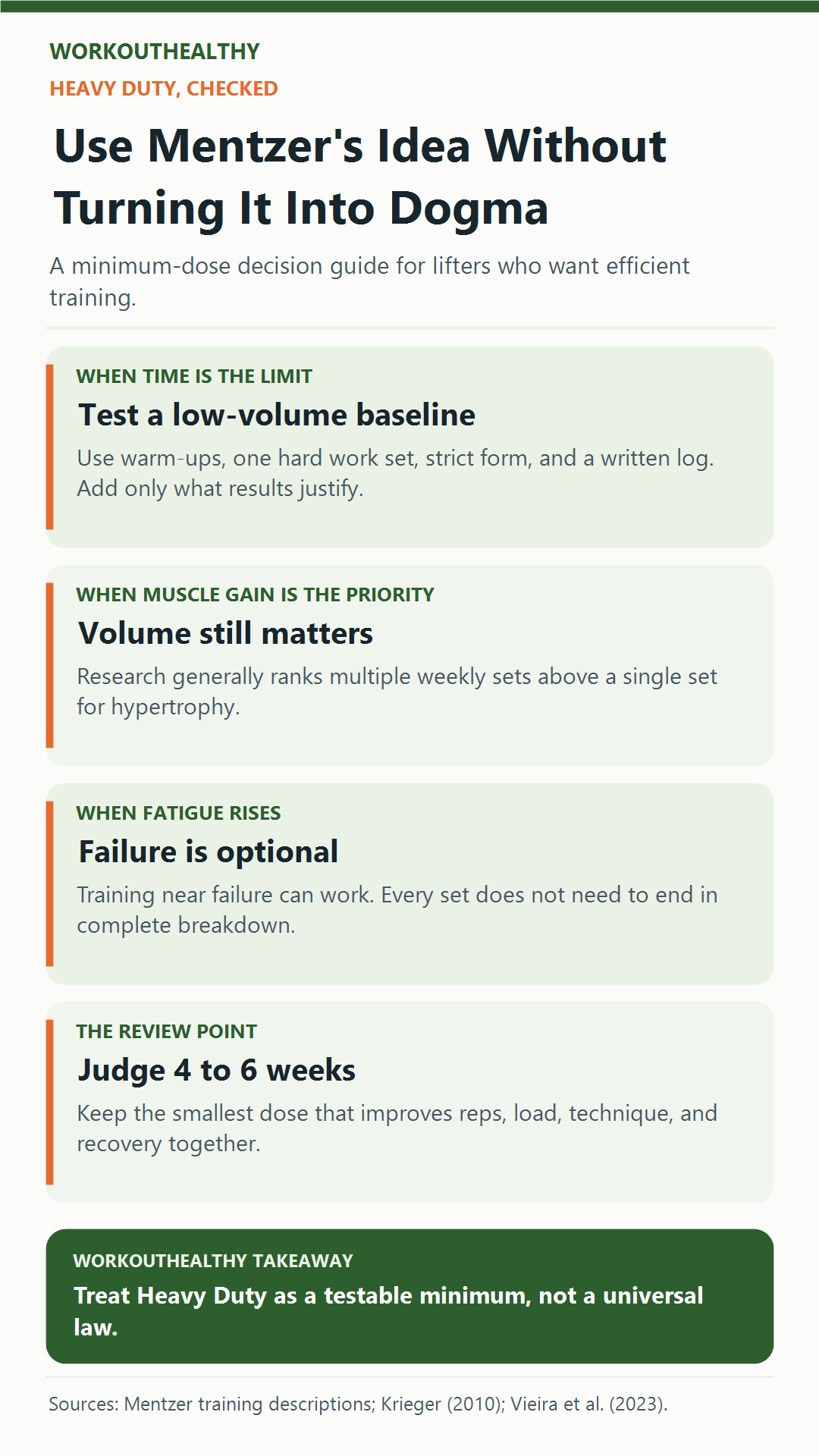
Heavy Duty is most useful as a challenge to junk volume, not as proof that one set is always enough.
What Heavy Duty meant
Mentzer’s system grew out of high-intensity training, a school of bodybuilding that emphasized a small number of demanding work sets, controlled repetitions, and enough rest to improve before the next session. The word “intensity” referred to effort, not to a fast circuit or a high heart rate.
A typical Heavy Duty interpretation uses warm-up sets that prepare the movement without creating much fatigue, followed by one all-out work set on an exercise. The lifter records the load and repetitions, then tries to improve that performance when the exercise returns.
That focus on progression is important. A short workout is not automatically effective. It becomes training when the exercises are appropriate, technique remains controlled, the hard sets are genuinely hard, and performance can be compared from one session to the next.
Mentzer also revised his recommendations over time. Some versions involved more frequent sessions and more work than the very sparse routines associated with his later teaching. That makes any one viral schedule a snapshot, not a complete definition.
The 30-minute claim needs context
Thirty minutes can be enough for a focused resistance session, especially when the plan has few exercises and long setup time is avoided. It can also be too little if warm-ups, equipment changes, and necessary practice are rushed just to satisfy a clock.
The more important issue is what the session contains. Four brief weekly workouts could distribute the body across a split routine. The same number would mean something different in a full-body plan, where every session repeats more movement patterns.
Training age changes the calculation too. A beginner needs repeated practice with manageable loads. An experienced bodybuilder may need more stimulus for a muscle that has already adapted to years of training. A lifter returning after time away may progress on a surprisingly small dose because the starting point has changed.
This is why copying the duration without copying the logic misses the point. Time is a constraint. Exercise selection, effort, weekly set volume, recovery, and progression are the actual training variables.
One set can work, but more can work better
Research supports a useful middle position. A single challenging set can produce strength and muscle gains, particularly for newer lifters and people moving from no resistance training to a consistent program. That makes it a legitimate minimum, not a fake workout.
Across groups, however, multiple-set programs tend to rank higher for hypertrophy than one-set programs. A major review of single versus multiple sets found an advantage for additional sets, and a large network meta-analysis later placed multiple-set prescriptions among the highest-ranked approaches for muscle growth.
That does not mean every exercise needs four or five sets. Weekly volume is accumulated across exercises and sessions. Two presses can both train the chest, and a row can add work for the elbow flexors even when it is not labeled an arm exercise.
If your program includes both a bench variation and a floor press, our comparison of the floor press versus the bench press can help you avoid treating similar movements as completely separate work.
Failure is a tool, not a requirement
Mentzer’s work sets were closely associated with muscular failure, the point where another repetition cannot be completed with the intended technique. That creates a clear endpoint, but it also increases fatigue and makes form breakdown more likely when judgment slips.
Modern comparisons do not show that every set must reach momentary failure for strength or hypertrophy. Sets stopped close to failure can recruit and fatigue the target muscles while leaving a little more room for technical consistency and additional weekly work.
A practical approach is to reserve failure for stable exercises where a missed repetition is easy to control, such as many machines and some isolation movements. Compound lifts with a bar over the body, complicated setup, or no safety arms deserve more margin.
Training with a reliable partner can make hard sets safer and easier to judge. Our guide to workout partner benefits explains where support helps and where it can turn into distraction.
Recovery has to match the dose
Heavy Duty placed recovery at the center of the program. That is sensible: adaptation happens after training, and a session that repeatedly lowers performance is not creating useful progression.
The trap is turning recovery into an excuse to avoid enough practice or volume. Muscle soreness is not a precise readiness test, and the absence of soreness does not prove that a workout was ineffective. Sleep, appetite, joint comfort, motivation, and actual performance are more useful together than any one signal alone.
Frequency should also match the exercise. Heavy, unfamiliar lifts may need more recovery than light technique work. A muscle can be ready while a painful joint is not. A full-body beginner session might fit three days per week, while a demanding split could space the same muscle farther apart.
If technique is the limiting factor, coaching may provide more value than another recovery day. The guide on whether to hire a personal trainer covers how to judge credentials and fit.
The WorkoutHealthy minimum-effective-dose trial
Here is the original-value framework: run a four-to-six-week training trial in which the goal is to find the least weekly work that improves performance without hiding behind a permanently easy program.
First, choose a stable group of exercises that covers the major movement patterns and fits your equipment. Keep them unchanged long enough to learn whether the plan works. Constant exercise rotation makes it difficult to tell progression from novelty.
Second, record the load, repetitions, technique notes, and an honest estimate of how many good repetitions remained. One work set can be the starting dose on each exercise, but warm-ups still matter and should be written separately.
Third, review the pattern after several exposures. If load or repetitions rise while joints feel good and technique stays consistent, keep the dose. If progress stalls for more than one exposure and recovery is otherwise sound, add one set to the lagging movement or muscle group instead of expanding the whole program.
Finally, reduce the dose if performance falls across sessions, soreness interferes with normal movement, or form deteriorates early. The test is not a contest to survive the least work. It is a way to earn each added set with evidence from your own training log.
Who should use this approach carefully
New lifters should avoid confusing all-out effort with good technique. Early progress comes quickly, and stopping a set with a few controlled repetitions available can provide plenty of stimulus while the movement is still being learned.
People training alone should be conservative on lifts where failure can trap the body or send a bar into an unsafe position. Safety arms, machines, dumbbells that can be released safely, and sensible exercise choices matter more than loyalty to a method.
Older adults and anyone returning from injury, illness, or a long layoff may benefit from lower volume, but that does not make maximal failure the right starting point. Exercise selection and progression should reflect current capacity, not a famous bodybuilder’s tolerance.
Bodybuilding history also includes performance-enhancing drug use, unusually favorable genetics, and professional incentives that do not apply to most readers. A method can still contain good ideas without proving that its most famous physique was produced by the routine alone.
The right minimum is the smallest program that keeps producing your goal, not the smallest program someone can defend online.
The bottom line
Mike Mentzer’s enduring contribution was forcing lifters to ask whether every set deserved its place. Brief, focused resistance training can work, and a single hard set can be a useful baseline.
The stronger evidence does not make one set, complete failure, or a fixed 30-minute schedule universal. Use the minimum-dose idea to improve efficiency, then let your log, recovery, technique, and goal decide whether the dose stays small or grows.
Efficiency is the lasting lesson. A brief plan earns trust when it can be repeated, measured, and adjusted intelligently, not when its brevity becomes an identity that no result is allowed to challenge.
Get the next evidence check.
Five practical fitness stories worth your time, every Friday.
One email a week. No product pitches. Unsubscribe in one click.
Medical disclaimer: This article is general product information, not medical advice. The equipment described here is not a treatment for any condition. If you have an injury, ongoing pain, or a medical condition, talk to a doctor or physical therapist before using any of it.