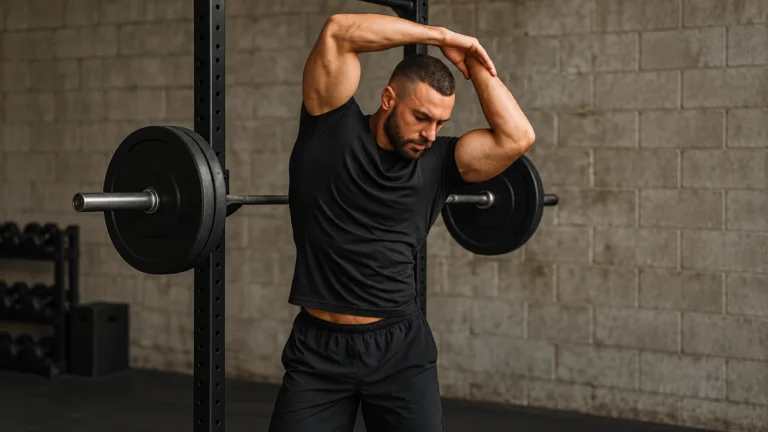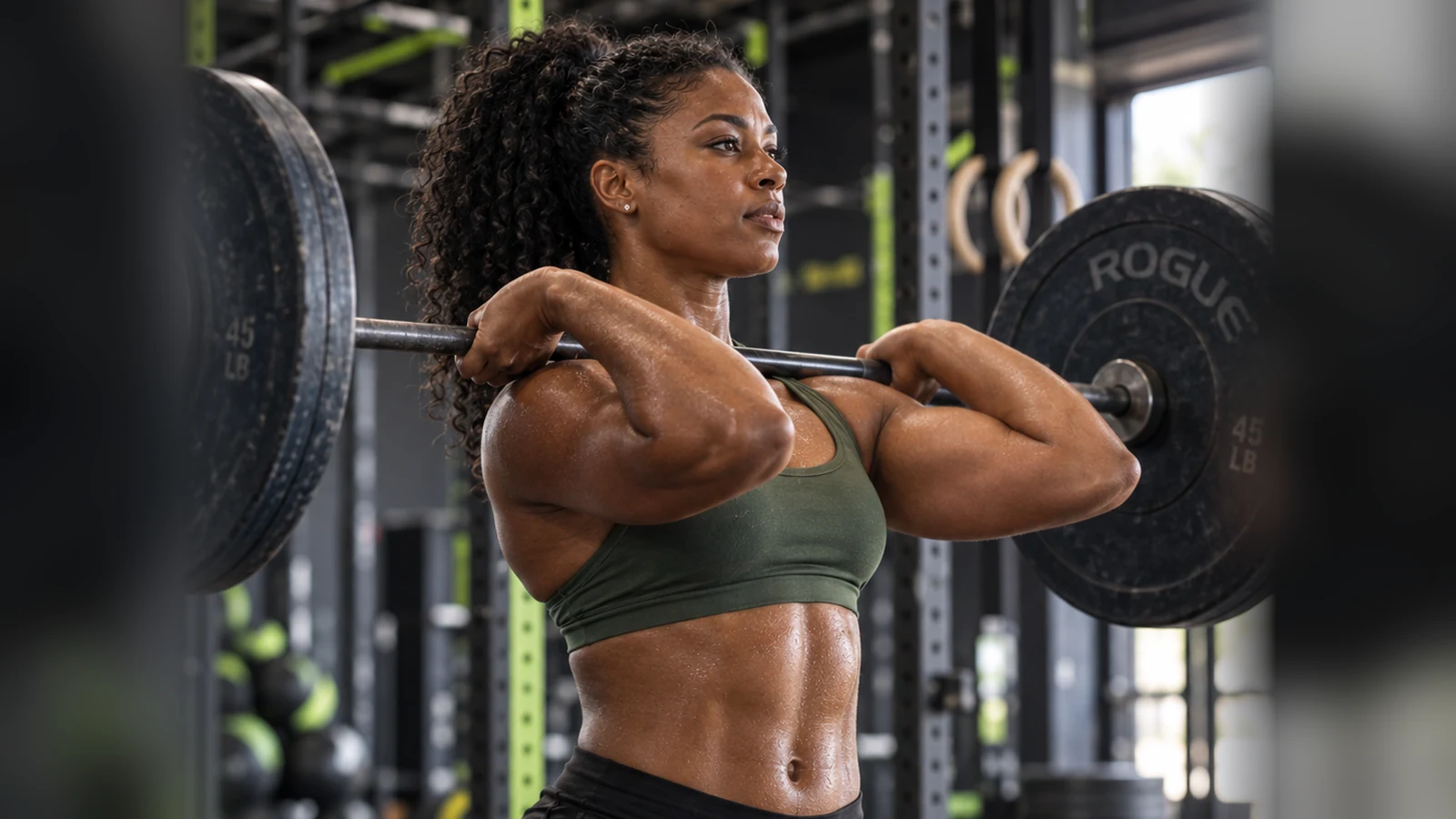

Say the word CrossFit at a dinner party and somebody will tell you about a friend who wrecked their shoulder.
The reputation is decades old now, and it has been repeated so often that most people treat it as settled fact.
The numbers tell a duller story.
Duller stories travel badly, which is part of why the reputation has outlived the evidence for it.
When researchers actually count injuries per hour of training, CrossFit lands in roughly the same range as the strength sports nobody worries about.
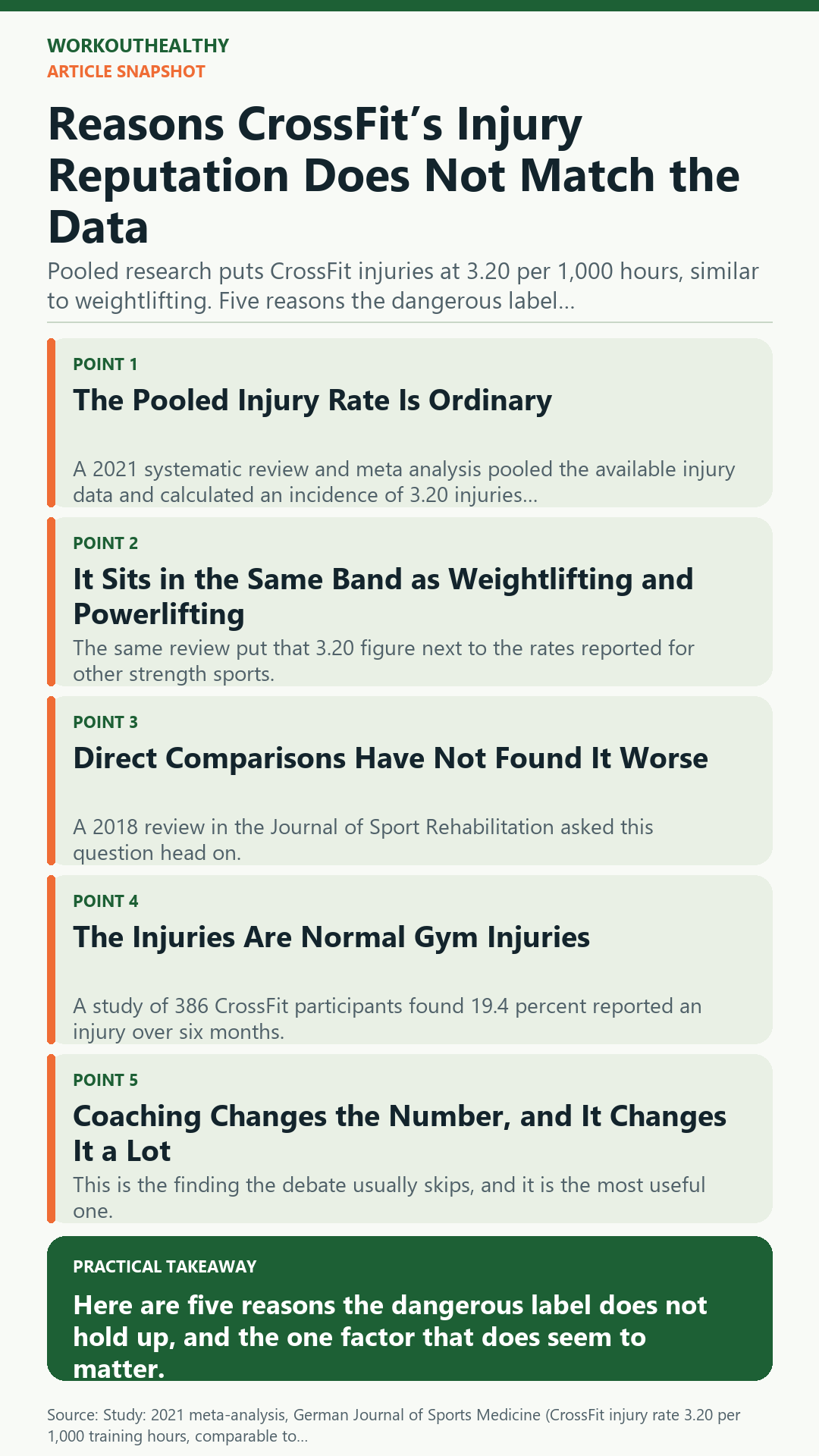
Here are five reasons the dangerous label does not hold up, and the one factor that does seem to matter.
Where the Reputation Came From
Two things built the myth, and neither was a study.
The first was a handful of widely shared stories about rhabdomyolysis, a serious condition where damaged muscle tissue overwhelms the kidneys.
It is real, it can happen after any brutally hard session, and it was talked about openly inside the community in a way that made it look more common than it is.
The second was video.
Ugly repetitions under a clock are filmed and shared in a way that a quiet set of heavy squats never is.
A sport that records itself constantly will always look more dangerous than one that does not.
Neither of those things is a measurement, and neither tells you the rate at which people actually get hurt.
1. The Pooled Injury Rate Is Ordinary
A 2021 systematic review and meta analysis pooled the available injury data and calculated an incidence of 3.20 injuries per 1,000 hours of training.
The confidence interval ran from 2.06 to 4.34, which tells you how much the individual studies disagreed.
That figure is the number the whole argument should turn on, because rate per hour is the only fair way to compare activities.
An activity with a million participants will always generate more total injury stories than one with ten thousand.
Counting total injuries without counting hours makes any popular activity look dangerous.
For perspective, an athlete training five hours a week would expect roughly one injury every four years at that rate.
That is not a reassurance so much as a sense of scale.
2. It Sits in the Same Band as Weightlifting and Powerlifting
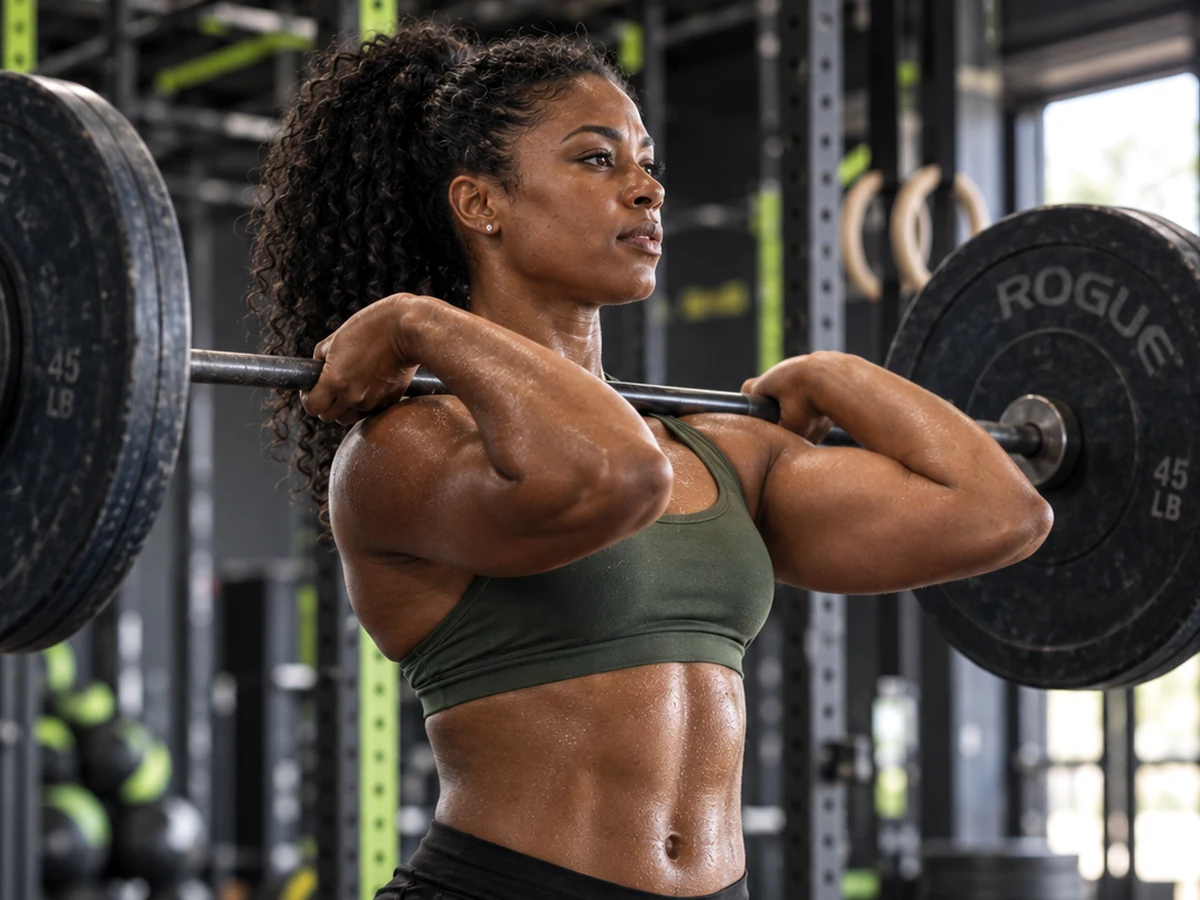
The same review put that 3.20 figure next to the rates reported for other strength sports.
Weightlifting came in around 2.4 to 3.3 per 1,000 hours, and powerlifting around 1.0 to 4.4.
The authors concluded that CrossFit injury rates were essentially equal to weightlifting and powerlifting, lower than strongman and Highland Games, and higher than bodybuilding.
Nobody warns their friends about the dangers of powerlifting at dinner parties.
The reviewers were explicit that injury rates in CrossFit do not seem to differ much from other strength sports.
Whether you find 3.20 per 1,000 hours acceptable is a personal question, but it is not an unusual number for the category.
3. Direct Comparisons Have Not Found It Worse
A 2018 review in the Journal of Sport Rehabilitation asked this question head on.
It compared CrossFit style training against other forms of exercise and found injury rates similar to those in weightlifting, gymnastics, running and other recreational fitness activities.
One included study of army personnel found comparable injury rates between soldiers using extreme conditioning programs and soldiers doing traditional military training.
The reviewers did not find the large gap the reputation implies.
That does not mean the reviewers were enthusiastic, and they noted the underlying research was thin and variable in quality.
Their conclusion was closer to no evidence of elevated risk than to proof of safety, which is a meaningful distinction.
4. The Injuries Are Normal Gym Injuries
A study of 386 CrossFit participants found 19.4 percent reported an injury over six months.
Shoulders led the list, followed by low back and knee.
Shoulder injuries clustered around gymnastic movements and low back injuries around the powerlifting movements, which is exactly where you would expect them in any gym.
There is no exotic CrossFit injury pattern, just the same three areas that bother lifters everywhere.
Men were injured more often than women in that sample, and age made no significant difference.
Most reported injuries were the kind that cost a few weeks of modified training rather than surgery.
The shoulders, low back and knees do not know what the workout is called. They respond to load, fatigue and how fast you added both.
5. Coaching Changes the Number, and It Changes It a Lot
This is the finding the debate usually skips, and it is the most useful one.
In that same study of 386 participants, injury rate fell significantly with trainer involvement.
Participants who trained under constant trainer supervision had a 14.6 percent injury rate.
Participants supervised only some of the time had a 31.0 percent rate, more than double.
The format was the same in both groups, so what differed was whether somebody was watching.
If you take one practical thing from all of this research, it is that the coach matters more than the logo on the door.
The question worth asking about a gym is not whether the workouts are hard but whether anybody will stop you mid set.
What This Evidence Does Not Prove
It does not prove CrossFit is safe for everyone, and it certainly does not prove every gym is run well.
Most of this data comes from surveys where participants recalled their own injuries, which tends to undercount minor problems and overcount memorable ones.
People who got badly hurt and quit are often missing from these samples entirely, which can flatter the numbers.
The 2021 review’s wide confidence interval means the true rate could be meaningfully higher or lower than 3.20.
The coaching finding is an association from a single survey, so it cannot prove supervision itself caused the lower rate.
It is also possible that people who choose closely supervised gyms differ from those who do not in ways nobody measured.
Definitions of injury also varied between studies, and a sore shoulder in one paper was a lost training week in another.
Finally, gym quality varies enormously between affiliates, so an average across many gyms says little about the specific one near you.
How to Lower Your Own Risk
Visit a gym before joining and watch a class rather than reading its website.
Count how many people a coach is watching at once, and whether anybody gets corrected mid set.
Ask what the on ramp looks like, because a good gym will insist on teaching movements before timing them.
Scale the workout rather than finishing it as written, and treat the prescribed version as a ceiling rather than a target.
Be especially careful with high repetition overhead work and high repetition deadlifts under a clock, since those are where fatigue meets the shoulders and low back.
Build up total weekly volume slowly, because sudden jumps in workload are the most consistent injury predictor across every sport studied.
Learn to stop a set when technique changes rather than when the rep count runs out.
Tell the coach about any old injury on your first day, so that scaling starts from real information.
Recovery is part of the plan too, and the case for it is stronger than most enthusiasts admit, as we covered in whether rest days actually build muscle.
Common Mistakes People Make
The biggest is competing with the whiteboard on day one, before the movements are learned.
The second is doing a technically demanding lift for time when your version of that lift falls apart after eight repetitions.
The third is training through a shoulder that has been complaining for three weeks because rest feels like quitting.
A fourth is assuming that a workout is appropriate because everybody else in the room is doing it.
A fifth is reading the low average injury rate and concluding that your own risk is low regardless of how you train.
A sixth is jumping straight into a competition class because it looked exciting online.
If you are still deciding whether the format suits you at all, our honest look at whether CrossFit is for you covers the tradeoffs beyond injury risk, and our take on whether a boot camp class is worth it applies many of the same questions to group training generally.
Who Should Talk to a Doctor First
Anyone with a shoulder, back or knee problem that already limits daily activities should get it assessed before starting.
The same goes for a history of disc injury, shoulder dislocation, or any surgery in the past year.
People with high blood pressure, heart disease or a heart rhythm condition should ask specifically about high intensity intervals.
Pregnant women can often train, but the modifications are real and worth planning with a clinician rather than guessing.
Anyone who has been sedentary for years should build a base before adding a clock, and a doctor can help decide how long that base needs to be.
Dark urine, severe muscle swelling or extreme soreness after a first session is a medical emergency rather than a badge of honor.
That is the rhabdomyolysis picture, and it needs a hospital rather than a rest day.
Watch the Original Video
Curious what else gets exaggerated? Subscribe to WorkoutHealthy Insider for practical explanations behind popular fitness claims.
References
Hülsmann, M., Reinecke, K., Barthel, T., & Reinsberger, C. (2021). Musculoskeletal injuries in CrossFit: A systematic review and meta-analysis of injury rates and locations. German Journal of Sports Medicine, 72(7), 351 to 358. https://www.germanjournalsportsmedicine.com/archive/archive-2021/issue-7/
Klimek, C., Ashbeck, C., Brook, A. J., & Durall, C. (2018). Are injuries more common with CrossFit training than other forms of exercise? Journal of Sport Rehabilitation, 27(3), 295 to 299. https://doi.org/10.1123/jsr.2016-0040
Weisenthal, B. M., Beck, C. A., Maloney, M. D., DeHaven, K. E., & Giordano, B. D. (2014). Injury rate and patterns among CrossFit athletes. Orthopaedic Journal of Sports Medicine, 2(4), Article 2325967114531177. https://doi.org/10.1177/2325967114531177
This article is for general information only and is not medical advice. If you have an injury, ongoing pain, or a medical condition, talk to a doctor or physical therapist before you change how you train or eat.