
A group boot camp class is worth joining if the thing stopping you is showing up alone, and if the coach can scale the work to the body you actually have.
It is a poor first choice if you are returning from an injury, if you need close technique coaching, or if a running clock makes you rush.
The format itself is not special.
What you are buying is a fixed hour, a room of other people, and someone else deciding what happens in it.
That can be worth a lot. It can also be the reason you get hurt.
What Actually Happens in a Boot Camp Class?
Most classes run 45 to 60 minutes and follow the same shape whatever the name on the door says.
You get a general warm up, a block of stations or timed intervals, and a short finisher that leaves everyone on the floor.
Equipment is usually light and portable, because the room has to reset in ninety seconds between stations.
Expect bodyweight movements, dumbbells or kettlebells in the lighter half of the rack, bands, a rower or a bike, and a lot of carrying things from one end of the room to the other.
| Segment | Rough time | What it usually involves |
|---|---|---|
| Warm up | 5 to 10 minutes | Easy cardio, some mobility, a few practice reps of what is coming |
| Movement brief | 2 to 5 minutes | The coach demonstrates each station and names the easier and harder versions |
| Main block | 25 to 35 minutes | Timed stations in rotation, short rests, mixed strength and cardio |
| Finisher | 3 to 6 minutes | A short, hard piece designed to empty the tank |
| Cool down | 3 to 5 minutes | Easy breathing and stretching, often cut short when the class runs late |
Nothing in that hour is unique to boot camp.
The distinguishing feature is the delivery: a group, a clock, and a coach talking to twenty people at once.
Does Training in a Group Really Make You Show Up More Often?
This is the strongest honest argument for a class, and it is also the one most often oversold.
A realist review of 52 group-based physical activity interventions found that 92 percent of them significantly increased participation, and that the successful ones shared specific ingredients rather than just putting people in a room together (Harden et al., 2015).
What mattered was whether members identified as a group, whether they communicated with each other, and whether the person leading was actually trained to lead.
So the ingredient is not the group. It is a group that functions as one.
Now the part the marketing leaves out.
When researchers compared group-based and individual-based interventions head to head across 71 studies, group formats showed only a small advantage for physical activity outcomes, and that advantage was not statistically significant (Kritz et al., 2026).
Group delivery came out ahead for functional outcomes such as strength and mobility, but for the simple question of whether people move more, the two formats looked roughly equivalent.
The practical translation is worth being blunt about.
Groups are not proven to beat training alone in general.
They tend to beat training alone for people who do not train alone well, which is a much narrower and much more useful claim.
If accountability is the missing piece for you, a class is one way to buy it, and training with a partner is another that costs nothing.
The class does not motivate you. The people in it do, and only in a room where somebody would notice you were gone. If nobody knows your name after six weeks, you are paying for a room, not a group.

Where Does One Program for Twenty People Break Down?
Everyone in the room gets the same stations, the same work intervals, and often the same rep targets.
Those twenty people arrive with different training histories, different joint health, different recovery, and very different responses to the identical dose of work.
A single program cannot be correct for all of them. It can only be close enough for most of them.
That is fine, as long as the coach knows it and builds the class around it.
Good scaling looks specific and it happens before the clock starts.
- Each station is demonstrated with an easier version and a harder version, named out loud, not implied.
- Load is offered as a range, and picking the lighter end is treated as a normal choice rather than a confession.
- The target is an effort level or a time, not a fixed number of reps everyone must reach.
- Someone new gets a shorter version of the main block, and the coach says so privately instead of announcing it.
- Stopping a station early is explicitly allowed.
Bad scaling is a coach who offers one version of every movement and then scales by volume of shouting.
You will know within one class which kind you have.
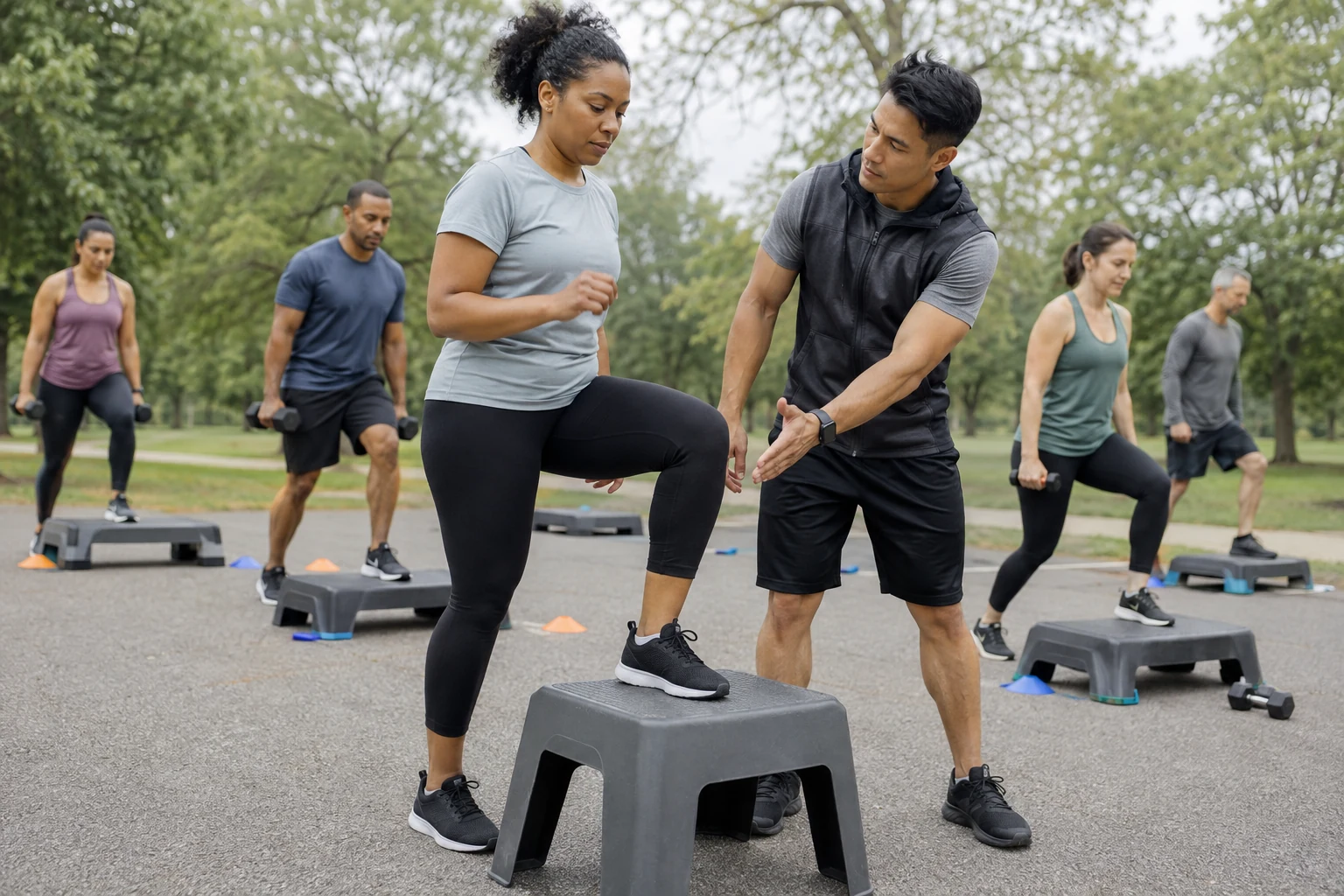
If what you actually need is someone watching only you, a class will not deliver it, and the honest comparison is with hiring a personal trainer for a short block of sessions instead.
How Does Fatigue Turn Into Injury Risk in a Timed Format?
The risk in a boot camp class is rarely the exercises themselves.
It is doing those exercises while tired, under a clock, in front of people.
Fatigue changes how the body stabilizes itself, and the change is measurable.
Research on fatigued lifting found that as muscles tired, active muscle stiffness dropped, and the body compensated by increasing cocontraction of opposing muscles to hold the spine stable, which raised spinal compression loads while narrowing the range of recruitment patterns available to keep that stability (Granata et al., 2004).
In plain terms, a tired body has fewer good options and pays more to use them.
A timed format pushes directly against that.
When the score is reps completed in a window, the incentive is to keep moving through exactly the point where you should slow down.
The combination to watch for is a loaded movement that heavily involves the spine or a single joint, placed late in a session, with a clock on it.
Weighted swings, loaded jumps, high rep overhead work, and anything that rounds a fatigued back under load are the usual candidates.
The rule that keeps people training for years is simple.
When technique changes, the set is over, regardless of what the clock says.
Who Is a Boot Camp Class Good For?
The format suits some people very well and is a bad opening move for others.
| Likely a good fit | Probably start elsewhere |
|---|---|
| You already move most weeks and want structure and company | You are inside a rehab plan or have not been cleared to train |
| You stall when you write your own sessions | You have pain that shows up during ordinary daily movement |
| You want general conditioning rather than a specific lift target | Your goal is a heavy barbell number, which needs its own programming |
| You respond well to a fixed time on the calendar | You have been sedentary for years and cannot yet walk briskly for 20 minutes |
| You enjoy competing gently with people around you | Competing makes you ignore your own limits, which is a real trait worth admitting |
That last row on the right decides more outcomes than fitness level does.
If you are coming off a long stretch of sitting, build a base first and join later.
A few weeks of consistent walking gives you something to arrive with, and our guide to how many miles to walk a day is a reasonable place to set that target.
Nothing about waiting eight weeks makes the class less useful when you get there.
What Should You Watch For on a Trial Class?
Treat the trial as an audit of the coach, not a test of yourself.
You are not there to prove anything.
You are there to find out how this room handles a person who is new.
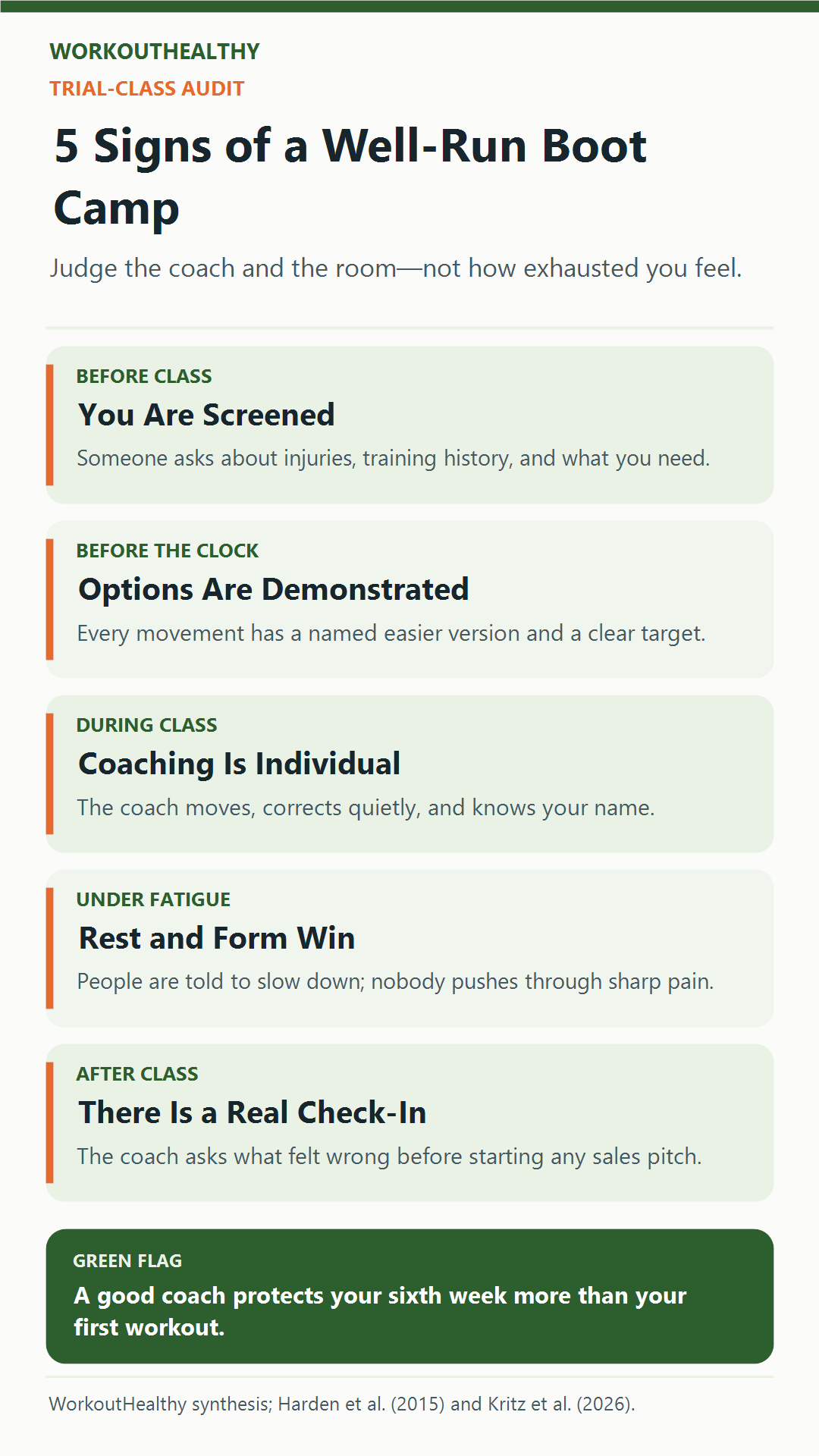
The best sign in a trial class is a coach who tells you to do less than everyone else and does not make it a thing. That is a person who has decided your sixth week matters more than your first one.
Before the class starts
- Somebody asks about injuries, surgeries, and how long you have been training, and then writes it down.
- You are told what the session contains before you are standing on a station.
- The coach introduces themselves and learns your name.
During the class
- Every movement is demonstrated, with at least one easier option named.
- The coach moves around the room and corrects individuals quietly, rather than coaching from one spot.
- Somebody gets told to slow down or drop a load, and it is handled without embarrassment.
- Rest periods are actually enforced instead of shrinking as the class runs behind.
- Nobody is told to push through sharp pain.
After the class
- The coach checks how you found it and asks what felt hard in a bad way.
- You are not walked straight into a sales conversation while you are still catching your breath.
- You can name what the session was training, not just that it was hard.
Two more things are worth checking that have nothing to do with the workout.
Ask how many people are usually in the room and how many coaches are on the floor, because one coach and thirty people means almost no individual correction is possible.
Ask what happens on a week when you can only come once, since a class that only works at four sessions a week is a class most people will quit.
So Is It Worth It?
For the right person it is one of the more reliable ways to train consistently, and consistency is the part almost everyone gets wrong.
Just be honest about what is doing the work.
The evidence says a group format is not automatically better than training on your own.
It says a well run group with a real coach and members who know each other helps people participate, and that the leader and the cohesion are the active ingredients.
So judge the coach and the room, not the brand of the class or how sore you were the next morning.
Soreness is not a measure of anything useful.
If you can find a class where the coach scales the work, knows your name, and would notice you missing, it is probably worth your money.
If you cannot, the format has very little left to offer you that a plan and a calendar would not.
Get the next evidence check.
Five practical fitness stories worth your time, every Friday.
One email a week. No product pitches. Unsubscribe in one click.
References
Granata, K. P., Slota, G. P., & Wilson, S. E. (2004). Influence of fatigue in neuromuscular control of spinal stability. Human Factors, 46(1), 81 to 91. https://doi.org/10.1518/hfes.46.1.81.30391
Harden, S. M., McEwan, D., Sylvester, B. D., Kaulius, M., Ruissen, G., Burke, S. M., Estabrooks, P. A., & Beauchamp, M. R. (2015). Understanding for whom, under what conditions, and how group-based physical activity interventions are successful: A realist review. BMC Public Health, 15, 958. https://doi.org/10.1186/s12889-015-2270-8
Kritz, M., Riddell, H., Olsen, D., Harden, S. M., Burke, S. M., Ntoumanis, N., & Thogersen-Ntoumani, C. (2026). Individual versus group-based interventions: A systematic review and meta-analysis of physical activity, functional, psychosocial and health outcomes. Nature Human Behaviour, 10(6), 1109 to 1121. https://doi.org/10.1038/s41562-026-02429-0
Medical disclaimer: This article is for general information only and is not medical advice. If you have an injury, ongoing pain, or a medical condition, talk to a doctor or physical therapist before you change how you train or eat.