
Cool down stretches after a workout can be a comfortable way to finish, but a short stretch is not a proven shortcut to faster muscle recovery. A gentle step-down and optional stretching serve different purposes: the first eases the transition from hard effort, while repeated stretching may help range of motion over time.
The original video is 6 minutes and 54 seconds long. The seven-minute routine below is a separate editorial example with a clear clock; neither it nor the video has been tested for next-day soreness or strength recovery.
An original seven-minute cool-down card
Take two minutes to move easily, then spend one minute on each of five comfortable stretches. Each one-minute slot has about 30 seconds per side; use a smaller range or skip any position that hurts.
| Clock | Movement and cue | Swap or support |
|---|---|---|
| 0:00 to 2:00 | Slow your walk or march until your breathing settles. | Move gently in place or sit and breathe comfortably. |
| 2:00 to 3:00 | Calf: step one foot back, keep that heel toward the floor and lean slightly forward; switch halfway. | Use a wall or chair for balance and shorten the step. |
| 3:00 to 4:00 | Back of thigh: place one heel slightly forward, soften the other knee and hinge at the hips; switch halfway. | Rest the forward heel on the floor, not a high surface, and hold support. |
| 4:00 to 5:00 | Front of hip: take a short split stance and gently shift forward with your torso tall; switch halfway. | Reduce the stance or hold a counter. |
| 5:00 to 6:00 | Chest: place one forearm lightly on a door frame and turn a little away; switch halfway. | Keep the elbow lower and use less turn, or simply open the arms gently. |
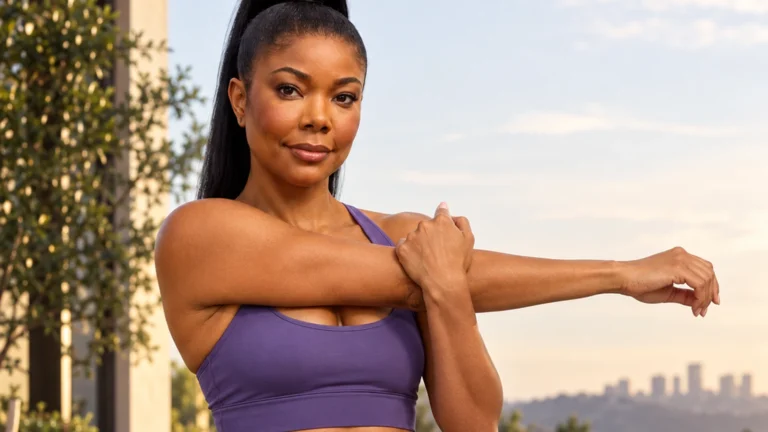
| 6:00 to 7:00 | Back of shoulder: draw one arm lightly across your body without pulling on the elbow; switch halfway. | Keep the reach smaller or relax the arms at your sides. |
The clock adds up to 2 + 5 = 7 minutes. After cardio, you might choose the easy walk and leg options; after upper-body strength work, you might choose the easy walk and comfortable shoulder or chest options.
Do not bounce or push into sharp pain, and let a prescribed rehabilitation plan take priority over this generic card. The NHS illustrates alternative cool-down stretches, including calf and hamstring options; it does not show every movement in this seven-minute card.
What stretching can and cannot promise
| Outcome | What the research suggests | Do not infer |
|---|---|---|
| Next-day soreness | The 2011 Cochrane review did not find a clinically important average reduction from stretching. | That this routine prevents delayed soreness. |
| Short-term strength recovery | A 2021 randomized-trial review did not show a clear post-exercise stretching advantage over passive rest; certainty was limited. | That a short stretch repairs muscle faster. |
| Range of motion | Regular stretching programs can improve tested range of motion over time. | That one seven-minute session produces a lasting flexibility gain. |
| Heart-rate step-down | Easy movement can help the immediate transition away from hard effort. | That this reduces future injury or guarantees a better next workout. |
How the original video fits the evidence
The embedded MrandMrsMuscle and Vivienne video is a 6-minute, 54-second follow-along stretch. Its listing offers a calm, equipment-free finish after training and describes faster recovery, but no cited study tested that particular sequence.
A stretch can feel pleasant without proving a recovery claim. The key distinction is whether the outcome is immediate comfort, tomorrow’s soreness, later strength or range of motion practiced over weeks.
Next-day soreness
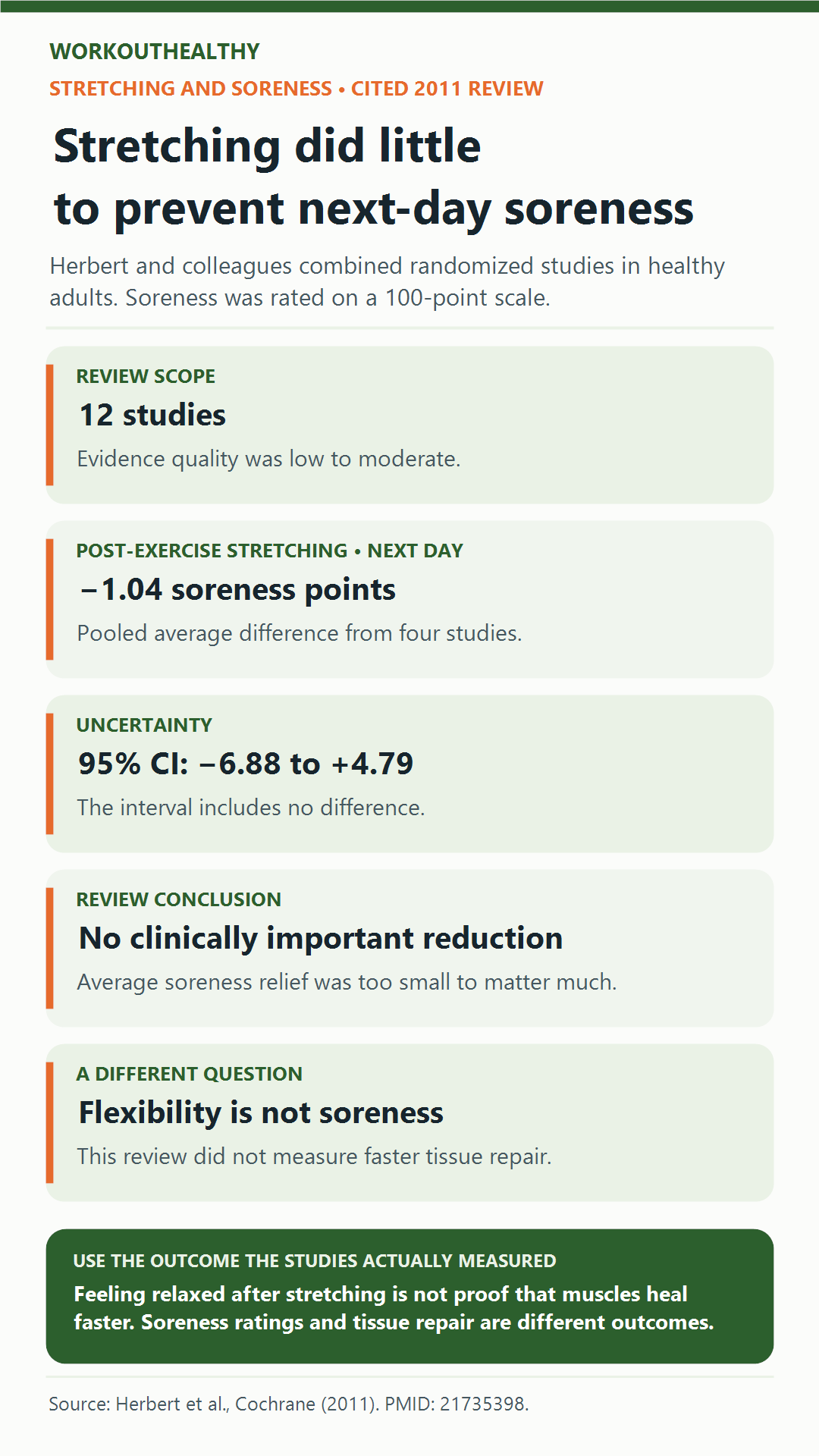
Herbert and colleagues’ 2011 Cochrane review included 12 stretching studies; four contributed to its next-day post-exercise soreness estimate. The mean difference was -1.04 points on a 100-point scale (95% confidence interval -6.88 to 4.79), which spans no difference and is not a clinically important average improvement.
The trials had limitations, including moderate or high risk of bias. Even so, this evidence does not support promising that a short stretch prevents soreness after a hard or unfamiliar workout.
Strength and soreness recovery
In Afonso and colleagues’ 2021 review, 11 randomized trials entered the qualitative analysis and 10 entered the pooled analysis of 229 eligible participants aged 17 to 38, mostly men. The pooled comparisons did not show a clear advantage over passive rest for strength recovery within one hour or soreness at 24, 48 or 72 hours.
About 70% of the trials were at high risk of bias, so the absence of a clear pooled advantage is not proof that every routine has exactly zero effect. It is a sound reason to avoid the stronger claim that stretching speeds muscle repair.
Walking down and range of motion
A gentle walk after hard exercise serves a different purpose from a held stretch. Van Hooren and Peake’s review found that active cool-downs can remove blood lactate faster, but did not establish that this translates into better later performance or less soreness.
Repeated stretching may be useful if greater range of motion is your goal. A review of 23 articles found improvements across stretching programs, while the duration of a single session was not a clear predictor; it did not test this seven-minute card as a recovery treatment.
Choose a comfortable finish and track what matters
Use the first two minutes to let your effort settle, then choose the stretches that suit the workout and your comfortable range. You can shorten the sequence, use the supports in the card or follow the original video instead; forcing the deepest position on screen has no research-backed payoff.
For a few sessions, note what you trained, whether you stretched, next-day soreness and how the next planned workout went. A personal log cannot isolate a treatment effect, but it can show whether this is a finish you enjoy repeating; our guide to why soreness is a poor training scoreboard explains why performance and consistency also matter.
Stop any movement that causes sharp or worsening pain. If you have an injury, ongoing symptoms or a prescribed rehabilitation plan, ask a qualified clinician how these general options fit your situation.
Watch the original video
Watch the 6-minute, 54-second routine from MrandMrsMuscle and Vivienne, published July 27, 2026.
Want more like this? Subscribe to WorkoutHealthy Insider for practical explanations behind popular fitness claims.
References
Afonso, J., Clemente, F. M., Nakamura, F. Y., Morouço, P., Sarmento, H., Inman, R. A., & Ramirez-Campillo, R. (2021). The effectiveness of post-exercise stretching in short-term and delayed recovery of strength, range of motion and delayed onset muscle soreness: A systematic review and meta-analysis of randomized controlled trials. Frontiers in Physiology, 12, 677581. https://doi.org/10.3389/fphys.2021.677581
American Heart Association. (2024, January 16). Warm up, cool down. https://www.heart.org/en/healthy-living/exercise-and-physical-activity/fitness-basics/warm-up-cool-down
Herbert, R. D., de Noronha, M., & Kamper, S. J. (2011). Stretching to prevent or reduce muscle soreness after exercise. Cochrane Database of Systematic Reviews, 2011(7), CD004577. https://doi.org/10.1002/14651858.CD004577.pub3
MrandMrsMuscle. (2026, July 27). Calm post-workout stretch | Full body cool down for faster muscle recovery & flexibility [Video]. YouTube. https://www.youtube.com/watch?v=SpVYmwzA1I8
Thomas, E., Bianco, A., Paoli, A., & Palma, A. (2018). The relation between stretching typology and stretching duration: The effects on range of motion. International Journal of Sports Medicine, 39(4), 243-254. https://doi.org/10.1055/s-0044-101146
Van Hooren, B., & Peake, J. M. (2018). Do we need a cool-down after exercise? A narrative review of the psychophysiological effects and the effects on performance, injuries and the long-term adaptive response. Sports Medicine, 48(7), 1575-1595. https://doi.org/10.1007/s40279-018-0916-2
General information: This article is not medical advice. If you have an injury, ongoing pain, or a medical condition, talk with a qualified clinician before changing your exercise routine.