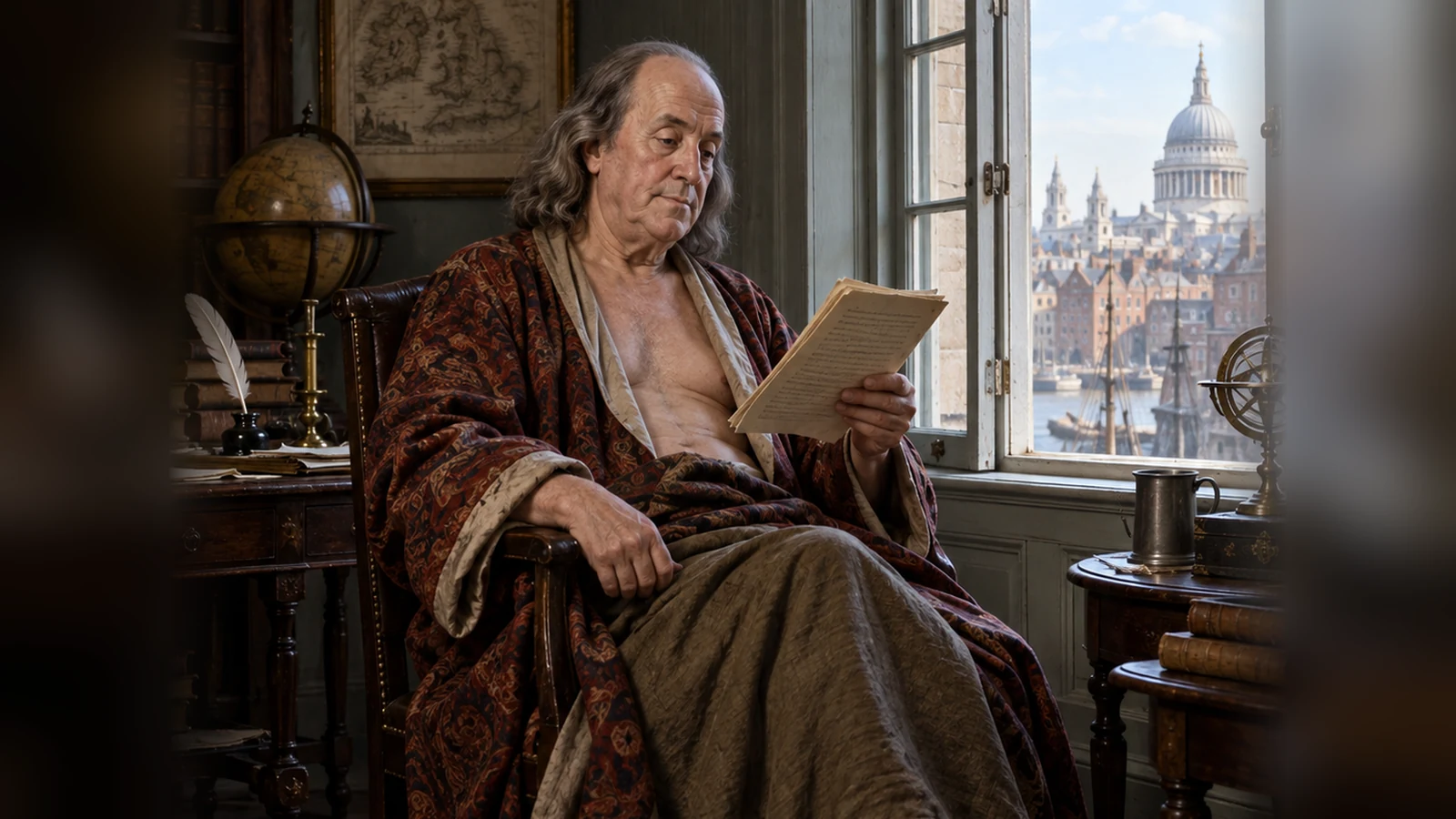

Benjamin Franklin had an odd morning habit.
He sat in his room with no clothes on, reading or writing, while the cool air did its work.
A widely shared version says he took these “air baths” every day to strengthen his health.
The habit is real, and it is in his own words. What it did for him is a different question.
What Franklin Actually Wrote
The clearest source is a letter Franklin sent from London on July 28, 1768.
He wrote it to Jacques Barbeu-Dubourg, a French doctor and friend.
An English extract of the letter was reprinted in The American Museum in 1790.
Barbeu-Dubourg also published it in French in 1773, in his collection of Franklin’s works.
I rise early almost every morning, and sit in my chamber, without any clothes whatever, half an hour or an hour, according to the season, either reading or writing.
He said the practice was “not in the least painful” and was actually agreeable.
He also admitted that he sometimes went back to bed afterward.
When he did, he said he got one or two more hours of very pleasant sleep.
He proposed calling the habit “a bracing or tonic bath.”
Who Franklin Was
Franklin was born in Boston in 1706 and died in Philadelphia in 1790.
He was a printer, writer, scientist, inventor, and diplomat.
He helped draft the Declaration of Independence and spent years in London and Paris.
He was also curious about health, exercise, and daily habits.
That curiosity shows up in many of his letters, including this one.
Why He Chose Air Over Cold Water
Cold baths were a popular health practice in Franklin’s time.
Franklin did not like them.
He wrote that the shock of cold water had always seemed “too violent” to him.
So he looked for a gentler option that still felt bracing.
Sitting in cool room air gave him a mild chill without the jolt of a plunge.
That detail matters. Franklin was not chasing extreme cold.
He was picking a dose he could enjoy and repeat.
Many people quit harsh health habits within weeks. A gentle version is easier to keep for years.
What Research Says About Mild Cold Exposure
Scientists have studied what happens when people spend regular time in cool air.
A 2013 study by van der Lans and colleagues placed 17 healthy young adults in a cool room.
The room was kept at 15 to 16 degrees Celsius, for six hours a day, over 10 days.
After those 10 days, the volunteers showed more active brown fat, a tissue that burns energy to make heat.
Their heat production without shivering also went up, from about 10.8 percent to 17.8 percent.
The volunteers also said the cold felt warmer and more comfortable by the end.
Their reported shivering dropped as well.
That fits Franklin’s own sense that the habit became agreeable rather than painful.
Still, six hours a day is far more than Franklin’s half hour to an hour.
What a Large Cold Shower Trial Found
Another line of research looks at short cold exposure, like a cold shower.
In a 2016 trial, Buijze and colleagues enrolled 3,018 working adults.
People were assigned to end their warm shower with 30, 60, or 90 seconds of cold water, or to skip the cold.
The cold shower groups had 29 percent less sickness absence from work than the control group.
But the number of days people actually felt ill did not differ between groups.
The authors also found that regular physical activity was linked with a similar drop in absence.
So cold exposure may change how people feel or cope. It did not clearly prevent illness in this trial.
What the Evidence Does Not Show
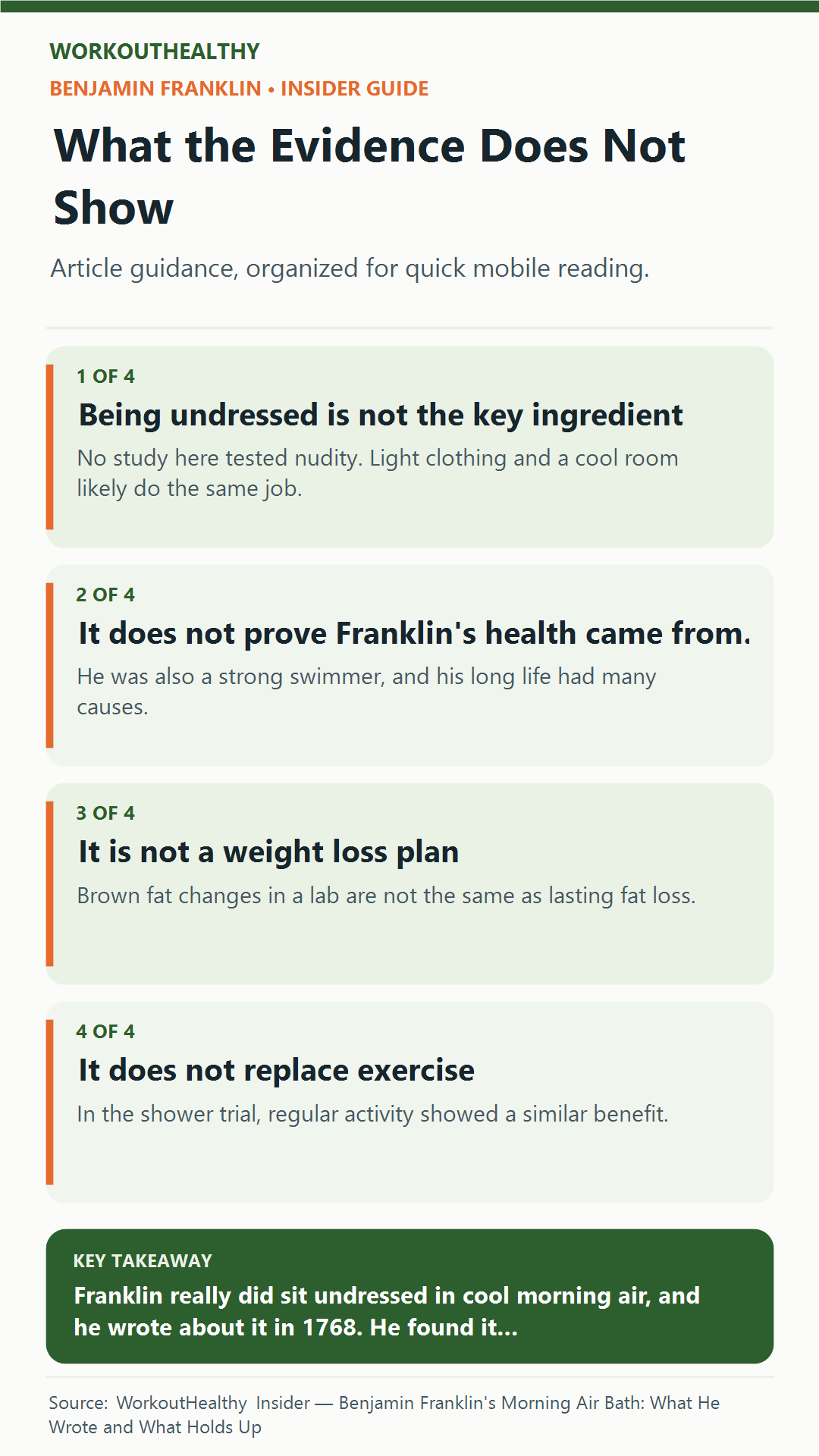
- Being undressed is not the key ingredient. No study here tested nudity. Light clothing and a cool room likely do the same job.
- It does not prove Franklin’s health came from air baths. He was also a strong swimmer, and his long life had many causes.
- It is not a weight loss plan. Brown fat changes in a lab are not the same as lasting fat loss.
- It does not replace exercise. In the shower trial, regular activity showed a similar benefit.
The more solid lesson is about routine.
Franklin built a calm, quiet start to his day, and he did it almost every morning.
How to Borrow the Idea Safely
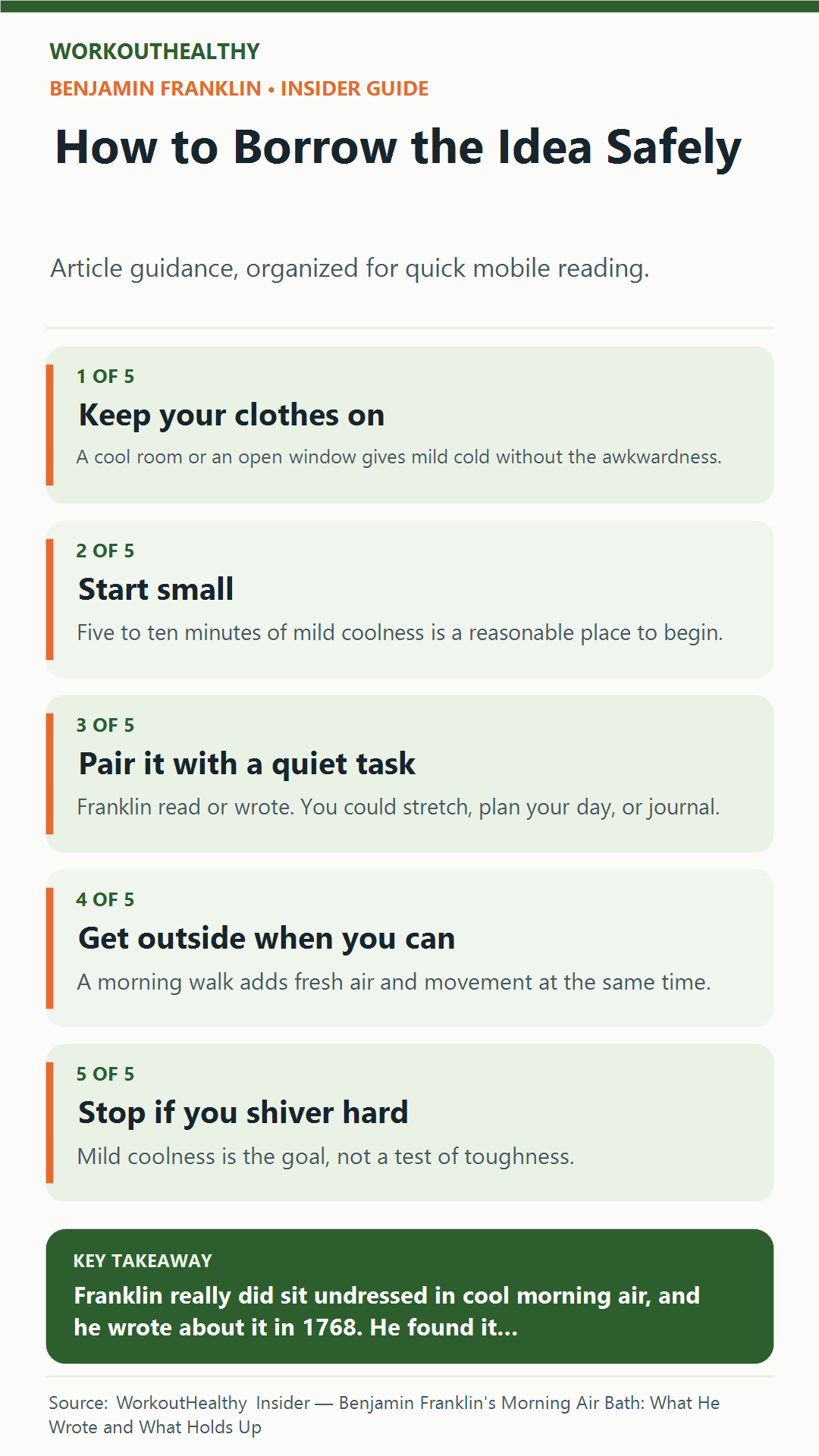
- Keep your clothes on. A cool room or an open window gives mild cold without the awkwardness.
- Start small. Five to ten minutes of mild coolness is a reasonable place to begin.
- Pair it with a quiet task. Franklin read or wrote. You could stretch, plan your day, or journal.
- Get outside when you can. A morning walk adds fresh air and movement at the same time.
- Stop if you shiver hard. Mild coolness is the goal, not a test of toughness.
If you sit most of the day, a few simple positions that help undo a day of sitting fit well into a morning routine.
A brisk morning walk also has benefits beyond fresh air, as our look at walking and the gut microbiome explains.
For more on staying well through cold and flu season, see what one study found about exercise and flu and pneumonia risk.
Who Should Be Careful
Cold exposure raises blood pressure and makes the heart work harder for a short time.
People with heart disease or high blood pressure should talk to a doctor before trying cold habits.
Older adults and people with poor circulation, such as Raynaud’s, lose heat faster and should be cautious.
Never use a very cold room while drowsy, drinking, or alone for long periods.
The Bottom Line
Franklin really did sit undressed in cool morning air, and he wrote about it in 1768.
He found it pleasant and bracing, and gentler than a cold bath.
Research shows the body can adapt to mild cold, and people may feel better with brief cold exposure.
The nudity adds nothing special. A calm, consistent morning routine with fresh air is the part worth keeping.
Want more stories like this? Subscribe to WorkoutHealthy Insider for practical explanations behind popular fitness claims.
References
- Buijze, G. A., Sierevelt, I. N., van der Heijden, B. C. J. M., Dijkgraaf, M. G., & Frings-Dresen, M. H. W. (2016). The effect of cold showering on health and work: A randomized controlled trial. PLoS ONE, 11(9), e0161749. https://doi.org/10.1371/journal.pone.0161749
- Franklin, B. (1768, July 28). Letter to Jacques Barbeu-Dubourg. Founders Online, National Archives. https://founders.archives.gov/documents/Franklin/01-15-02-0098
- van der Lans, A. A. J. J., Hoeks, J., Brans, B., Vijgen, G. H. E. J., Visser, M. G. W., Vosselman, M. J., Hansen, J., Jörgensen, J. A., Wu, J., Mottaghy, F. M., Schrauwen, P., & van Marken Lichtenbelt, W. D. (2013). Cold acclimation recruits human brown fat and increases nonshivering thermogenesis. The Journal of Clinical Investigation, 123(8), 3395 to 3403. https://doi.org/10.1172/JCI68993
This article is for general information only and is not medical advice. If you have an injury, ongoing pain, or a medical condition, talk to a doctor or physical therapist before you change how you train or eat.