

A brisk, sustainable walk can count as moderate aerobic activity. Faster is not required for every health benefit attributed to walking.
The useful distinction is between benefits linked to walking at all, benefits of reaching a moderate effort and claims about fast intervals. This article also separates outdoor cadence research from the 30-minute indoor Body Kind Fitness video below.
Power walking benefits, with the right evidence attached
| Outcome or claim | What supports it | Limit |
|---|---|---|
| Moderate aerobic activity | The CDC intensity guide identifies brisk walking as moderate activity. | The name “power walk” alone does not establish your intensity. |
| Cardiometabolic risk | An observational walker-versus-runner study found similar lower risks of reported hypertension, high cholesterol and diabetes at comparable estimated energy expenditure. | It does not prove that walking caused those differences or that a 30-minute walk equals a 30-minute run. |
| Longer-term mortality | A US adult cohort linked higher daily step count with lower mortality; higher step intensity was not independently associated after accounting for total steps. | This is not evidence that power walking uniquely extends life or that a specific pace is required. |
| Fast intervals | Adding faster segments changes the immediate effort of a walk and may make an aerobic session more challenging. | The cited long-term cohorts do not test this particular interval pattern or promise an extra disease-risk reduction. |
Popular benefit lists often combine all four categories into one claim about a daily fast walk. The table gives you a more usable question: which outcome matters to you, and did the supporting study actually compare pace, total activity or both?
Use the talk test before a step-count rule
Use the CDC talk test: at a moderate relative effort, you can talk but not sing. Fitness and terrain change the effort of a given pace.
A 2018 cadence review proposed roughly 100 steps a minute as a practical population-level clue for moderate ambulatory walking. It is not an individual pass/fail threshold and was not validated as a rule for marching in place.
To estimate cadence, count every footfall for 15 seconds and multiply by four: 25 steps becomes 100 steps per minute. That is a counting example, not a personal target.
For an indoor session, judge effort rather than copying an outdoor cadence. The featured video was not an intervention in these walking studies.
A manageable 15-to-20-minute entry walk
If you are new to brisk walking, one editorial way to explore it is a few easy minutes, a short stretch at a pace where talking becomes a little harder, then an easy finish. A 15-to-20-minute session is an example for practice, not a required starting dose or a claim about immediate health outcomes.
Repeat at a comfortable level before lengthening the brisk part, and allow for hills, heat and how you feel that day. If walking provokes concerning symptoms, stop and seek appropriate medical advice.
Outdoor walking and the featured indoor video
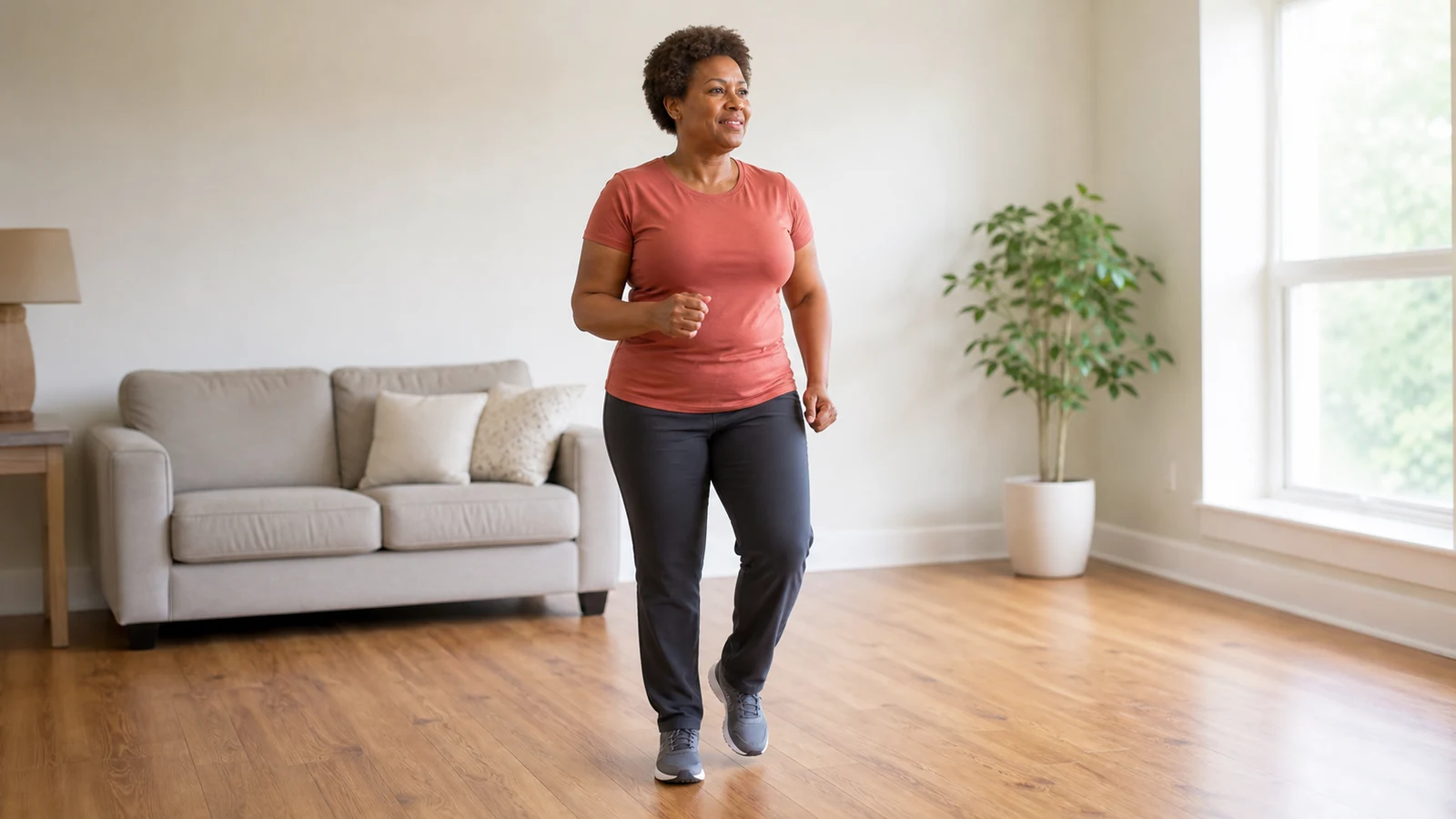
The 30-minute Body Kind Fitness video is all standing and presented as a home power walk. It offers a convenient guided session, but its in-place steps cannot be assumed to cover the same distance or energy use as outdoor brisk walking at a measured pace.
Use the video as an option when it suits your space and balance, with a clear floor and a slower or supported version if needed. You do not have to copy its full 30 minutes to learn whether the effort feels manageable.
What the walking-versus-running study means
Williams and Thompson compared large cohorts of walkers and runners across estimated energy-expenditure categories. Similar risk associations at comparable expenditure do not make the activities equal minute for minute, and self-selected activity groups leave room for confounding.
That result supports walking as a meaningful aerobic choice without requiring a claim that it is identical to running. Our daily walking-distance guide explains why a useful goal is better framed around time, intensity and your own pace than one universal mileage number.
Watch the indoor walking video
Sources
- CDC, How to Measure Physical Activity Intensity.
- Tudor-Locke et al. (2018), walking-cadence review.
- Williams and Thompson (2013), observational walker-versus-runner comparison.
- Saint-Maurice et al. (2020), step count, step intensity and mortality cohort.
This is general fitness information, not medical advice. If you have a condition or symptoms that affect exercise, ask a qualified clinician how to adapt your activity.