
Dwayne Johnson’s Black Adam physique was not built with one superhero workout.
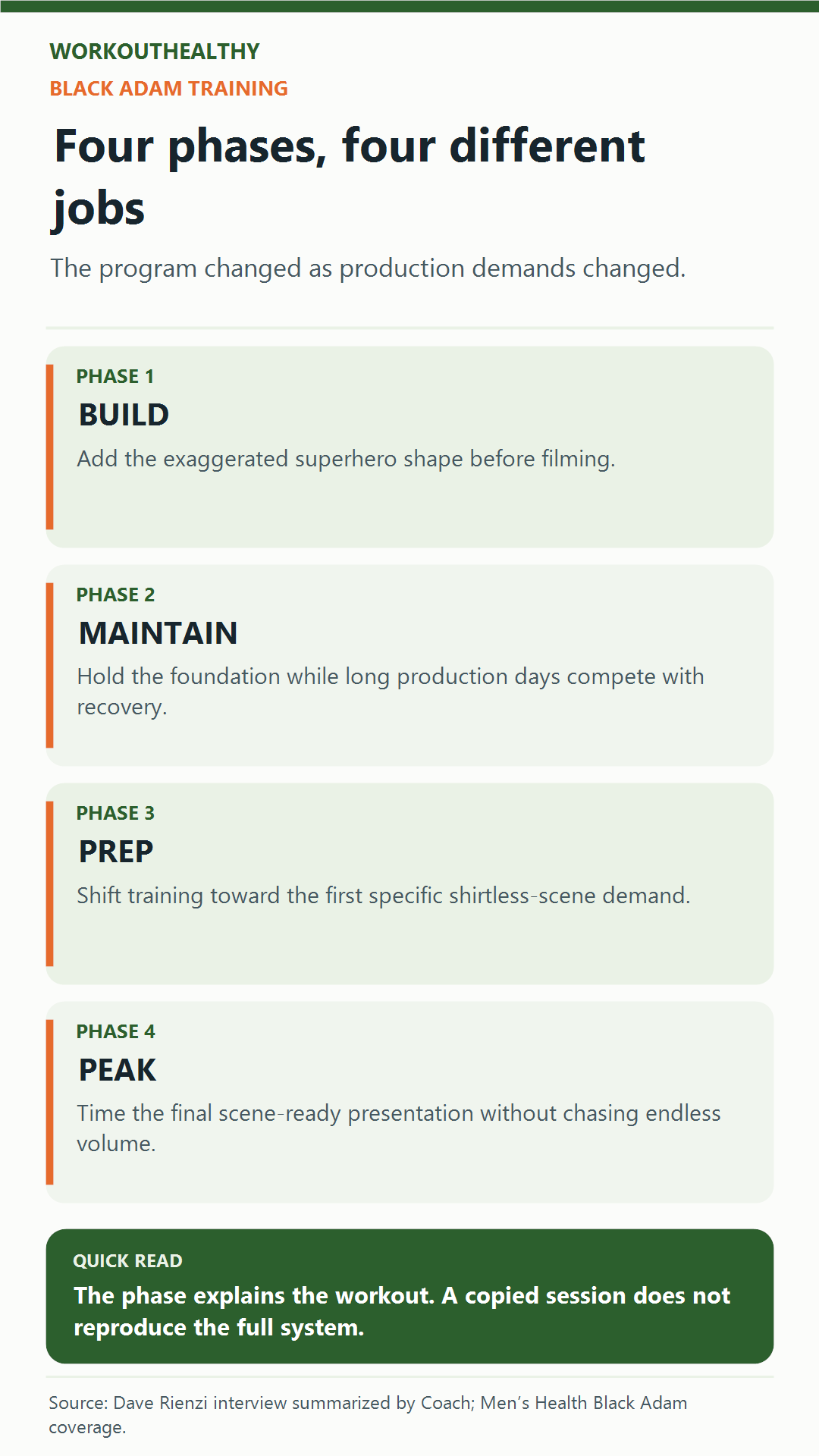
His longtime strength coach, Dave Rienzi, described a four-phase plan that changed as the job changed: build the look, maintain it during production, then peak for specific shirtless scenes.
That sequence explains more than any copied list of presses, rows, or cable exercises. The program was organized around a movie schedule, a camera-ready target, and the need to hold an unusually muscular look for months.
The useful lesson is not Johnson’s exercise list. It is matching the training phase to the job in front of you.
The Four Training Phases
In an interview summarized by Coach, Rienzi divided the work across the 12 months before filming and the production period.
Phase one focused on adding the exaggerated superhero shape. Phase two maintained that foundation while Johnson filmed. Phases three and four prepared him for particular shirtless scenes, when presentation and timing mattered most.
This is an original-value way to read the plan:
- Build: create the adaptation with enough progressive training and food.
- Hold: reduce avoidable fatigue while keeping the muscle and movement quality.
- Peak: direct more attention to the exact visual or performance demand.
- Repeat: adjust again when production dates or scene demands move.
The phases were not four unrelated programs. They were different answers to a changing constraint.
That distinction is easy to miss when workouts are published as standalone lists. A chest session from the peak phase may contain more targeted volume, shorter rest, or finishers chosen for an immediate visual effect. Pulling it out of the calendar removes the reason it looked that way. The phase explains the session; the session alone does not explain the physique.
Why Building and Maintaining Are Different Jobs
Adding muscle generally asks for enough training volume, progressive overload, recovery, and energy. Maintaining an existing result can often be done with less work, especially over a short period.
That matters on a film set. Long days, repeated takes, travel, and stunt work can compete with training recovery. A plan that keeps pushing maximum volume may create fatigue without adding useful visual change.
Johnson told Men’s Health that maintaining the physique for months was the real challenge. That makes the middle phase more important than a dramatic before-and-after photo suggests.
What the Published Workouts Show
Rienzi shared examples built from familiar bodybuilding movements, including presses, fly variations, rows, pulldowns, cable work, and finishers. The programming used controlled tempos, supersets, and selected rep ranges rather than turning every set into a maximal lift.
For one late chest phase, reporting from Men’s Health emphasized training designed around the shirtless scenes. That is context, not a universal chest template.
The exercises look accessible because many are. The hard-to-copy parts are the accumulated training age, daily schedule, coaching attention, nutrition, recovery resources, and tolerance built over decades.
Our breakdown of Johnson’s rice-and-protein shake reaches the same conclusion from the nutrition side: one visible tactic sits inside a much larger system.
What a Movie Physique Photo Hides
A still image does not show lighting, a temporary pump, camera angle, wardrobe decisions, hydration status, or the exact point in the training calendar.
It also does not show the team. Johnson had an experienced coach, professional food support, production planning, and a job that rewarded the result. Those resources do not erase his effort. They explain why copying the workout does not recreate the outcome.
A screen-ready physique is a production result as well as a training result.
That perspective is useful when comparing your ordinary week with an actor’s peak. A routine that supports work, family, sleep, and steady progress can be more successful than one that only produces a dramatic photo for a few days.
It also changes how progress should be judged. During a build phase, stronger repetitions and added training volume may be useful markers. During maintenance, holding performance with fewer sessions can be a win. During a peak, the goal may be freshness and presentation rather than another personal record. Using the same scorecard in every phase can make good programming look like failure.
How to Use the Phase Idea in a Normal Program
Choose one primary job for the next block. It might be learning technique, building strength, adding muscle, preparing for an event, or maintaining while life is busy.
Then decide what must change when the phase changes. A build phase may need more weekly sets and a small calorie surplus. A maintenance phase may keep intensity while reducing volume. A peak may practice a specific test or presentation without adding unnecessary fatigue.
Track the minimum information that guides the next decision: loads, repetitions, effort, pain, sleep, and whether you completed the planned sessions. For another example of a celebrity plan shaped by the role, see Glen Powell’s seven-week Top Gun training push.
The four-phase Black Adam plan is impressive. Its transferable value is the structure, not the fantasy of becoming Johnson by copying one workout.
Follow WorkoutHealthy Insider for celebrity workout context you can actually use.