
Protein matters during a calorie deficit, but it does not replace the energy and carbohydrate needed for hard training.
Arnold Schwarzenegger’s Pump Club highlighted a 2026 randomized crossover trial in 19 active adults. The most severe low-energy condition kept protein at 1.5 grams per kilogram while cutting carbohydrate and fat enough that average sprint power fell compared with adequate intake.
The finding is useful. It is also narrower than a headline that says protein “does not work.”
Hitting a protein target cannot guarantee good training when the total diet leaves too little fuel.
What the Study Tested
The European Journal of Sport Science trial included nine women and 10 men described as healthy and active. Each person completed three five-day diet conditions in randomized order.
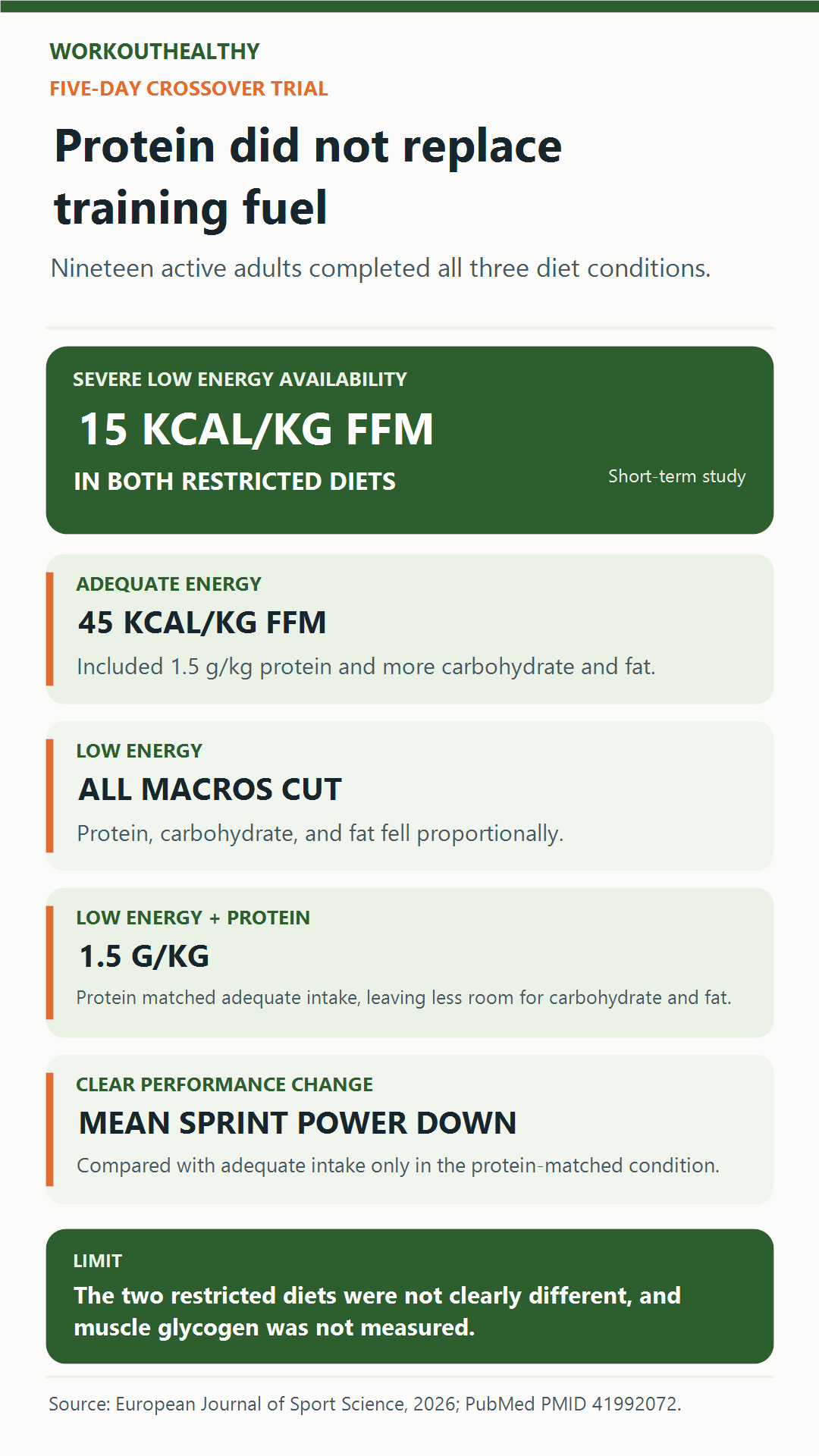
The adequate-energy condition supplied 45 kilocalories per kilogram of fat-free mass per day and 1.5 grams of protein per kilogram. One low-energy condition supplied 15 kilocalories per kilogram of fat-free mass while reducing all macronutrients proportionally. The second low-energy condition used the same severe energy availability but matched protein to the adequate diet.
Participants completed resting measurements, 45 minutes of fixed-load cycling, and a 30-second Wingate sprint before and after each condition.
This was a controlled short-term test of severe low energy availability. It was not a typical months-long fat-loss plan.
Energy availability is not the same as simply counting calories eaten. Researchers subtract exercise energy expenditure and relate what remains to fat-free mass. That makes the measure useful in sport science, but it also means the study’s numbers should not be copied directly into a consumer calorie app without the same measurements and definitions.
What Happened to Sprint Performance
Average Wingate power declined in the low-energy, protein-matched condition compared with adequate intake. The proportionally reduced condition did not show the same clear performance decline against adequate intake.
Crucially, the two restricted diets were not clearly different from each other on the performance outcome. That means the study does not prove that preserving more protein caused the drop.
The protein-matched diet necessarily left less room for carbohydrate and fat. The authors described reduced carbohydrate availability as a possible explanation, but muscle glycogen was not measured.
Participants also commonly reported hunger, fatigue, weakness, and frustration during both restricted conditions. Those subjective responses matter because adherence and training quality are part of any real-world diet.
What the Trial Cannot Prove
Nineteen participants and five days per condition are enough to detect some short-term responses, not to settle long-term questions about strength, muscle retention, fat loss, or health.
The trial used a very large drop from 45 to 15 kilocalories per kilogram of fat-free mass. A moderate calorie deficit may not reproduce the same response.
The study also tested a 30-second all-out cycling sprint. That outcome does not automatically predict a one-repetition maximum, a long run, or a normal resistance-training session.
Schwarzenegger’s practical message, to begin with a smaller deficit that leaves room for protein and carbohydrate, is sensible, but it remains an application of the evidence rather than the direct result of a long fat-loss trial.
The study warns against an extreme short-term cut; it does not identify one perfect calorie deficit for everyone.
A Practical Deficit Check
Use performance and recovery as feedback instead of treating the calorie target as sacred.
- Is body weight trending down at the intended pace?
- Are key lifts, repetitions, or conditioning sessions holding reasonably steady?
- Is hunger manageable most days?
- Are sleep, mood, and concentration deteriorating?
- Can the plan still include carbohydrate around demanding sessions?
If weight is dropping rapidly while several performance and recovery markers worsen, the deficit may be more aggressive than the goal requires.
One bad session is not enough to diagnose the problem. Training performance naturally varies with sleep, stress, heat, hydration, illness, and the workout itself. Look for a pattern across comparable sessions. If several markers fall together for more than a week, restore some food, reduce training stress, or pause the cut before making another large change.
Our guide to contest-prep versus off-season eating shows why a temporary physique peak and a sustainable everyday diet need different standards.
How to Build a More Sustainable Cut
Start with the smallest calorie reduction likely to move the trend, keep protein adequate, and preserve enough carbohydrate and fat for training, health, and food preference.
Adjust from two to four weeks of data rather than one weigh-in. Water, glycogen, sodium, and digestion can hide the true rate of change over a few days.
Keep resistance training in the plan and avoid adding so much cardio that recovery collapses. Our article on Dwayne Johnson’s slower 50-pound cut offers a useful contrast with crash dieting, while Schwarzenegger’s plant-forward diet provides broader context for how he discusses food now.
A protein goal is a foundation. Total energy, carbohydrate availability, training load, and recovery still determine what you can do with it.
This article is for general education and is not individualized nutrition or medical advice.
Follow WorkoutHealthy Insider for study breakdowns that keep the useful finding and the limitations together.