

Dwayne Johnson says he lost 50 pounds over a full year for his role in Benny Safdie’s Lizard Music, settling around 232 to 235 pounds while keeping the strength, endurance, and conditioning his work still demanded.
The striking part is not a secret food or a celebrity-only trick. It is the time he gave the change, the performance signals he watched, and his decision to avoid an extreme cut.
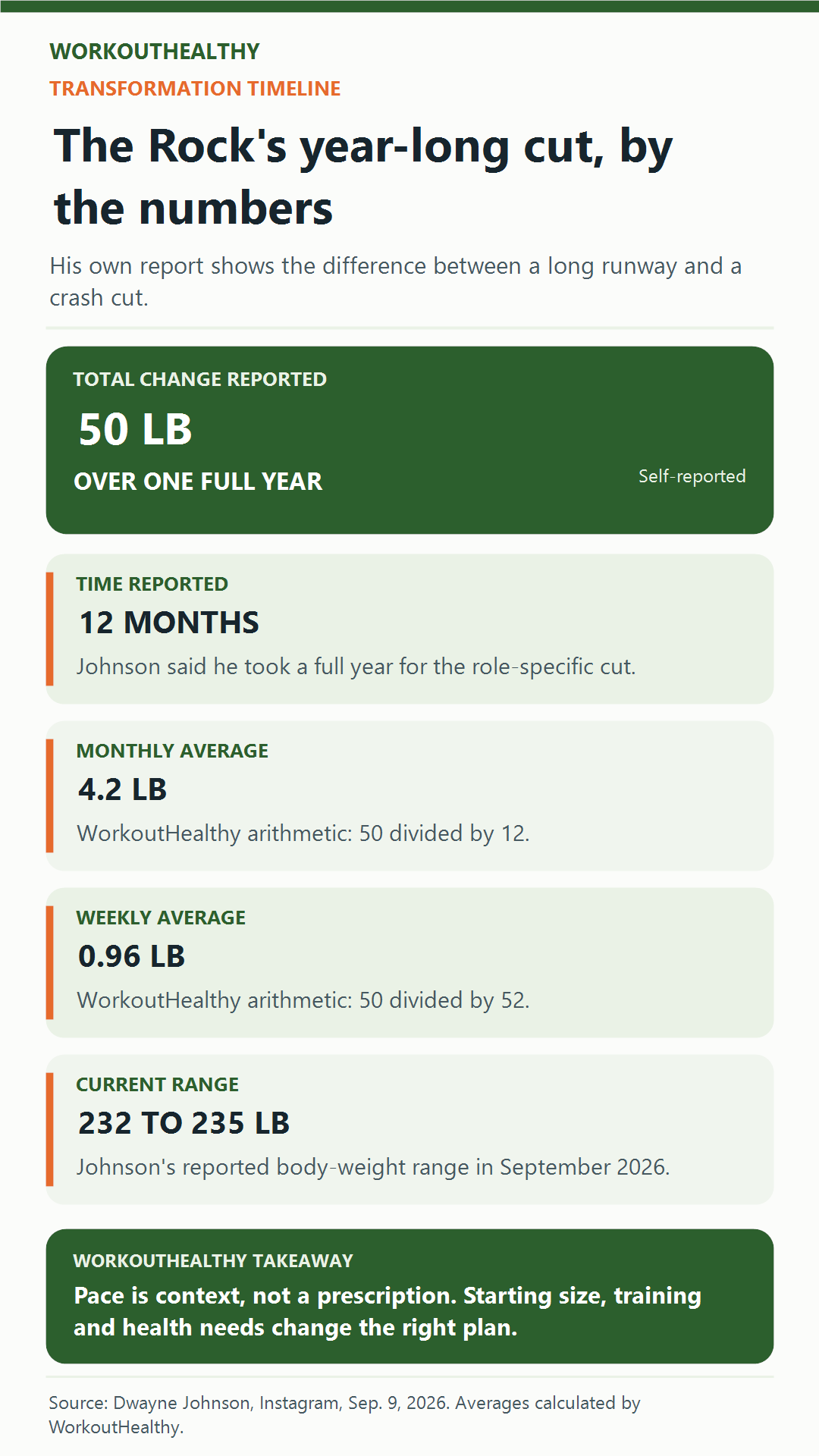
Quick answer: Johnson’s reported pace averages about 0.96 pound per week. That number fits the broad idea of gradual weight loss, but his body size, training history, professional support, and role deadline make his exact plan personal rather than a template.
The most useful part of a transformation is often the runway, not the reveal.
What Johnson actually reported
In a September 9, 2026 Instagram update, Johnson wrote that he had taken a full year to lose 50 pounds for Lizard Music. He described his current weight as 232 to 235 pounds and said his conditioning was holding well.
He also said he wanted the cut to be strategic and wise instead of extreme. That framing matters because the final photograph cannot show the decisions, adjustments, and ordinary weeks that produced it.
Johnson reported higher-carbohydrate days of about 450 grams on his two leg-training days and on Sunday. He described the rest of the week as lower or medium carbohydrate days around 250 to 300 grams.
Those amounts are large by everyday standards, but Johnson is also unusually large and trains at a level built over decades. Copying the grams without copying his total energy needs, workload, and support would remove the context that makes the numbers meaningful.
His mobile post-workout meal combined protein powder, blueberries, cooked jasmine rice, ice, and stevia, eaten roughly 30 to 45 minutes after training. WorkoutHealthy has already examined his rice-and-protein idea in a separate Dwayne Johnson workout-fuel breakdown.
This article addresses the larger transformation instead. The central question is how a long runway can help someone change body weight while continuing to train, work, and monitor performance.
What the pace works out to
Fifty pounds divided by 12 months equals about 4.2 pounds per month. Dividing the same reported change by 52 weeks gives an average of about 0.96 pound per week.
That average does not mean the scale moved by exactly the same amount every seven days. Body weight shifts with water, carbohydrate storage, sodium, digestion, travel, sleep, and the timing of each weigh-in.
A year-long average is useful because it smooths those short swings and shows the broad direction. It also makes clear that a dramatic visual change can come from a series of modest weekly changes rather than one punishing phase.
The Centers for Disease Control and Prevention describes about 1 to 2 pounds per week as a common gradual pace for many adults trying to lose weight. Johnson’s reported average lands near the lower end of that general range, but a population guideline cannot determine the right pace for one person.
Starting weight changes the meaning of a pound, and so do age, health conditions, medication, body composition, and training demands. Anyone using a deadline should treat the calendar as a planning tool, not as permission to force a fixed weekly loss.
Why a full year changes the problem
A short deadline encourages large daily sacrifices because there are fewer days available to create the total change. A longer runway can spread the work across more meals, sessions, and recovery cycles.
That does not make a long cut effortless. It makes adjustment possible, which is different and often more valuable.
If training performance falls, hunger becomes disruptive, or recovery starts deteriorating, a person with time can reduce the size of the deficit, add maintenance periods, or revise the end point. A crash timeline gives each warning sign less room to influence the plan.
Johnson’s acting schedule adds another reason to protect the runway. He was not preparing for one weigh-in, because he still needed enough energy to train, rehearse, travel, and perform during a production.
The same principle applies outside film work. A plan that makes someone too depleted to work, parent, sleep, and train is failing even if the scale temporarily moves faster.
Long timelines also shift attention from perfect days to recoverable weeks. One restaurant meal or missed session matters less when the system can absorb it without prompting punishment.
How strength training fits a cut
Weight loss alone does not reveal what type of tissue changed. That is why resistance training, adequate nutrition, and performance monitoring matter when the goal includes keeping useful muscle and strength.
A 2025 systematic review of randomized trials found that resistance exercise during dietary weight loss helped protect fat-free mass and improved strength compared with diet alone in adults with overweight or obesity. That evidence supports the general strategy, not Johnson’s specific outcome.
Strength can still fluctuate during a cut because leverage, glycogen, fatigue, motivation, and exercise selection all change the number on the bar. A temporary dip is information, but it is not automatically proof that muscle has disappeared.
Useful monitoring includes repeated lifts under similar conditions, session quality, soreness, sleep, resting energy, and the ability to recover before the next hard workout. No single metric deserves complete control of the plan.
Training volume may need adjustment as available energy falls. Preserving a meaningful strength stimulus while trimming fatigue is usually more sensible than trying to set personal records on every lift.
Recovery still does real work during a deficit, and our guide to rest days and muscle growth explains why adding effort cannot replace enough time to adapt.
What his carb cycling does and does not show
Johnson placed his highest reported carbohydrate intake on two leg days and Sunday, while other days stayed lower. This is a form of matching more fuel to selected demands rather than removing carbohydrate from the plan.
Hard leg sessions often contain large amounts of work, so prioritizing carbohydrate around them has a clear practical logic. Carbohydrate availability can support training quality, but a weekly pattern still has to fit total energy intake and the rest of the diet.
His numbers do not prove that carb cycling caused the weight loss or preserved his performance. They only document how one experienced athlete organized intake during this phase.
A person can lose weight with a steady daily intake, flexible portions, or several different meal patterns when the overall plan creates a sustainable energy deficit. The pattern is a tool for adherence and performance, not a metabolic password.
Lower-carbohydrate days also change muscle fullness because stored carbohydrate carries water. Johnson acknowledged that fluctuation, which is another reminder that appearance and scale weight can shift without an equal change in body fat.
Readers interested in another flexible celebrity eating pattern can compare this approach with Arnold Schwarzenegger’s plant-forward diet, where the useful lesson is again the pattern rather than imitation.
The pace-and-performance check
WorkoutHealthy’s pace-and-performance check separates four questions that social media usually compresses into one before-and-after image. It asks what changed, how long it took, what performance was retained, and what personal context made the plan possible.
Change: use a consistent weight trend and, when helpful, waist measurements, photographs, or professionally measured body composition. A single weigh-in is too noisy to describe the whole transformation.
Time: calculate the average over the full block, then compare it with energy, hunger, and recovery. A pace is only useful when the person can continue living and training with it.
Performance: choose two or three repeatable signals, such as a main lift, conditioning benchmark, and ordinary daily energy. Protecting every peak number is unrealistic, but a broad collapse deserves attention.
Context: write down starting size, health considerations, medications, professional support, work demands, and the reason for the deadline. This step prevents a celebrity’s result from becoming an anonymous prescription.
What regular lifters can borrow
The first transferable lesson is to buy time before increasing restriction. If a goal matters, start earlier and choose a pace that leaves room for work, sleep, relationships, and training.
The second lesson is to place more of the day’s useful fuel near the sessions that need it most. That may mean a larger meal before a demanding workout, more carbohydrate across the surrounding meals, or simply avoiding a long fast before high-volume work.
The third lesson is to track function beside body weight. When strength, energy, sleep, mood, and recovery all worsen together, the plan needs review even if the scale is moving.
The fourth lesson is to keep food simple enough to repeat. Johnson’s portable meal solved a scheduling problem, but a familiar sandwich, yogurt with fruit, rice bowl, or other ordinary option can serve the same practical role.
People who prefer morning training should also separate preference from proof. Our review of fasted training and fat loss explains why training before breakfast is an option rather than a requirement.
If a plan preserves the goal but destroys the week around it, the plan is too expensive.
The limits of the story
Johnson’s numbers are self-reported and do not include a public day-by-day food log, verified body-composition series, or complete training record. His statements can describe his experience without proving which variable produced each result.
He also works with resources that many readers do not have, including control over food preparation, scheduling, and professional support. Those advantages can make a demanding plan easier to execute and easier to correct.
The role itself is another special condition. Film preparation may prioritize a visual target on a fixed date, while a regular adult may care more about long-term health, strength, sports performance, or comfort in daily life.
Rapid changes, persistent fatigue, dizziness, disrupted sleep, worsening training, or obsessive food behavior are reasons to stop treating the process as a discipline test. A qualified clinician or registered dietitian can help assess what the plan is costing.
Social media also rewards the most dramatic frame. It rarely shows maintenance, rebounds, production changes, or the ordinary weeks that decide whether the result lasts.
The bottom line
Dwayne Johnson’s 50-pound Lizard Music transformation stands out because he says it took a full year and avoided an extreme cut. The reported average of about 0.96 pound per week makes the slow timeline visible.
The lesson worth keeping is not his calorie intake, carbohydrate grams, or scale number. It is the combination of time, training, fuel placement, and repeated performance checks.
Start here: choose one realistic outcome, give it a longer runway than social media suggests, and track two function markers beside the scale for the next four weeks.
Medical disclaimer: This article is general product information, not medical advice. The equipment described here is not a treatment for any condition. If you have an injury, ongoing pain, or a medical condition, talk to a doctor or physical therapist before using any of it.