

For the film All Things Fall Apart, Curtis “50 Cent” Jackson reportedly dropped from about 214 pounds to 160 pounds in nine weeks. Contemporary reports described a liquid diet and treadmill walks lasting up to three hours a day. The transformation was for a role as a college football player with cancer, not a general weight-loss program.
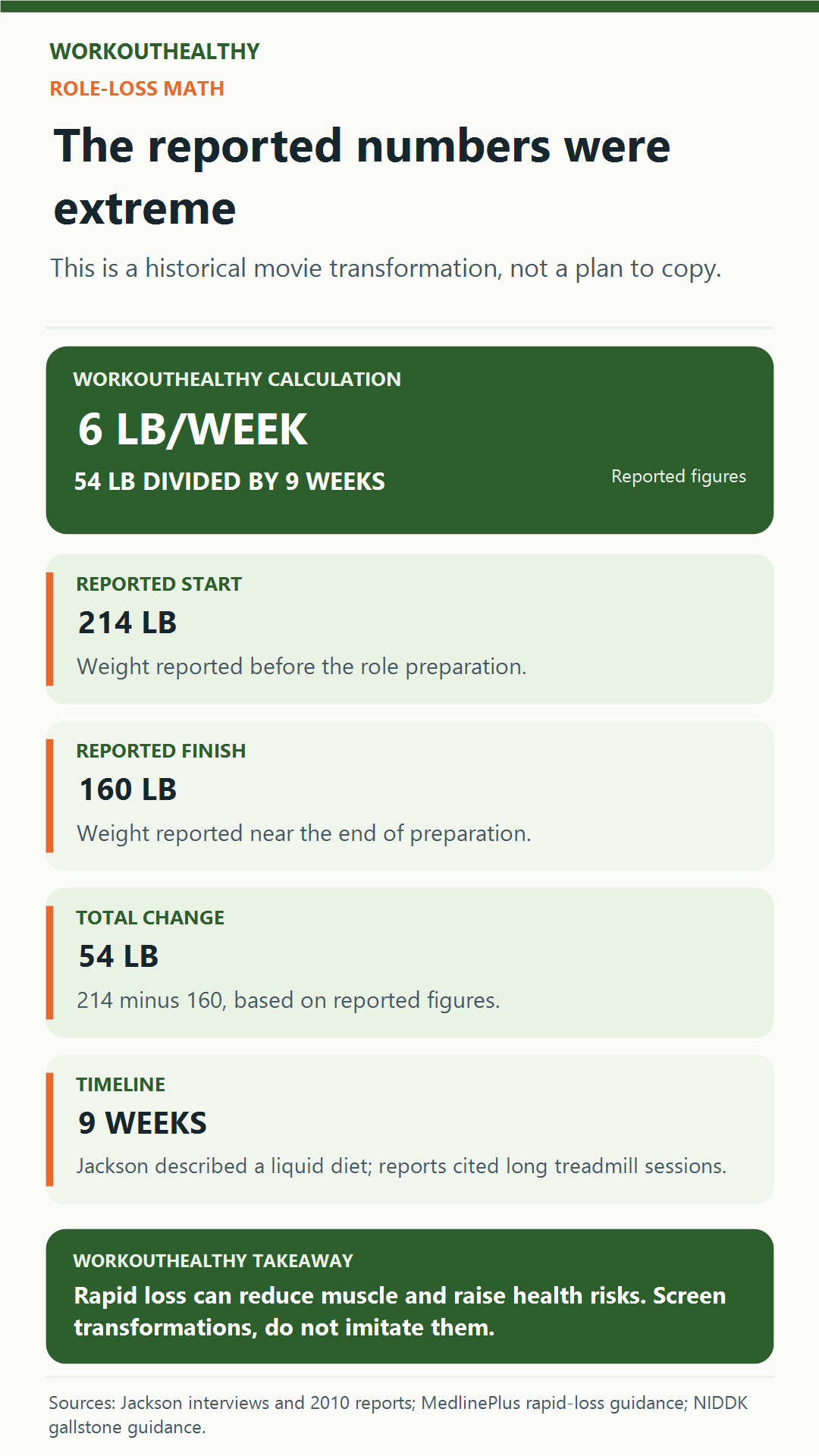
Those numbers deserve context. A 54-pound change across nine weeks averages about six pounds per week. That arithmetic does not reveal how much was fat, water, muscle, or glycogen, and it does not prove what happened on every day. It does show why the result should be screened as an extreme production demand rather than copied as a fitness challenge.
A dramatic transformation can demonstrate commitment while still being a poor model for everyday health.
The recovery phase is part of the cost, even when the headline ends at the after photo.
What was reported
Jackson discussed the liquid diet in interviews at the time, and news reports described his starting and finishing weights as roughly 214 and 160 pounds. The nine-week timeline and long treadmill sessions were also widely reported. The movie was released in 2011 after initially circulating under the title Things Fall Apart.
The precise daily menu, calorie intake, training load, medical monitoring, and body-composition changes were not published as a clinical record. Claims that a trainer or nutritionist made the process safe should not be added without a direct source. “Supervised” also never means risk-free.
The role-loss math
Subtracting 160 from 214 gives a reported total change of 54 pounds. Dividing 54 by nine gives six pounds per week on average. WorkoutHealthy owns that simple calculation; Jackson did not report a perfectly linear six-pound loss every week.
The estimate is useful because it lets readers compare the transformation with general medical guidance. MedlinePlus says losing more than one or two pounds per week is not safe for most people and notes possible loss of muscle, water, and bone density.
Why rapid loss raises concern
Rapid loss can bring fatigue, nausea, constipation or diarrhea, and loss of lean tissue. NIDDK also warns that losing weight quickly can raise the chance of gallstones because of changes in bile and gallbladder emptying. Very low-calorie approaches require medical oversight for specific clinical situations.
A film deadline changes the incentive, not the physiology. The fact that an actor accepted a tradeoff for a role does not show that the tradeoff is appropriate for another person, especially someone who is pregnant, older, still growing, managing a chronic condition, or recovering from illness.
What the scale cannot separate
A bathroom scale combines fat mass, lean tissue, organs, bone, glycogen, water, and digestive contents into one number. During aggressive restriction, the drop is not automatically all body fat. Lower carbohydrate intake can reduce glycogen and the water stored with it. Insufficient protein and resistance training can make muscle loss more likely.
That is why our guide to body composition beyond the scale emphasizes function and composition instead of treating every pound as the same outcome.
Rebuilding is not a rewind button
After an extreme cut, rebuilding muscle and strength takes training, adequate food, sleep, and time. Increasing calories can restore glycogen and water quickly, while new muscle tissue develops more slowly. The body does not simply reverse every step in the same order.
A sensible resistance plan progresses from tolerable loads and controlled technique. Chasing the old scale number as fast as possible can create a second extreme. The beginner body-recomposition strength plan shows how ordinary training decisions differ from a movie transformation.
Professional support has limits
A production can provide scheduling, meals, coaches, and medical access that most people do not have. That context matters, but it should not be used as a blanket safety claim. A professional can monitor symptoms and adjust a plan; they cannot make severe energy restriction biologically neutral.
Readers also cannot see contracts, deadlines, reshoots, makeup, lighting, dehydration, or the editing that shapes a before-and-after story. What looks like a personal challenge may be a coordinated commercial project.
How to screen a transformation story
Start with the reported timeline and calculate the average rate. Ask whether the source is the person, a trainer, a studio, or a repost. Look for the actual diet and training details, not labels such as “clean” or “disciplined.” Then ask which costs, symptoms, and recovery demands were disclosed.
Finally, identify the goal. Preparing to portray illness is almost the opposite of pursuing long-term health. A result can be authentic for the role and still be irrelevant to a sustainable fitness plan.
The bottom line
Jackson’s All Things Fall Apart transformation was extreme by the reported numbers. The average rate was far above what general guidance considers safe for most people, and the scale change cannot be assumed to represent fat alone.
Admire the commitment if you choose, but do not turn the method into a challenge. If you want to change body weight or rebuild strength after illness or a restrictive period, use a slower plan shaped by your medical needs, food access, training history, and qualified care.