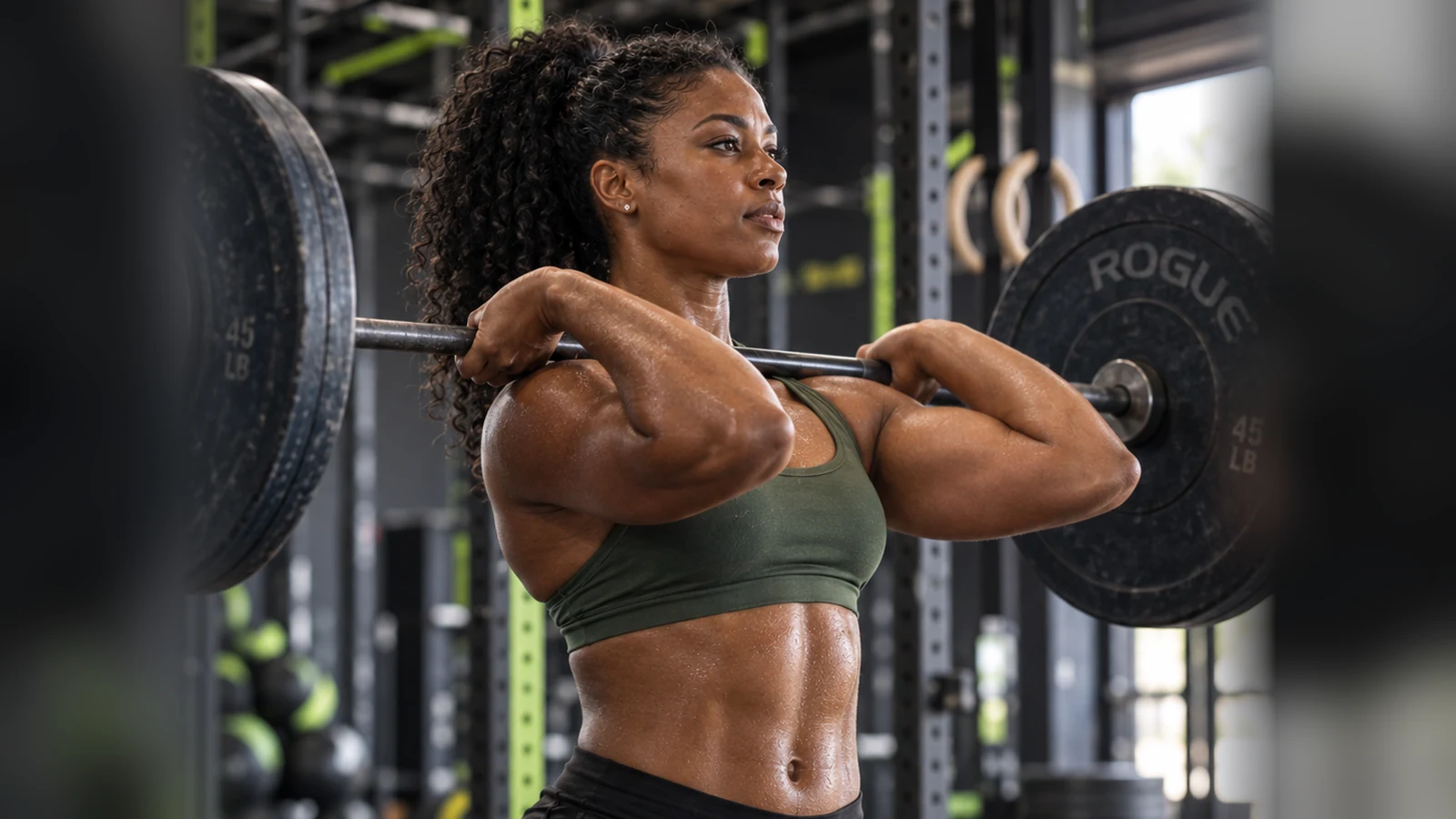

Toning is one of the most successful marketing words in fitness history.
It promises a specific look without the thing people are afraid of, which is getting bigger.
The trouble is that toning is not a kind of training, a kind of muscle, or a process the body knows how to do.
A toned appearance is simply visible muscle sitting under a lower layer of body fat.
That means every toning question is really two questions wearing one coat.
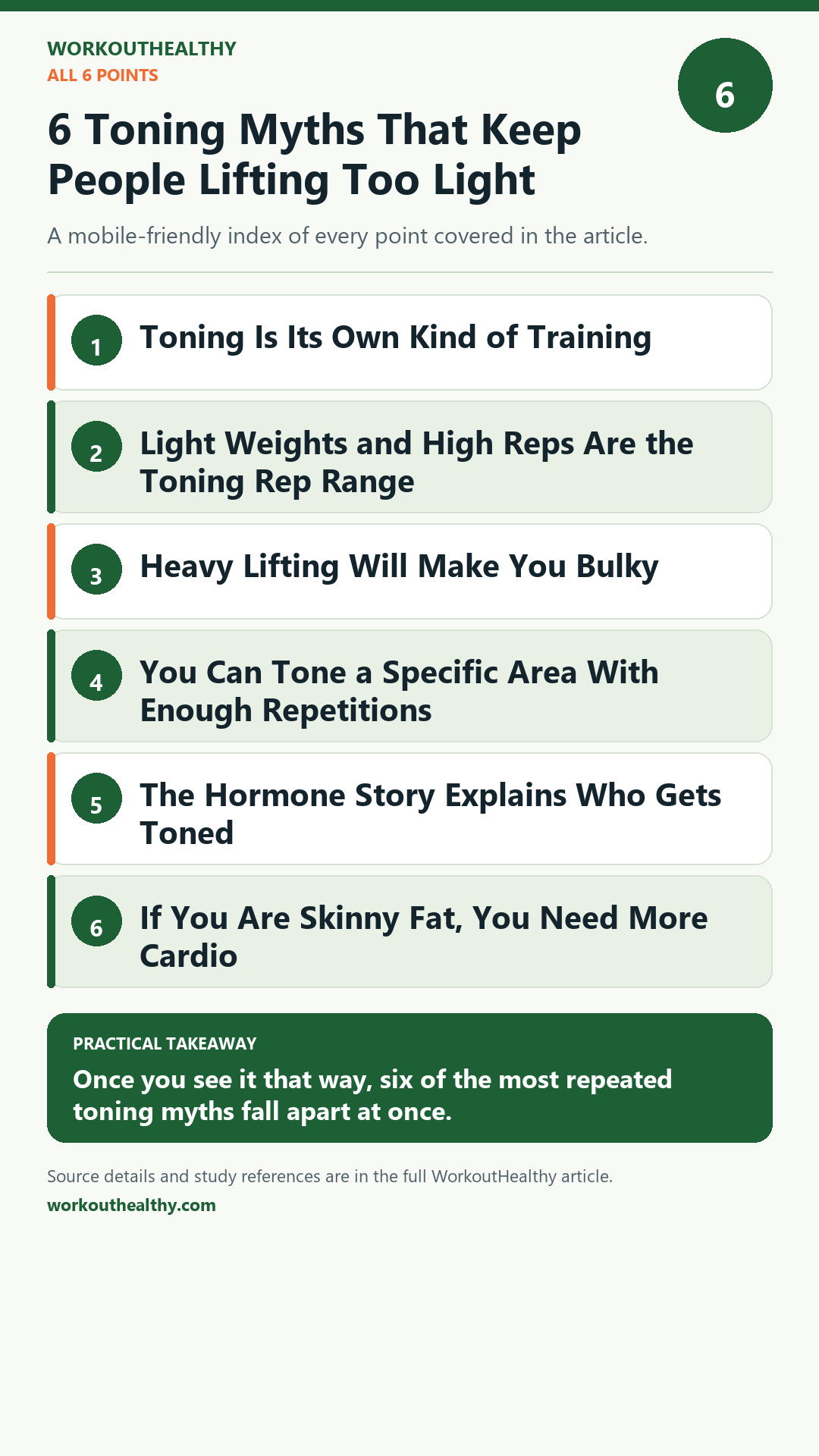
Once you see it that way, six of the most repeated toning myths fall apart at once.
1. Toning Is Its Own Kind of Training
There is no separate physiological process called toning.
Muscles can get bigger, get stronger, get more enduring, or shrink from disuse.
The word tone in a medical sense refers to the small amount of tension a resting muscle holds, and you cannot change that meaningfully with a workout.
What people actually want is more muscle and less fat, which are two separate projects with two different levers.
Training builds the muscle, and mostly food decides the fat.
Any program that promises to do both at once without addressing either honestly is selling the word rather than the result.
2. Light Weights and High Reps Are the Toning Rep Range
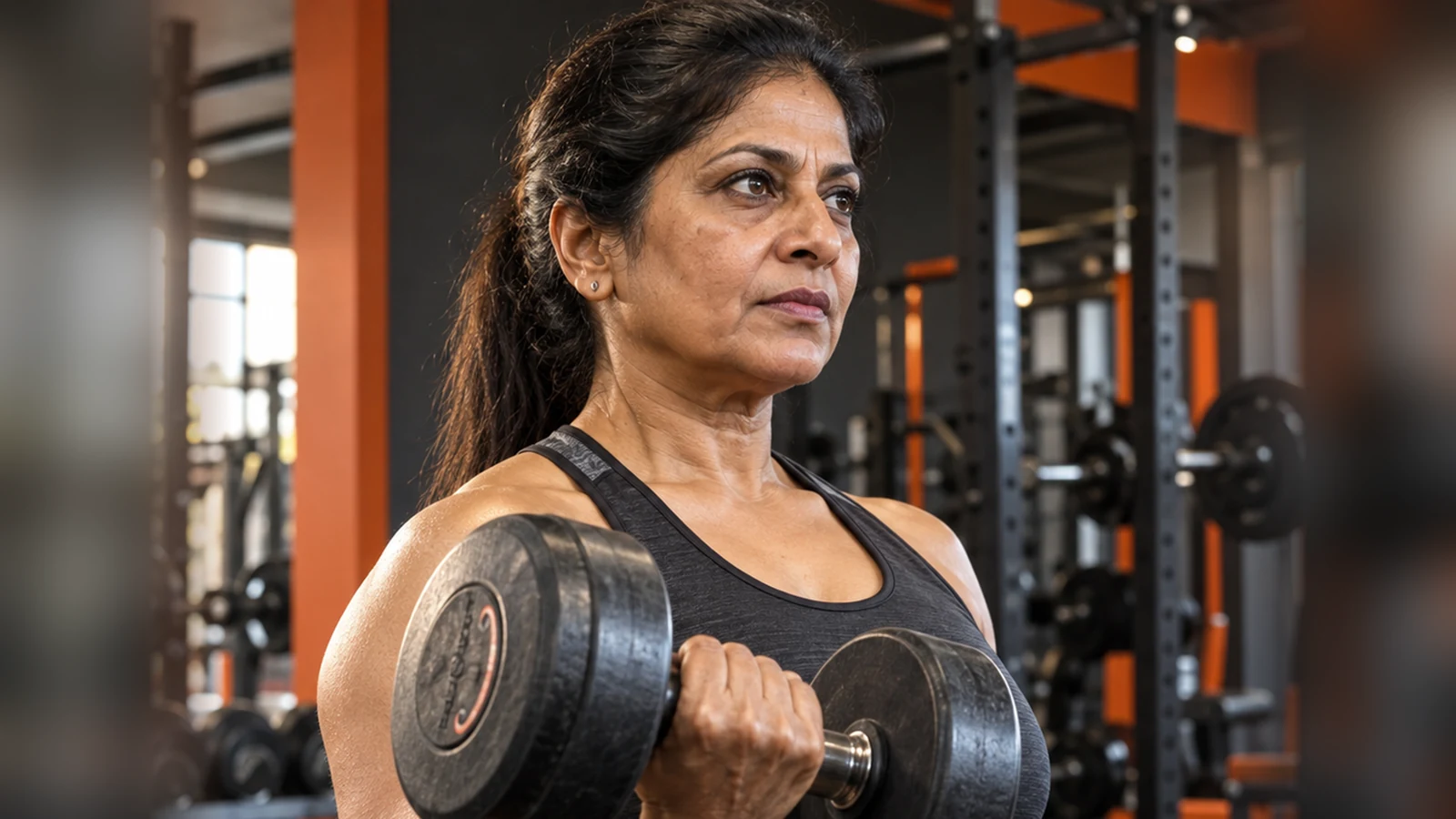
This is the myth that keeps people using the three kilogram dumbbells for years.
A meta analysis comparing low load with high load resistance training found that muscle growth was similar between the two when sets were taken close to failure.
Strength gains were clearly greater with heavier loads, but the size of the muscle responded to hard effort rather than to the number on the dumbbell.
In other words, high repetition training is not a toning protocol, it is a muscle building protocol with a different entry price.
The catch is that most people using light weights never go near failure, so they get neither the strength nor the size.
Twenty easy repetitions is a warm up, not a working set.
3. Heavy Lifting Will Make You Bulky
Muscle is famously hard to add, and it does not arrive by accident.
The people who look large train for years with high volume and eat a large surplus of calories on purpose.
Lifting heavy three times a week while eating at maintenance does not produce that outcome.
It produces slightly more muscle, better strength, and the exact appearance the word toned is pointing at.
Women generally add muscle at a similar relative rate to men but from a smaller starting point, so the absolute change is smaller.
Nobody has ever accidentally become too muscular. It is a years long project that people pursue deliberately and still find difficult.
4. You Can Tone a Specific Area With Enough Repetitions
Spot reduction is the oldest promise in the business, and it does not work.
Doing a thousand crunches trains the muscles under the fat on your stomach, but it does not tell the body to take fat from that region.
Where you lose fat first is largely set by genetics and hormones, not by which exercise you chose.
The abdominal work is still worth doing, just not for the reason the infomercial gave.
A stronger midsection helps you lift and carry, and it will look better once overall body fat comes down.
5. The Hormone Story Explains Who Gets Toned
You will hear that light weights are right for women because of hormones, and that heavy weights only work for men.
A 2016 trial in resistance trained young men found that neither training load nor the post exercise rise in testosterone and growth hormone predicted who gained muscle or strength.
The hormone spike that gyms talk about turned out not to drive the result.
What predicted gains was the training itself, done with effort, over time.
The broader question of whether men and women need different programs is one we looked at directly in our piece on whether men and women need different workouts, and the honest answer is far less different than the marketing suggests.
6. If You Are Skinny Fat, You Need More Cardio
This is the myth that makes the problem worse.
The skinny fat description usually means low muscle mass and moderate body fat, which is a muscle problem more than a fat problem.
Adding cardio and cutting calories further tends to strip away the small amount of muscle that is already there.
The fix is resistance training and enough protein, which is the approach we set out in our guide to gaining muscle when you are naturally skinny.
Counterintuitively, many people in this position should eat more rather than less while they build a base.
What the Rep Range Research Actually Shows
This is the question underneath all six myths, so here is the answer plainly.
The meta analysis of low load versus high load training found comparable hypertrophy across a wide range of repetitions, roughly from heavy sets of five up to sets of thirty.
What mattered was that the sets were taken near the point where you could not do another clean repetition.
There is no research identifying a rep range that produces definition specifically, because definition comes from body fat rather than from repetitions.
So the honest answer to which rep range gives you a toned look is that several of them work, and none of them work without also managing body fat.
Why This Matters Beyond How You Look
The toning conversation is almost entirely about appearance, which undersells what the training does.
A 2022 review pooling sixteen long term studies found that people who did muscle strengthening activity had roughly ten to seventeen percent lower risk of dying from any cause, and lower risk of cardiovascular disease, total cancer and diabetes.
The benefit showed up at about thirty to sixty minutes a week, which is two short sessions.
Muscle is also what lets people stay independent in their seventies and eighties.
Chasing a look is a perfectly good reason to start, but it is the smallest of the reasons to keep going.
What This Evidence Does Not Prove
It does not prove that load never matters.
Heavier training produced clearly better strength gains, so somebody training for strength should not read this as permission to stay light.
The 2016 trial used young resistance trained men, so it cannot tell us how hormone responses work in women or in older adults.
Light load training also requires more sets taken to genuine failure, which is uncomfortable and time consuming in a way the studies control for and real life does not.
And most of these trials ran for eight to twelve weeks, which is short compared with how long people actually train.
Group averages also hide wide individual differences in how people respond to the same program.
Finally, no study has tested the word toned, because it is not a measurable outcome anybody can define.
How to Actually Get the Look
Lift two or three times a week using movements that cover the whole body.
Choose a load you could do for about six to fifteen repetitions and take most sets within a couple of repetitions of failure.
Add weight or repetitions over time, because progression is what turns a workout into a program.
Eat enough protein to support the training, somewhere around 1.6 grams per kilogram of body weight per day.
Manage body fat slowly with a small calorie deficit rather than a crash diet, because fast loss takes muscle with it.
Sleep and consistency matter more than exercise selection in the first year.
Give any program at least twelve weeks before judging it, since visible change lags behind real change.
A single pair of dumbbells is enough to start, as we showed in our look at whether one dumbbell workout can build muscle and burn fat at once.
Common Mistakes People Make
The first is never increasing the weight, which turns a training program into a routine.
The second is stopping sets far short of a real challenge because a plan said fifteen repetitions and fifteen came up easy.
The third is cutting calories hard while doing lots of cardio and almost no lifting, which produces a smaller version of the same body.
A fourth is judging progress by the scale, which moves in confusing directions when you gain muscle and lose fat at the same time.
A fifth is changing programs every three weeks before anything has had time to work.
A sixth is separating toning exercises from strength exercises, when they are the same exercises with a different label.
Who Should Talk to a Doctor First
Check in before starting if you have a heart condition, high blood pressure that is not controlled, or a history of chest pain during exertion.
The same applies if you have osteoporosis, a recent fracture, or a joint replacement, since some loaded movements need modifying.
People with kidney disease should discuss protein intake specifically rather than following a general recommendation.
Anyone planning a large calorie deficit should get guidance, and anyone with a history of disordered eating should involve a professional before changing their diet.
Unexplained weight loss, ongoing fatigue or muscle weakness that appeared on its own is a reason to see a doctor rather than a reason to train harder.
Watch the Original Video
Want the muscle without the myths? Subscribe to WorkoutHealthy Insider for practical explanations behind popular fitness claims.
References
Momma, H., Kawakami, R., Honda, T., & Sawada, S. S. (2022). Muscle-strengthening activities are associated with lower risk and mortality in major non-communicable diseases: A systematic review and meta-analysis of cohort studies. British Journal of Sports Medicine, 56(13), 755 to 763. https://doi.org/10.1136/bjsports-2021-105061
Morton, R. W., Oikawa, S. Y., Wavell, C. G., Mazara, N., McGlory, C., Quadrilatero, J., Baechler, B. L., Baker, S. K., & Phillips, S. M. (2016). Neither load nor systemic hormones determine resistance training-mediated hypertrophy or strength gains in resistance-trained young men. Journal of Applied Physiology, 121(1), 129 to 138. https://doi.org/10.1152/japplphysiol.00154.2016
Schoenfeld, B. J., Grgic, J., Ogborn, D., & Krieger, J. W. (2017). Strength and hypertrophy adaptations between low- vs. high-load resistance training: A systematic review and meta-analysis. Journal of Strength and Conditioning Research, 31(12), 3508 to 3523. https://doi.org/10.1519/JSC.0000000000002200
This article is for general information only and is not medical advice. If you have an injury, ongoing pain, or a medical condition, talk to a doctor or physical therapist before you change how you train or eat.