

The importance of body composition is that the same scale weight can reflect different amounts of fat and lean tissue. That extra detail can be useful when someone is losing weight, rebuilding strength, or being assessed for low muscle mass, but a scan is not a verdict on health.
The practical question is which measure would change your next decision. Weight, waist size, strength or physical function, blood pressure, and laboratory results often provide more useful context together than a body fat percentage alone.
Two people, one scale reading: what else would you ask?
Imagine two adults of the same height and weight. One has kept their usual strength and waist measurement, while the other reports weaker stair climbing and a larger waist than before.
The identical scale number cannot explain those differences. Neither person can be diagnosed from this example, and even a body composition scan would not replace a history, examination, and appropriate clinical tests.
For the second person, a clinician may assess strength and function, review a waist trend, and check relevant risk markers. A composition estimate might add context if the answer would change care, but it is not automatically the first or best test.
When body composition adds value, and when it does not
| Question | Useful first measure | When a composition estimate may help | What it cannot decide alone |
|---|---|---|---|
| Is my general health risk changing? | Blood pressure, glucose testing, blood lipids, waist trend, and medical history | A clinician may use it when tissue distribution or low lean tissue is relevant to assessment | It cannot diagnose diabetes, cardiovascular disease, or metabolic syndrome |
| Am I losing strength during weight change? | Repeatable strength or functional task, symptoms, and training history | A standardized scan may help describe fat and lean tissue change | Lean tissue on a scan is not a direct measurement of muscle strength or muscle tissue |
| Is a home body fat scale showing progress? | Consistent conditions and a trend over time, alongside function and waist if useful | It may offer a rough estimate if hydration and device conditions are stable | A small day-to-day percentage change may be measurement noise |
| Do I need a DXA body composition scan? | The specific clinical or training question | It can estimate fat, lean soft tissue, and bone mineral when the result has a purpose | A scan is not routinely needed to make every exercise or nutrition decision |
This is a decision aid, not a screening schedule. A clinician can decide whether a scan or another test is justified for a particular concern, especially when unexplained weakness, rapid body change, or illness is involved.
What scale weight, waist, DXA, and bioimpedance actually measure
A scale measures total weight. It cannot separate fat from muscle, bone, organs, or water, so a stable reading does not prove that every tissue stayed the same.
Waist circumference is a simple indicator of abdominal size and a component of cardiometabolic risk assessment. It does not directly quantify visceral fat, and a change in the tape measurement is not a diagnosis.
DXA estimates fat mass, lean soft tissue, and bone mineral using low-dose X-rays. Lean soft tissue includes more than skeletal muscle, and hydration, food, positioning, equipment, and analysis choices can affect a comparison between scans (expert-endorsed body composition methods guide).
Bioelectrical impedance analysis, including many home “body fat” scales, uses electrical measurements and prediction equations to estimate body compartments. Hydration and the device’s assumptions can change the result, so repeat readings under similar conditions and avoid treating a single decimal point as precise (BIA and DXA methods review).
For repeated scans, use the same method, device and protocol. Before acting, ask whether the difference exceeds expected measurement variability.
Body composition is separate from metabolic risk markers
Metabolic syndrome refers to a cluster of five findings: waist circumference, blood pressure, fasting glucose, triglycerides, and HDL cholesterol. The harmonized clinical definition uses three abnormal findings out of the five, with waist thresholds interpreted for the relevant population (2009 joint scientific statement).
A body fat percentage does not stand in for those measurements. In particular, a consumer scale cannot tell you your blood pressure, glucose, triglycerides, or HDL level.
That is why “my scan looks better” and “my cardiometabolic risk markers improved” are different claims. If you are concerned about diabetes or cardiovascular risk, review actual measurements with a healthcare professional instead of inferring them from a scale or scan.
What the exercise studies show
Ross and colleagues randomly assigned 52 men with obesity to four groups for three months, including exercise with and without weight loss (Ross 2000 trial). Abdominal fat fell even in the exercise-without-weight-loss group, whereas fasting and glucose-challenge glucose and insulin did not significantly change versus control.
Fat distribution and specific metabolic tests are different outcomes. This trial does not predict what a home scale will show for every person.
Verheggen and colleagues’ review found that both diet and exercise reduced visceral fat, with greater scale-weight loss after diet. The exercise advantage for visceral-fat reduction was a statistical trend, not a clear between-treatment difference.
The result compared studies of interventions, not the accuracy of a home scale. It cannot tell an individual how much visceral fat a tape-measure change represents.
Another trial compared aerobic training, resistance training, and both in sedentary adults with excess weight and abnormal lipids. In its metabolic-syndrome analysis, the combined program was not significantly better than aerobic training alone and took more training time; the result does not establish one universally superior mode (Bateman 2011 trial).
In this analysis, the combined group improved its metabolic-syndrome score, while the aerobic-only group’s change fell short of conventional significance. HDL cholesterol, fasting glucose and systolic blood pressure did not significantly change within any group.
Aerobic and resistance activity can answer different personal goals, including fitness and strength. If a practical walking habit is your next step, our walking-distance guide explains why one universal daily mileage is unhelpful.
Weight change and GLP-1 treatment: read “lean mass” carefully
When weight changes, fat and lean tissue can both change. In a 160-person DXA substudy of the SURMOUNT-1 trial, adults receiving tirzepatide had greater reductions in fat and lean mass than placebo at 72 weeks, and roughly one-quarter of weight lost in each group was categorized as lean mass (SURMOUNT-1 DXA substudy).
Tirzepatide acts on GIP and GLP-1 receptors, so these figures should not be relabeled as an Ozempic result. DXA lean mass includes nonmuscle tissue and fluid, and the substudy did not test whether a specific lifting or protein plan prevented loss of functional muscle.
If treatment brings weakness, difficulty with daily tasks, or concern about nutrition, bring that change to the prescribing team. A clinician or dietitian can decide which functional measures, nutrition review, or body composition assessment would actually help.
A practical way to follow progress without chasing a percentage
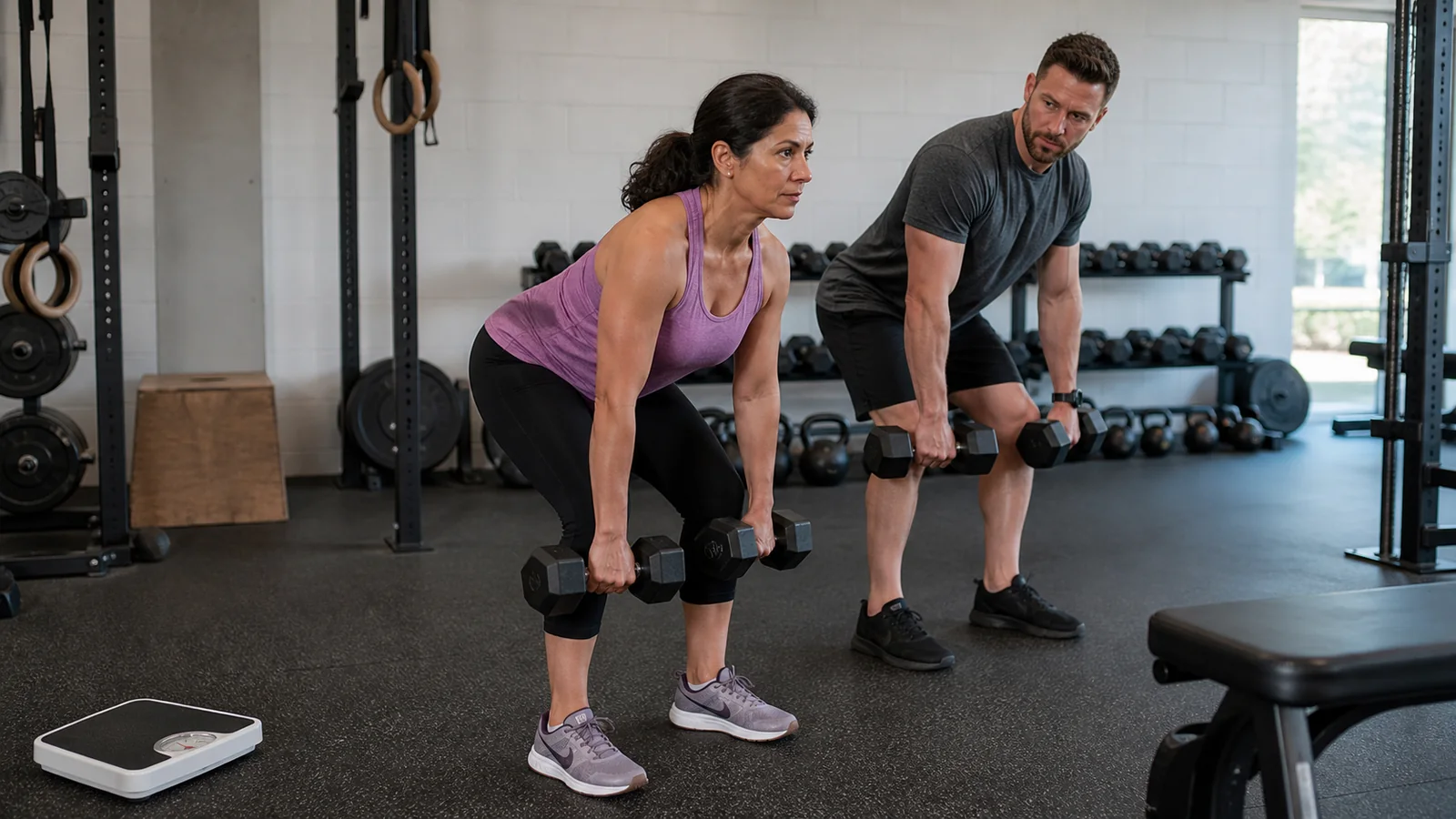
- Name the question first. Are you following a treatment, building strength, or checking a clinical risk marker?
- Use a repeatable measure that matches it. That could be a strength log, a familiar stair or walking task, a waist trend, or a test ordered by your clinician.
- Keep measurement conditions consistent. Compare like with like and avoid interpreting normal daily water shifts as tissue change.
- Act on meaningful changes. Persistent weakness or concerning symptoms deserve assessment even if your body fat number looks unchanged.
There is no requirement to buy a body composition device to begin moving or to seek appropriate medical care. The useful measure is the one that answers a real question and can be interpreted accurately.
How the Chris Powell podcast fits
The channel’s description presents Chris Powell’s views on weight loss, muscle preservation and metabolic health. It also promotes commercial products, so treat the episode as commentary rather than evidence for a treatment.
The podcast also discusses emotional eating and difficult life experiences. Those topics deserve a supportive, individual approach rather than an assumption that a person’s weight or laboratory result reveals their history.
The featured portrait for this page is an editorial illustration, not a verified photograph of Powell. The video is retained below so readers can hear the original discussion and compare its claims with the research summarized here.
Watch the original conversation
Sources
- Alberti et al., 2009 joint statement on metabolic syndrome.
- Expert-endorsed guide to body composition measurement methods.
- BIA and DXA critical overview.
- Assessment of lean mass and physical performance.
- Ross et al., 2000 randomized trial.
- Verheggen et al., 2016 systematic review.
- Bateman et al., 2011 randomized trial.
- SURMOUNT-1 DXA substudy.
This article is for general information and is not medical advice. A healthcare professional can help interpret unexpected weakness, body changes, test results, or treatment decisions in your own situation.