
Most training plans look the same in January as they do in July.
Some ancient Greek physicians took a different view.
A popular post says Hippocrates urged people to match their training and diet to the seasons.
The Hippocratic writings do say this, although the details differ from how the idea is often shared.
Where the Seasonal Idea Comes From
The advice appears in the Hippocratic Corpus, a large collection of Greek medical texts linked to Hippocrates of Cos.
Hippocrates lived roughly from 460 to 370 BCE, and many different authors wrote the texts that carry his name.
The first book of Regimen says exercise should be proportioned to the amount of food, the person’s constitution, their age, and the season of the year.
It even mentions adjusting for changes in the winds.
A shorter work, Regimen in Health, gives more specific seasonal advice for ordinary people.
A good plan bends with the seasons without breaking the habit.
What the Texts Actually Recommend
According to Regimen in Health, people should eat as much as possible and drink as little as possible in winter.
Meat in winter was to be roasted, to keep the body dry and warm.
As spring arrived, the advice shifted toward more drinking and boiled rather than roasted meats.
By summer, boiled meats were preferred to counter the season’s drying effects on the body.
The reasoning came from the Greek idea of balancing hot, cold, wet, and dry qualities in the body.
What We Could Not Confirm
Some versions say Hippocrates called for more rest in cold months and more activity as the weather warmed.
We could not confirm that exact advice in the passages we reviewed.
What we can confirm is the broader rule that exercise should be matched to the season, along with food.
We also do not present his humoral reasoning as correct by modern standards.
What Modern Research Shows About Seasons
A 2021 scoping review by Turrisi and colleagues pulled together data from 110 studies and more than 118,000 people.
Physical activity, including moderate to vigorous activity, was higher in summer than in winter.
Sedentary time rose in winter compared with spring or summer.
Activity was higher with longer daylight and warmer temperatures, and lower with more rain or snow.
The authors suggested that programs to boost activity should plan for weather effects.
In short, seasons already shape how people move, whether they plan for it or not.
How Coaches Plan Across the Year
Modern athletes plan training in phases, a practice called periodization.
A 2010 review by Issurin described how traditional periodization split the training year into smaller periods.
He noted limits in that older model, such as fatigue from long periods that target many abilities at once.
He proposed block periodization instead, with specialized blocks of concentrated work that focus on a few selected abilities.
This is not the same as Hippocratic seasonal regimen.
It does share the idea that training should change across the year rather than stay frozen.
How to Adjust Your Year Sensibly
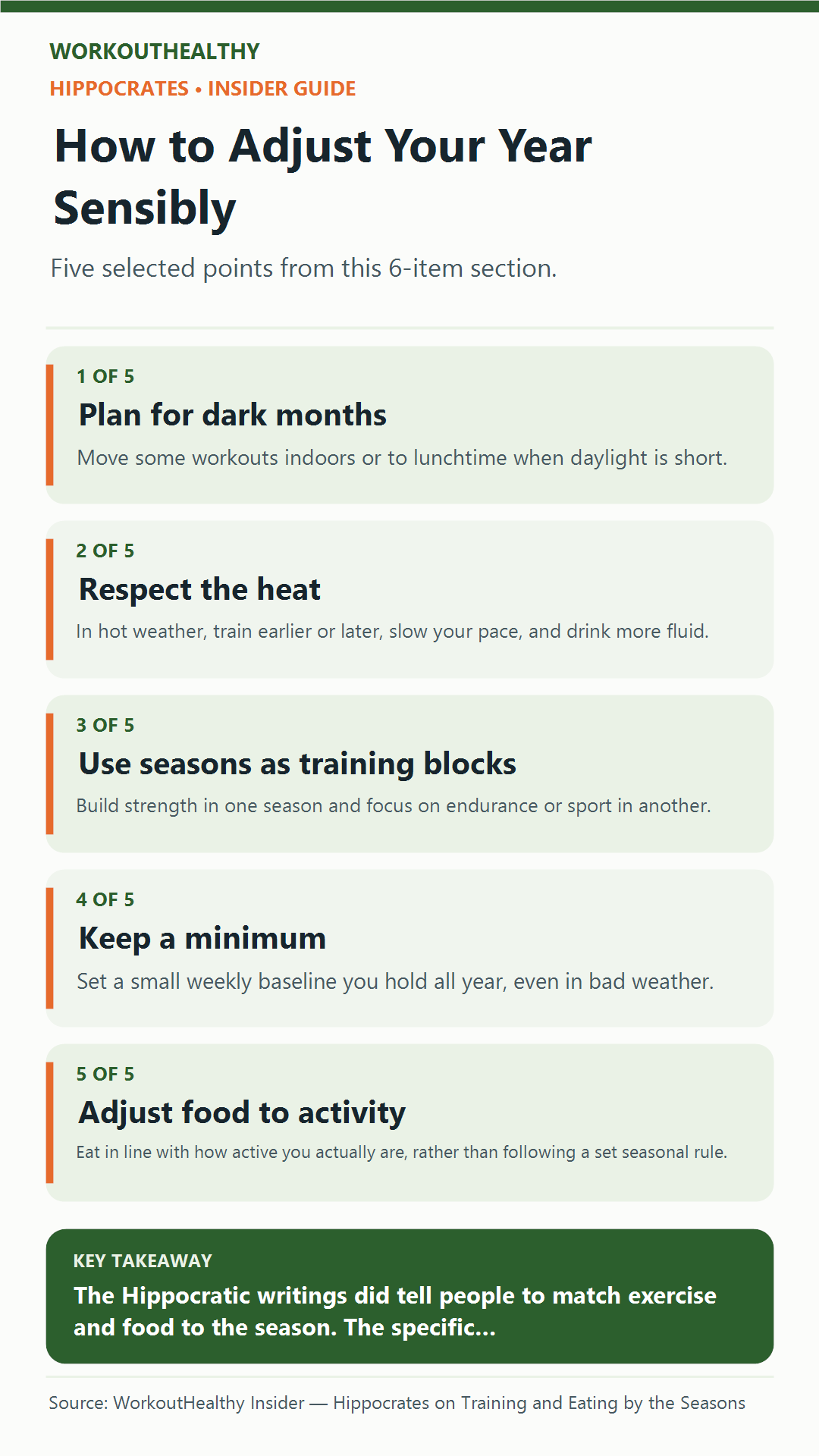
- Plan for dark months. Move some workouts indoors or to lunchtime when daylight is short.
- Respect the heat. In hot weather, train earlier or later, slow your pace, and drink more fluid.
- Use seasons as training blocks. Build strength in one season and focus on endurance or sport in another.
- Keep a minimum. Set a small weekly baseline you hold all year, even in bad weather.
- Adjust food to activity. Eat in line with how active you actually are, rather than following a set seasonal rule.
- Watch energy and mood. Winter slumps are common, so note when motivation drops and plan around it.
For cold or rainy days, our guide to quiet home cardio with no equipment keeps you moving indoors.
A group class can help in slow seasons, and our look at whether a boot camp class is worth it weighs the pros and cons.
If you run outdoors and want an extra challenge in mild weather, read about weighted vest running first.
A Simple Four Season Example
Here is one way a regular exerciser could shape a year.
In winter, lean on indoor strength training, with shorter outdoor sessions when daylight allows.
In spring, slowly add more outdoor walking, running, or cycling as days get longer.
In summer, enjoy the extra daylight, but move hard sessions to cooler parts of the day.
In autumn, keep some outdoor work while shifting back toward strength before winter.
Across all four seasons, keep at least two short strength sessions and some daily walking.
That baseline protects your progress when weather or holidays get in the way.
Adjust the plan for where you live, since winters and summers vary a lot from place to place.
The point is not the exact schedule. It is choosing your seasonal changes ahead of time.
Common Mistakes
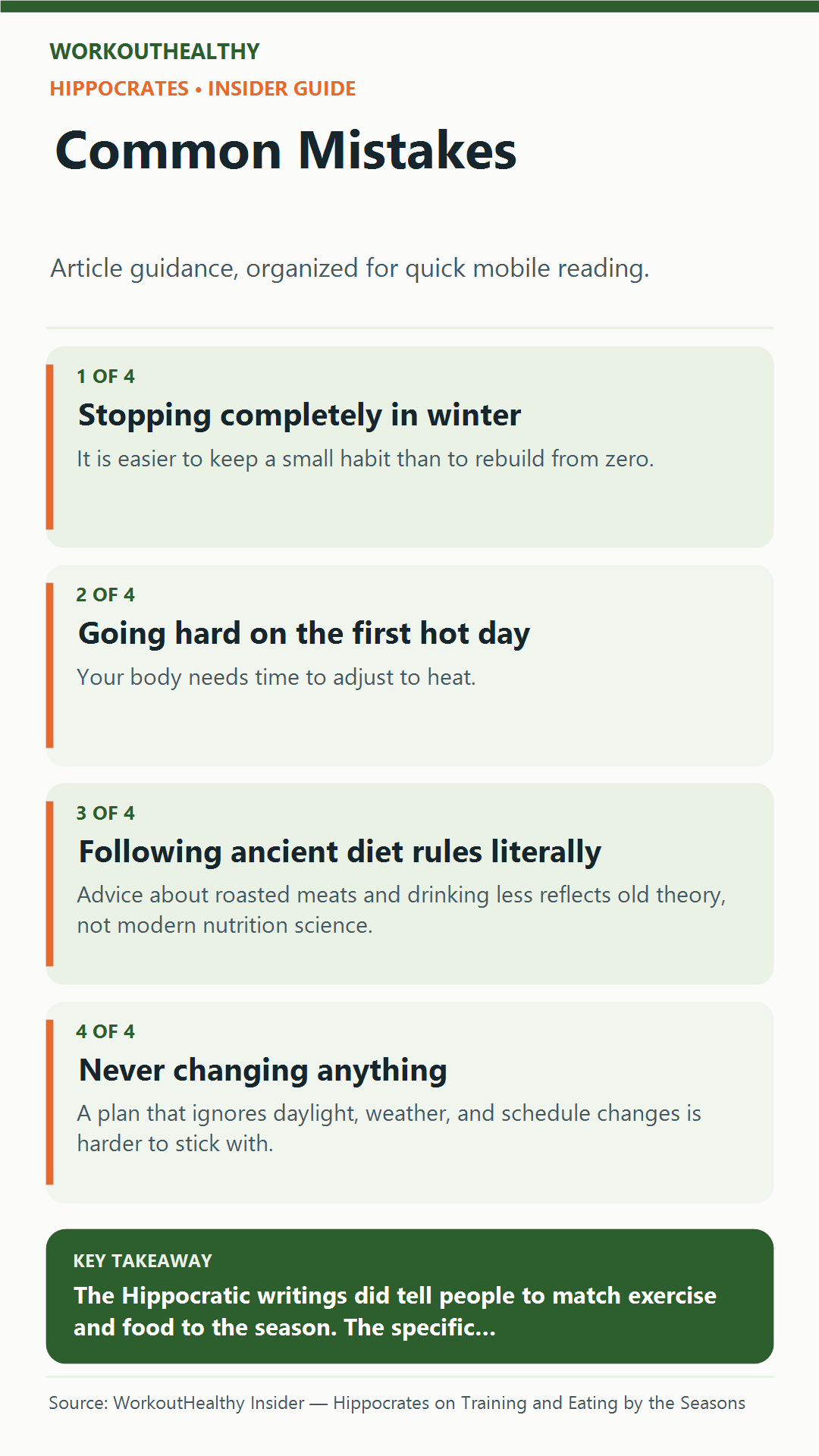
- Stopping completely in winter. It is easier to keep a small habit than to rebuild from zero.
- Going hard on the first hot day. Your body needs time to adjust to heat.
- Following ancient diet rules literally. Advice about roasted meats and drinking less reflects old theory, not modern nutrition science.
- Never changing anything. A plan that ignores daylight, weather, and schedule changes is harder to stick with.
Who Should Be Careful
Older adults and people with heart conditions should take extra care exercising in heat and cold.
Anyone with asthma may find cold, dry air a trigger, so a longer warm up or indoor option can help.
People with seasonal low mood that affects daily life should speak with a doctor.
Limiting fluids, as the ancient winter advice suggests, is not a safe modern practice for active people.
The Bottom Line
The Hippocratic writings did tell people to match exercise and food to the season.
The specific diet advice rests on old theories and should not be followed literally.
Modern research shows seasons strongly affect how active people are.
Plan for those shifts, keep a year round baseline, and change your training on purpose rather than by accident.
Want more stories like this? Subscribe to WorkoutHealthy Insider for practical explanations behind popular fitness claims.
References
- Hippocrates. (1931). Regimen I. In Hippocrates (Loeb Classical Library 150). https://www.loebclassics.com/view/hippocrates_cos-regimen_i/1931/pb_LCL150.229.xml
- Issurin, V. B. (2010). New horizons for the methodology and physiology of training periodization. Sports Medicine, 40(3), 189 to 206. https://doi.org/10.2165/11319770-000000000-00000
- The Open University. (n.d.). Health and wellbeing in the ancient world. OpenLearn. https://www.open.edu/openlearn/mod/oucontent/view.php?id=97279§ion=_unit3.1
- Turrisi, T. B., Bittel, K. M., West, A. B., Hojjatinia, S., Hojjatinia, S., Mama, S. K., Lagoa, C. M., & Conroy, D. E. (2021). Seasons, weather, and device-measured movement behaviors: A scoping review from 2006 to 2020. International Journal of Behavioral Nutrition and Physical Activity, 18(1), 24. https://doi.org/10.1186/s12966-021-01091-1
This article is for general information only and is not medical advice. If you have an injury, ongoing pain, or a medical condition, talk to a doctor or physical therapist before you change how you train or eat.